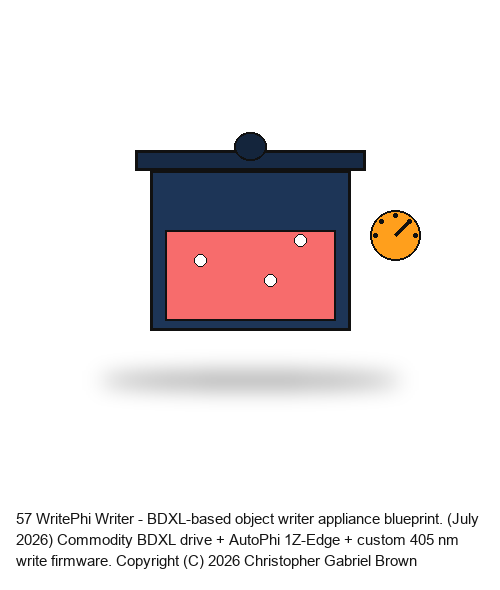
WritePhi Study — Writer Blueprint
The WRITEPHI-WRITER appliance blueprint: SPEC + reference controller PCB schematic + firmware skeleton + shared _factory.py. Personal + educational use only; no commercial rights. Downloadable zip (~55 KB, 12 files).
© CRI-ONE. All rights reserved. Patents issued and pending. Unauthorized reproduction of the underlying designs is prohibited.
Extended catalog & full narrative — WritePhi Study — Writer Blueprint
The extended dossier appended from the 2026-08-05 catalog snapshot. Prices in the body copy have been stripped; the live-store price on this page is the authoritative figure. Images have been omitted.
WritePhi Writer — The Desktop Object Writer That Starts the Pipeline
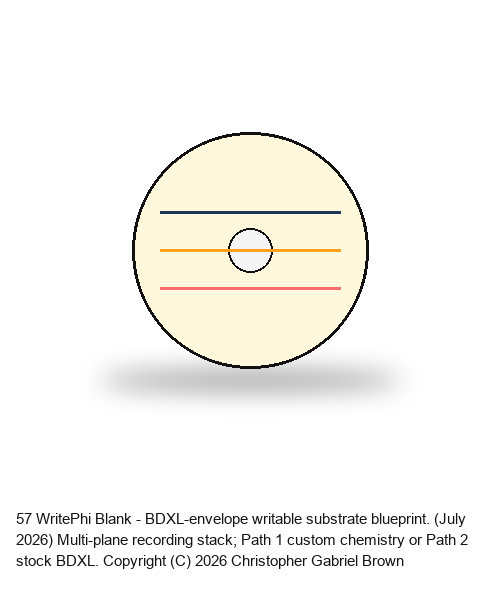
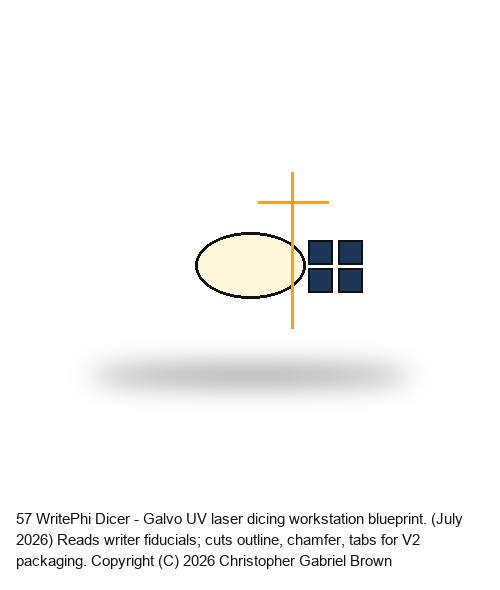
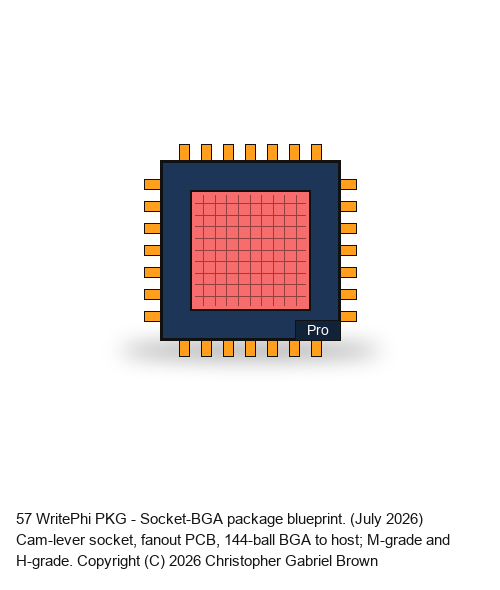
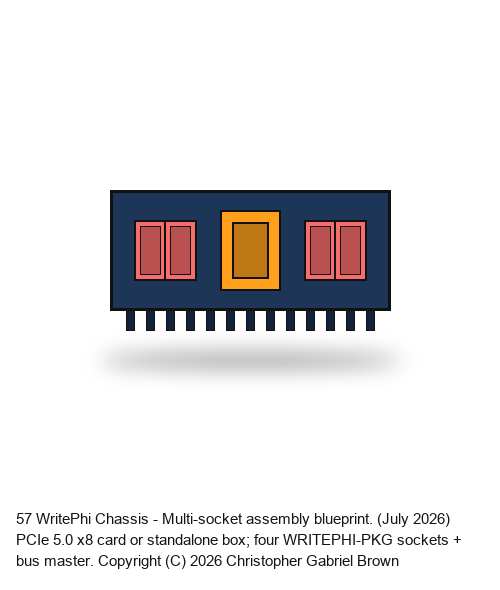
This is the entry point to the entire WritePhi platform. Without a Writer, there is no way to inscribe circuits onto a blank. Every downstream SKU — Blank, Dicer, PKG, Chassis, Library — assumes a written disc exists. The Writer is the flagship appliance: load a blank, execute a compiled write program, eject a functional circuit-processor chip.
What Is the WritePhi Writer?
A bench-top BDXL-drive-based object writer that retasks a commodity 405 nm optical-drive assembly with custom WritePhi firmware. Instead of inventing a write head from scratch, the design marries a mature BDXL burner (focus servo, tracking servo, spindle, load/eject) to an AutoPhi 1Z-Edge controller board and a WritePhi write-program interpreter.
Think: commodity BDXL optics + custom firmware + circuit-forming blank chemistry — kitchen-table chip fabrication without a cleanroom or mask set.
Two Throughput Grades
- Family M (standard): Consumer BDXL burner, 4×–6× rated, ≥200 mW 405 nm diode, ±20 µm focus tolerance across a 3-layer stack. Target: full M-grade write in 8–25 minutes.
- Family H (professional): Archival-tier BDXL burner, ≥500 mW pulsed 405 nm, motorized per-tile refocus, ±5 µm depth tolerance across a 4-layer stack. Target: full H-grade write in 25–90 minutes.
What's In The Zip
- WRITER_APPLIANCE_SPEC.md — 50+ page master spec: form factor (400×400×250 mm bench-top), power budget (≤1,200 W peak), BDXL drive integration, blank handling, safety interlocks, M vs H grade paths
- hardware/WRITER_CTRL/ — ERC-clean KiCad 10 controller schematic + BOM + LAYOUT_HINT: AutoPhi 1Z-Edge bus, power delivery, USB-C host link, BDXL drive interface, grade-sensing photodetector array
- firmware/writer_control/ — Firmware skeleton (C, no-std): write-program interpreter, BDXL physical-layer retask, focus/tracking closed loop, USB command protocol, fault codes for grade mismatch
- hardware/_factory.py — Shared KiCad emit primitives used across the WritePhi family
- JARGON_LEVELS.md — Four knowledge tiers (Newcomer through Architect) for the same subject at different depths
- Family hero SVG + per-SKU hero SVG — Store and documentation figures
- LICENSE.md, HANDOFF.md, CONTACT_INFO.txt
The Physics
WritePhi writing exploits 405 nm focused exposure at the BDXL recording plane — the same wavelength commodity BDXL drives already use. The novelty is not the laser; it is the circuit-forming recording chemistry on the blank and the firmware that drives the drive assembly as a lithography tool rather than a data burner. Multi-layer BDXL stacks become multi-tier circuit planes: refocus per layer, write independent circuits at different z-positions.
Your Work
- BDXL drive assembly: Pioneer BDR-212, LG WH16NS40, ASUS BW-16D1HT, or Panasonic UJ-260 class (~–300 each for prototypes)
- Controller PCB: Layout from delivered schematic; JLCPCB or Advanced Circuits (~for 5 boards)
- Chassis + power stage: Bench-top enclosure, 120 V / 15 A mains stage, elastomer vibration isolation per spec
- Firmware bring-up: Implement modules beyond skeleton — calibration tables, write-path compensation, grade detection
- Optical alignment: Verify focus servo tracks circuit-forming blank chemistry (Path 1 vs Path 2)
- Certification: FCC Part 15 Class B, UL 61010-1, IEC 60825 laser safety (Class 1 product intent with enclosed write head)
- Total BOM (prototype): –8k depending on drive grade and enclosure choices
- Build time: 4–8 weeks integration after parts arrive
Timeline
Day 0: download + schematic review. Week 1–2: order drive + PCB fab. Week 4–6: mechanical assembly + first power-on. Week 6–8: firmware bring-up + optical alignment. Week 8–10: first successful write on Path 2 stock BDXL. Week 12+: Path 1 custom-chemistry blanks when substrate is ready.
Certification
- IEC 60825-1 (laser safety): Enclosed BDXL write head; Class 1 product intent with interlocked access
- FCC Part 15 Class B: Consumer-appliance EMC for controller + drive assembly
- UL 61010-1 / IEC 62368-1: Bench instrument safety for classroom / lab deployment
License (Study Tier)
✅ Personal/lab use, build one Writer for research, publish results. ❌ Manufacture and sell Writer units commercially. Upgrade: WRITEPHI-COMMERCIAL .
Portfolio conversation — WritePhi (Project 57) + WritePhi Devices (Project 58)
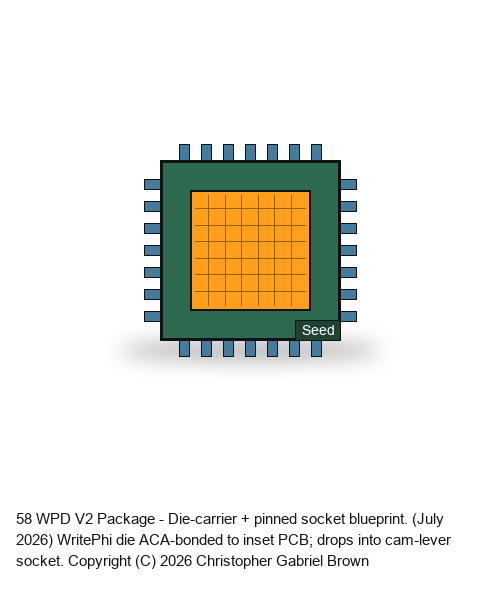
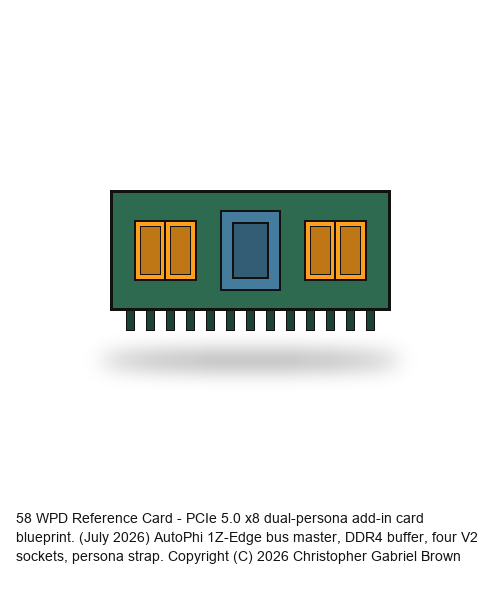
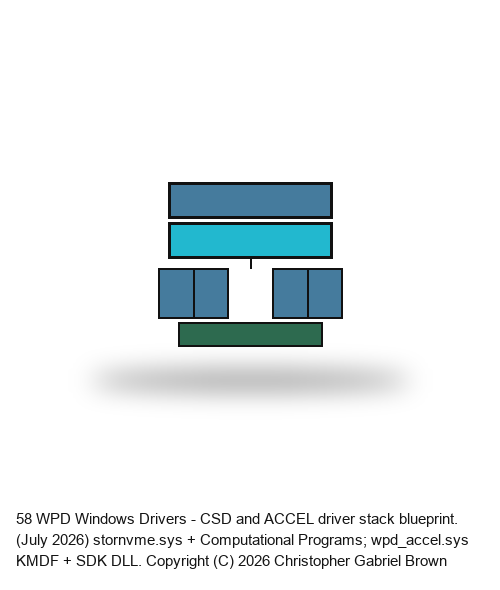
These two product families are one continuous story in two chapters, not unrelated store listings. WritePhi (Project 57) is the kitchen-table fabrication layer: Writer → Blank → Dicer → PKG → Chassis → Library makes replaceable WritePhi dies at the bench. WritePhi Devices / WPD (Project 58) is the deployment layer for those same dies: the V2 inset package (carried forward from WRITEPHI-PKG and cut geometry from WRITEPHI-DICER) drops into pinned sockets on a reference PCIe 5.0 card, where Windows-facing CSD and ACCEL personas plus on-card firmware turn a homemade die into a plug-and-play host peripheral.
If you are buying on this page, you are in the make chapter. An OEM or power user who completes the 57 pipeline and wants volume-manufacturable packaging plus a Windows card stack continues in the run chapter — browse WritePhi Devices (WPD) on the same store. Neither family requires the other to be useful alone; together they describe the full path from blank substrate to installed Windows accelerator.
Fulfillment: Instant download after checkout. SHA-256 checksum published for integrity verification.
Region: USA-only (nginx geoblocking enforced). International buyers: contact us for special licensing.
Currency: USD only. Sub- via standard checkout (Stripe). Over : Term Sheet financing available.
Support: crioneaka@outlook.com | Christopher Gabriel Brown, Inventor | 24-48hr response.
Chris's philosophy: Every design engineered by hand. If it's specced, it works. If it has limits, we say so.
© 2026 Christopher Gabriel Brown · cri-one.com
f4972e97d2ff5abe2967eb7c86e49452a8ae7604a938120da9e877ba4aa6ce6f
WritePhi Study — Writer Blueprint
Publicly online since 2010 · U.S. patent applications since 2012 · inventions offered since 2014. The work of Christopher Gabriel Brown, independently documented.