WPD Study — Reference Cards Blueprint
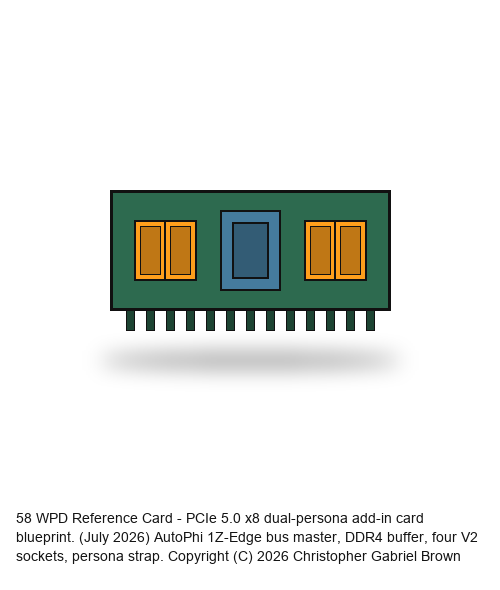
PCIe 5.0 x8 add-in card reference schematic + INSET-PCB-M reference schematic + BOMs + SPECs. Personal + educational use only. Downloadable zip (~49 KB).
© CRI-ONE. All rights reserved. Patents issued and pending. Unauthorized reproduction of the underlying designs is prohibited.
Extended catalog & full narrative — WPD Study — Reference Cards Blueprint
The extended dossier appended from the 2026-08-05 catalog snapshot. Prices in the body copy have been stripped; the live-store price on this page is the authoritative figure. Images have been omitted.
WPD Reference Cards — PCIe 5.0 Add-In Card, Two Personas
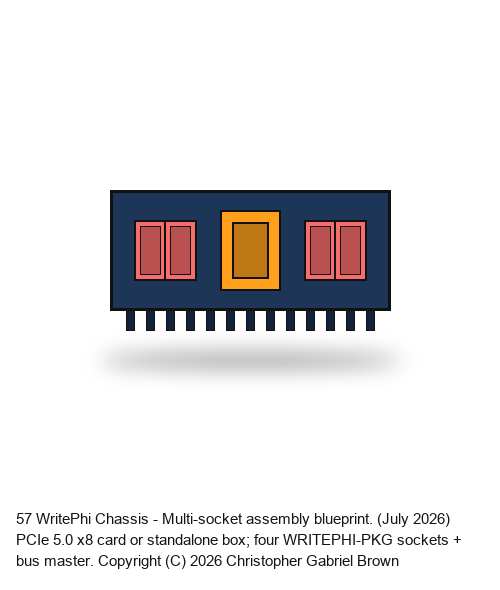
This is where WritePhi meets standard PC hardware. A PCIe 5.0 x8 add-in card with 4 V2 sockets and an AutoPhi 1Z-Edge bus master. Strap a resistor differently, get a different device: WPD-CSD (NVMe storage + Computational Programs) or WPD-ACCEL (compute accelerator with DirectML backend).
Card Architecture
- Form factor: PCIe 5.0 x8 add-in card, full-height half-length (109 × 111 mm)
- Bus interface: PCIe 5.0 x8 (32 GT/s per lane, 32 GB/s aggregate)
- Bus master: AutoPhi 1Z-Edge (Chris's own chip, from AutoPhi portfolio)
- Sockets: 4× V2 sockets (accepts M-grade or H-grade dies)
- Memory: DDR4 buffer (typically 2-4 GB) for CSD cache or ACCEL working memory
- Boot flash: NOR flash for persona firmware (CSD vs ACCEL selection)
- Power: 75W from PCIe slot + 6-pin auxiliary connector
- Cooling: Passive heatsink (default) or optional axial fan
The Two-Persona Design
WPD-CSD (Computational Storage Device) Persona
- Card enumerates as NVMe 2.0 storage device
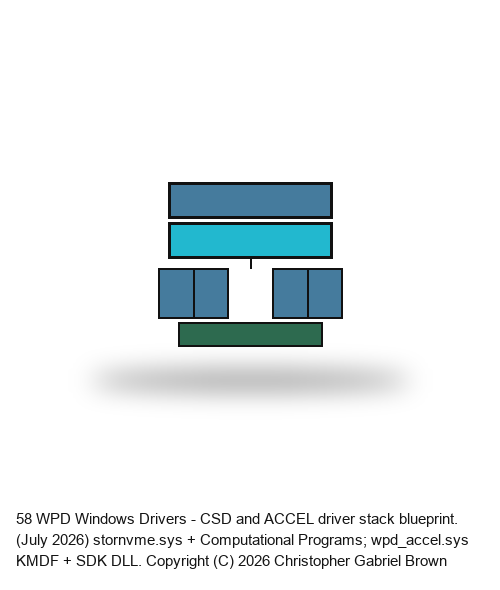
- Uses Windows in-box stornvme.sys driver (no custom driver needed)
- Computational Programs extension (NVMe 2.0 feature): host can query on-device WritePhi ICs as NVMe namespaces
- Ideal for: on-device data processing, encrypted storage with hardware crypto, filter offload
WPD-ACCEL (Compute Accelerator) Persona
- Card enumerates as generic PCIe device (Vendor ID: cri-one)
- Requires custom KMDF driver (wpd_accel.sys)
- DirectML backend integration for GPU-agnostic ML workloads
- MMIO command queues for host-to-device job submission
- Ideal for: on-device inference (ML models compiled to WritePhi ICs), custom compute (crypto, signal processing)
Persona Selection
Two solder-jumper resistors (R1 and R2) select the persona at boot:
- R1 populated, R2 empty: CSD persona
- R1 empty, R2 populated: ACCEL persona
- Both populated: Default to CSD (safer)
- Both empty: Fault mode (LED indicator)
What's In The Zip
- PCIe_CARD_SPEC.md — Master spec: form factor, power delivery, cooling, connector pinouts, host system requirements
- BUS_MASTER_SCHEMATIC.kicad_sch — 1Z-Edge + DDR4 + NOR flash + PCIe interface. All pins wired, all decoupling shown, all impedance-controlled traces marked.
- SOCKET_INTERFACE.kicad_sch — 4× V2 sockets with independent PCIe Gen4 x2 links to the bus master (8 GB/s per socket)
- PERSONA_STRAP.kicad_sch — R1/R2 strap resistor circuit + boot-time detection logic
- THERMAL_ANALYSIS.pdf — CFD simulation: heat map at 75W dissipation, worst-case junction temp (72°C at 40°C ambient), airflow requirements for optional fan
- INSET_PCB_M.kicad_sch — Reference INSET-PCB-M carrier (also included in WPD-STUDY-V2, bundled here for context)
- FIRMWARE_LOADER.c — Boots 1Z-Edge, reads strap resistors, loads CSD or ACCEL persona firmware from NOR flash
- BOM.csv — Full BOM with vendor part numbers (Digikey, Mouser, Avnet)
- PCB_LAYOUT_HINTS.md — Length matching (±10 mils), impedance control (100 Ω differential, 50 Ω single-ended), power plane design, decoupling capacitor placement
- LICENSE.md, HANDOFF.md, CONTACT_INFO.txt
Why PCIe 5.0 (Not 4.0)?
- Bandwidth: WritePhi ICs can generate/consume ~4 GB/s per die. With 4 sockets, aggregate 16 GB/s. PCIe 4.0 x8 = 16 GB/s (bottlenecked). PCIe 5.0 x8 = 32 GB/s (comfortable headroom).
- Future-proofing: PCIe 5.0 is the current-gen standard (2022+). Cards will remain relevant for 5-7 years.
- Backwards compatibility: PCIe 5.0 cards work in PCIe 4.0 or 3.0 slots at reduced speed.
Your Work
- PCB layout: Impedance-controlled 12-layer stackup, Megtron 6 dielectric. Requires HSD-experienced PCB engineer (~40-80 hours, -15k)
- Fab: Sanmina, TTM, or Multek. ~-8k for 5 prototypes.
- Assembly: Contract EMS (Sanmina, Jabil, or smaller shops) or manual assembly. ~-5k for 5 prototypes.
- Bring-up: PCIe link training, memory training (DDR4), firmware boot. Budget 2-4 weeks.
- Certification: FCC Part 15 Class B (~-5k), PCI-SIG electrical + protocol compliance (-5k), WHCP for Windows drivers (~-10k)
Timeline
- Schematic capture from reference: 2-3 weeks
- PCB layout: 4-8 weeks
- Fab + assembly: 5-8 weeks
- Bring-up: 2-4 weeks
- Firmware integration: 4-8 weeks (depends on persona choice)
- Certification: 4-8 weeks
- Total to first shippable card: 5-8 months
License (Study Tier)
✅ Build cards for research/lab use. ❌ Sell cards commercially. Upgrade: WPD-COMMERCIAL .
Portfolio conversation — WritePhi Devices (Project 58) + WritePhi (Project 57)
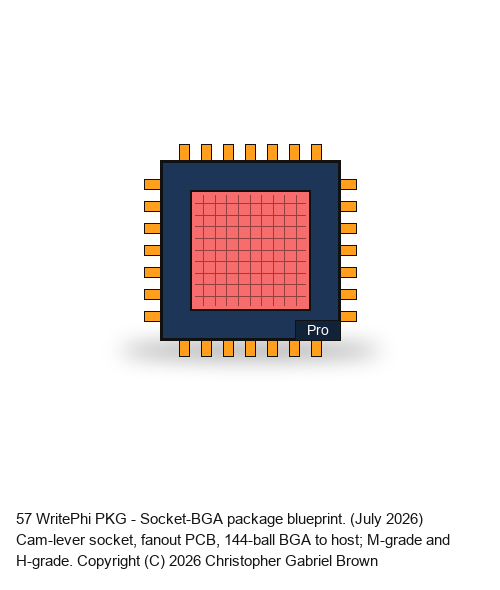
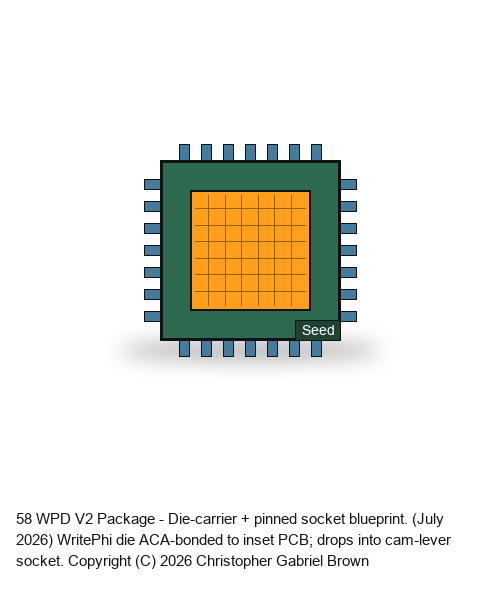
WPD does not exist in isolation. It is the Windows host deployment half of the same portfolio conversation that begins in WritePhi (Project 57). Project 57's kitchen-table pipeline — Writer, Blank, Dicer, PKG socket-BGA, Chassis bed, and reference IC library — fabricates the M-grade and H-grade WritePhi dies that this card's four pinned sockets accept. The V2 package blueprint here is an explicit production-scale extension of 57's PKG plus additional cut marks and tabs that WRITEPHI-DICER executes in the same dicing pass.
If you are buying on this page, you are in the run chapter: PCIe card reference designs, persona firmware, and Windows driver plans. Makers who need to produce the dies themselves start in the make chapter — browse WritePhi (Project 57). Either half stands alone for study or commercial licensing; both halves together narrate bench fabrication through installed Windows compute.
Fulfillment: Instant download after checkout. SHA-256 checksum published for integrity verification.
Region: USA-only (nginx geoblocking enforced). International buyers: contact us for special licensing.
Currency: USD only. Sub- via standard checkout (Stripe). Over : Term Sheet financing available.
Support: crioneaka@outlook.com | Christopher Gabriel Brown, Inventor | 24-48hr response.
Chris's philosophy: Every design engineered by hand. If it's specced, it works. If it has limits, we say so.
© 2026 Christopher Gabriel Brown · cri-one.com
5cbd8114d8157109caafe1b26efa4019f4e5094f667b0344887332bdd2f7fadf
WPD Study — Reference Cards Blueprint
Publicly online since 2010 · U.S. patent applications since 2012 · inventions offered since 2014. The work of Christopher Gabriel Brown, independently documented.