WritePhi Study — Dicer Blueprint
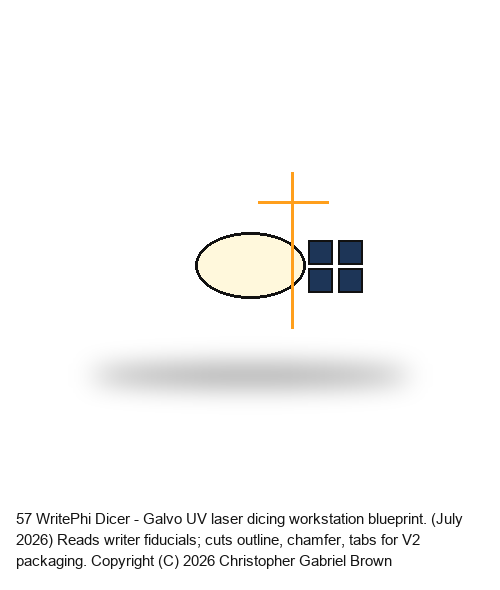
The WRITEPHI-DICER galvo UV laser dicing station blueprint: SPEC + reference DICER_CTRL PCB schematic. Personal + educational use only. Downloadable zip (~49 KB).
© CRI-ONE. All rights reserved. Patents issued and pending. Unauthorized reproduction of the underlying designs is prohibited.
Extended catalog & full narrative — WritePhi Study — Dicer Blueprint
The extended dossier appended from the 2026-08-05 catalog snapshot. Prices in the body copy have been stripped; the live-store price on this page is the authoritative figure. Images have been omitted.
WritePhi Dicer — Precision Die Separation at Micron Scale
After you write a blank, you need to cut it into individual dies. The Dicer reads fiducials embedded by the Writer and cuts each die's outline, chamfer, and IC tab slots with micron-level precision. Without a Dicer, you have a written blank but no usable chips.
What Is the WritePhi Dicer?
A desktop galvo-based UV laser cutting station that processes written WritePhi blanks into individual dies ready for packaging. Uses a 355 nm UV galvo laser with precision XY stage and computer vision alignment.
Think: laser cutter + machine vision + precision motion control, purpose-built for cutting BDXL-envelope substrates without thermally damaging adjacent dies.
Why UV Galvo?
Chris evaluated four alternatives:
- Mechanical dicing saw: ~, 200 µm kerf waste, cracks polycarbonate
- CO2 laser (10.6 µm): PC is transparent at 10.6 µm; just heats up, doesn't cut
- Fiber laser (1064 nm): Melts rather than ablates. Poor edge quality
- Picosecond UV: Ideal but -200k, cleanroom optics maintenance
355 nm nanosecond DPSS (-15k) hits the sweet spot: enough energy for clean polycarbonate ablation, precise enough for micron accuracy, affordable enough for desktop.
What The Dicer Cuts (Per Die)
- Die outline: Rectangular perimeter (5×5 mm M-grade, 12×12 mm H-grade)
- 45° pin-1 chamfer: Orientation indicator (mandatory for automated pick-and-place)
- 3 fiducial marks: Cross features for downstream alignment
- IC tabs (V2 packaging): Small tabs that mate with V2 inset PCB carrier slots
What's In The Zip
- DICER_SPEC.md — 60+ page spec: optical system (laser, beam expansion, F-theta lens), motion system (galvo, XY stage, Z-focus), vision (fiducial detection, path compensation), control (FPGA/MCU, real-time DAC), safety (Class 4 enclosure, interlocks), software (G-code-like path language)
- hardware/DICER_CTRL/ — Complete controller PCB: ERC-clean KiCad 10 schematic, 16-bit DAC (LTC1668) for galvo, image sensor interface, stepper drivers (TMC5160), laser Q-switch driver, interlock chain, full BOM with vendor part numbers, layout hints
- firmware/dicer_control/ — Firmware skeleton: OpenCV fiducial detection, Bresenham path planning, arc interpolation, thermal drift + mirror hysteresis compensation, USB command interface
- CALIBRATION_PROCEDURE.md — Critical: initial cal with reference target, daily 5-min drift compensation, miscalibration warning signs
- MATERIAL_HANDLING.md — Load/unload discs without warping
- THERMAL_ANALYSIS.md — Heat spread during cutting; avoiding damage to adjacent dies
- SAFETY_ENCLOSURE.md — Class 4 laser enclosure (IEC 60825 compliance)
- LICENSE.md, HANDOFF.md, CONTACT_INFO.txt
The Physics
UV galvo dicing is cold ablation: 355 nm photon energy (3.5 eV) exceeds C-C bond energy (~3.6 eV), so material is directly photolyzed rather than melted. Result: clean edges (~1-2 µm kerf vs 200 µm for saws), minimal HAZ (~5-10 µm vs 100+ µm for IR), vertical sidewalls.
Must manage: ablation debris (assist gas N2/air), beam divergence (F-theta lens compensates), mirror hysteresis (firmware compensation).
Your Work
- Laser: Photonics Industries DS-355 (~), CNI MPL-F-355 (~), or Coherent AVIA 355 (~ premium)
- Galvo mirrors: ScannerMAX Saturn 1B or Cambridge 6215H (~-5k matched pair)
- F-theta lens: Sill Optics 355 nm (-2k)
- XY stage: Aerotech ANT130-XY (~) or Newport ILS150HA (~)
- Vision: Basler ace acA2440 + lens (~)
- Controller PCB: JLCPCB or Advanced Circuits (~for 5)
- Enclosure: Steel + interlocked door + UV-blocking window + exhaust (-3k custom)
- Total BOM: -50k depending on laser choice
- Build time: 2-4 weeks assembly, 1-2 weeks calibration
Timeline
Day 0: order parts. Week 8-12: parts arrive. Week 12-16: mechanical + electrical assembly. Week 16-18: software bring-up. Week 18-19: initial calibration. Week 19-20: first diced disc. Week 24-30: repeatable production.
Certification
- IEC 60825-1 (laser safety): Mandatory Class 4. Interlocks, warnings, key switch, emission indicator
- FCC Part 15: Standard EMC for controller PCB
- OSHA: Workplace use needs Laser Safety Officer certification + eye protection at specified OD
License (Study Tier)
✅ Personal/lab, dice your own discs, publish research. ❌ Sell Dicer units, offer Dicer services for revenue. Upgrade: WRITEPHI-COMMERCIAL .
Portfolio conversation — WritePhi (Project 57) + WritePhi Devices (Project 58)
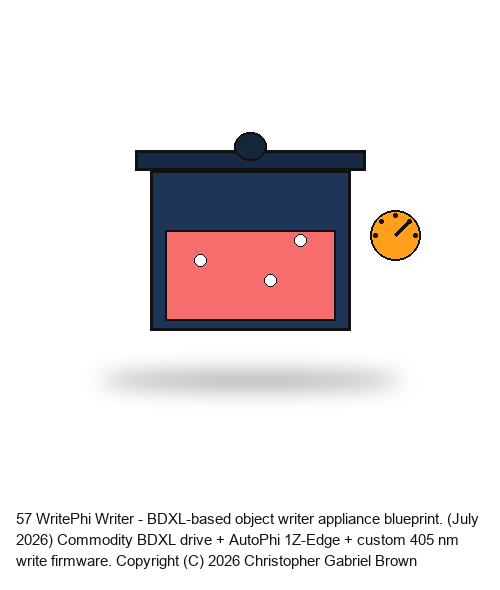
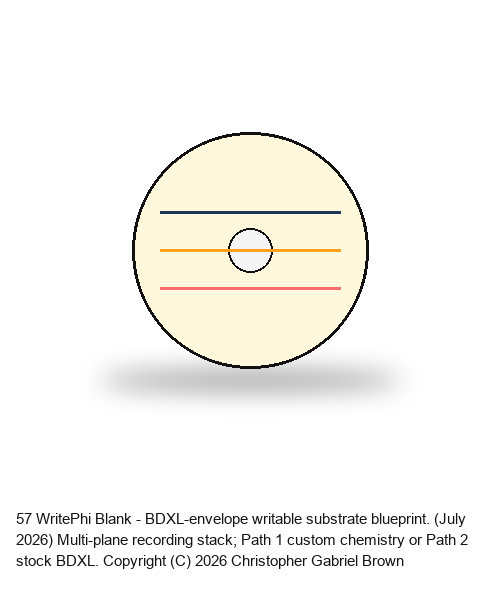
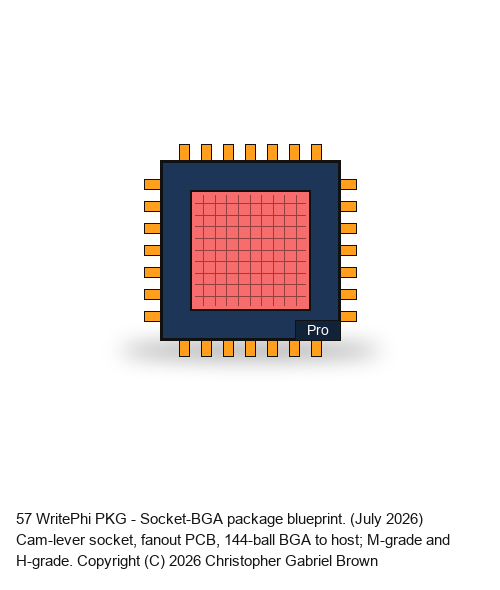
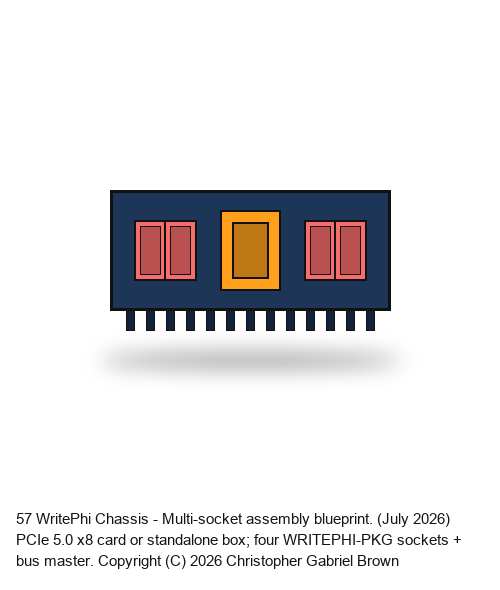
These two product families are one continuous story in two chapters, not unrelated store listings. WritePhi (Project 57) is the kitchen-table fabrication layer: Writer → Blank → Dicer → PKG → Chassis → Library makes replaceable WritePhi dies at the bench. WritePhi Devices / WPD (Project 58) is the deployment layer for those same dies: the V2 inset package (carried forward from WRITEPHI-PKG and cut geometry from WRITEPHI-DICER) drops into pinned sockets on a reference PCIe 5.0 card, where Windows-facing CSD and ACCEL personas plus on-card firmware turn a homemade die into a plug-and-play host peripheral.
If you are buying on this page, you are in the make chapter. An OEM or power user who completes the 57 pipeline and wants volume-manufacturable packaging plus a Windows card stack continues in the run chapter — browse WritePhi Devices (WPD) on the same store. Neither family requires the other to be useful alone; together they describe the full path from blank substrate to installed Windows accelerator.
Fulfillment: Instant download after checkout. SHA-256 checksum published for integrity verification.
Region: USA-only (nginx geoblocking enforced). International buyers: contact us for special licensing.
Currency: USD only. Sub- via standard checkout (Stripe). Over : Term Sheet financing available.
Support: crioneaka@outlook.com | Christopher Gabriel Brown, Inventor | 24-48hr response.
Chris's philosophy: Every design engineered by hand. If it's specced, it works. If it has limits, we say so.
© 2026 Christopher Gabriel Brown · cri-one.com
2243bb0143e83edbd11a3eddf78715513e2515f02a35e7352f5d13e0b1cf75b0
WritePhi Study — Dicer Blueprint
Publicly online since 2010 · U.S. patent applications since 2012 · inventions offered since 2014. The work of Christopher Gabriel Brown, independently documented.