WritePhi Study — PKG Socket-BGA Blueprint
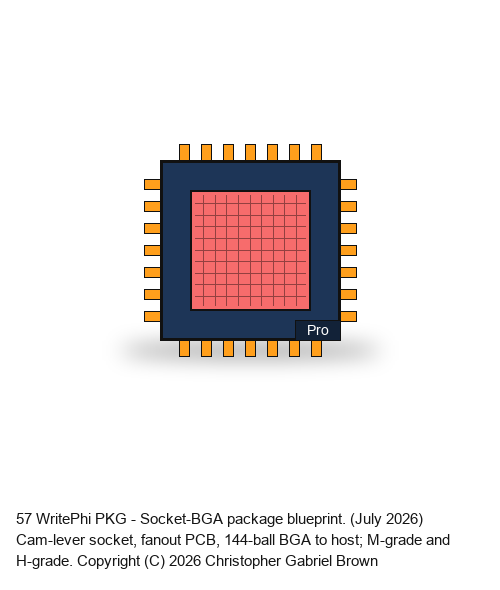
The WRITEPHI-PKG socket-BGA package blueprint: SPEC + M-grade schematic + H-grade schematic. Personal + educational use only. Downloadable zip (~60 KB).
© CRI-ONE. All rights reserved. Patents issued and pending. Unauthorized reproduction of the underlying designs is prohibited.
Extended catalog & full narrative — WritePhi Study — PKG Socket-BGA Blueprint
The extended dossier appended from the 2026-08-05 catalog snapshot. Prices in the body copy have been stripped; the live-store price on this page is the authoritative figure. Images have been omitted.
WritePhi PKG — Socket-BGA Package: Microelectronics Packaging Done Right
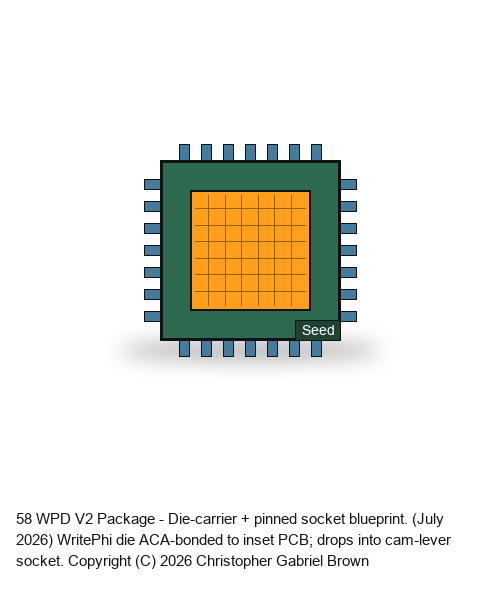
A WritePhi die needs a carrier and socket to talk to a host PCB. This is the mechanical + electrical interface: inset PCB, pogo-pin socket, 144-ball BGA fanout. Two grades: M (standard) and H (high-density).
Two Grades
- M-Grade (Standard): 1.0 mm pitch BGA, 84 signal pins, 12×12 mm die footprint. Standard PCB fab tolerances (±50 µm). Fits M-grade WritePhi ICs (~150-500 transistor designs).
- H-Grade (High-Density): 0.5 mm pitch BGA, 168 signal pins, 30×30 mm die footprint. Requires microvia PCB fab (±25 µm). Fits H-grade WritePhi ICs (up to 3,160 transistors).
What's In The Zip
- PKG_SPEC.md — Master spec: two-grade architecture, dimensional tolerances, thermal budget, electrical parasitic budget (target: ≤50 pF pin capacitance, ≤5 nH lead inductance)
- M-Grade schematic (KiCad 10) — Fanout routing (star topology from die pads to BGA balls), via pattern (single-layer breakout), thermal traces (thermal vias in ground plane), signal integrity margins
- H-Grade schematic (KiCad 10) — Microvia stack-up, controlled impedance (differential 90 Ω, single-ended 50 Ω), tighter tolerances, sequential lamination requirements
- DXF mechanical drawings — Socket + inset PCB mechanical drawings for CNC fab
- ASSEMBLY_PROCEDURE.md — ACA (Anisotropic Conductive Adhesive) bonding: temperature profile (100°C peak, 30s dwell), curing time, pogo-pin contact force (50 gf per pin)
- RELIABILITY_DATA.md — JEDEC thermal cycling (-40°C to +125°C, 500 cycles), shock (1500g, 0.5 ms), vibration (10-2000 Hz random)
- BOM_M.csv — Full M-grade BOM with vendor part numbers
- BOM_H.csv — Full H-grade BOM with vendor part numbers
- LICENSE.md, HANDOFF.md, CONTACT_INFO.txt
Why This Is Serious Packaging
You'll learn:
- Die-attach chemistry: ACA at ≤100°C (vs 260°C reflow) enables temperature-sensitive substrates
- BGA ball placement: ±50 µm accuracy critical for reliable soldering
- Via aspect ratio: Standard PCB fabs handle 6:1; microvias require 1:1 (laser-drilled)
- H-Grade challenges: 0.5 mm pitch demands ±25 µm track/space—only advanced fabs (Sanmina, TTM, Advanced Circuits Rev.C)
Your Work
- PCB layout: Fan-out routing per grade. You do this in KiCad/Altium.
- Fab vendor: M-grade: any standard PCB fab. H-grade: must support microvia + sequential lamination. Chris recommends Advanced Circuits, TTM, or Sanmina.
- BGA ball attach: Pick-and-place with 0.5 mm ball feeder (Panasonic NPM-D3, or hand-place with a stencil for prototypes)
- ACA curing: Programmable hot plate or curing oven
- Reliability testing: Thermal cycling chamber (rental /week) or contract lab ( for JEDEC-standard test)
Timeline
Design review: 1 week. PCB fab (M): 5 days. PCB fab (H, microvia): 3-4 weeks. Assembly setup: 1 week. First package: week 2 (M) or week 5 (H). Reliability testing: 4-8 weeks.
License (Study Tier)
✅ Build packages for personal/lab research, publish papers. ❌ Sell packaged chips commercially. Upgrade: WRITEPHI-COMMERCIAL .
Portfolio conversation — WritePhi (Project 57) + WritePhi Devices (Project 58)
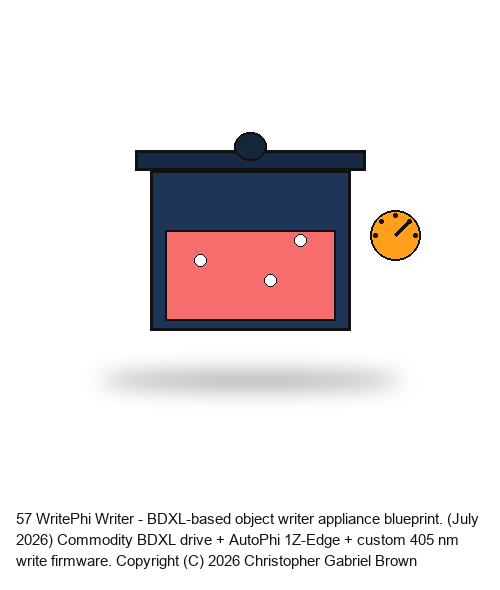
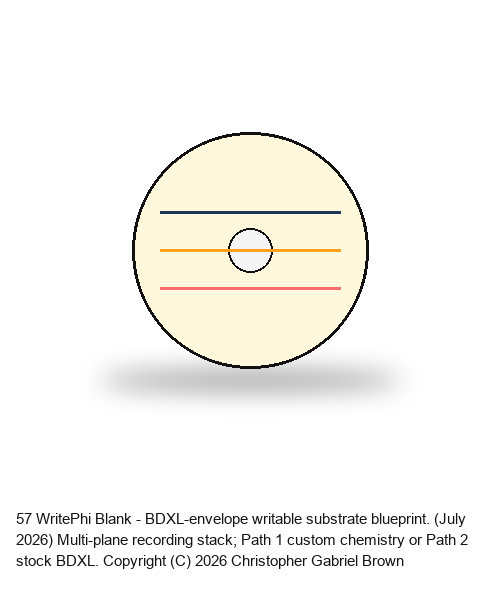
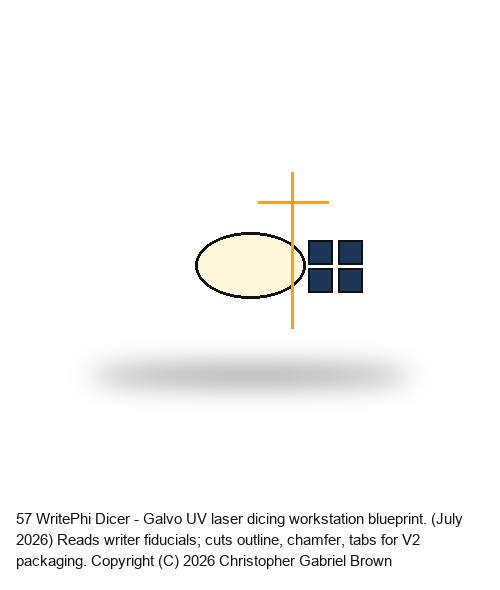
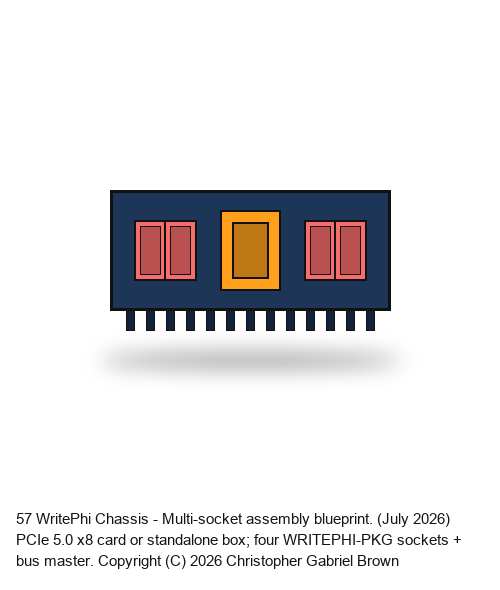
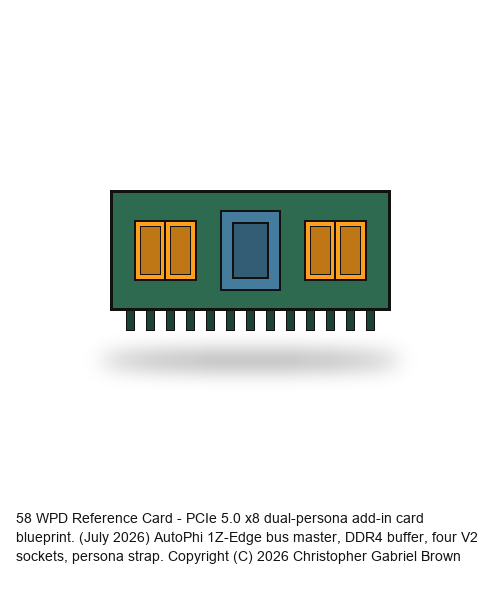
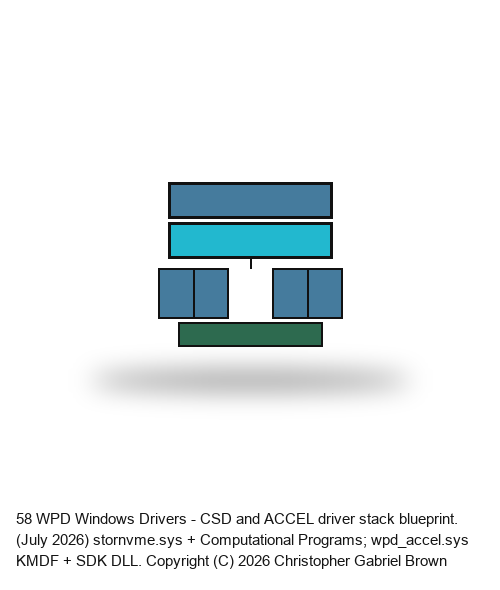
These two product families are one continuous story in two chapters, not unrelated store listings. WritePhi (Project 57) is the kitchen-table fabrication layer: Writer → Blank → Dicer → PKG → Chassis → Library makes replaceable WritePhi dies at the bench. WritePhi Devices / WPD (Project 58) is the deployment layer for those same dies: the V2 inset package (carried forward from WRITEPHI-PKG and cut geometry from WRITEPHI-DICER) drops into pinned sockets on a reference PCIe 5.0 card, where Windows-facing CSD and ACCEL personas plus on-card firmware turn a homemade die into a plug-and-play host peripheral.
If you are buying on this page, you are in the make chapter. An OEM or power user who completes the 57 pipeline and wants volume-manufacturable packaging plus a Windows card stack continues in the run chapter — browse WritePhi Devices (WPD) on the same store. Neither family requires the other to be useful alone; together they describe the full path from blank substrate to installed Windows accelerator.
Fulfillment: Instant download after checkout. SHA-256 checksum published for integrity verification.
Region: USA-only (nginx geoblocking enforced). International buyers: contact us for special licensing.
Currency: USD only. Sub- via standard checkout (Stripe). Over : Term Sheet financing available.
Support: crioneaka@outlook.com | Christopher Gabriel Brown, Inventor | 24-48hr response.
Chris's philosophy: Every design engineered by hand. If it's specced, it works. If it has limits, we say so.
© 2026 Christopher Gabriel Brown · cri-one.com
182514d477f33911b21367aec49a54959772343e0b7e9cea7771db1cddff57beWritePhi Study — PKG Socket-BGA Blueprint
Publicly online since 2010 · U.S. patent applications since 2012 · inventions offered since 2014. The work of Christopher Gabriel Brown, independently documented.