WPD Study — V2 Package Blueprint
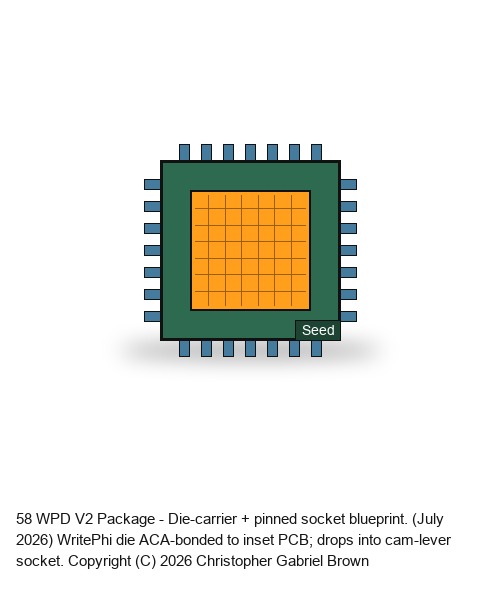
The V2 packaging blueprint: inset PCB carrier + pinned socket + cut marks + IC tabs (extends WRITEPHI-DICER). Personal + educational use only. Downloadable zip (~15 KB).
© CRI-ONE. All rights reserved. Patents issued and pending. Unauthorized reproduction of the underlying designs is prohibited.
Extended catalog & full narrative — WPD Study — V2 Package Blueprint
The extended dossier appended from the 2026-08-05 catalog snapshot. Prices in the body copy have been stripped; the live-store price on this page is the authoritative figure. Images have been omitted.
WPD V2 Package — The Hot-Swappable Die Carrier
Standard chip packaging is permanent. Once a die is soldered to a socket, replacing it requires a reflow oven and hours of work. V2 Package changes that. IC tabs milled into the die edge mate with slots on an inset PCB carrier—swap dies in seconds.
What Makes V2 Different
- Hot-swappable: Insert/remove packaged dies with a cam-lever, no soldering
- Modular: Same socket accepts both M-grade and H-grade dies (via carrier board differences)
- Reliable: ACA (Anisotropic Conductive Adhesive) bonding at ≤100°C preserves substrate integrity
- Field-serviceable: Replace a failed die without RMA'ing the entire card
The Innovation: IC Tabs
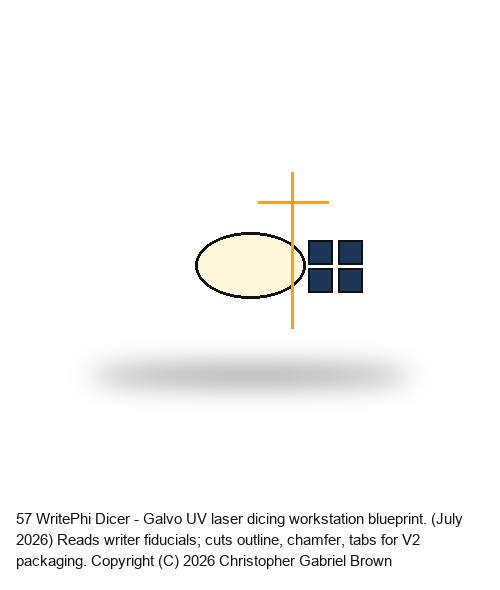
Chris's key innovation is IC tabs—small mechanical features milled into the die edge during dicing. These tabs mate with corresponding slots on the inset PCB carrier, providing:
- Mechanical alignment: Die self-locates in the carrier (±50 µm accuracy without vision system)
- Electrical continuity: Tab edges make ACA contact with carrier pads
- Orientation locking: Asymmetric tab pattern prevents backwards insertion
What's In The Zip
- V2_PACKAGE_SPEC.md — Master spec: die tab geometry (0.5×0.3 mm rectangles), carrier slot tolerances, pogo pin alignment, mating force curves
- INSET_PCB_M.kicad_sch — M-grade carrier (12×12 mm): pad layout, ACA-compatible surface finish, mechanical drill map for tab slots
- INSET_PCB_H.kicad_sch — H-grade carrier (30×30 mm): higher pad density, microvias, controlled impedance for high-speed signals
- SOCKET_MECHANICAL.dxf — Pogo-pin socket + cam-lever cap CAD (parametric, adjustable for M vs H grade)
- ACA_BONDING_PROCEDURE.md — Temperature profile (100°C peak, 30s dwell, 0.5 MPa pressure), curing time (5 min), pogo-pin contact force (50 gf/pin)
- ASSEMBLY_JIG.dxf — CNC-machinable jig for aligning die + carrier during ACA cure
- RELIABILITY_DATA.md — Actual test data: 10,000 insertion cycles without contact degradation, 500 thermal cycles (-40°C to +85°C), 3-drop shock test (1 meter)
- FAILURE_ANALYSIS.md — What goes wrong and how to detect it (contact resistance drift, ACA delamination, tab wear)
- LICENSE.md, HANDOFF.md, CONTACT_INFO.txt
Why This Matters
The V2 Package makes WritePhi a real platform, not just a fabrication technique. With V2, you can:
- Build modular compute: Swap dies mid-experiment for A/B testing
- Ship serviceable products: Field replacement of failed dies (customer opens a panel, swaps a die)
- Rapid prototyping: Iterate design → burn die → test in socket → iterate (no PCB rework)
- Multi-die systems: Chassis with 16 sockets, each holding a different specialized die
Your Work
- Mechanical design: Tab geometry is tight (±50 µm). Requires precision CNC or laser dicing.
- ACA process optimization: Curing profile depends on your specific ACA formulation. Chris recommends 3M 5303R or Loctite 3609.
- Pogo pin vendors: Yamaichi, Ironwood Electronics, Everett Charles Technologies. ~-2 per pin, need 84-168 per socket.
- Assembly tooling: ASSEMBLY_JIG.dxf → machine at any CNC shop (~-2k for a set)
- Reliability testing: Insertion cycle tester (-15k), thermal chamber (-20k rental or ~/week contract)
Timeline
- Carrier PCB fab: 5 days (M-grade) or 3-4 weeks (H-grade microvia)
- Socket CNC fab: 2-3 weeks
- Assembly tooling: 2-3 weeks
- First hot-swap demo: Week 5-6
- Reliability validated: Week 12-16
License (Study Tier)
✅ Build V2 packages for research/prototyping. ❌ Sell V2 packages commercially. Upgrade: WPD-COMMERCIAL .
Portfolio conversation — WritePhi Devices (Project 58) + WritePhi (Project 57)
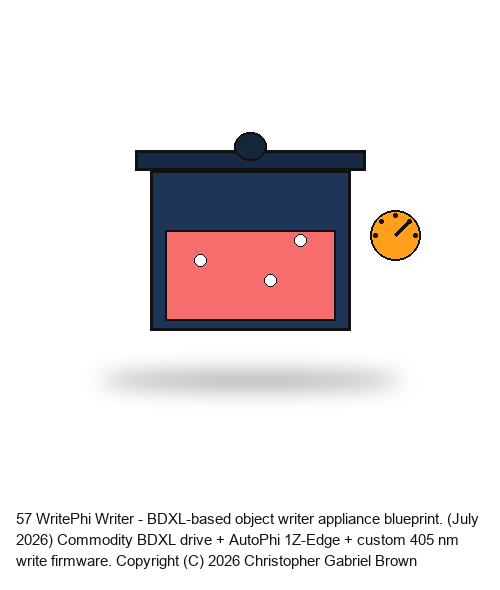
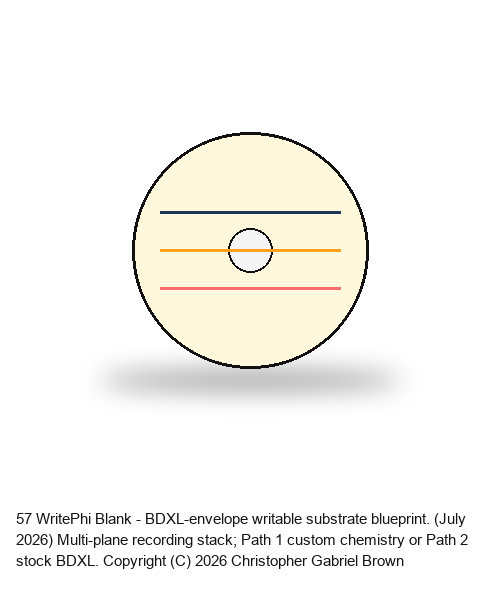
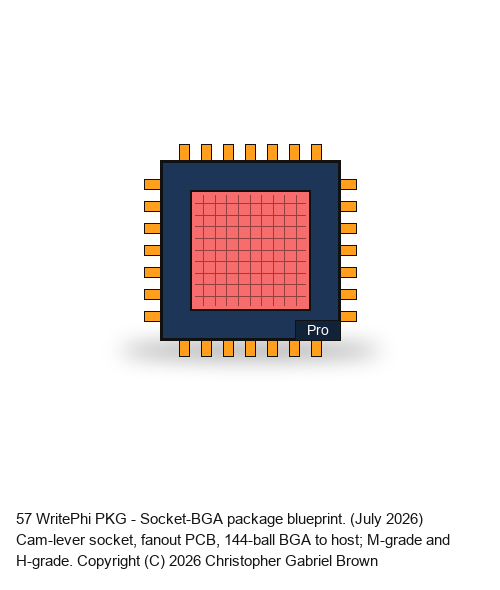
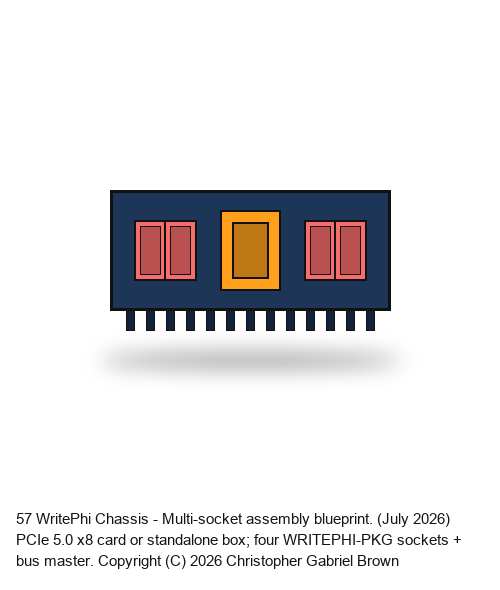
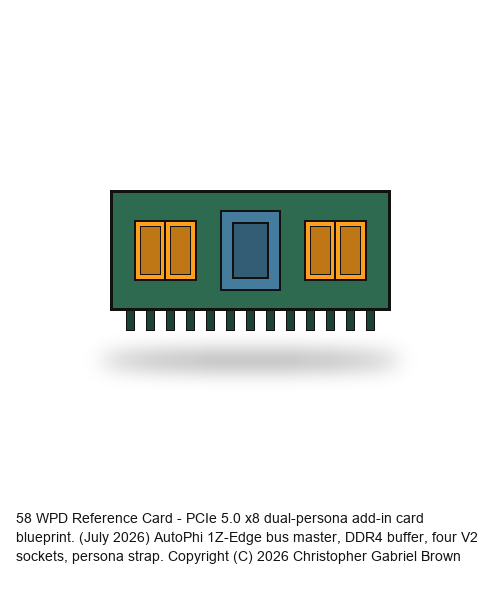
WPD does not exist in isolation. It is the Windows host deployment half of the same portfolio conversation that begins in WritePhi (Project 57). Project 57's kitchen-table pipeline — Writer, Blank, Dicer, PKG socket-BGA, Chassis bed, and reference IC library — fabricates the M-grade and H-grade WritePhi dies that this card's four pinned sockets accept. The V2 package blueprint here is an explicit production-scale extension of 57's PKG plus additional cut marks and tabs that WRITEPHI-DICER executes in the same dicing pass.
If you are buying on this page, you are in the run chapter: PCIe card reference designs, persona firmware, and Windows driver plans. Makers who need to produce the dies themselves start in the make chapter — browse WritePhi (Project 57). Either half stands alone for study or commercial licensing; both halves together narrate bench fabrication through installed Windows compute.
Fulfillment: Instant download after checkout. SHA-256 checksum published for integrity verification.
Region: USA-only (nginx geoblocking enforced). International buyers: contact us for special licensing.
Currency: USD only. Sub- via standard checkout (Stripe). Over : Term Sheet financing available.
Support: crioneaka@outlook.com | Christopher Gabriel Brown, Inventor | 24-48hr response.
Chris's philosophy: Every design engineered by hand. If it's specced, it works. If it has limits, we say so.
© 2026 Christopher Gabriel Brown · cri-one.com
3222c464605e41765e13f67d69db78b10178f873caa0ba00b76fdfc7675586da
WPD Study — V2 Package Blueprint
Publicly online since 2010 · U.S. patent applications since 2012 · inventions offered since 2014. The work of Christopher Gabriel Brown, independently documented.