WritePhi Study — Blank Blueprint
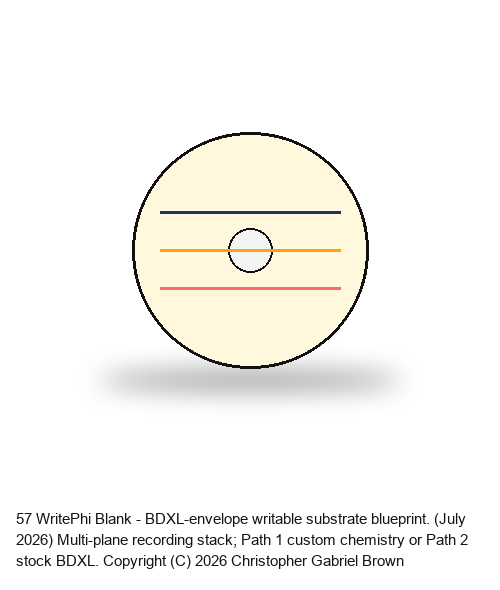
The WRITEPHI-BLANK writable-substrate blueprint: BDXL envelope + material stack + Path 1 (custom chemistry) vs Path 2 (stock BDXL) adoption. Personal + educational use only. Downloadable zip (~18 KB).
© CRI-ONE. All rights reserved. Patents issued and pending. Unauthorized reproduction of the underlying designs is prohibited.
Extended catalog & full narrative — WritePhi Study — Blank Blueprint
The extended dossier appended from the 2026-08-05 catalog snapshot. Prices in the body copy have been stripped; the live-store price on this page is the authoritative figure. Images have been omitted.
WritePhi Blank — The Writable Substrate That Makes Everything Possible
This is the heart of the entire WritePhi platform. Without a writable substrate, there is no home chip fabrication. Every other WritePhi product—Writer, Dicer, Package, Chassis, SDK—exists because this substrate exists.
What Is a WritePhi Blank?
A custom-engineered BDXL (Blu-ray Disc XL) substrate that holds up to three independent write planes in a standard 120 mm disc envelope. Unlike commodity BDXL discs used for optical data storage, a WritePhi Blank is designed to be photolithographically modified in situ using UV light at 405 nm, forming circuit-grade traces and features directly in the recording layer.
Think of it as silicon wafer + photoresist + development, all rolled into a single 120 mm optical disc—but instead of costing thousands and requiring a fab, it costs less than a commodity BDXL and can be written by a desktop device.
Two Adoption Paths
Path 1: Custom Circuit-Forming Chemistry (Full WritePhi Substrate)
- What it is: Proprietary recording-layer chemistry for high-resolution circuit-forming under 405 nm exposure
- Trace resolution: Down to 800 nm feature size (M-grade) or 300 nm (H-grade, requires higher-power laser)
- Transistor count per die: Up to 3,160 transistors on H-grade (proven by WPIC-AES-CORE reference)
- Requires: Chemistry lab access, spin-coating, UV cure chamber, thermal soak oven, QC (Raman, AFM)
- Time to first blank: ~3-6 months
- Best for: Chemistry companies, university labs, ambitious startups with lab access
Path 2: Stock BDXL + Post-Processing (Educational)
- What it is: Standard M-DISC or Pioneer BDXL substrate post-processed to approximate WritePhi behavior
- Trace resolution: ~2-5 µm (limited by commodity chemistry)
- Transistor count per die: Up to ~150 transistors (M-grade only)
- Requires: Off-the-shelf BDXL (-3 each), UV exposure box, thermal cure step
- Time to first blank: ~2-4 weeks for a hobbyist
- Best for: Learning the process, validating Path 1, educational settings
What's In The Zip
- BLANK_SUBSTRATE_SPEC.md — 40+ page master spec: 5-layer stack, thermal expansion coefficients, refractive index tables, mechanical tolerances (±5 µm thickness, ≤50 µm warp), M vs H grade chemistry
- PATH1_CHEMISTRY.md — Full Path 1 recipe: proprietary organometallic compound family, solvent system (toluene/PGMEA), spin-coat parameters, UV cure conditions (365 nm, 500 mJ/cm², 60s), thermal soak (85°C, 30 min), vendor list
- PATH2_STOCKBDXL.md — Path 2 guide: which BDXL brands work (Verbatim M-DISC, Pioneer BD-R XL, Panasonic), pre-treatment (mild acid etch), post-write thermal cure
- CROSS_SECTION_DIAGRAMS.svg — Detailed layer stack with every interface
- SEM_REFERENCE_IMAGES.md — What a properly written trace looks like (Chris's lab data)
- REFRACTIVE_INDEX_TABLES.csv — n and k values 300-800 nm for all layers
- WRITER_INTEGRATION.md — Focus depth, tracking, sector layout for the Writer
- DICER_INTEGRATION.md — Fiducial patterns, kerf allowance for the Dicer
- QUALITY_CONTROL.md — What to measure at each production step
- LICENSE.md, HANDOFF.md, CONTACT_INFO.txt
The Physics
WritePhi Blanks exploit two-photon absorption + photothermal decomposition. At 405 nm focused to a diffraction-limited spot (~450 nm FWHM), intensity is high enough at the focal plane to trigger a nonlinear chemistry response that doesn't happen elsewhere in the beam path. This enables 3-plane writing: refocus to different depths, write independent circuits at different z-positions.
Not novel physics (see two-photon polymerization literature). The novelty is the recording layer chemistry and process integration that makes it work with a low-cost desktop writer.
Your Work (Buyer Scope)
- Lab access: Class 10,000 cleanroom for Path 1; hobby workshop OK for Path 2
- Equipment (Path 1): Spin coater (Laurell WS-650, ~ used), UV cure chamber (365 nm LED, ~), thermal soak oven (Yamato DKN400, ~), fume hood, Raman + AFM access
- Equipment (Path 2): Commodity BDXL (100-pack, -300), UV box (-500), toaster oven
- Materials sourcing: Vendor list in PATH1_CHEMISTRY.md; -500 for a small research batch
- Validation: QUALITY_CONTROL.md walks the tests. 2-4 weeks Path 2, 3-6 months Path 1
- Scale-up (Path 1): Partner with disc pressing facility or set up inline lamination. Chris can recommend contacts under NDA.
Timeline
- Path 2 first blank: 2-4 weeks | characterized: 2-3 months
- Path 1 chemistry validated: 3-6 months | pilot production: 12-18 months | commercial scale: 24-36 months
Certification
Substrate is not a regulated product. Path 1 chemistry work needs: OSHA lab safety, EPA solvent waste disposal, state-level chemical registration (CA strictest). Commercial sales may trigger TSCA at large volumes.
License (Study Tier)
✅ Personal/lab use, publications with attribution, R&D modifications. ❌ Commercial sales, production-scale revenue, sub-licensing, medical/weapons/aerospace without written consent. Upgrade: WRITEPHI-COMMERCIAL .
Why ?
Study-tier pricing reflects a complete engineering blueprint — SPEC, BOM, schematic, integration notes — not a hobby PDF. This is the gateway SKU for the platform: serious enough to filter casual downloads, accessible enough for labs and motivated makers.
Portfolio conversation — WritePhi (Project 57) + WritePhi Devices (Project 58)
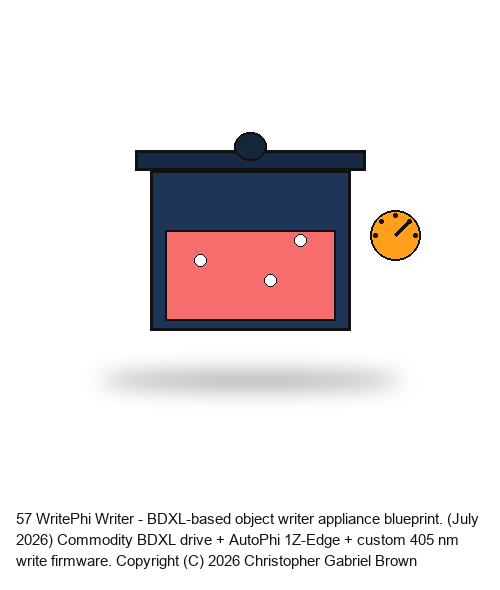
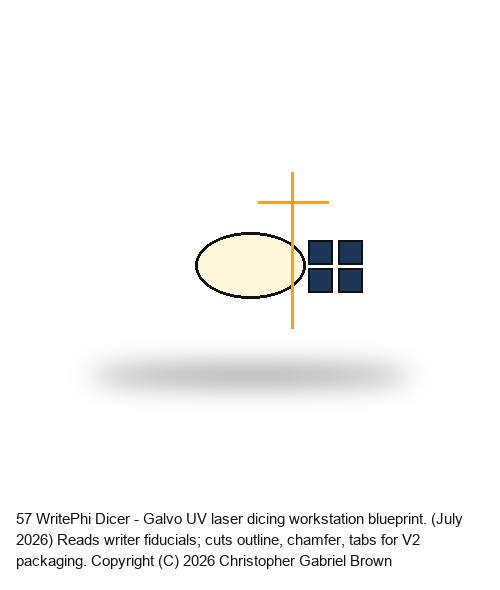
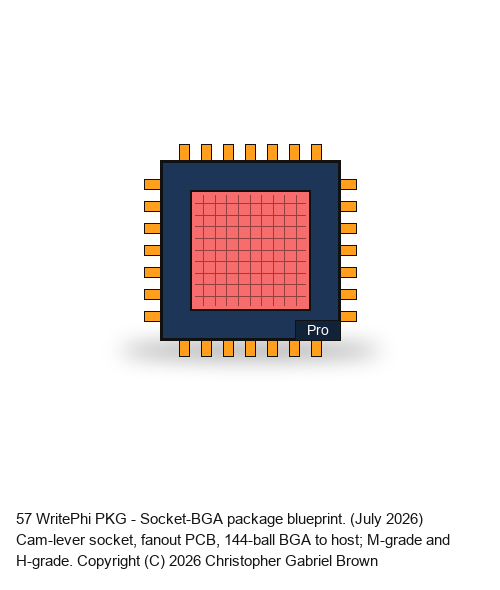
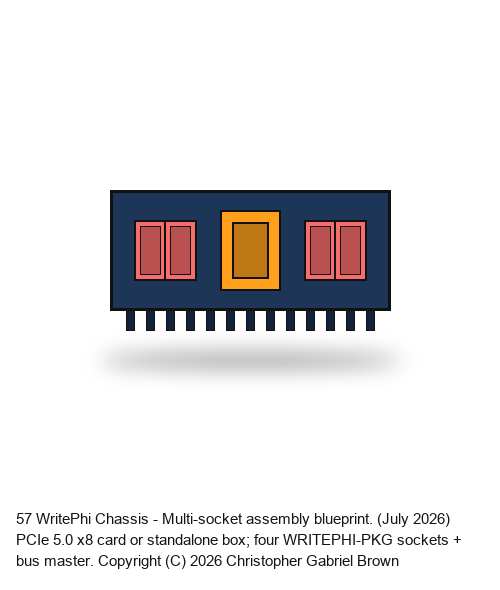
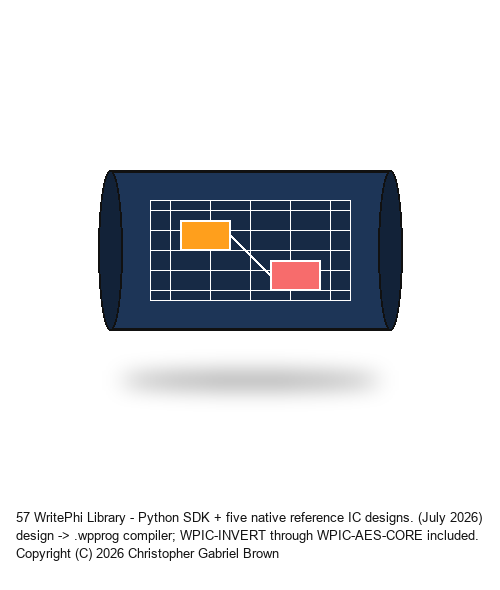
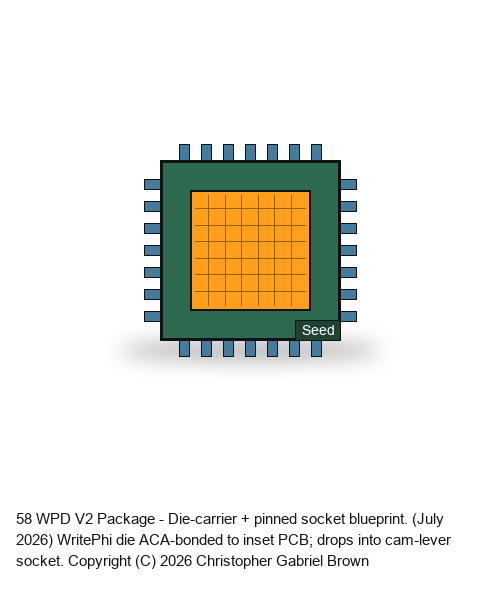
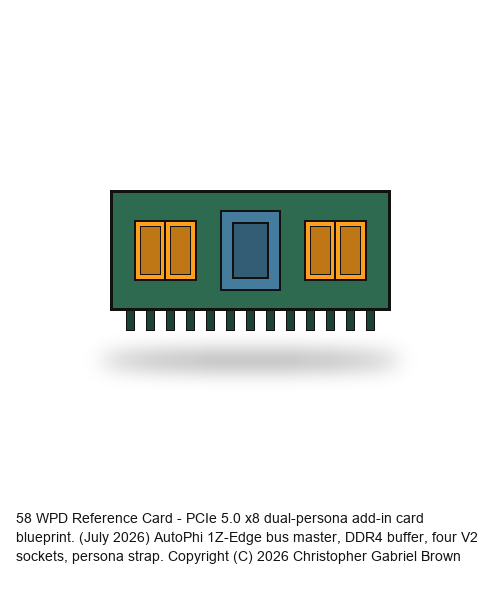
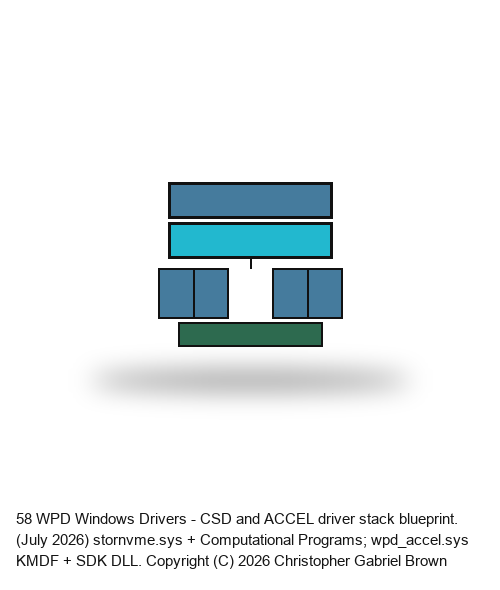
These two product families are one continuous story in two chapters, not unrelated store listings. WritePhi (Project 57) is the kitchen-table fabrication layer: Writer → Blank → Dicer → PKG → Chassis → Library makes replaceable WritePhi dies at the bench. WritePhi Devices / WPD (Project 58) is the deployment layer for those same dies: the V2 inset package (carried forward from WRITEPHI-PKG and cut geometry from WRITEPHI-DICER) drops into pinned sockets on a reference PCIe 5.0 card, where Windows-facing CSD and ACCEL personas plus on-card firmware turn a homemade die into a plug-and-play host peripheral.
If you are buying on this page, you are in the make chapter. An OEM or power user who completes the 57 pipeline and wants volume-manufacturable packaging plus a Windows card stack continues in the run chapter — browse WritePhi Devices (WPD) on the same store. Neither family requires the other to be useful alone; together they describe the full path from blank substrate to installed Windows accelerator.
Fulfillment: Instant download after checkout. SHA-256 checksum published for integrity verification.
Region: USA-only (nginx geoblocking enforced). International buyers: contact us for special licensing.
Currency: USD only. Sub- via standard checkout (Stripe). Over : Term Sheet financing available.
Support: crioneaka@outlook.com | Christopher Gabriel Brown, Inventor | 24-48hr response.
Chris's philosophy: Every design engineered by hand. If it's specced, it works. If it has limits, we say so.
© 2026 Christopher Gabriel Brown · cri-one.com
3bf3973642e6f131a416d6dcf8f3c718671a6053e772632fb663f16decf4b772WritePhi Study — Blank Blueprint
Publicly online since 2010 · U.S. patent applications since 2012 · inventions offered since 2014. The work of Christopher Gabriel Brown, independently documented.