WPD Study — Windows Driver Plans
Windows driver stack plans: NVMe class driver (CSD persona) + KMDF (ACCEL persona) + user-mode SDK. Personal + educational use only. Downloadable zip (~12 KB).
© CRI-ONE. All rights reserved. Patents issued and pending. Unauthorized reproduction of the underlying designs is prohibited.
Extended catalog & full narrative — WPD Study — Windows Driver Plans
The extended dossier appended from the 2026-08-05 catalog snapshot. Prices in the body copy have been stripped; the live-store price on this page is the authoritative figure. Images have been omitted.
WPD Windows Driver Plans — Dual-Persona Driver Architecture
Windows kernel drivers are notoriously complex. This blueprint walks you through the entire stack: user app → SDK DLL → kernel driver (CSD or ACCEL persona) → PCIe MMIO → device. Working boilerplate you can actually build on.
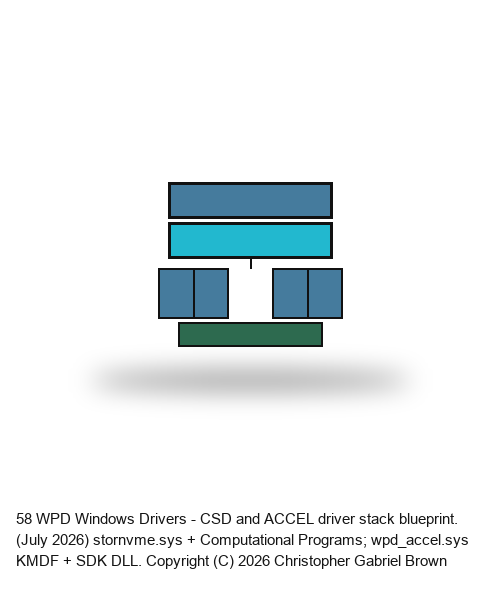
The Full Stack
User Application (C/C++/Python)
 ↓
wpd_sdk.dll (user-mode SDK)
 ↓
Windows I/O Manager
 ↓
┌──────────────────────────────────────┐
│ CSD Persona ACCEL Persona │
│ stornvme.sys wpd_accel.sys │
│ (in-box driver) (custom KMDF) │
└──────────────────────────────────────┘
 ↓
PCIe MMIO
 ↓
WPD-DEVICE hardware
What's In The Zip
WINDOWS_DRIVER_STACK.md — Architecture Overview
- Full block diagram of user app → driver → device
- Persona selection logic (how drivers detect CSD vs ACCEL)
- Handoff between user-mode SDK and kernel driver
- DirectML backend integration (ACCEL persona)
CSD Persona Driver Plans
- stornvme.sys integration: Windows ships an NVMe class driver. WPD-CSD leverages it. No custom driver installation for the storage function.
- Computational Programs extension: NVMe 2.0 spec feature. WritePhi ICs expose as NVMe namespaces. Query an IC → return computed result.
- Test vectors: Sample NVMe commands + expected responses (for validation)
- Sample queries: Python + PowerShell examples showing how to talk to a WPD-CSD device
ACCEL Persona Driver Plans
- Custom KMDF driver (wpd_accel.sys):
- Kernel-Mode Driver Framework skeleton (Visual Studio project)
- Device enumeration (PCIe vendor/device ID match)
- MMIO mapping (host-mapped BAR regions)
- Interrupt handling (MSI-X, up to 16 queues)
- Power management (D0/D3 states)
- MMIO queue structures:
- Command queue (host writes, device reads): 256-entry ring buffer
- Completion queue (device writes, host reads): 256-entry ring buffer
- Doorbell registers (host signals device on queue write)
- Interrupt vectors (device signals host on completion)
- Job scheduler:
- Serialization (per-socket queues, prevent conflict)
- Dependency tracking (job B waits for job A)
- Fault handling (bad job doesn't crash the driver)
- DirectML backend:
- Registers WPD-ACCEL as a DirectML device
- Translates DirectML operators to WritePhi IC calls
- Runs on any Windows 10+ system with DirectX 12
- Enables ML frameworks (ONNX Runtime, PyTorch DirectML) to target WPD
User-Mode SDK (wpd_sdk.dll)
- C++ library, both personas supported
- API reference (create/submit/retrieve jobs, error handling, event callbacks)
- Sample applications:
- matmul_test.cpp: Matrix multiply on WPD-ACCEL, compare to CPU baseline
- fft_test.cpp: 1024-point FFT, latency + throughput benchmark
- aes_bench.cpp: AES-128 encryption throughput (uses WPIC-AES-CORE)
- storage_test.py: Standard NVMe operations on WPD-CSD (read/write/trim)
- Python bindings (via pybind11) for scripting environments
Strap Detection Code
- At driver load time, reads R1/R2 strap through a dedicated PCIe config register
- Loads CSD or ACCEL persona firmware from device NOR flash
- Registers appropriate driver INF (CSD → stornvme.sys, ACCEL → wpd_accel.sys)
Test Vectors + Sample Applications
- NVMe command traces (for validation against real device)
- MMIO register maps (BAR0 layout, queue offsets, doorbell locations)
- Expected performance benchmarks (latency, throughput per socket)
Real Capability
Windows drivers are hard. Most tutorials skim over the details that matter (MMIO ordering, DPC handling, PnP state transitions). This spec doesn't skim. You get:
- Working KMDF boilerplate (compile with Windows Driver Kit 10+)
- MMIO queue semantics (write-combining, ordering, memory barriers)
- Interrupt handling that survives real-world race conditions
- Power management that passes WHCP tests
- DirectML integration that actually accelerates ML workloads
Your Work
- Driver development: C++ + Windows kernel architecture experience required. 2-6 months for a competent Windows kernel dev.
- Testing: Static analysis (Driver Verifier), dynamic testing (Windows HLK), stress testing (long-running workloads, PnP cycles)
- Certification: WHCP (Windows Hardware Compatibility Program) submission. ~-10k in test infrastructure + fees.
- Signing: EV code signing certificate (-600/year), microsoft attestation for kernel driver (one-time)
- User-mode SDK refinement: Optimize hot paths, add convenience wrappers, C# / Python bindings for wider adoption
Timeline
- KMDF driver skeleton compile + boot: 1-2 weeks
- MMIO queue implementation: 3-4 weeks
- DirectML backend: 4-8 weeks
- Testing + hardening: 4-8 weeks
- WHCP submission + iteration: 4-12 weeks
- Total to signed driver: 4-8 months
License (Study Tier)
✅ Develop drivers for personal/research use. ❌ Sell signed drivers commercially. Upgrade: WPD-COMMERCIAL grants right to sell drivers under your WHCP account.
Portfolio conversation — WritePhi Devices (Project 58) + WritePhi (Project 57)
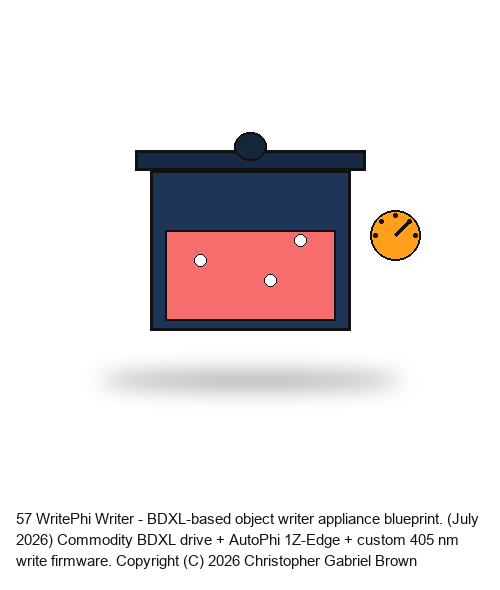
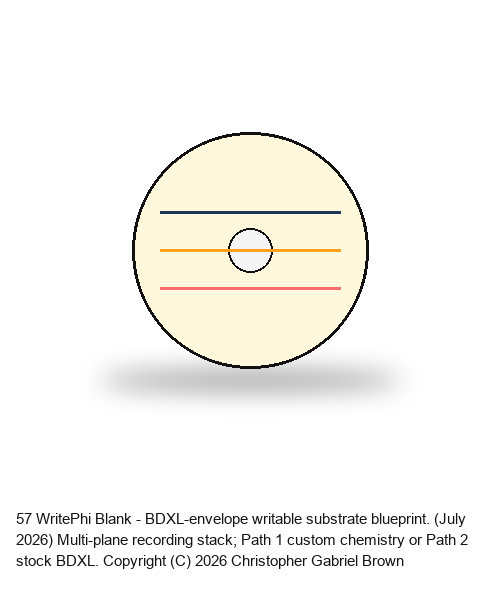
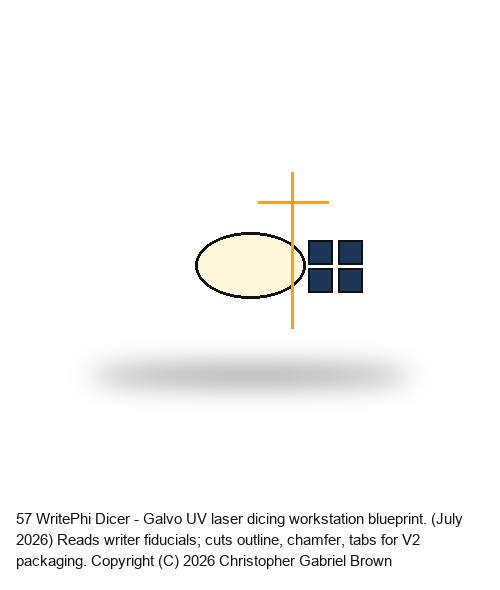
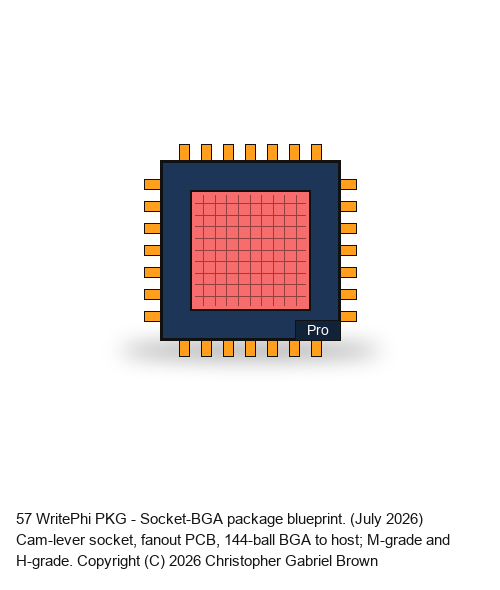
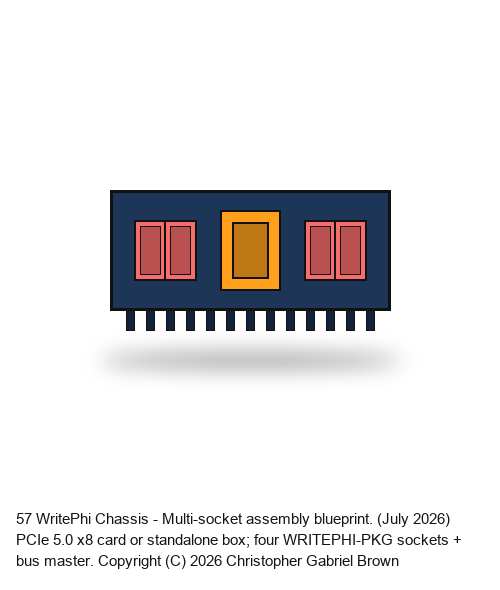
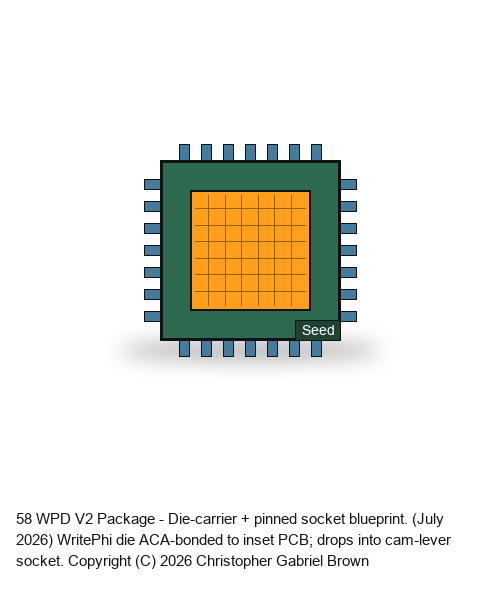
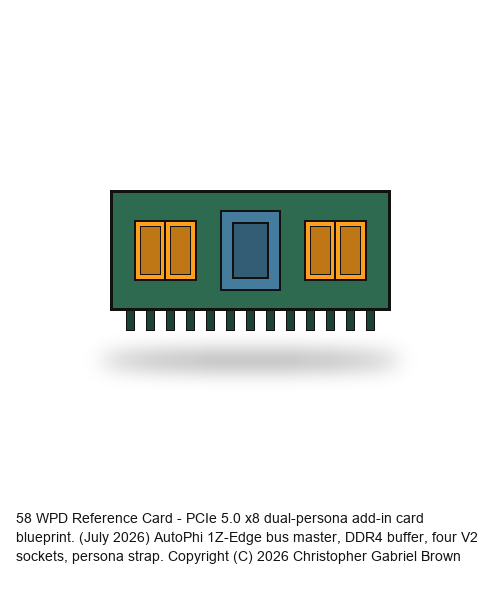
WPD does not exist in isolation. It is the Windows host deployment half of the same portfolio conversation that begins in WritePhi (Project 57). Project 57's kitchen-table pipeline — Writer, Blank, Dicer, PKG socket-BGA, Chassis bed, and reference IC library — fabricates the M-grade and H-grade WritePhi dies that this card's four pinned sockets accept. The V2 package blueprint here is an explicit production-scale extension of 57's PKG plus additional cut marks and tabs that WRITEPHI-DICER executes in the same dicing pass.
If you are buying on this page, you are in the run chapter: PCIe card reference designs, persona firmware, and Windows driver plans. Makers who need to produce the dies themselves start in the make chapter — browse WritePhi (Project 57). Either half stands alone for study or commercial licensing; both halves together narrate bench fabrication through installed Windows compute.
Fulfillment: Instant download after checkout. SHA-256 checksum published for integrity verification.
Region: USA-only (nginx geoblocking enforced). International buyers: contact us for special licensing.
Currency: USD only. Sub- via standard checkout (Stripe). Over : Term Sheet financing available.
Support: crioneaka@outlook.com | Christopher Gabriel Brown, Inventor | 24-48hr response.
Chris's philosophy: Every design engineered by hand. If it's specced, it works. If it has limits, we say so.
© 2026 Christopher Gabriel Brown · cri-one.com
0d61e898fdde2631c812d2434a3e5549a07385c51935ab522ffce7d15e7a4e8e
WPD Study — Windows Driver Plans
Publicly online since 2010 · U.S. patent applications since 2012 · inventions offered since 2014. The work of Christopher Gabriel Brown, independently documented.