WPD Study — Firmware Blueprint
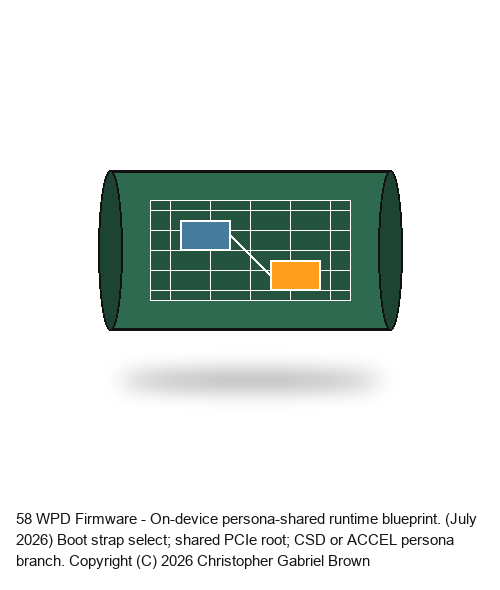
On-device firmware overview: AutoPhi 1Z-Edge bus master with CSD + ACCEL persona shared runtime. Personal + educational use only. Downloadable zip (~6 KB).
© CRI-ONE. All rights reserved. Patents issued and pending. Unauthorized reproduction of the underlying designs is prohibited.
Extended catalog & full narrative — WPD Study — Firmware Blueprint
The extended dossier appended from the 2026-08-05 catalog snapshot. Prices in the body copy have been stripped; the live-store price on this page is the authoritative figure. Images have been omitted.
WPD Firmware — A Minimal OS for the AutoPhi 1Z-Edge Bus Master
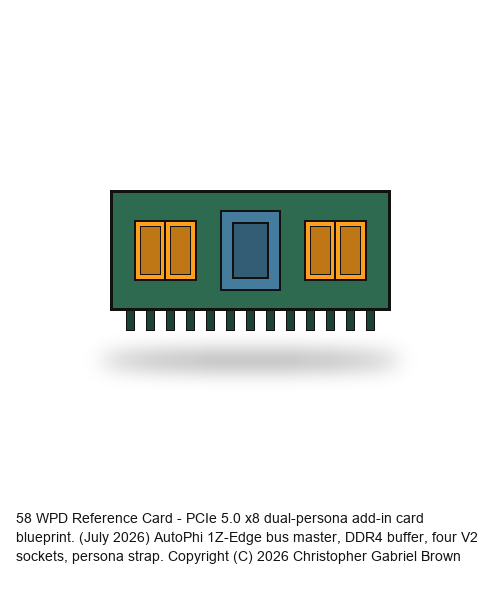
The on-device firmware that makes WPD work. Runs on the AutoPhi 1Z-Edge bus master. Boots, reads persona strap, initializes hardware, exposes the right interface (NVMe for CSD, MMIO queues for ACCEL). Same codebase, two personas.
Architecture
┌─────────────────────────────────────┐
│ Boot / Persona Select │ ← reads strap R1/R2
│ (reads NOR flash, sets up MMU) │
└─────────────────────────────────────┘
 ↓
┌─────────────────────────────────────┐
│ Shared Runtime │
│ - PCIe root complex init │
│ - Hyperthreading (2 threads/core) │
│ - Socket management (4 V2 sockets) │
│ - DDR4 controller (2-4 GB buffer) │
│ - NOR flash driver (firmware storage)│
└─────────────────────────────────────┘
 ↓
┌────────────────────┬────────────────┐
│ CSD Persona │ ACCEL Persona │
│ - NVMe front-end │ - MMIO queues │
│ - Comp Programs │ - Job dispatch │
│ - Query engine │ - Scheduler │
│ - Namespace mgmt │ - DirectML VM │
└────────────────────┴────────────────┘
What's In The Zip
FIRMWARE_SPEC.md — Master Specification
- Boot flow (from reset to persona ready)
- Memory map (BAR0, BAR1, DDR4 layout)
- Interrupt architecture (MSI-X vectors)
- Power management (idle states, wake events)
Bootloader
- Read strap resistors via GPIO
- Initialize MMU + cache
- Load persona firmware from NOR flash (SHA-256 verified)
- Jump to persona main
- Fallback: if persona firmware corrupt, boot recovery mode (allows re-flash via PCIe DMA)
Shared Runtime
- PCIe root complex: Enumerate host bridge, configure BAR windows, handle config-space accesses
- Hyperthreading management: 1Z-Edge supports 2 hardware threads per core; runtime provides thread pool for both personas
- Socket management: 4× V2 socket enumeration, hotplug support (die insertion/removal detection), fault isolation (bad die quarantine)
- DDR4 controller: Memory training on boot, ECC scrubbing during idle, error reporting to host
- NOR flash driver: Persona firmware storage, wear leveling, verify-after-write
CSD Persona Firmware
- NVMe front-end: Parses NVMe commands from host, translates to internal operations
- Namespace management: Standard NVMe namespaces map to storage; Computational Programs map to WritePhi ICs
- Computational Programs registry: Table of installed programs, maps namespace ID → WritePhi IC → parameters
- Query engine: Executes on-device IC (via socket bus), returns results as NVMe read response
- SMART logging: Standard NVMe SMART fields (endurance, temperature, error counts)
ACCEL Persona Firmware
- MMIO queue listener: Monitors host-mapped ring buffers for new job submissions
- Job dispatcher: Routes jobs to available sockets based on required IC type
- Scheduler:
- FIFO by default, priority-boostable
- Dependency tracking (job B waits for job A completion)
- Fault recovery (retry on transient error, quarantine socket on persistent error)
- DirectML bytecode interpreter:
- Consumes DirectML operator streams from the wpd_accel.sys driver
- JIT-compiles operators to WritePhi IC sequences
- Manages activation memory in DDR4
Test Harness
- Bare-metal tests for each subsystem (bootloader, memory, PCIe, socket, both personas)
- Loopback tests (host command → firmware → host response, verify end-to-end)
- Fault injection (simulate socket failure, verify graceful degradation)
Real Capability
This is a minimal but complete OS for a specialized device. You'll understand:
- How a hypervisor-style platform handles multiple work modes on shared silicon
- How to build a real MMIO queue system that survives concurrent host+device access
- How to integrate DirectML for GPU-agnostic ML inference on custom silicon
- How NVMe 2.0 Computational Programs work (they're new; few implementations exist)
Your Work
- Firmware integration: Adapt to your specific PCB variant (BAR layouts, GPIO mappings, DDR4 config)
- Performance tuning: Memory bandwidth optimization, cache line alignment, hyperthread scheduling
- Testing: Extend test harness with your workload-specific tests
- Power management: Implement idle state entry/exit if targeting battery-powered use cases
- Field updates: Design a firmware update mechanism (via PCIe DMA to NOR flash, with rollback)
Timeline
- Bootloader adaptation: 1-2 weeks
- Shared runtime integration: 2-4 weeks
- Persona firmware bring-up: 4-8 weeks per persona
- Testing + hardening: 4-8 weeks
- Total to production-grade firmware: 3-6 months
License (Study Tier)
✅ Modify firmware for research/personal use. ❌ Sell WPD cards with this firmware commercially. Upgrade: WPD-COMMERCIAL .
Portfolio conversation — WritePhi Devices (Project 58) + WritePhi (Project 57)
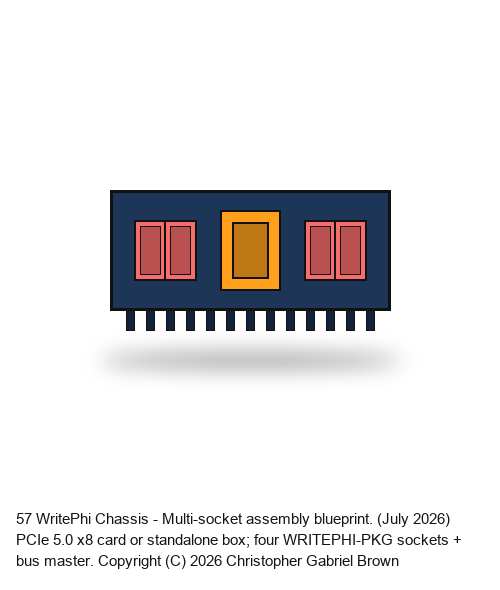
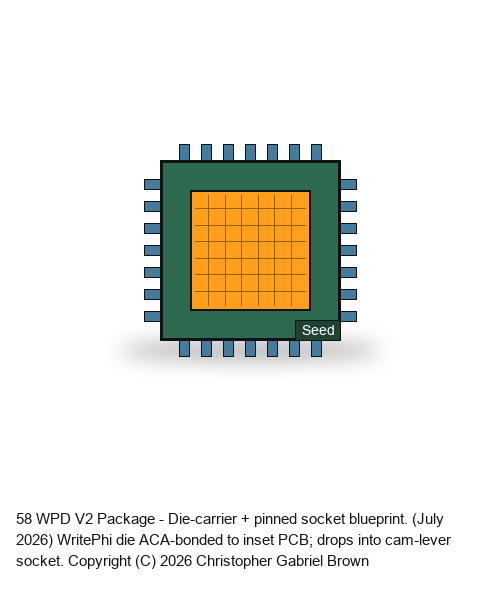
WPD does not exist in isolation. It is the Windows host deployment half of the same portfolio conversation that begins in WritePhi (Project 57). Project 57's kitchen-table pipeline — Writer, Blank, Dicer, PKG socket-BGA, Chassis bed, and reference IC library — fabricates the M-grade and H-grade WritePhi dies that this card's four pinned sockets accept. The V2 package blueprint here is an explicit production-scale extension of 57's PKG plus additional cut marks and tabs that WRITEPHI-DICER executes in the same dicing pass.
If you are buying on this page, you are in the run chapter: PCIe card reference designs, persona firmware, and Windows driver plans. Makers who need to produce the dies themselves start in the make chapter — browse WritePhi (Project 57). Either half stands alone for study or commercial licensing; both halves together narrate bench fabrication through installed Windows compute.
Fulfillment: Instant download after checkout. SHA-256 checksum published for integrity verification.
Region: USA-only (nginx geoblocking enforced). International buyers: contact us for special licensing.
Currency: USD only. Sub- via standard checkout (Stripe). Over : Term Sheet financing available.
Support: crioneaka@outlook.com | Christopher Gabriel Brown, Inventor | 24-48hr response.
Chris's philosophy: Every design engineered by hand. If it's specced, it works. If it has limits, we say so.
© 2026 Christopher Gabriel Brown · cri-one.com
50994ddf9c54573e08ea4956022e9460361ce6be5c4602d4d1b8e5641bd25eb4
WPD Study — Firmware Blueprint
Publicly online since 2010 · U.S. patent applications since 2012 · inventions offered since 2014. The work of Christopher Gabriel Brown, independently documented.