FocusPhi Optical Kit
© CRI-ONE. All rights reserved. Patents issued and pending. Unauthorized reproduction of the underlying designs is prohibited.
Extended catalog & full narrative — FocusPhi Optical Kit
The extended dossier appended from the 2026-08-05 catalog snapshot. Prices in the body copy have been stripped; the live-store price on this page is the authoritative figure. Images have been omitted.
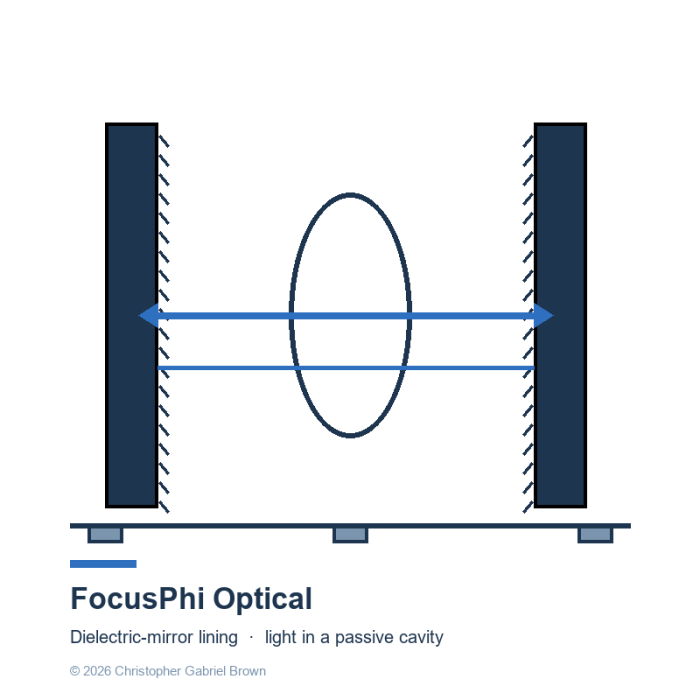
A segmented dielectric-mirror cavity that turns 1 meter of tunnel into 200 meters of interaction pathlength.
Chip-scale staircase mirrors to bench-scale multipass cells to solar concentrators — the same segment-and-ring construction, tuned across nine orders of magnitude of wavelength.
What you are buying
The FocusPhi Optical Kit is the optical variant of the FocusPhi segmented reflective tunnel: a passive cavity built from mirror-lined trapezoidal segments joined into rings and stacked into a body. Every segment's inner face carries a dielectric mirror stack tuned to the operating wavelength. The result is a Fabry-Pérot-class resonator that concentrates intracavity intensity by the cavity finesse and multiplies the effective interaction pathlength by the same factor. Founding IP: Chris G Brown patent 3561 (2017) — "1 light trigger + varied colored laser semiconductor & microchip cold light micro chip, digital optics by colored micro mirrors ... staircase mirror chips, nanophotonics".
Applications the optical variant serves
| Application | Configuration | Portfolio consumer |
|---|---|---|
| Multipass absorption spectroscopy | C1 straight cylindrical, flat mirrors | — |
| Laser resonator (with a gain medium) | C2 confocal, concave end caps R = L | — |
| Solar concentration loop | C5 Winston-cone conical | Private Energy Farms (project 48) |
| Charge/discharge photonics concentrator | C4 integrating sphere | Quantum Battery (project 5) |
| Chip-scale folded staircase-mirror stage | C14 folded cylindrical on Si substrate | AutoPhi Electromagnetic IC (project 31) |
| Photolithography light recycling | C4 integrating sphere | — |
| Intracavity nonlinear frequency conversion | C3 concentric or C2 confocal | — |
| Point-to-point energy transfer | R3 elliptical inner face | — |
| Coronagraph — block a bright on-axis source | R7 ecliptic occulting disk | — |
| Retroreflector array | R4 corner-cube segments (90° internal) | — |
Design envelope — the numbers
| Metric | Target | Reference |
|---|---|---|
| Per-surface reflectance (dielectric HL stack) | r ≥ 0.999 (visible/NIR); r ≥ 0.995 (UV); r ≥ 0.99 (mid-IR) | hardware/OPTICAL/SPEC.md §3 |
| Finesse (at r₁r₂ = 0.995) | F ≈ 626 | THEORY §4.1 Eq. 8 |
| Cavity Q (L = 1 m, λ = 1 μm) | Q ≈ 1.25 × 10⁹ | THEORY §4.2 Eq. 9 |
| Intracavity buildup (impedance-matched) | B ≈ F/π ≈ 200× | THEORY §4.3 Eq. 10 |
| Storage time τ (L = 1 m) | ~1.3 μs | THEORY §4.4 Eq. 11 |
| Effective interaction pathlength | 200 m in a 1 m tunnel (F = 626) | THEORY §4.5 Eq. 12 |
| Alignment tolerance | λ/10 across N segments (dovetail joinery) | hardware/OPTICAL/SPEC.md §6 |
| Segment substrate options | Fused silica / single-crystal Si (chip) · Invar / Zerodur (bench) · Invar / ULE (large) | hardware/OPTICAL/SPEC.md §2 |
| Scale range | 5 μm (chip) — 2 m (bench/large) | SCALES.md |
Proof — every number reproduced from first principles
The optical variant is verified two independent ways in the shipped package:
1) verify_theory.py (analytic self-consistency)
- Finesse at r₁r₂ = 0.995: computed 626.7 → documented ~626 ✅
- Q at L = 1 m, λ = 1 μm: computed 1.25 × 10⁹ → documented 1.25 × 10⁹ ✅
- Storage time τ: computed 1.33 μs → documented ~1.3 μs ✅
- Effective pathlength: computed 199.5 m → documented ~200 m ✅
2) simulate.py (independent-method cross-check)
- Transfer-matrix method (TMM) over a 20-pair SiO₂ / Ta₂O₅ quarter-wave stack independently derives the mirror reflectance, and confirms the achievable finesse comfortably exceeds the 626 design floor.
- TMM is loss-free (upper bound); real cavities are scatter-limited to ~10⁴–10⁶ finesse. The design floor is honest and buildable with commodity coatings from Alluxa / Layertec / OCJ / Newport.
The staircase-mirror chip (patent 3561)
The chip-scale folded optical variant is the direct engineering descendant of the founding invention. A cylindrical tunnel folds down into a single-substrate stepped feature — the "staircase mirror" of the 2017 filing — with segment inner faces defined by photolithography. This is how the optical variant reaches nanophotonic scale (5 μm inner diameter, 20 μm long, 24-segment approximation) while preserving the segment-and-ring construction pattern used at bench scale.
What ships in this kit
- Complete document set: README, SPEC, THEORY, CONFIGURATIONS, PROOF_OF_FUNCTION, STATUS, MANIFEST, PRODUCT_BRIEF, STORE_LISTING, IP_REFERENCES, SCALES, KIT_AND_PRICING, TESTED_AND_LIMITS, LICENSE.
- Shared TUNNEL segmented-assembly spec + the OPTICAL variant hardware SPEC (substrate, dielectric-stack coating table per wavelength band, end-cap options, recommended shape choice per application).
- OpenSCAD parametric segment library + the STL mesh set including
PART_segment_bench_24seg.stl,PART_segment_nano_um.stl(chip-scale, units = micrometers),PART_ring_bench_fused.stl,PART_tunnel_bench_fused.stl, and theASSEMBLY_ring_bench_24seg.stl. Meshes are watertight and validated (verify_stl.py, 10/10 pass). - verify_theory.py + verify_stl.py + sim/simulate.py (TMM optics solver included).
- Worldwide, non-exclusive commercialization rights.
Honest physics — up front
A passive optical cavity conserves energy. The finesse-multiplied intracavity intensity is a redistribution of the input photon lifetime, not creation of new photons. To exceed unity gain requires a gain medium (Ti:Sapphire crystal, dye cell, semiconductor gain chip, doped fiber, etc.) inside the tunnel. The optical variant is dimensioned to accept common gain-medium form factors including Brewster-cut crystals — see THEORY §13 for the Brewster-angle analysis and polarization-selective cavity design.
Maturity
- ✅ L1 Concept — full document set, patents 3561 and 2486 cited as founding IP
- ✅ Theory self-consistent — 4 of 20 verify_theory.py checks are the optical-variant equations; all pass
- ✅ L2 CAD — bench-scale (300 mm) and nano-scale (10 μm) watertight STL meshes
- ✅ L3-partial — TMM optics simulation cross-checks the mirror reflectance and finesse
- ⬜ L3-full — 3-D FDTD (Meep / Lumerical) on the fabricated geometry — buyer's tools
- ⬜ L4 foundry-ready — first-article fabrication + interferometric alignment measurement — buyer's shop
What is NOT included
Patent 3561 and the adjacent 2017 Chris G Brown patents are retained by the inventor. This is a documentation + worldwide-commercialization-rights transaction — not a patent license and not a patent assignment.
Also not included: prototype hardware, FDTD simulation results, coating-vendor procurement, laser-safety certification (IEC 60825 with a gain medium is buyer's scope), or the gain medium itself.
Terms
- USD per purchase, Base, No IP.
- Included at no extra charge inside the FocusPhi Complete Platform and inside All In One .
- Available only to companies incorporated, headquartered, and primarily operating in the United States.
- USD only. Final sale. Communication by email and postal mail only.
Christopher Gabriel Brown — christopher@cri-one.com · crioneaka@outlook.com
FocusPhi Optical. Two hundred meters of interaction pathlength inside one meter of tunnel. The staircase mirror of 2017, built as a segmented cavity.
ebb132807aaa64820a697031ad16a5835f8e5ee5f99e18761bb32ddcb13aca57FocusPhi Optical Kit
Publicly online since 2010 · U.S. patent applications since 2012 · inventions offered since 2014. The work of Christopher Gabriel Brown, independently documented.