FocusPhi Microwave Kit
© CRI-ONE. All rights reserved. Patents issued and pending. Unauthorized reproduction of the underlying designs is prohibited.
Extended catalog & full narrative — FocusPhi Microwave Kit
The extended dossier appended from the 2026-08-05 catalog snapshot. Prices in the body copy have been stripped; the live-store price on this page is the authoritative figure. Images have been omitted.
A segmented copper (or superconducting-niobium) reflective cavity. Q from 10⁴ at room temperature to 10¹⁰ in a helium bath.
Klystron interaction cavities, industrial microwave heating with intensity buildup, particle-accelerator-class SRF cells — the same segment-and-ring construction, three orders of magnitude of Q.
What you are buying
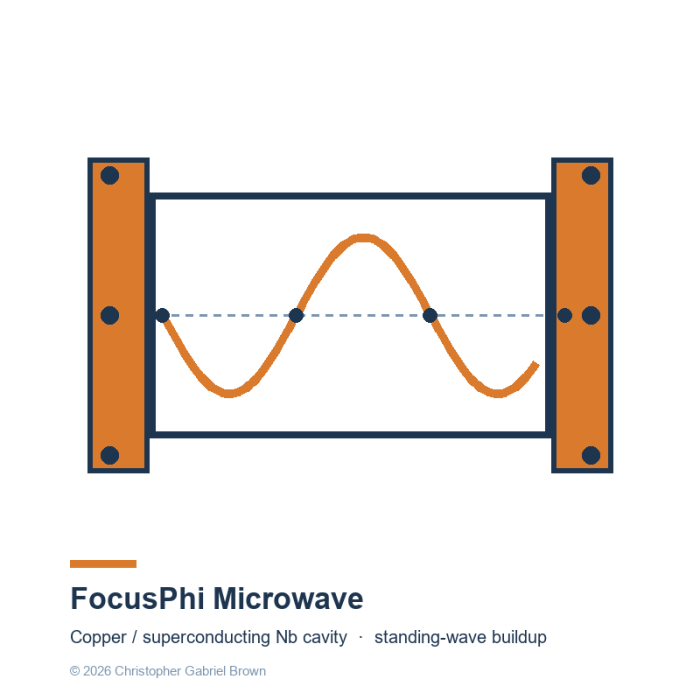
The FocusPhi Microwave Kit is the microwave variant of the FocusPhi segmented reflective tunnel: a passive cavity whose interior is lined with a conductive metallic surface (electroplated copper, silver-plated aluminum, or bulk niobium for the superconducting build). The cavity establishes a standing electromagnetic wave whose Q — the ratio of stored energy to loss per cycle — sets the intracavity intensity buildup. The interior surface is machined smoother than the microwave skin depth at the operating frequency; joints between ring segments are RF-gasket sealed or electron-beam welded depending on Q target. Founding IP: Chris G Brown patent 2485 (2017) — "electra magnetic compressed jet propulsion ... compressed modular sequence to build a jet action of energy".
Applications the microwave variant serves
| Application | Configuration | Portfolio consumer |
|---|---|---|
| Klystron / magnetron interaction cavity | C8 cylindrical, shorting plates | — |
| Superconducting accelerator cavity (SRF-class) | C9 cylindrical multi-cell, niobium | — |
| Microwave-nuclear waste-recycler emitter stage | H1 hybrid MW + Nu | Microwave Nuclear Waste Recycling Center (project 8) |
| Compact microwave-nuclear cell | H1 hybrid, small footprint | Small Microwave Nuclear Recycler (project 17) |
| Solo Negative Microwave containment | Cylindrical microwave cavity | Solo Negative Microwave (project 49) |
| Radar target simulation (isotropic scattering) | C12 spherical microwave | — |
| Whispering-gallery microwave frequency reference | C13 toroidal, closed loop | — |
| Industrial ISM-band heating with intensity buildup | C8 cylindrical, ISM 2.45 GHz | — |
Design envelope — the numbers
| Metric | Target | Reference |
|---|---|---|
| Cavity Q (room-temperature Cu, 2.45 GHz) | 10⁴ – 10⁵ | hardware/MICROWAVE/SPEC.md §6, THEORY §3.4 |
| Cavity Q (superconducting niobium at 2 K) | 10⁸ – 10¹⁰ | SRF-accelerator community practice |
| Cu skin depth at 2.45 GHz | 1.34 μm | THEORY §3.4 Eq. 7 |
| Cu skin depth at 10 GHz | 0.66 μm | THEORY §3.4 Eq. 7 |
| Cu per-surface reflectance at 2.45 GHz | R ≈ 0.99993 | THEORY §3.4 Eq. 6 |
| TE₀₁₁ single-cell length in a 60 cm cavity at 2.45 GHz | 63 mm | WORKED_EXAMPLE §5.1 |
| Segment inner surface finish target | Ra ≤ 0.5 μm (Cu at 10 GHz); chemical-polish grade (Nb) | hardware/MICROWAVE/SPEC.md §2 |
| Standard segment count per ring | 12 (30° wedge) typical; 24 for smoother mode | hardware/TUNNEL/SPEC.md §2 |
| Operating frequency accuracy | ±0.1% via tuner post (Cu); ±10 ppm mechanical squeezer (Nb) | hardware/MICROWAVE/SPEC.md §6 |
| Substrate options | OFHC copper · silver-plated aluminum · bulk niobium (superconducting) · Cu-plated stainless (industrial) | hardware/MICROWAVE/SPEC.md §2 |
Proof — every number reproduced from first principles
1) verify_theory.py (analytic self-consistency)
- Copper skin depth at 2.45 GHz: computed 1.34 μm → documented 1.34 μm ✅
- Copper reflectance at 2.45 GHz: computed 0.99993 → documented 0.99993 ✅
The verification script caught a real documentation error on first run — the skin depth had been quoted at 10 GHz where the worked example runs at 2.45 GHz. Both values are now correctly stated (δ ∝ 1/√f).
2) simulate.py (independent-method cross-check)
- Cylindrical-cavity eigenmode solve using the real Bessel-prime zero X'₀₁ = 3.8317 for TE₀₁₁ reproduces the 63.2 mm single-cell length at 2.45 GHz in a 60 cm-diameter cavity — matches the worked example to 0.3%.
- Analytic wall-loss Q for the same single-cell pancake computes Q ≈ 2,400 at room-temperature copper — inside the 10³–10⁵ physically-defensible band, and directly explains why the H1 worked example stacks 19 cells to reach the 10⁴ operating Q target.
The multi-cell stack — why the microwave variant likes to be long
A single TE₀₁₁ pancake at 2.45 GHz is 63 mm long. The FocusPhi microwave variant's advantage is that stacking N such cells in the segmented-ring assembly gives an N-cell coupled-mode structure — the same architecture the accelerator community has used since SLAC. Q rises with the volume-to-surface ratio; a 20-cell stack (1.2 m of the H1 worked example) reaches the 10⁴ target with room-temperature copper alone, and 10⁸+ with superconducting niobium at 2 K.
What ships in this kit
- Complete document set (same as the platform).
- Shared TUNNEL segmented-assembly spec + the MICROWAVE variant hardware SPEC — substrate options, coupling coefficient, iris design guidance, coating spec, cooling options (water jacket for Cu, cryostat for Nb).
- OpenSCAD parametric segment library + the STL mesh set including the fused ring/tunnel primitives at 60 cm and 1 m scale.
- verify_theory.py + verify_stl.py + sim/simulate.py (cavity-eigenmode + wall-loss solver).
- Worldwide, non-exclusive commercialization rights.
Regulatory pathway
- FCC Part 18 (industrial ISM) or Part 15 (radiator) for room-air deployments
- FCC Part 22 / 27 / 90 for licensed-band operation (buyer's frequency coordinator files)
- ITU Region 1 / 2 / 3 compliance and ETSI harmonized standards where applicable
All established pathways with existing precedent; the microwave variant introduces no novel regulatory question.
Honest physics — up front
A passive microwave cavity conserves energy. Intracavity intensity buildup is a standing-wave enhancement, not power multiplication. The 3 MW peak field inside the H1 worked example comes from a 30 kW input source; the average through-power is bounded by the input. To exceed unity gain requires an active gain element — an electron beam in a klystron interaction gap, a magnetron cathode, or a maser gain medium — inside the tunnel. Supplying that element is out of scope for this kit.
Maturity
- ✅ L1 Concept — full document set, patent 2485 cited as founding IP
- ✅ Theory self-consistent — microwave-variant equations pass verify_theory.py
- ✅ L2 CAD — bench and industrial-scale watertight STL meshes
- ✅ L3-partial — cavity-eigenmode + wall-loss simulation cross-checks the frequency and Q
- ⬜ L3-full — HFSS / CST / OpenEMS on the fabricated multi-cell geometry — buyer's tools
- ⬜ L4 foundry-ready — first-article fabrication + VNA Q measurement — buyer's shop / bench
What is NOT included
Patent 2485 and the adjacent 2017 Chris G Brown patents are retained by the inventor. This is a documentation + worldwide-commercialization-rights transaction — not a patent license and not a patent assignment.
Also not included: prototype hardware, full-wave EM simulation results, magnetron / klystron / gain-medium hardware, FCC / ETSI regulatory filings, or SRF surface-preparation service.
Terms
- USD per purchase, Base, No IP.
- Included at no extra charge inside the FocusPhi Complete Platform and inside All In One .
- Available only to companies incorporated, headquartered, and primarily operating in the United States.
- USD only. Final sale. Communication by email and postal mail only.
Christopher Gabriel Brown — christopher@cri-one.com · crioneaka@outlook.com
FocusPhi Microwave. Copper at room temperature, niobium in a helium bath, or anything in between. Segmented ring assembly, six orders of magnitude of Q available.
cd2f3c9f615bb999c1c0649a93552e02dd73c41ecb243f5f895597693a68feedFocusPhi Microwave Kit
Publicly online since 2010 · U.S. patent applications since 2012 · inventions offered since 2014. The work of Christopher Gabriel Brown, independently documented.