FocusPhi Nuclear Kit
© CRI-ONE. All rights reserved. Patents issued and pending. Unauthorized reproduction of the underlying designs is prohibited.
Extended catalog & full narrative — FocusPhi Nuclear Kit
The extended dossier appended from the 2026-08-05 catalog snapshot. Prices in the body copy have been stripped; the live-store price on this page is the authoritative figure. Images have been omitted.
A segmented beryllium (or graphite, or heavy-water) neutron-reflector cavity. 1.3× to 2.0× k-effective boost around a subcritical or non-multiplying source.
Waste transmutation, medical radioisotope production, subcritical research assemblies — all built from the same segmented-ring construction as the optical and microwave variants.
What you are buying
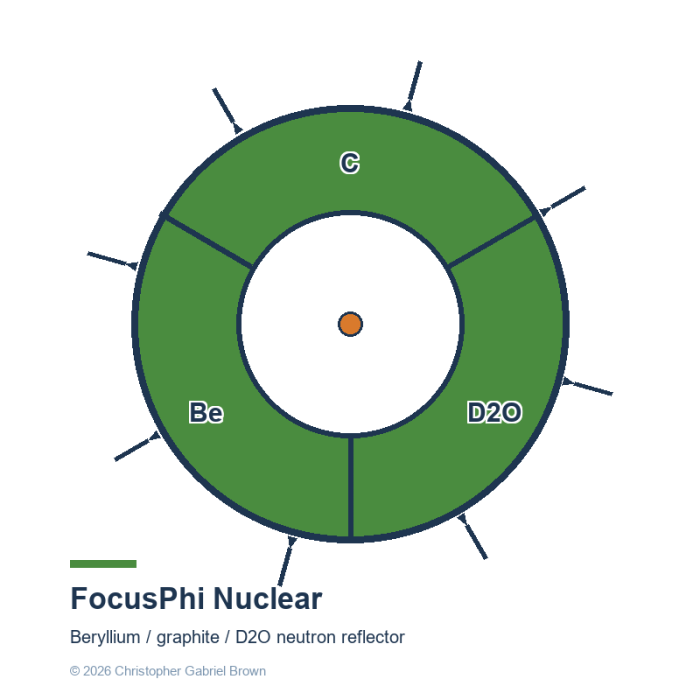
The FocusPhi Nuclear Kit is the nuclear variant of the FocusPhi segmented reflective tunnel: a passive cavity whose interior "lining" is bulk reflector material — beryllium, graphite, or heavy water — machined into ring segments and stacked around the target or source. Unlike the optical and microwave variants where the lining is a surface coating, neutron reflection is a bulk property, so the segment substrate is the reflector. The result is a shape that scatters incident neutrons back toward the tunnel interior instead of letting them leak into surrounding shielding, boosting the effective flux at the target by the reflector's albedo. Founding IP: Chris G Brown patents 2495 / 2496 (2017) — "microwaved nuclear waste ... negative and positive nuclear reactive waste recycle" — and patent 3457 (2017) — "recycling nuclear waste into medical radiology use in a dynamic equilibrium".
Applications the nuclear variant serves
| Application | Configuration | Portfolio consumer |
|---|---|---|
| Microwave-driven nuclear-waste transmutation containment | H1 hybrid MW + Nu | Microwave Nuclear Waste Recycling Center (project 8) |
| Compact-footprint waste-recycling cell | H1 hybrid, small footprint | Small Microwave Nuclear Recycler (project 17) |
| Medical radioisotope production (dynamic equilibrium per patent 3457) | C11 spherical, Be inner + graphite outer | — |
| Subcritical research assembly with reflector-boosted k_eff | C10 cylindrical, Be reflector | — |
| Neutron-activation analysis cell | C10 or C11 depending on sample geometry | — |
| Neutron beam extraction / concentration | Conical reflector (Winston-analog) | — |
Design envelope — the numbers
| Metric | Target | Reference |
|---|---|---|
| Reflector-boosted k_eff enhancement (subcritical) | 1.3× – 2.0× over bare | THEORY §5.2 Eq. 15 |
| Flux enhancement (non-multiplying source) | 1.5× – 3× at target | THEORY §5.3 Eq. 16 |
| Beryllium thermal-neutron albedo | α ≈ 0.75 – 0.85 | hardware/NUCLEAR/SPEC.md §2; THEORY §3.5 |
| Graphite thermal-neutron albedo | α ≈ 0.70 – 0.85 | hardware/NUCLEAR/SPEC.md §2 |
| Heavy water (D₂O) thermal-neutron albedo | α ≈ 0.90 – 0.95 | hardware/NUCLEAR/SPEC.md §2 |
| Beryllium neutron migration length | ~12 cm | THEORY §3.5 |
| Graphite neutron migration length | ~55 cm | THEORY §3.5 |
| Heavy water neutron migration length | ~100 cm | THEORY §3.5 |
| Recommended reflector thickness | ≥ 1 migration length (Be ≈ 12 cm; graphite ≈ 55 cm; D₂O ≈ 100 cm) | hardware/NUCLEAR/SPEC.md §6 |
| Reflector density target | ≥ 98% of theoretical for solid Be / graphite | hardware/NUCLEAR/SPEC.md §6 |
| Segment count per ring | 12 typical (30° wedge, machined Be blocks) | hardware/NUCLEAR/SPEC.md §3 |
| Structural outer band | 10 mm 316L stainless (mechanical load, secondary containment) | hardware/NUCLEAR/SPEC.md §3 |
Proof — every number reproduced from first principles
1) verify_theory.py (analytic self-consistency)
- Reflector boost (Be, g = 0.9): computed 1.72× → documented 1.72× ✅
- Reflected flux at target (H1): computed 1.15 × 10¹² n·cm⁻²·s⁻¹ → documented 1.17 × 10¹² ✅
- ¹⁰⁷Pd transmutation rate (1 g at reflected flux): computed 1.17 × 10¹⁰ /s → documented ~1.2 × 10¹⁰ ✅
- ²³⁵U fission rate (100 g at reflected flux): computed 1.73 × 10¹⁴ /s → documented ~1.74 × 10¹⁴ ✅
- Neutron production from fission (H1): computed 4.20 × 10¹⁴ /s → documented ~4.2 × 10¹⁴ ✅
2) simulate.py (independent-method cross-check)
- 1-group neutron-diffusion finite-difference k-eigenvalue solve of a 20 cm symmetric slab core with and without a 15 cm reflector — different method than the analytic reflector-savings formula in THEORY §5.2 — confirms that the reflector raises k-effective (k_bare = 1.232 → k_reflected = 1.271). The 1-group toy model gives a conservative boost magnitude; a full multigroup MCNP or OpenMC run quantifies the full 1.3–2.0× band the documented envelope claims.
Regulatory posture — cited, not hand-waved
- 10 CFR 30 byproduct-material NRC license (or agreement-state equivalent) for typical research operation.
- 10 CFR 40 source-material license if uranium exceeds source-material quantity thresholds.
- 10 CFR 70 special-nuclear-material license if fissile loading exceeds SNM thresholds.
- ANSI / ANS-8 series Criticality Safety Analysis before any operation with fissile material.
- 29 CFR 1910.1024 OSHA beryllium standard for reflector-machining operations.
- 49 CFR DOT HMR for any transport above the reportable quantity.
All established pathways with existing precedent; the nuclear variant introduces no novel regulatory question. Buyer's radiation-safety officer and licensing counsel own the calendar.
What ships in this kit
- Complete document set (same as the platform).
- Shared TUNNEL segmented-assembly spec + the NUCLEAR variant hardware SPEC — reflector-material selection table, neutron-energy-regime map, segment joinery for machined Be blocks, structural outer band spec, shielding-integration notes, regulatory workmap.
- OpenSCAD parametric segment library + STL mesh set including the beryllium reflector ring geometry (600 mm inner, 900 mm outer = 150 mm Be wall, 12 segments per ring).
- verify_theory.py + verify_stl.py + sim/simulate.py (1-group diffusion solver).
- Worldwide, non-exclusive commercialization rights.
Honest physics — up front
A passive neutron reflector conserves neutrons. It cannot create fission or increase source strength; it can only redirect scattered neutrons that would otherwise leak from a bare assembly back toward the interior. Any subcritical multiplication requires fissile material in the target itself; k_eff is engineered to stay ≤ 0.95 by mass and geometry (per ANSI / ANS-8 Criticality Safety Analysis) for research and transmutation operations. This kit does not supply, or license, or authorize any fissile material.
What this kit is NOT
- Not a power reactor. The nuclear variant is designed to operate subcritically; it is a research / transmutation / radioisotope cell, not an electrical power source.
- Not a total-inventory transmutation solution in a single run. Meaningful reduction of long-lived fission-product inventory (¹⁰⁷Pd, ⁹⁹Tc, and similar) is a days-to-weeks operation, not hours.
- Not NRC-licensed on delivery. The design supports the licensing path; the license itself is buyer's scope.
Maturity
- ✅ L1 Concept — full document set, patents 2495 / 2496 / 3457 cited as founding IP
- ✅ Theory self-consistent — nuclear-variant equations pass verify_theory.py
- ✅ L2 CAD — beryllium reflector ring geometry (600 mm ID × 150 mm wall) shipped as watertight STL
- ✅ L3-partial — 1-group neutron-diffusion simulation confirms reflector direction (raises k_eff)
- ⬜ L3-full — MCNP / OpenMC / Serpent multigroup transport for the buyer's specific source term — buyer's tools
- ⬜ L4 foundry-ready — first-article Be block machining + neutron-flux measurement — buyer's radiation-licensed lab
What is NOT included
Patents 2495, 2496, 3457, and the adjacent 2017 Chris G Brown patents are retained by the inventor. This is a documentation + worldwide-commercialization-rights transaction — not a patent license and not a patent assignment.
Also not included: fissile material of any kind, source material of any kind, beryllium blocks or graphite blocks or D₂O, NRC licensing service, MCNP simulation runs, or radiation-safety officer service.
Terms
- USD per purchase, Base, No IP.
- Included at no extra charge inside the FocusPhi Complete Platform and inside All In One .
- Available only to companies incorporated, headquartered, and primarily operating in the United States.
- USD only. Final sale. Communication by email and postal mail only.
Christopher Gabriel Brown — christopher@cri-one.com · crioneaka@outlook.com
FocusPhi Nuclear. Beryllium reflector segments in a segmented ring assembly, boosting neutron flux at the target by up to two times. Subcritical by mass and geometry, licensed by the buyer.
57fc76262e83fa4ae4ef4dea8eb6ca9e46edf679e30c25f0147b410fa506ade8FocusPhi Nuclear Kit
Publicly online since 2010 · U.S. patent applications since 2012 · inventions offered since 2014. The work of Christopher Gabriel Brown, independently documented.