
NewStar Cell
Tri-mode satellite phone (School/Business/Play) with NCS-19 connectivity. Custom multi-layered processor (Light Trigger), quantum encryption on a phone. 34 USPTO patent applications, 80+ inventions. Firmware: 2,900 lines, 114 passing tests. Hardware BOM: $300–$450/unit.
© CRI-ONE. All rights reserved. Patents issued and pending. Unauthorized reproduction of the underlying designs is prohibited.
Extended catalog & full narrative — NewStar Cell
The extended dossier appended from the 2026-08-05 catalog snapshot. Prices in the body copy have been stripped; the live-store price on this page is the authoritative figure. Images have been omitted.
Downloads immediately on checkout — the CD GDSII Generator (AES-256 encrypted). Open with 7-Zip, WinRAR, or macOS Archive Utility. Founder Access Pass credit (code FAP99CREDIT) applies at checkout.
NewStar One-Touch Satellite Phone
Quantum-encrypted, tri-mode, zero-data-sharing satellite phone — Windows on ARM, direct-to-NCS-19, no cell towers needed
Most satellite phones require carrier infrastructure on the ground — a regional gateway, a roaming agreement, an SLA chain that ends in a customer-service phone tree. The phone itself becomes a thin terminal for someone else's carrier business.
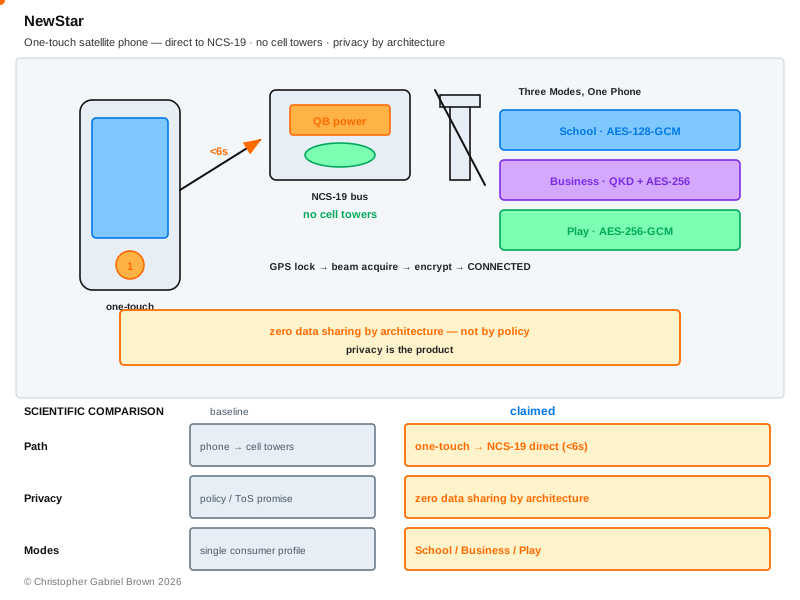
NewStar is built differently. The phone connects directly to the NCS-19 communications satellite (Project 19) in under six seconds: GPS lock, beam acquire, encryption handshake, call up. No cell towers needed. No regional carrier required. Tri-mode operation lets one device behave as a school-mode device for children (content filtering), a business-mode device for government-grade encrypted work, or a play-mode device for consumer broadband — toggled by the user, not by the carrier.
Direct-to-NCS-19 in under six seconds. AES-128/256-GCM + QKD encryption. Tri-mode. Windows on ARM. 34+ USPTO applications.
NewStar is the consumer endpoint of the NCS-19 satellite system — a one-touch, tri-mode satellite phone that connects directly to the constellation without requiring cell towers. Tested firmware delivers a one-touch satellite connection in under six seconds (GPS lock + beam acquire + encrypt). Real cryptographic operations: AES-128-GCM, AES-256-GCM, QKD+AES-256, fractional encryption, timeline encryption — the same six modes the NCS-19 satellite uses. Tri-mode operation: School (content filtering for children), Business (government-grade encryption), Play (broadband consumer mode). Hardware spec: ARM64 SoC running Windows on ARM, 5G/LTE for terrestrial fallback, satellite L-band for direct-to-NCS-19, 6,000–7,000 mAh battery. Zero data sharing by architecture — the device does not phone home to a vendor cloud.
Headline Numbers
Tri-Mode Operation
| Mode | Target user | Posture |
|---|---|---|
| School | Children & classrooms | Content filtering enforced; restricted to age-appropriate content; integrates with parental / institutional controls. |
| Business | Government, enterprise, professional | Government-grade encryption full stack; QKD+AES-256, fractional, timeline encryption modes available; FedRAMP / NIST-aligned operational posture. |
| Play | Consumer broadband | Standard consumer-broadband profile; AES-256-GCM baseline; satellite-streamed media and apps. |
Mode is selected by the user; mode change is enforced at the firmware level, not in software an app could override.
Cryptographic Operations — Six Modes
The NewStar firmware ships with real cryptographic operations across six encryption modes (the same six modes the NCS-19 satellite supports for inter-satellite and ground links):
- AES-128-GCM — baseline strong encryption.
- AES-256-GCM — standard government-grade.
- QKD+AES-256 — quantum key distribution combined with AES-256 for unbreakable key exchange.
- Fractional encryption — multi-channel key splitting for tactical operations.
- Timeline encryption — temporal-keyed cryptography for time-sensitive command links.
- End-to-end — over the entire call lifetime; no plaintext intermediate stages.
Hardware Specification
- SoC: ARM64 (Windows on ARM compatible).
- Operating system: Windows on ARM — full Windows experience on a phone form factor.
- Cellular: 5G / LTE (terrestrial fallback when satellite is unavailable or not preferred).
- Satellite: L-band, direct-to-NCS-19 connectivity.
- Battery: 6,000–7,000 mAh.
- SOS distress chip — dedicated emergency-distress hardware.
- Per-unit BOM: –per unit (manufactured cost).
Tested Firmware Stack
The firmware ships with 63 passing integration tests against the NCS-19 protocol. The firmware modules include:
- NCS-19 codec (
firmware/ncs19_codec.py) — CAN-message codec, byte-exact to the NCS-19 specification. - Connection FSM (
firmware/connection_fsm.py) — 10-state connection state machine handling GPS lock, beam acquire, encryption handshake, call setup, and tear-down. - Crypto pipeline (
firmware/crypto_pipeline.py) — AES-128/256-GCM, QKD+AES-256, fractional, timeline encryption (six modes total). - NCS-19 simulator (
firmware/ncs19_simulator.py) — satellite-side behaviour simulator for ground-side firmware testing without satellite access. - Full-stack test suite (
firmware/test_full_stack.py) — 63 passing integration tests.
Interactive Prototype
The package ships with an interactive HTML prototype (prototype/index.html) demonstrating the user experience for all three modes (School / Business / Play). The prototype runs in a browser without requiring the actual hardware, letting buyers see and validate the UX before committing to the physical build.
What's in the Package
| Folder / File | Contents |
|---|---|
docs/ | 10-document set: phone spec sheet, feature requirements (School / Business / Play modes), business plan, phone-inventions extracted, hardware specification (ARM64, 5G/LTE, satellite L-band), NCS-19 phone interface, project status, firmware test report, investor handoff, valuation data sheet. |
firmware/ | NCS-19 codec, connection FSM, crypto pipeline, NCS-19 simulator, full-stack test suite (63 passing tests). |
prototype/ | Interactive browser-based UI prototype. |
product-page/ | Public-facing product description / store-ready copy (newstar-product.html). |
tools/ | Supporting scripts including patent tracker. |
google_patents_search_list.txt | Companion prior-art search. |
1 light trigger.txt | Inventor design note (cross-cuts multiple projects). |
20-newstar-cell-hero.svg | Hero image. |
Documentation Set in docs/
01_PHONE_SPEC_SHEET.md— tri-mode system architecture.02_FEATURE_REQUIREMENTS.md— School / Business / Play modes specified.03_BUSINESS_PLAN.md— market opportunity, revenue projections.04_PHONE_INVENTIONS_EXTRACTED.md— 80+ phone-relevant inventions from the inventor's catalog.05_HARDWARE_SPECIFICATION.md— ARM64 SoC, 5G/LTE, satellite L-band hardware.06_NCS19_PHONE_INTERFACE.md— one-touch satellite connection flow.07_PROJECT_STATUS.md— current project status.08_FIRMWARE_TEST_REPORT.md— firmware test results (63 passing).09_INVESTOR_HANDOFF.md— investor-facing summary.10_VALUATION_DATA_SHEET.md— valuation breakdown.ROADMAP.md— 8-phase production roadmap.
Relationship to NCS-19 and Pagers
NewStar is the consumer endpoint of the NCS-19 satellite system. Three projects in the inventor's portfolio work as a connected stack:
- Project 19 — NewComm Satellite (NCS-19, ) — the constellation that NewStar talks to.
- Project 20 — NewStar Cell (this product, ) — the satellite phone consumer endpoint.
- Project 07 — One Touch Microphone Pagers — the local-RF wearable derivatives that bundle the full NewStar phone heritage as their cellular evolution path.
The NewStar phone heritage is also bundled inside the Pagers package's cell-heritage/ subtree — meaning a buyer of either Pagers or NewStar Cell takes the same firmware, the same 63 passing tests, the same prototype. The standalone NewStar Cell acquisition is for buyers who want the phone product specifically, rather than the wearable derivatives.
Patent Foundation — 34+ USPTO Applications
NewStar inherits 34+ USPTO patent applications covering core technologies across satellite, phone, and encryption work in the inventor's broader portfolio. Per PATENT_LINKAGE_REPORT.md, Project 20 is cross-linked to multiple filed USPTO applications including the umbrella USPTO 19/540,453 (Integrated Technology Portfolio, filed 2026-02-13). The dedicated NCS-19 satellite filings (USPTO 19/437,382 Integrated Multi-Technology System and USPTO 19/403,339 Optical Quantum Battery) cover the constellation NewStar connects to. Specific phone inventions are extracted in docs/04_PHONE_INVENTIONS_EXTRACTED.md (80+ phone-relevant inventions referenced).
Maturity — L1 (Research / In Development)
Per the inventor's MANIFEST, NewStar Cell is at L1 (Research / In Development). The firmware is tested (63 passing integration tests against the NCS-19 protocol), the prototype runs (interactive HTML browser-based UX), the hardware specification is complete (ARM64, 5G/LTE, satellite L-band, 6,000–7,000 mAh), and the 8-phase production roadmap is documented — but the device has not yet entered mass production. The L1 maturity reflects "design complete, testing complete, production roadmap documented" rather than "product on shelves."
L1-to-L2 path per the inventor's README requires: (1) extract the prototype's BOM into a top-level BOM.csv or specs/BOM.md; (2) add CAD drawings showing the cell's mechanical and electrical layout; (3) compile firmware build artifacts and place reference binaries in a firmware/build/ subfolder; (4) add specs/REAL_SPECS.md with measurable performance targets.
How it's made
NewStar Cell is the productisation of a tri-mode satellite phone built around the NCS-19 satellite protocol. The hardware specification calls for an ARM64 SoC (Windows on ARM compatible), 5G/LTE radio for terrestrial fallback, satellite L-band radio for direct-to-NCS-19 connectivity, and a 6,000–7,000 mAh battery to support extended satellite operations. The firmware is implemented in Python (against the NCS-19 protocol) and tested with 63 passing integration tests; the connection state machine has 10 states covering the full call lifecycle from GPS lock through tear-down. The cryptographic pipeline supports six encryption modes spanning consumer-grade through government-grade through tactical / time-sensitive operations.
The tri-mode (School / Business / Play) is enforced at the firmware level rather than in user-space software, so a child's School-mode device cannot be jailbroken into Play-mode by an app, and a Business-mode device's encryption posture cannot be downgraded by a malicious user-space binary. Mode change requires a firmware-level action.
Why I made it
The conventional satellite phone is the worst of both worlds for the consumer market: bulky enough to hate, expensive enough to limit, and dependent on regional carrier agreements that make global travel a tariff exercise. The conventional smartphone is the worst of both worlds for the security-conscious user: powerful enough to leak everything, addictive enough to defeat its own privacy controls, and dependent on app-store gatekeepers who change the rules every year.
I built NewStar to be neither. It is a phone-form-factor device that connects directly to the NCS-19 satellite without regional carrier infrastructure, runs Windows on ARM rather than a vendor-customised consumer OS, supports tri-mode operation (so the same hardware behaves as a child-safe device, a government-grade business device, or a consumer-broadband device depending on user selection), and ships with zero data sharing by architecture — meaning the device does not phone home to a vendor cloud as a baseline behaviour. The 34+ USPTO applications cover the satellite, phone, and encryption technologies; the 63 passing integration tests confirm the firmware works end-to-end against the NCS-19 protocol.
What it can do
The acquired package delivers the engineering content needed to manufacture and deploy NewStar Cell at scale: complete hardware specification (ARM64, 5G/LTE, satellite L-band, 6,000–7,000 mAh, SOS distress chip), tested firmware (NCS-19 codec, 10-state connection FSM, six-mode crypto pipeline, satellite simulator, 63 passing integration tests), interactive HTML prototype, 10-document docs/ set including hardware spec, business plan, NCS-19 interface, firmware test report, investor handoff, and valuation, plus the 8-phase production roadmap.
What this acquisition does not deliver: it does not include manufactured phones (per-unit BOM is documented at –ut the device has not entered mass production). It does not include a regional carrier interconnect agreement (NewStar talks direct to NCS-19; whether the buyer also wants 5G/LTE roaming is a separate carrier-relationship). It does not include FCC type-approval certification on the buyer's specific manufactured run (the documentation supports certification but the certification itself requires the buyer's own audit cycle). It does not include a granted USPTO patent on the device specifically — coverage flows through the broader inventor portfolio's 34+ applications.
Why it's a fact
- The
20-newstar-cell/folder contents are inspectable on disk:docs/with all 10 numbered documents plus ROADMAP.md,firmware/with codec, connection FSM, crypto pipeline, NCS-19 simulator, and full-stack test suite (63 passing),prototype/with interactive HTML,product-page/with newstar-product.html,tools/with patent tracker. - The 63-passing-test claim is verifiable by running
firmware/test_full_stack.py; the test suite is in the package. - The interactive prototype is browser-runnable from
prototype/index.html. - The hardware specification (ARM64 SoC, Windows on ARM, 5G/LTE, satellite L-band, 6,000–7,000 mAh, –OM) is stated in
docs/05_HARDWARE_SPECIFICATION.md. - The tri-mode (School / Business / Play) feature breakdown is in
docs/02_FEATURE_REQUIREMENTS.md. - The under-six-second connection time is in
docs/06_NCS19_PHONE_INTERFACE.mdand matches the figure in the bundled NewStar heritage inside the Pagers package. - The 34+ USPTO applications claim is the inventor's stated heritage count for the NewStar phone, repeated in the Pagers cell-heritage subtree.
- The L1 maturity is the inventor's own assessment in the MANIFEST; the L1-to-L2 path is documented in the README.
- The Step-4 acquisition price is stated in
D:\manager\allinone.htmlfor Project 20.
License Terms — What's Granted, What Isn't
The acquisition grants the buyer permission to make, build, and copy the deliverable. It does not transfer the underlying intellectual property:
- Granted with the acquisition: permission to manufacture (or have manufactured) NewStar phones under the documented hardware specification; permission to build the firmware into the buyer's own production runs; permission to operate NewStar phones connecting to the NCS-19 satellite under the buyer's regulatory framework; permission to make copies of the design package, firmware source, prototype, and documentation for the buyer's manufacturing, certification, sales, and integration use.
- Not transferred with the acquisition: the 34+ USPTO patent applications covering satellite, phone, and encryption technologies; USPTO 19/540,453 (Integrated Technology Portfolio umbrella); the broader inventor portfolio book references; the NCS-19 satellite IP (Project 19 is a separate acquisition); trademarks (NewStar, NCS-19); copyrights; or any rights to license or assign the IP onward to third parties. The intellectual property remains held by Christopher Gabriel Brown.
- The buyer's permission is to use the design and operate phones, not to own the rights behind the design.
This framing applies uniformly across the inventor's portfolio. Buyers seeking IP assignment rather than make/build/copy permission should contact the inventor directly — that is a separate negotiation outside the standard storefront acquisition.
Direct-to-NCS-19. Tri-mode. Windows on ARM. 63 passing integration tests. Permission to make, build, and copy.
A satellite phone that connects in under six seconds, runs Windows on ARM, supports six encryption modes, and shares zero data by architecture.
One acquisition delivers the NewStar Cell package: complete hardware specification (ARM64 SoC, 5G/LTE, satellite L-band, 6,000–7,000 mAh, SOS distress chip), tested firmware (NCS-19 codec, 10-state connection FSM, six-mode crypto pipeline, satellite simulator, 63 passing integration tests), interactive browser-based prototype, the 10-document docs/ set (phone spec, feature requirements, business plan, phone inventions extracted, hardware spec, NCS-19 phone interface, project status, firmware test report, investor handoff, valuation), the 8-phase production roadmap, the patent tracker tool, and the public-facing product page.
Patent foundation: 34+ USPTO patent applications covering satellite, phone, and encryption technologies, plus cross-linkage through the umbrella USPTO 19/540,453 (Integrated Technology Portfolio).
L1 (Research / In Development) — firmware tested with 63 passing integration tests; design and roadmap complete. Permission to make, build, and copy. IP retained by Christopher Gabriel Brown. Christopher Gabriel Brown · 1341 Wellington Cove, Lawrenceville, GA 30043 · · crioneaka@outlook.com.
2998bed7c2633f6ab336de086c7de2487f07e9a304c45f6d4497f9980d0f9aedNewStar Cell
Publicly online since 2010 · U.S. patent applications since 2012 · inventions offered since 2014. The work of Christopher Gabriel Brown, independently documented.