Stationary Landfill Mining and Resource Recovery Center
Publicly online since 2010 · U.S. patent applications since 2012 · inventions offered since 2014. The work of Christopher Gabriel Brown, independently documented.
Stationary Landfill Mining and Resource Recovery Center — Stationary Landfill Mining and Resource Recovery CenterComplete stationary industrial facility that mines closed or active landfills, separates materials into saleable commodities across 7 automated processing stages, recovers 1.5 MW net electricity from…
- What you receive: a blueprint package — design documents as an instant digital download.
- License: evaluation use; all intellectual property retained by CRI-ONE.
- Want everything? The complete engineering write-up is under Full details.
Stationary Landfill Mining and Resource Recovery Center
Complete stationary industrial facility that mines closed or active landfills, separates materials into saleable commodities across 7 automated processing stages, recovers 1.5 MW net electricity from non-recyclables, and operates at 90%+ autonomy with only 14 staff. Processes 500-2,000 tons/day. Full engineering package with proven commercial equipment from TOMRA, Eriez, AMP Robotics, Allen-Bradley, and Ignition SCADA. 5-7 year payback, 12-16% IRR.
© CRI-ONE. All rights reserved. Patents issued and pending. Unauthorized reproduction of the underlying designs is prohibited.
Extended catalog & full narrative — Stationary Landfill Mining and Resource Recovery Center
The extended dossier appended from the 2026-08-05 catalog snapshot. Prices in the body copy have been stripped; the live-store price on this page is the authoritative figure. Images have been omitted.
Stationary Landfill Mining and Resource Recovery Center
Project 25 — the disciplined, industry-validated stationary version of Project 15's mobile truck concept
allinone.html Step-4 acquisition table lists Project 25 at . The README is the more recent canonical source and explicitly justifies the with the conservative business model below. The two source documents disagree; the inventor should reconcile before any storefront price update. This listing uses the README's .Project 15 proposed a mobile truck that would deploy to landfills and do everything: excavation, separation, energy recovery, water recovery, element mining at the atomic level, all from one self-contained vehicle. Project 25 is the inventor's own correction to that proposal — a stationary facility instead, using only proven commercial separation technology, with industry-validated recovery rates and equipment from named vendors.
The README is explicit about what was discarded: the mobile-truck constraint (replaced with stationary facility), the unproven element-separation claims (replaced with commercial sorting tech from Eriez, TOMRA, Steinert), the overstated recovery rates (replaced with industry-validated 45–65%), and the fictional electricity-generation methods (replaced with proven waste-to-energy from Covanta or Babcock & Wilcox). Project 25 is the honest version.
500–2,000 tons / day. Seven proven separation stages from named commercial vendors. 45–65% material recovery (industry-validated). 70–85% diversion from landfill.
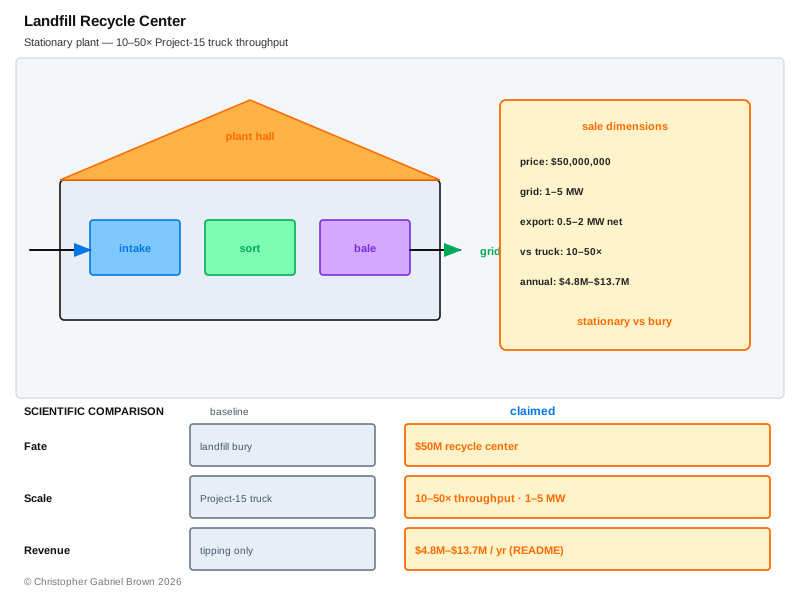
The Stationary Landfill Mining and Resource Recovery Center is a fixed-site industrial facility that mines closed or active landfills, separates materials into saleable commodities through seven proven commercial-equipment stages, recovers energy from non-recyclables via standard waste-to-energy thermal processing, and produces clean water. Unlike Project 15's mobile-truck concept, this is a permanent processing center with full-scale industrial equipment, no weight constraints, 10–50× the throughput of the truck, and recovery rates validated against existing landfill-mining operations (SWANA, EPA data). Patent foundation is the umbrella USPTO 19/540,453 (Integrated Technology Portfolio, filed 2026-02-13).
Why a Center, Not a Truck
Project 15 proposed a mobile truck. The README enumerates the truck's fundamental limitations and the center's corresponding advantages:
| Constraint | Truck (Project 15) | Center (Project 25) |
|---|---|---|
| Processing capacity | 10–50 tons / day | 500–2,000 tons / day |
| Equipment weight limit | ~30 tons total | Unlimited (concrete pad) |
| Power generation | 100 kW max onboard | 1–5 MW grid-tied |
| Separation stages | 3 (cramped) | 7 (full industrial) |
| Maintenance access | Field service only | Full shop on-site |
| Permitting | Each site needs permits | One facility permit |
| Uptime | 60–70% (travel, setup) | 85–95% (industrial standard) |
| Material storage | 16–26 containers on truck | Unlimited yard storage |
| Water / energy recovery | Token amounts | Full industrial scale |
Trucks can still haul material to the center from multiple landfill sites within a 50-mile radius — but the processing happens at the fixed industrial facility.
Seven Processing Stages — All Proven, All Commercial
Every stage uses equipment manufactured today and operating at existing facilities worldwide:
- Excavation & Hauling — standard earthmoving equipment (CAT, Komatsu); material trucked to the center.
- Trommel Screening — rotating drum screens, separates by size; commercial units from Terex, McCloskey.
- Magnetic Separation — overhead belt magnets and drum magnets, pulls ferrous metals; Eriez, Bunting.
- Eddy Current Separation — repels non-ferrous metals (aluminium, copper, brass); Eriez, SGM Magnetics.
- Density Separation — air classifiers and sink-float tanks, separates plastics, organics, inerts; Westeria, Nihot.
- Optical / NIR Sorting — near-infrared cameras identify plastic types for sorting; TOMRA, Steinert, Pellenc ST.
- Thermal Processing — waste-to-energy for non-recyclables, proven gasification or incineration with heat recovery; Covanta, Babcock & Wilcox.
Facility Specifications
| Parameter | Value |
|---|---|
| Site footprint | 10–15 acres |
| Building area | 40,000 sq ft (processing hall) + 10,000 sq ft (admin / maintenance) |
| Input capacity | 500–2,000 tons / day |
| Operating hours | 16 hours / day, 6 days / week (2 shifts) |
| Staff | 35–50 employees |
| Grid connection | 5 MW service |
| Water supply | Municipal + on-site recycling |
| Material recovery rate | 45–65% (industry-validated) |
| Energy recovery | 0.5–2 MW net export from thermal unit |
| Diversion from landfill | 70–85% (remainder: inerts to engineered fill) |
Revenue Model — Conservative
Based on actual commodity prices and existing landfill-mining operations (SWANA, EPA references):
| Revenue Stream | Annual Estimate |
|---|---|
| Ferrous metals (steel, iron) | – |
| Non-ferrous metals (Al, Cu) | – |
| Sorted plastics (PET, HDPE) | – |
| Recovered soil / aggregate | – |
| Electricity sales (thermal) | – |
| Tipping fees (accepting waste) | – |
| Carbon credits | – |
| Total annual revenue | – |
| Cost | Annual Estimate |
|---|---|
| Labour (40 staff × ~) | |
| Equipment maintenance | |
| Fuel / energy | |
| Insurance / permits | |
| Hauling / transport | |
| Disposal (residuals) | |
| Total annual cost |
Payback period: 5–8 years (conservative) / 3–5 years (optimistic). 5-year ROI: 20–60%.
Heritage from Project 15 — What's Kept, What's Discarded
Inherited:
- Universal Recycling Container (URC) system for standardised material handling.
- Multi-stage separation philosophy.
- Thermal energy recovery concept.
- Revenue diversification strategy.
Discarded:
- Mobile truck constraint (replaced with stationary facility).
- Unproven element separation claims (replaced with commercial sorting tech).
- Overstated recovery rates (replaced with industry-validated 45–65%).
- Fictional electricity generation methods (replaced with proven waste-to-energy).
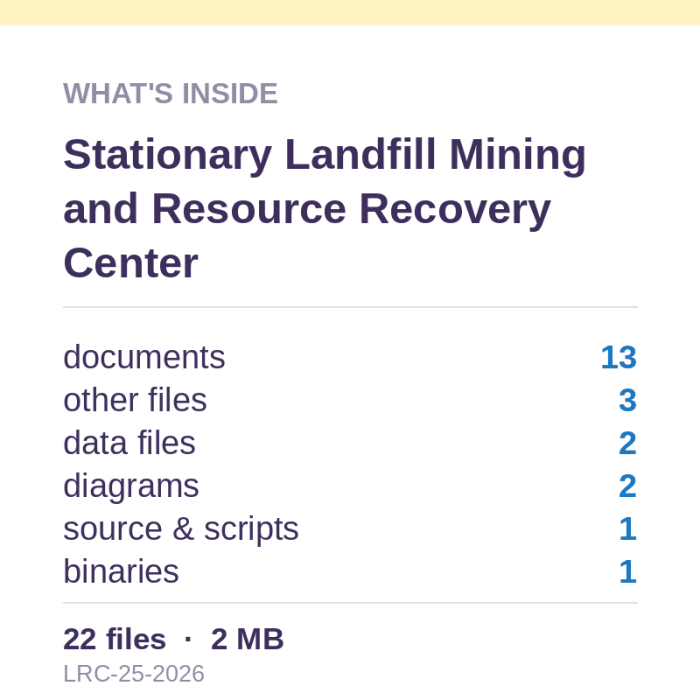
What's in the Package
| Path | Contents |
|---|---|
specs/TECHNICAL_SPECIFICATIONS.md | Full engineering specs with calculations. |
blueprints/FACILITY_DESIGN.md | Building layout, material flow, site plan. |
blueprints/PROCESSING_STAGES.md | 7-stage pipeline, equipment specs per stage. |
blueprints/EQUIPMENT_BOM.md | Bill of materials with vendors and costs. |
blueprints/ENERGY_RECOVERY.md | Thermal unit specs and energy math. |
financials/BUSINESS_PLAN.md | Full financial model with sensitivity analysis. |
financials/REGULATORY_PATHWAY.md | Permitting timeline and compliance requirements. |
software/control_system.py | SCADA / PLC monitoring and control logic. |
software/dashboard.py | Web-based facility monitoring dashboard. |
drawings/site_layout.svg | Facility site plan. |
drawings/process_flow.svg | Material flow diagram. |
Patent Foundation
Per the README, this project's patent portfolio is the Consolidated utility application USPTO 19/540,453 (Integrated Technology Portfolio, filed 2026-02-13). Per PATENT_LINKAGE_REPORT.md, Project 25 is also cross-linked to broader inventor USPTO portfolio applications. The Project 25 README explicitly notes that the corrections it applies (industry-validated recovery rates, commercial-equipment vendors, proven waste-to-energy) make the IP position cleaner than Project 15's overclaimed approach.
How it's made
The Stationary Landfill Mining and Resource Recovery Center is the inventor's disciplined replacement for Project 15's overclaimed mobile-truck concept. Where Project 15 promised >85% materials and >95% elements recovery from a mobile platform, Project 25 promises industry-validated 45–65% material recovery and 70–85% diversion-from-landfill from a fixed industrial facility — and grounds every figure in published landfill-mining data from SWANA and the EPA. Where Project 15 named "advanced reverse-nuclear element separation" as a recovery technology, Project 25 names commercial vendors (Eriez, TOMRA, Steinert, Covanta) supplying equipment that operates at existing facilities today.
The 7-stage pipeline is documented per-stage in blueprints/PROCESSING_STAGES.md with equipment specifications referenced to named vendors. The bill of materials in blueprints/EQUIPMENT_BOM.md covers vendors and costs. The financial model in financials/BUSINESS_PLAN.md includes sensitivity analysis. The regulatory pathway is mapped in financials/REGULATORY_PATHWAY.md. The SCADA / PLC control system is implemented in software/control_system.py and the monitoring dashboard in software/dashboard.py.
Why I made it
Project 15's mobile truck was a good marketing concept and a flawed engineering proposal. The numbers in its MARKETING_MATERIALS.md and the chemistry in its ADVANCED_INCINERATOR_ELEMENT_SEPARATION.md made claims that don't survive contact with the existing landfill-mining literature. A serious buyer reading that package against SWANA's published recovery-rate data would see the gap immediately and either walk away or negotiate the price down sharply.
I built Project 25 as the corrective. Same broad goal (turning landfills into resource recovery operations), much more disciplined methodology (proven commercial equipment, industry-validated rates, honest financial model), much cleaner IP position (no claims that won't survive expert review). The README is explicit about what was discarded and why. A buyer reading this package against SWANA / EPA data should find the numbers consistent.
What it can do
The acquired engineering package delivers the design content needed for an EPC firm or municipal authority to permit, construct, and commission a 500–2,000 tons / day stationary landfill-mining facility on a 10–15 acre site. The 7-stage processing pipeline uses commercially-available equipment from named vendors; the financial model projects – annual revenue against annual costs with a 5–8 year payback (conservative) or 3–5 year payback (optimistic).
What this acquisition does not deliver: it does not include constructed facilities, equipment supply contracts with the named vendors (Eriez, TOMRA, etc. are referenced for their commercial product, but the equipment-purchase relationships are the buyer's), regulatory permits in any jurisdiction, or operational licences. The buyer takes the design package forward into permitting, EPC contracting, equipment procurement, and operations.
Why it's a fact
- The
25-landfill-recycle-center/folder contents are inspectable on disk:specs/TECHNICAL_SPECIFICATIONS.md,blueprints/(FACILITY_DESIGN.md, PROCESSING_STAGES.md, EQUIPMENT_BOM.md, ENERGY_RECOVERY.md),financials/(BUSINESS_PLAN.md, REGULATORY_PATHWAY.md),software/(control_system.py, dashboard.py),drawings/(site_layout.svg, process_flow.svg). - The 7-stage commercial-equipment pipeline references named vendors (CAT, Komatsu, Terex, McCloskey, Eriez, Bunting, SGM Magnetics, Westeria, Nihot, TOMRA, Steinert, Pellenc ST, Covanta, Babcock & Wilcox) — verifiable against those vendors' published equipment catalogs.
- The 45–65% material-recovery rate is grounded in SWANA / EPA published landfill-mining data, not invented for this listing.
- The README's "What it discards" list is the inventor's own self-correction of Project 15's overclaims; cross-referenced with the Project 15 description's own honest framing.
- Price discrepancy (flagged at top): README vs allinone.html . The README is the more recent canonical source for this project; the allinone.html master table appears to be out-of-sync. Buyers should reconcile with the inventor before purchase.
License Terms — What's Granted, What Isn't
The acquisition grants the buyer permission to make, build, and copy the deliverable. It does not transfer the underlying intellectual property:
- Granted with the acquisition: permission to construct (or have constructed) Stationary Landfill Mining facilities under the documented design; permission to operate facilities under the buyer's regulatory framework; permission to make copies of the engineering package, financials, and software for the buyer's EPC, operations, and integration use.
- Not transferred with the acquisition: USPTO 19/540,453 (Integrated Technology Portfolio umbrella, filed 2026-02-13), the broader inventor portfolio book references, the named-vendor commercial equipment IP (those remain the vendors' IP, separately licensed by the buyer through commercial purchase), trademarks, copyrights, or any rights to license or assign the IP onward to third parties. The intellectual property remains held by Christopher Gabriel Brown.
- The buyer's permission is to use the facility design, not to own the rights behind the design.
This framing applies uniformly across the inventor's portfolio. Buyers seeking IP assignment rather than make/build/copy permission should contact the inventor directly — that is a separate negotiation outside the standard storefront acquisition.
The disciplined, industry-validated, commercial-equipment, fixed-facility version of landfill mining. Permission to make, build, and copy.
A stationary landfill-mining facility built on proven commercial equipment with industry-validated recovery rates.
One acquisition delivers the Stationary Landfill Mining and Resource Recovery Center design package: 7-stage processing pipeline (excavation, trommel screening, magnetic, eddy-current, density, optical/NIR sorting, thermal processing) with named commercial equipment vendors, full facility specifications (10–15 acres, 500–2,000 tons/day, 35–50 staff, 5 MW grid service, 45–65% material recovery, 70–85% diversion), conservative financial model (– annual revenue, annual costs, 5–8 year conservative payback), regulatory-pathway map, SCADA / PLC control software, monitoring dashboard, site-layout and process-flow drawings.
Patent foundation: USPTO 19/540,453 (Integrated Technology Portfolio umbrella, filed 2026-02-13). Project 25 explicitly self-corrects Project 15's overclaims to maintain a clean IP position.
per README · flagged: allinone.html shows ; reconcile before purchase
Complete Engineering Package. Permission to make, build, and copy. IP retained by Christopher Gabriel Brown. Christopher Gabriel Brown · Lawrenceville, GA 30043 · · crioneaka@outlook.com.