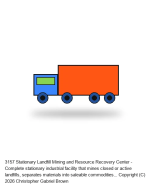
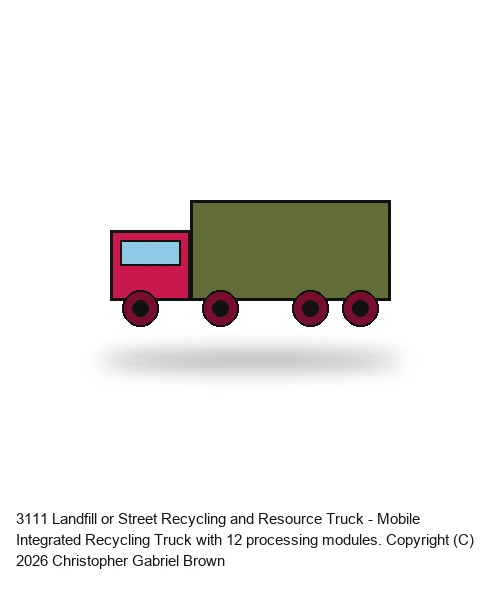
Landfill or Street Recycling and Resource Truck
Mobile Integrated Recycling Truck with 12 processing modules. 7 revenue streams per unit ($912K–$5M/year). Self-powered, autonomous 24/7 operation. 10–30+ MW electricity generation. Manufacturing cost $1.78M–$2.84M per truck. 50+ CGB patents integrated.
© CRI-ONE. All rights reserved. Patents issued and pending. Unauthorized reproduction of the underlying designs is prohibited.
Extended catalog & full narrative — Landfill or Street Recycling and Resource Truck
The extended dossier appended from the 2026-08-05 catalog snapshot. Prices in the body copy have been stripped; the live-store price on this page is the authoritative figure. Images have been omitted.
Downloads immediately on checkout — the CD GDSII Generator (AES-256 encrypted). Open with 7-Zip, WinRAR, or macOS Archive Utility. Founder Access Pass credit (code FAP99CREDIT) applies at checkout.
Landfill or Street Recycling and Resource Truck
Mobile Integrated Recycling Truck — complete landfill resource-recovery system in one self-contained mobile unit
"From Landfill to Resource Mine — One Mobile Unit, Complete Recovery."
The conventional landfill is a liability: a regulated site that costs money every year to manage and eventually shuts down without ever giving anything back. The conventional recycling operation is fragmented: separate vendors for materials, energy, water, carbon, elements, each with their own infrastructure. This truck is neither. It deploys to any landfill, autonomously excavates, separates, and processes the materials through 12 integrated modules — and turns the landfill into a resource mine generating seven separate revenue streams from one unit.
50+ patented technologies in one self-contained mobile unit. Seven revenue streams. 70–90% autonomous. Mobile to any landfill.
The Mobile Integrated Recycling Truck combines 50+ patented technologies into a single self-contained mobile unit that performs complete resource recovery operations at any landfill site. It generates 1–5 MW of electricity, extracts water and carbon, mines elements at atomic levels, and produces market-ready materials — all while improving environmental conditions on the deployed site. Material recovery exceeds 85%; element recovery exceeds 95%. Seven simultaneous revenue streams (material sales, precious metals, rare-earth elements, electricity, water, carbon, gas) from a single mobile platform with 70–90% autonomous operation. Stated payback: 1–6 years; stated ROI: 38%–572% over 5 years.
Headline Numbers
Truck Specifications
| Spec | Value |
|---|---|
| Dimensions | 60–80 ft × 12–14 ft × 14–16 ft |
| Loaded weight | 80–100 tons |
| Processing capacity | 10–50 tons / day |
| Electricity generation | 1–5 MW |
| Water production | 100–500 gal / day |
| Carbon recovery | 1–5 tons / day |
| Material recovery | >85% |
| Element recovery | >95% |
| Water recovery | >90% |
| Air quality improvement | >90% |
| Energy efficiency | >80% |
| Container capacity | 16–26 ISO-compatible containers |
What This Truck Does — Twelve Integrated Modules
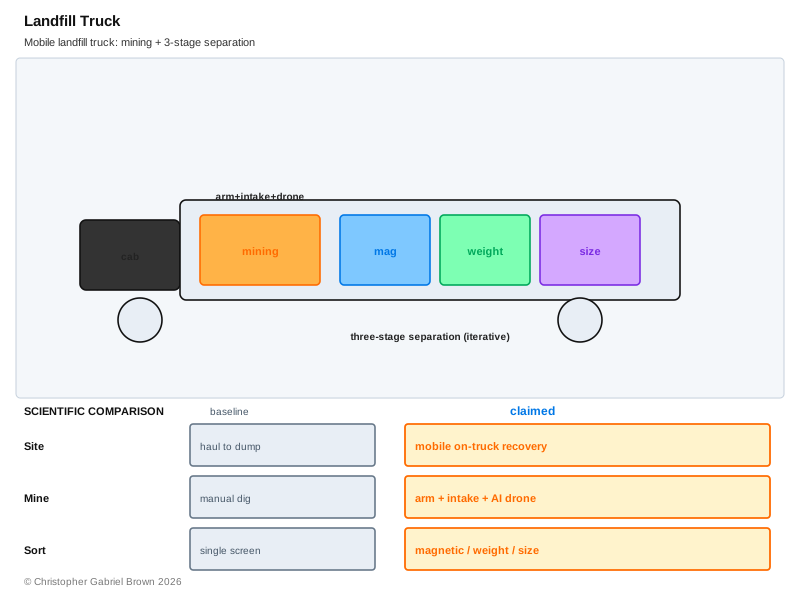
The 12 integrated modules combine functions that conventional recycling operations split across multiple vendors: excavation, material separation (advanced reverse-nuclear element separation at atomic level), distillation and heat recovery for water and carbon, electricity generation and element mining, autonomous landfill bots, advanced incinerator-grade element separation, mobile container handling, and the integrated control architecture. The result is a self-contained recovery operation that does not depend on external power, external feedstock prep, or external materials handling.
Seven Revenue Streams — What the Truck Sells
- Material sales — recovered materials sold into commodity markets.
- Precious metals — gold, silver, platinum-group metals extracted at the atomic level.
- Rare-earth elements — the rare-earth metals that current recycling operations rarely recover.
- Electricity sales — 1–5 MW generated, exported to the grid or to the deployed site's needs.
- Water sales — recovered and treated water (100–500 gal / day) sold or returned to the site.
- Carbon sales — recovered carbon (1–5 tons / day) sold to industrial buyers.
- Gas sales — treated process gas as a salable output.
Stated Economics
| Metric | Range |
|---|---|
| Annual revenue | – |
| Annual costs | – |
| Net margin | 40%–70% |
| Payback period | 1–6 years |
| 5-year ROI | 38%–572% |
| Initial investment | – (per truck deployment) |
| Step-4 IP acquisition | (full design package per allinone.html) |
The IP acquisition price is for the design package that produces trucks. The per-truck deployment-and-operations economics are stated separately as buyer business-case ranges.
Four Buyer Profiles — Value Propositions
Landfill operators. Problem: landfills are liabilities requiring ongoing management and environmental compliance. Solution: transform the landfill into a profitable resource mine with complete resource recovery. Generate revenue from existing landfills; reduce volume and environmental liability; improve site conditions and compliance.
Recycling companies. Problem: traditional recycling requires multiple separate systems with limited recovery rates. Solution: complete mobile recycling system with >85% materials and >95% elements recovery. Mobile deployment to any site; multiple revenue streams; lower operational costs (self-powered, autonomous); higher profitability (40–70% net margin).
Municipalities. Problem: landfills require ongoing management, environmental compliance, and long-term liability. Solution: mobile system that recovers resources, generates revenue, and improves environment. Generate revenue from landfill operations; reduce environmental liability; create jobs and economic activity; meet environmental goals.
Investors. Problem: need profitable, scalable, sustainable investment opportunities. Solution: high-ROI, scalable business model with strong market demand. Fast payback (1–6 years); high ROI (38%–572% over 5 years); multiple revenue streams; scalable (add more trucks for growth); large and growing markets (–500B / year, 5%–10% annual growth).
Market Context
The combined market across landfill mining, recycling, resource recovery, and waste-to-energy is sized in the package's marketing materials at –500 billion per year with 5%–10% annual growth. The truck competes against fragmented vendor ecosystems where the buyer otherwise has to integrate separate excavation, separation, processing, energy, and material-sales operations. Net positive environmental impact is positioned as a primary differentiator alongside the economics.
Patent Foundation
50+ patented technologies are integrated into the truck per the inventor's marketing materials. The package includes the dedicated PATENT_APPLICATION_MOBILE_INTEGRATED_TRUCK.md (filed at USPTO; receipt copy N417patentapp1172026.pdf on disk) and the broader Application Type 1172026 record. Per PATENT_LINKAGE_REPORT.md, Project 15 is cross-linked to multiple inventor USPTO applications across the broader portfolio including the umbrella USPTO 19/540,453 (Integrated Technology Portfolio).
How it's made
The Mobile Integrated Recycling Truck is the productisation of an integrated 12-module recovery architecture in a self-contained mobile chassis. The package documents (in the source folder) cover the full engineering picture: MOBILE_INTEGRATED_RECYCLING_TRUCK.md (system spec), EXPANDED_MODULE_SPECIFICATIONS.md (per-module spec), ADVANCED_INCINERATOR_ELEMENT_SEPARATION.md (the atomic-level element-separation chemistry), AUTONOMOUS_LANDFILL_BOTS.md (the robotics layer), DISTILLATION_HEAT_RECOVERY_WATER_CARBON.md (the distillation flow), ELECTRICITY_GENERATION_AND_ELEMENT_MINING.md (the energy and element-mining loops), MATERIAL_ROUTING_PLAN.md (the internal flow), OPERATIONAL_PROCEDURES.md (the field operations manual), MANUFACTURING_SPECIFICATIONS.md (the build spec), IMPLEMENTATION_ROADMAP.md (the rollout plan), and COST_ANALYSIS_AND_FINANCIAL_PROJECTIONS.md + BUSINESS_PLAN.md + ENTITY_VALUATION.md (the economics).
The 50+ patented technologies are integrated rather than just listed: the autonomous robotics layer feeds the advanced element separator, which feeds the distillation heat-recovery loop, which feeds the electricity-generation module, which powers the truck and exports surplus. Material routing is documented end-to-end so the truck does not depend on external material handling at the deployed site.
Why I made it
Landfills are a liability that municipalities pay to maintain. Recycling is a fragmented industry where the buyer of recovered materials, the buyer of recovered energy, and the buyer of recovered water are typically three different vendor relationships under three separate contracts on three different schedules. Both of those facts are stable facts of the existing waste-and-recycling market — the conventional industry has had decades to integrate them and has not.
I built the Mobile Integrated Recycling Truck because the integration is what makes the economics work. A separate excavation contractor plus a separate material-recovery facility plus a separate water-treatment plant plus a separate carbon-recovery vendor plus a separate energy-generation operation can each be profitable at scale, but their combined overhead, transport costs, and inter-vendor friction eats most of the margin. One mobile unit that does all of it on-site eliminates the inter-vendor friction, captures all seven revenue streams from a single capital deployment, and lets the buyer redeploy to the next landfill when this one is mined out. That's what the truck is.
What it can do
The acquired design package delivers the full engineering content for a self-contained mobile recycling truck capable of 10–50 tons / day processing, 1–5 MW electricity, 100–500 gal / day water, 1–5 tons / day carbon recovery, >85% material recovery, >95% element recovery, >90% air quality improvement, and >80% energy efficiency, with 70–90% autonomous operation across 12 integrated modules over a 60–80 ft truck chassis carrying 16–26 ISO-compatible containers.
What the package does not deliver: it does not include manufactured trucks. It does not include feedstock contracts with specific landfill operators. It does not include regulatory approvals at any jurisdiction. The acquisition is the design package; manufacturing, deployment site contracts, regulatory clearance, and operations are the buyer's downstream responsibility.
Why it's a fact
- The folder
D:\special\15-landfill-recycling-mine\contents are inspectable on disk: the named module-spec files (MOBILE_INTEGRATED_RECYCLING_TRUCK.md, EXPANDED_MODULE_SPECIFICATIONS.md, ADVANCED_INCINERATOR_ELEMENT_SEPARATION.md, AUTONOMOUS_LANDFILL_BOTS.md, DISTILLATION_HEAT_RECOVERY_WATER_CARBON.md, ELECTRICITY_GENERATION_AND_ELEMENT_MINING.md, MATERIAL_ROUTING_PLAN.md), the operational procedures, manufacturing specifications, implementation roadmap, business plan, cost analysis, financial projections, entity valuation, marketing materials, and the patent application source. - Performance numbers (1–5 MW, 70–90% autonomous, >85% material, >95% element, >90% water, >90% air quality, 12 modules, 50+ patented technologies, 16–26 ISO-compatible containers) are stated in the inventor's MARKETING_MATERIALS.md and supported by the per-module specifications.
- Economics (–/ year revenue, –/ year costs, 1–6 year payback, 38%–572% 5-year ROI, –initial deployment investment) are stated in the inventor's COST_ANALYSIS_AND_FINANCIAL_PROJECTIONS.md and BUSINESS_PLAN.md.
- The patent application is on disk as
PATENT_APPLICATION_MOBILE_INTEGRATED_TRUCK.mdand the USPTO N417 receipt asN417patentapp1172026.pdf. - The IP-acquisition price is the Step-4 full-acquisition price stated in
D:\manager\allinone.htmlfor Project 15. (Note: this is the IP acquisition price for producing trucks. The per-truck deployment economics (– initial) are separate operating-business numbers stated in the package's business plan.)
License Terms — What's Granted, What Isn't
The acquisition grants the buyer permission to make, build, and copy the deliverable. It does not transfer the underlying intellectual property:
- Granted with the acquisition: permission to manufacture (or have manufactured) Mobile Integrated Recycling Trucks at the documented spec; permission to operate trucks at landfill or street recycling sites under the buyer's regulatory licensing; permission to make copies of the design package, business plan, marketing materials, and operational documentation for the buyer's manufacturing, sales, deployment, and operations use.
- Not transferred with the acquisition: the 50+ underlying patented technologies, the dedicated USPTO patent application for the Mobile Integrated Truck, the umbrella USPTO 19/540,453, the inventor's broader portfolio book references, trademarks, copyrights, or any rights to license or assign the IP onward to third parties. The intellectual property remains held by Christopher Gabriel Brown.
- The buyer's permission is to use the design and operate the trucks, not to own the rights behind the design.
This framing applies uniformly across the inventor's portfolio. Buyers seeking IP assignment rather than make/build/copy permission should contact the inventor directly — that is a separate negotiation outside the standard storefront acquisition.
One mobile unit. Seven revenue streams. 12 integrated modules. 50+ patented technologies. Permission to make, build, and copy.
From landfill to resource mine — one mobile unit, complete recovery.
One acquisition delivers the Mobile Integrated Recycling Truck design package: 12-module integrated architecture, 50+ patented technologies, complete engineering documentation (system spec, per-module specs, advanced element separation, autonomous bots, distillation, electricity generation, material routing), operational procedures, manufacturing specifications, implementation roadmap, marketing materials, business plan, cost analysis, financial projections, entity valuation, and the dedicated patent application source plus USPTO N417 receipt.
Patent foundation: dedicated USPTO patent application for the Mobile Integrated Truck (receipt on file as N417patentapp1172026.pdf) plus the umbrella USPTO 19/540,453 (Integrated Technology Portfolio).
IP acquisition price for the design package. Per-truck deployment economics: – initial investment, 1–6 year payback, 38%–572% 5-year ROI per the package's business plan. Permission to make, build, and copy. IP retained by Christopher Gabriel Brown. Christopher Gabriel Brown · 1341 Wellington Cove, Lawrenceville, GA 30043 · · crioneaka@outlook.com.
2d5e30a1d3ae33bc8e62930100b458cbc7b8eaa26662e646a97a28b88af0988fLandfill or Street Recycling and Resource Truck
Publicly online since 2010 · U.S. patent applications since 2012 · inventions offered since 2014. The work of Christopher Gabriel Brown, independently documented.