One Touch Microphone Pagers for Children and Adults
Complete acquisition: 8 device designs (3 child, 3 adult, 2 base stations), satellite-grade AES-256 encryption, 34+ USPTO patents, tested firmware, manufacturing-ready package. Derived from NCS-19 satellite and NewStar phone architectures.
© CRI-ONE. All rights reserved. Patents issued and pending. Unauthorized reproduction of the underlying designs is prohibited.
Extended catalog & full narrative — One Touch Microphone Pagers for Children
The extended dossier appended from the 2026-08-05 catalog snapshot. Prices in the body copy have been stripped; the live-store price on this page is the authoritative figure. Images have been omitted.
Downloads immediately on checkout — the CD GDSII Generator (AES-256 encrypted). Open with 7-Zip, WinRAR, or macOS Archive Utility using password CRIONE99KEY. Founder Access Pass credit (code FAP99CREDIT) applies at checkout.
One Touch Microphone Pagers for Children and Adults
One large button. One microphone. One paired voice on the other end.
No screens. No apps. No internet. No camera. No GPS tracking. No cloud. No stored audio. The simplest way to keep a child connected to a parent — and a worker to a foreman — without surrendering a phone to a six-year-old or to a hardhat.
Built down from a satellite-grade encrypted voice architecture, scaled to a 45-gram clip-on with 72-hour standby and an 8-hour talk time.
One button, one voice, one paired connection. Six product variants. Two base stations. Satellite and cellular heritage included.
PagerKid and PagerOne are simple, durable, voice-only pager devices that descend from the NewStar One-Touch Satellite Phone (Project 20) and the NCS-19 Communications Satellite (Project 19). The one-touch communication paradigm and the satellite system's secure encrypted architecture are miniaturised into compact wearable devices for children (PagerKid Mini / Sport / School) and adults (PagerOne Compact / Pro / Rugged) with no screen, no app, no internet, no camera. The acquisition is the complete hardware, firmware, industrial-design, and compliance package, plus the full satellite and cellular heritage that gives the product line a documented evolution path from local RF to satellite and cellular connectivity.
Six Product Variants — Children and Adults
PagerKid — Children's Line. Three variants, all IP67 waterproof, drop-rated, with 72-hour standby and 8-hour talk time:
- PagerKid Mini — Ages 3–6, extra-large button, rounded edges, bright colours.
- PagerKid Sport — Ages 6–12, clip-on, sporty design, rubberised.
- PagerKid School — Ages 6–12, lanyard mount, quiet vibrate mode for classroom use.
PagerOne — Adult Line. Three variants for pocket-carry through industrial use:
- PagerOne Compact — Belt-clip or pocket-carry, slim profile, one-touch voice to paired device.
- PagerOne Pro — Lanyard / badge mount, vibrate + audio alert, multi-channel (pairs with up to 4 devices).
- PagerOne Rugged — IP68, MIL-STD-810H drop rating, for outdoor / industrial / field use.
Base Stations:
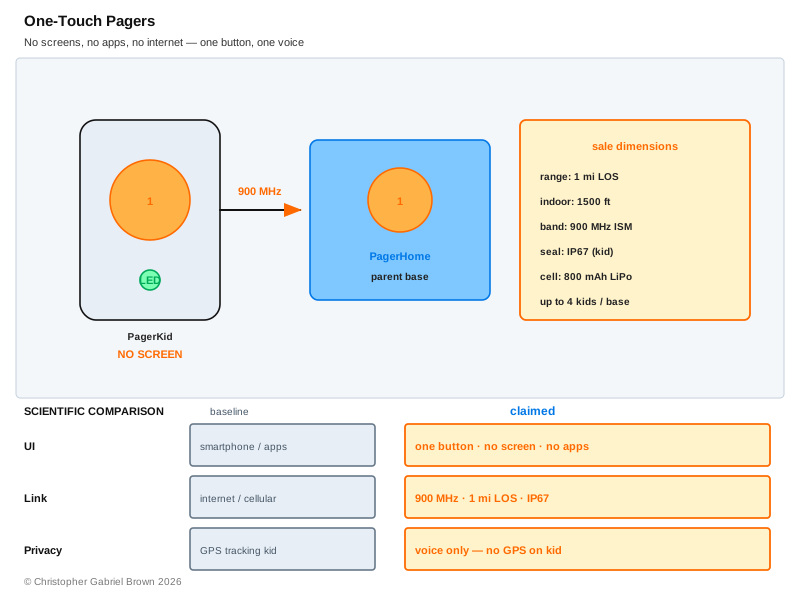
- PagerHome Base — desktop base station, pairs with up to 4 child or adult devices, distinct chime per device, optional auto-answer mode for young children, wall power + 4-hour battery backup.
- PagerHub Office — multi-device hub, pairs with up to 8 devices, wall-mountable for workplace use.
Technical Specifications
| Spec | PagerKid | PagerHome |
|---|---|---|
| Frequency | 902–928 MHz ISM | 902–928 MHz ISM |
| Modulation | GFSK | GFSK |
| TX Power | 100 mW (+20 dBm) | 250 mW (+24 dBm) |
| Range (LOS) | 1 mile | 1 mile |
| Range (Indoor) | 1500 ft | 1500 ft |
| Audio Codec | ADPCM 32 kbps | ADPCM 32 kbps |
| Battery | 800 mAh LiPo | 2000 mAh LiPo (backup) |
| Standby Time | 72 hours | Wall-powered |
| Talk Time | 8 hours | Unlimited (wall) |
| Charging | USB-C | Barrel jack + USB-C |
| Weight | 45 g | 180 g |
| IP Rating | IP67 | IP44 |
| Operating Temp | −10°C to 50°C | 0°C to 40°C |
Safety-First Child Design
PagerKid is designed for children, which means it is designed against the things conventional kid-tracker watches and phones also do but probably shouldn't:
- No GPS tracking. The device does not record or transmit location.
- No data storage. No on-device audio recording, no cloud backup.
- No microphone hot-mic. The mic activates only on the user's button press, never remotely.
- No screen, no apps, no camera, no internet. The attack surface is reduced to a one-button voice channel.
- LED indicator shows green (connected), amber (calling), red (low battery) — nothing else.
The pairing protocol is adapted from the NewStar satellite phone's encrypted-link architecture, scaled down from satellite-grade to local 902–928 MHz ISM-band RF while maintaining the same no-data-storage, no-cloud, zero-exfiltration principles.
Satellite and Cellular Heritage — Included
The Pagers package includes the complete NCS-19 communications satellite system design (Project 19) and the complete NewStar tri-mode satellite phone design (Project 20) as bundled heritage. These are not pointers; the directories ship inside the Pagers package with their content intact.
NCS-19 Communications Satellite (heritage):
- AES-256-GCM encryption, quantum key distribution (QKD), phased array antennas with beam hopping, inter-satellite laser crosslinks.
- 19 CAN bus message definitions with byte-level protocol specifications.
- 8 service types (Government / Military / Public encrypted, broadband, broadcast, IoT, emergency, blockchain).
- 6 encryption modes (AES-128/256-GCM, QKD+AES-256, fractional, timeline).
- Production-ready Python flight software (
obc_message_defs.py). - Complete engineering drawings, wiring diagrams, and 3D-printable models.
- 70+ blueprint documents including government proposals and compliance assessments.
NewStar One-Touch Satellite Phone (heritage):
- Tested firmware: NCS-19 codec, 10-state connection FSM, crypto pipeline (63 passing integration tests).
- One-touch satellite connection flow (GPS lock + beam acquire + encrypt < 6 seconds).
- Real cryptographic operations: AES-128/256-GCM, QKD+AES-256, fractional, timeline encryption.
- Interactive HTML prototype demonstrating the user experience.
- 34+ USPTO patent applications covering core technologies.
- Detailed hardware spec (ARM64 SoC, 5G/LTE, satellite L-band, 6,000–7,000 mAh battery).
These integrated capabilities provide a documented evolution path from the local-RF PagerKid / PagerOne product to satellite-connected and cellular-connected variants with government-grade encryption.
What's in the Package
| Folder | Contents |
|---|---|
hardware/ | PagerKid & PagerHome schematics, BOMs (PagerKid, PagerHome, PagerOne), RF link budget, antenna spec, PCB stackup. |
firmware/ | PagerKid firmware spec, PagerHome firmware spec, pairing protocol, audio codec spec. |
industrial-design/ | Specs for all six PagerKid / PagerOne variants and both base stations, plus colour-material-finish (CMF) document. |
safety/ | FCC compliance, CPSIA compliance, SAR testing, battery safety. |
sales-pitches/ | Investor deck. |
handoffs/ | Manufacturing handoff checklist. |
satellite-heritage/ | Full NCS-19 communications satellite system (Project 19) — specs, software, drawings, blueprints, 3D-print models, sales pitches, patent receipts, scripts. |
cell-heritage/ | Full NewStar tri-mode satellite phone (Project 20) — docs, firmware (codec, connection FSM, crypto pipeline, simulator, 63 passing tests), interactive HTML prototype, patent tracker. |
Intellectual Property
The acquisition includes:
- Proprietary one-touch communication protocol (derived from the NewStar satellite phone architecture).
- Secure pairing protocol adapted from satellite-grade encrypted-link design, scaled to local RF.
- Industrial designs for PagerKid Mini, Sport, and School variants.
- Industrial designs for PagerOne Compact, Pro, and Rugged variants.
- PagerHome and PagerHub base-station designs.
- NCS-19 satellite communication protocol and CAN bus message definitions.
- NewStar tri-mode phone firmware (codec, FSM, crypto pipeline).
- 34+ USPTO patent applications covering satellite, phone, and encryption technologies (heritage from Projects 19 and 20).
- Brand names: PagerKid, PagerOne, PagerHome, PagerHub, NewStar, NCS-19.
Per PATENT_LINKAGE_REPORT.md, project 07-one-touch-pagers is cross-linked across most of the inventor's filed USPTO applications — reflecting that the Pagers product inherits IP coverage from the satellite (Project 19) and phone (Project 20) heritage subtrees that ship inside its package.
How it's made
The Pagers product line is the productised assembly of three layers of the inventor's portfolio. The bottom layer is the NCS-19 communications satellite system — AES-256-GCM, QKD, phased-array, inter-satellite laser crosslinks, 19-CAN-message protocol, government-grade encryption. The middle layer is the NewStar tri-mode satellite phone — the one-touch user paradigm, the 10-state connection FSM, the crypto pipeline with 63 passing integration tests, the ARM64 hardware spec. The top layer — the actual Pagers product — takes the one-touch paradigm and the encrypted-link architecture from the phone, scales the radio down from satellite L-band / 5G/LTE to local 902–928 MHz ISM, removes the screen / apps / internet / camera / GPS, and packages the result in six size-and-context-tuned variants for children and adults plus two base stations.
The full design package — hardware schematics and BOMs, firmware specs, industrial-design specs, FCC and CPSIA compliance, SAR testing, battery safety, and the manufacturing handoff checklist — ships alongside the heritage subtrees, so a manufacturer can take the package and start a production run with the satellite-and-cellular evolution path documented and on file.
Why I made it
The conventional answer when a parent wants to keep a six-year-old reachable is one of two products: a kid's smartwatch with GPS tracking and a remote-listen feature, or a stripped-down smartphone with parental controls. Both surrender a screen-attached, internet-connected, location-broadcasting, microphone-accessible device to the child. Both also require monthly cellular service. Both have failure modes that range from "child gets bullied via the watch" to "watch firmware exfiltrates location to a vendor cloud" to "smartphone becomes a TikTok delivery vehicle within 48 hours of being given to the child."
I built the Pagers line because the actual requirement — one button, one voice, one paired adult on the other end — is the simplest possible communication primitive, and there was no reason it couldn't be a 45-gram clip-on with 72-hour battery and IP67 waterproofing on local RF. The same primitive happens to be exactly what an industrial worker, a hospital orderly, a security guard, or a hardhat-wearing field engineer also wants in their pocket. PagerOne is that adult version. The satellite and cellular heritage is bundled because the next step — if a buyer wants to take the product line beyond local RF — is already designed and tested.
What it can do
The Pagers product line covers six wearable form factors (PagerKid Mini / Sport / School, PagerOne Compact / Pro / Rugged) and two base stations (PagerHome Base, PagerHub Office) on local 902–928 MHz ISM-band RF, with a 1-mile line-of-sight range, 1,500-foot indoor range, ADPCM 32 kbps audio, 72-hour standby, 8-hour talk time, USB-C charging, and IP67 / IP68 / MIL-STD-810H protection depending on variant. Distinct chimes per device on the base station; auto-answer mode for young children. No screen. No apps. No internet. No camera. No GPS tracking. No data storage. No microphone hot-mic.
The bundled satellite-and-cellular heritage gives the product line a documented evolution path: PagerKid / PagerOne can stay as local-RF devices, or future variants can add satellite connectivity (using the NCS-19 protocol stack) or cellular / 5G connectivity (using the NewStar tri-mode phone firmware) without having to design those layers from scratch. The 34+ USPTO applications covering satellite, phone, and encryption technologies are heritage assets the buyer takes with the acquisition.
What the package does not deliver: it does not include manufactured hardware, FCC certification, or CPSIA conformance testing on actual produced units (the package documents the design-for-compliance, not the test reports for a manufactured run). The handoff price is for the design package; production runs and certification are the buyer's downstream responsibility.
Why it's a fact
Every claim above can be checked against the source record:
- The
07-one-touch-pagers/folder contents are inspectable on disk: hardware schematics and BOMs, firmware specs, industrial-design specs, FCC / CPSIA / SAR / battery-safety compliance documents, the investor deck, the handoff checklist, and the two heritage subtrees in their entirety. - The technical-specification table (902–928 MHz ISM, GFSK, 100 mW TX, 1-mile LOS, ADPCM 32 kbps, 800 mAh LiPo, 72-hr standby, 8-hr talk, IP67) is the inventor's own table from
README.md, not invented for this listing. - The NCS-19 satellite heritage ships inside the package — specs (ICD, CAN bus byte specs, connector specs, requirements list, traceability matrix), software (
obc_message_defs.py), drawings, 70+ blueprint documents. End-to-end inspection is possible before acquisition. - The NewStar phone heritage ships inside the package — tested firmware (codec, FSM, crypto pipeline, simulator, 63 passing integration tests), interactive HTML prototype, 8-phase production roadmap, hardware specification, business plan, and the inventor's claim of 34+ USPTO patent applications.
- The "no GPS tracking, no data storage, no microphone hot-mic" safety properties are stated in the inventor's README.md as design constraints; they are verifiable against the firmware and pairing-protocol specifications also bundled in the package.
- The handoff price of is stated in both
WEB_DESCRIPTION.htmlandREADME.md.
License Terms — What's Granted, What Isn't
The acquisition grants the buyer permission to make, build, and copy the deliverable. It does not transfer the underlying intellectual property:
- Granted with the acquisition: permission to manufacture (or have manufactured) the six PagerKid / PagerOne wearable variants and the two base stations (PagerHome, PagerHub); permission to build and certify the resulting hardware to FCC and CPSIA standards under the buyer's own production runs; permission to make copies of the design package (hardware schematics, BOMs, firmware specs, industrial-design specs, compliance documentation, satellite + cellular heritage subtrees) for the buyer's engineering and integration use.
- Not transferred with the acquisition: the 34+ USPTO patent applications inherited via the NCS-19 satellite (Project 19) and NewStar phone (Project 20) heritage subtrees, the proprietary one-touch communication protocol's underlying IP, the secure pairing protocol design, trademarks (PagerKid, PagerOne, PagerHome, PagerHub, NewStar, NCS-19), copyrights, or any rights to license or assign the IP onward. The intellectual property remains held by Christopher Gabriel Brown.
- The buyer's permission is to use the design package, not to own the rights behind the design package.
This framing applies uniformly across the inventor's portfolio. Buyers seeking IP assignment rather than make/build/copy permission should contact the inventor directly — that is a separate negotiation outside the standard storefront acquisition.
Six product variants. Two base stations. Local RF, with a satellite and cellular evolution path included.
A buyer who acquires the Pagers product line takes possession of the complete hardware-and-firmware design package for six wearable variants and two base stations, plus the bundled NCS-19 communications satellite system and NewStar tri-mode satellite phone — including the 34+ USPTO applications that come with that heritage. The acquisition is the design package, ready for manufacturing.
One button, one voice, one paired connection — with a satellite-and-cellular evolution path included.
One acquisition delivers the Pagers product line: six wearable variants (PagerKid Mini / Sport / School, PagerOne Compact / Pro / Rugged), two base stations (PagerHome Base, PagerHub Office), the complete hardware schematics and BOMs, the firmware specs (PagerKid, PagerHome, pairing protocol, audio codec), the industrial-design specs for all eight devices including colour-material-finish, the FCC and CPSIA compliance documents, the SAR and battery-safety documents, the investor deck, the manufacturing handoff checklist, and the bundled NCS-19 communications satellite (Project 19) and NewStar tri-mode satellite phone (Project 20) heritage subtrees.
Patent foundation: 34+ USPTO patent applications covering satellite, phone, and encryption technologies, inherited from the NCS-19 and NewStar heritage subtrees that ship inside the Pagers package. Brand names included: PagerKid, PagerOne, PagerHome, PagerHub, NewStar, NCS-19.
Handoff Price:
Complete design — ready for manufacturing. Local RF (902–928 MHz ISM) with satellite-and-cellular evolution path. Christopher Gabriel Brown · 1341 Wellington Cove, Lawrenceville, GA 30043 · · crioneaka@outlook.com.
5babe6c096dc7e18a04ddc511fa3865415a8e6bbcc3a373ebda0e12f2e5f3f6e
One Touch Microphone Pagers for Children and Adults
Publicly online since 2010 · U.S. patent applications since 2012 · inventions offered since 2014. The work of Christopher Gabriel Brown, independently documented.