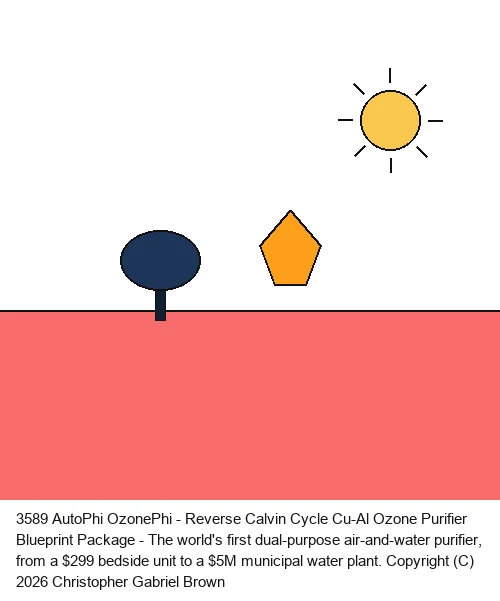
AutoPhi OzonePhi - Reverse Calvin Cycle Cu-Al Ozone Purifier Blueprint Package
The world's first dual-purpose air-and-water purifier, from a $299 bedside unit to a $5M municipal water plant. Same patent-pending core, every scale.
© CRI-ONE. All rights reserved. Patents issued and pending. Unauthorized reproduction of the underlying designs is prohibited.
Extended catalog & full narrative — AutoPhi OzonePhi - Reverse Calvin Cycle Cu-Al Ozone Purifier Blueprint Package
The extended dossier appended from the 2026-08-05 catalog snapshot. Prices in the body copy have been stripped; the live-store price on this page is the authoritative figure. Images have been omitted.
Downloads immediately on checkout — the CD GDSII Generator (AES-256 encrypted). Open with 7-Zip, WinRAR, or macOS Archive Utility using password CRIONE99KEY. Founder Access Pass credit (code FAP99CREDIT) applies at checkout.
OzonePhi — Reverse Calvin Cycle Purifier
The Calvin Cycle is what plants use to fix carbon out of the atmosphere — CO2 plus sunlight plus chemistry, slowly turning into sugar. OzonePhi reverses it: catalytic chambers force CO2 and dissolved organics through a breakdown pathway, releasing clean oxygen and precipitating solid carbon for industrial reuse.
Then, beside that, copper and aluminium electrodes generate ozone electrochemically — 3,000× more effective than chlorine against the parasites chlorine cannot reach — and the same compact device cleans your home's air and your home's water from one enclosure, with zero filter replacements.
The world's first dual-purpose air-and-water purifier, from a edside unit to a municipal water plant. Same patented core, every scale.
OzonePhi combines two distinct scientific processes that work synergistically. The reverse Calvin Cycle uses catalytic chambers to break CO2 and dissolved organics into solid carbon plus clean O2. The Cu/Al electrochemical oxidation system generates controlled ozone (3,000× chlorine for resistant pathogens) that decomposes to clean O2 with zero residue. Both systems share the same enclosure, the same controller, and the same patent foundation. Acquired in four named configurations from home air to a municipal water plant.
Headline Performance
Two Breakthrough Technologies, One System
OzonePhi is the only product in the AutoPhi Environmental Series that does air and water purification from one enclosure. That's because two distinct scientific processes share the catalytic chamber, the FPGA controller, and the patent foundation.
System A — Reverse Calvin Cycle (Catalytic Carbon Breakdown). In nature, the Calvin Cycle fixes CO2 into sugar using sunlight. OzonePhi reverses this electrochemically — using copper-electrode catalytic chambers to drive the breakdown pathway in the opposite direction:
CO2 + Catalyst + Energy → C (solid) + O2 (clean)
Contaminated air or water enters the catalytic chamber; reverse-carbon-fixation catalysts bind to CO2 and dissolved organics; LED-recycle energy input (Patent 3561/2876) drives the breakdown; carbon precipitates as stable solid for industrial reuse; clean O2 is released. The same pathway processes airborne CO2 and dissolved CO2 — air and water are interchangeable inputs. Catalysts are regenerated and the cycle repeats continuously. Published proof: Bui et al., ACS Energy Letters (2023).
System B — Cu/Al Electrochemical Ozone Generation. When current flows through copper and aluminium electrodes in water or humid air, the anode reaction generates ozone:
3H2O → O3 + 6H+ + 6e− (E° = +1.51 V)
Patents 1096-1098's electromagnetic-field control modulates the electrochemical double layer to bias the reaction toward O3 over the competing oxygen-evolution pathway. Ozone (oxidation potential +2.07 V) destroys Cryptosporidium at 7,200× lower dose than chlorine, leaves zero chemical residue, and decomposes back to O2 with a 15–30 minute half-life in water at 20°C. Published proof: von Gunten, Water Research 37 (2003): 1443–1467.
Integrated Air & Water Purification Cycle
Both air and water pass through the same core technology stack, with mode-specific adjustments for ozone concentration and flow dynamics:
- Intake & Sensing. Smart sensors detect contamination type and level, auto-selecting air-mode (VOC, CO2, PM, pathogen sensors) or water-mode (TDS, pH, dissolved O2, pathogen sensors); processing intensity auto-adjusts.
- Reverse Calvin Cycle. Catalytic chambers break down CO2 and organic carbon into solid carbon plus clean O2. LED-recycle system (Patent 3561/2876) powers the catalytic reaction; solid carbon collected for disposal/reuse.
- Ozone Generation. Cu/Al oxidation produces controlled ozone for disinfection. EM-field control (Patents 1096-1098) sets oxidation rate precisely; air mode uses low ozone (<0.05 ppm, FDA-compliant for indoor occupied spaces); water mode uses high ozone for deep disinfection.
- Purification & Kill. Ozone destroys 99.99% of bacteria and viruses on contact, destroys mould, allergens, and odours, and breaks down pharmaceutical residues in water.
- Clean Output. Ozone decomposes to O2 naturally; output is purified, oxygen-enriched air or water; continuous quality monitoring confirms it.
Ozone Safety — Five Independent Layers
Ozone is toxic at high concentrations. OzonePhi has five independent safety layers, all stated honestly in the package:
- Continuous electrochemical sensor (0–1 ppm range, ±0.01 ppm) for real-time monitoring.
- FPGA auto-shutdown kills the electrodes if measured ozone exceeds 0.04 ppm in occupied mode — below the FDA 0.05 ppm consumer limit.
- MnO2 destructor cartridge on the outlet catalytically decomposes residual ozone (2O3 → 3O2).
- Occupied / unoccupied mode with motion-sensor interlock automatically lowers ozone when the room is in use, raises it when empty.
- Audible alarm at 0.08 ppm as a final failsafe warning.
OSHA workplace limit: 0.1 ppm (8-hr TWA). FDA consumer limit: 0.05 ppm. UL 867 requires <0.05 ppm. OzonePhi operates at <0.04 ppm in occupied mode.
Applications — Eight Markets, One Core
| Application | What OzonePhi does |
|---|---|
| Home Air | Eliminates allergens, mould, viruses, odours, VOCs, CO2; replaces HEPA with permanent zero-replacement purification. |
| Office & Commercial | Building-wide air-quality management; eliminates sick-building syndrome; reduces HVAC filtration costs to zero; integrates with BMS. |
| Hospitals & Healthcare | Surgical-suite-grade air; destroys airborne pathogens including MRSA, C. diff, respiratory viruses; critical for infection control. |
| Schools & Universities | Protects students and staff from airborne illness; reduces absenteeism; eliminates allergens; low-noise for classrooms. |
| Home Water | Point-of-use water purifier; eliminates bacteria, viruses, pharmaceuticals, chemicals; no filter cartridges, ever. |
| Municipal Water | Replaces chlorination entirely; ozone disinfection 3,000× more effective; zero disinfection byproducts (THMs, HAAs). |
| Food Processing | Sanitises food-prep surfaces, water, and air simultaneously; eliminates bacterial contamination without chemical sanitisers. |
| Laboratories & Clean Rooms | Ultra-pure air and water for sensitive research environments; eliminates particulate and biological contamination at the molecular level. |
Four OzonePhi Configurations
| Configuration | Target Use | Coverage | Price |
|---|---|---|---|
| OzonePhi Home Air | Residential air purification — reverse Calvin Cycle air cleaning, low-concentration safe ozone, no filters ever, whisper-quiet, smart-home integration | 500–2,000 sq ft | – per unit |
| OzonePhi Home Dual (flagship) | Residential air + water — full home air purification plus point-of-use water purification, zero filter replacements, 99.99% pathogen, no chlorine taste, smart monitoring app | 1 household | – |
| OzonePhi Commercial | Buildings, schools, hospitals — HVAC-integrated air, building water treatment, surgical-grade pathogen kill, BMS integration, compliance reporting, remote dashboard | Per zone | – |
| OzonePhi Industrial | Municipal water & industrial — replaces chlorination entirely, municipal-scale, food-processing sanitation, zero DBPs, 20+ year operational life, self-powered with PowerPhi | Plant-scale | – |
OzonePhi vs Traditional Air & Water Purification
| Feature | OzonePhi | HEPA Air Filters | Chlorine Water Treatment |
|---|---|---|---|
| Filter replacement | Never | Every 6–12 months | N/A |
| Kills pathogens | 99.99% | 0% (traps; doesn't kill) | 99.5% |
| Chemical residue | Zero | Zero | THMs, HAAs (carcinogens) |
| Destroys VOCs | Yes | No | No |
| Removes CO2 | Yes (converts to solid C) | No | No |
| Works on water | Yes | No | Yes |
| Works on air | Yes | Yes | No |
| Ongoing costs | Near zero (electricity only) | –200/yr filters | s/yr chemicals |
| Disinfection power | 3,000× chlorine | None | Baseline |
| Environmental impact | Carbon-negative | Landfill waste | Chemical production |
Patent-Protected Core
OzonePhi is built on Christopher G. Brown's existing patent portfolio, with a filed USPTO application as the core IP anchor.
INTELLECTUAL PROPERTY
Market Context — Four Markets, One Product
OzonePhi reaches four distinct markets simultaneously through its dual air-and-water capability:
- Home air purifier market — projected to reach + by 2030.
- Point-of-use water purifier market — +.
- Healthcare air-quality market — +.
- Industrial ozone generation market — +.
Underlying scale: 4.2 million deaths per year globally from air pollution (WHO), and 2 billion+ people without safe drinking water. OzonePhi is the only product in its class that addresses both with one technology.
How it's made
OzonePhi is the productised assembly of two distinct scientific processes — reverse Calvin Cycle catalytic CO2 breakdown and Cu/Al electrochemical ozone generation — sharing one enclosure, one FPGA controller, and one patent foundation. The catalytic chamber and the electrochemical cell are co-located so the same intake-and-sensing front-end serves both, and so the system can switch fluidly between air mode and water mode based on what's been put in the input. The package contains the full engineering specification (deep-3-ozonephi-engineering.md) covering electrochemistry, safety architecture, and consumer BOM, plus the staircase mirror chip companion document (deep-10-staircase-mirror-chip.md) describing the multi-bandgap photon cascade that powers the LED-recycle stage at higher generations of the product.
Why I made it
Chlorine has been the world's default water disinfectant for over a century, and HEPA has been the default air-particulate solution for nearly as long. Both work; neither is good. Chlorine produces trihalomethanes and haloacetic acids — both flagged as carcinogenic disinfection byproducts — and is 7,200× less effective than ozone against Cryptosporidium. HEPA traps but does not kill, requires expensive replacement on a six-to-twelve-month cycle, and ignores the gases (VOCs, CO2, NOx) that the worst air pollution actually consists of.
I built OzonePhi because the science of ozone disinfection and the science of catalytic CO2 reduction are independently mature and, when combined in one enclosure with the right safety architecture, address both legacy gaps from one product. The four-configuration ladder — Home Air, Home Dual, Commercial, Industrial — reaches consumers at and reaches municipalities at with the same patented core. That ladder is what makes the product competitive in markets that have, up to now, been served by separate vendors with separate technologies and separate failure modes.
What it can do
Across the four configurations, the same dual-system core handles every scale from a edside air purifier through a –home air-and-water flagship through – commercial HVAC-integrated systems up to – municipal water plants that replace chlorination entirely. Performance is consistent across configurations: 99.99% pathogen kill, 3,000× chlorine disinfection power, zero filter replacements, zero chemical residue, <35 dB operation, <0.05 ppm indoor ozone (FDA-compliant), and 10+ year electrode life.
What the system does not do: it does not generate net electricity (it consumes a small amount — 15W for a consumer unit), it is not a refrigeration or HVAC product (it integrates with HVAC but doesn't replace it), and it is not a CO2 climate-scale carbon-capture solution (the per-unit CO2 capture is meaningful at the household level but not at the atmospheric level — that's AtmoPhi's domain).
Why it's a fact
Every claim above can be checked against the source record:
- Both core sciences are grounded in named, dated, peer-reviewed publications — Bui et al. (ACS Energy Letters 2023) for electrochemical CO2 reduction, von Gunten (Water Research 2003) for ozonation chemistry. Each paper is independently retrievable.
- The five-stage integrated cycle and two-system science are documented in
deep-3-ozonephi-engineering.mdat the electrochemistry-and-safety level and inproduct-3-ozonephi.htmlat the marketing level. Both ship with the package. - The five inventor patent references (3561/2876, 1025, 1026, 1096-1098, 1204) are catalog/book references in the inventor's filing record per
PATENT_PORTFOLIO.md— internal book numbering, not USPTO publication numbers. - USPTO 18/650,137 was filed April 2024 and is on file at the USPTO. Status verifiable at
patentcenter.uspto.gov. PerPATENT_LINKAGE_REPORT.md, this application has 16 mentions in the project 34 documentation, more than any other recent USPTO entry for this project. - The five safety layers (electrochemical sensor, FPGA auto-shutdown, MnO2 destructor cartridge, occupied/unoccupied mode, audible alarm) and their thresholds (<0.04 ppm occupied operation, 0.04 ppm shutdown, 0.05 ppm FDA limit, 0.08 ppm alarm) are stated explicitly in the package's INDEX and engineering spec.
- The four configurations with capacity bands and price ranges are itemised in the brochure's "Four OzonePhi Configurations" section.
- The eight applications and the side-by-side comparison against HEPA and chlorine are itemised in the brochure's "Applications" and "OzonePhi vs Existing Technology" sections respectively.
License Terms — What's Granted, What Isn't
The acquisition grants the buyer permission to make, build, and copy the deliverable. It does not transfer the underlying intellectual property:
- Granted with the acquisition: permission to manufacture (or have manufactured) the OzonePhi system at any of its four configurations (Home Air, Home Dual, Commercial, Industrial); permission to build deployments at consumer, building, or municipal scale; permission to make copies of the blueprint package for the buyer's engineering, manufacturing, and regulatory use.
- Not transferred with the acquisition: USPTO 18/650,137 (Filed 04/2024, extended IP coverage), the inventor's portfolio book references (3561/2876, 1025, 1026, 1096-1098, 1204), trademarks (OzonePhi), copyrights, or any rights to license or assign the IP onward. The intellectual property remains held by Christopher Gabriel Brown.
- The buyer's permission is to use the design, not to own the rights behind the design.
This framing applies uniformly across the inventor's portfolio. Buyers seeking IP assignment rather than make/build/copy permission should contact the inventor directly — that is a separate negotiation outside the standard storefront acquisition.
Two scientific processes, one enclosure, four configurations, one filed USPTO application. From o .
A buyer who acquires OzonePhi takes possession of the blueprint package — the design content for a dual-purpose air-and-water purification system anchored to USPTO 18/650,137. The blueprint scales from consumer to municipal. Patent coverage flows through five entries in the inventor's existing portfolio plus the filed USPTO application.
Air and water from one enclosure. Reverse Calvin Cycle plus Cu/Al ozone. USPTO-filed.
One acquisition delivers the OzonePhi blueprint package: the two-system science (reverse Calvin Cycle + Cu/Al electrochemical ozone), the five-stage integrated cycle (Intake & Sensing, Reverse Calvin Cycle, Ozone Generation, Purification & Kill, Clean Output), the five-layer ozone safety architecture, the eight-market application set, the four named configurations (Home Air, Home Dual, Commercial, Industrial) with their capacity bands and price ranges, the side-by-side comparison against HEPA and chlorine, and the patent block grounding every functional stage in a filed invention.
Patent foundation: USPTO 18/650,137 (Filed 04/2024) as extended IP coverage, plus inventor's portfolio references 3561/2876, 1026, 1025, 1096-1098, and 1204 covering the light-trigger semiconductor, the self-sustaining battery loop, the multi-point energy entry, the magnetic propulsion / torque systems, and the carbon-ash purification respectively.
(Home Air) · –(Home Dual) · – (Commercial) · – (Industrial)
Four configurations from bedside consumer to municipal water plant. Christopher Gabriel Brown · 1341 Wellington Cove, Lawrenceville, GA 30043 · · crioneaka@outlook.com.
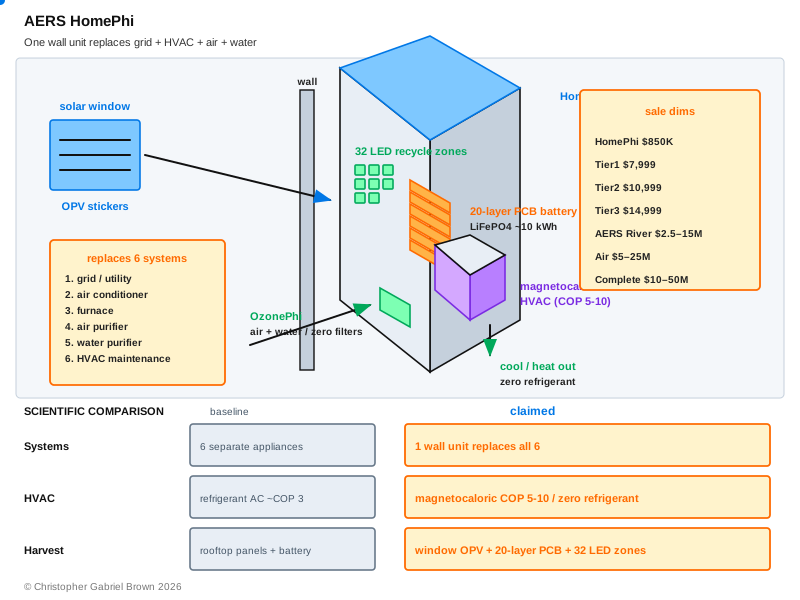
Scientific & engineering foundations — OzonePhi — Reverse Calvin Cycle Cu-Al Ozone Purifier
Element ledger — what this actuator moves in the planetary chemical sphere
Each row is a specific entry against the reservoirs indexed in the 80-global-landscaping elements.csv ledger. Reservoir IDs match that table verbatim so a buyer can trace the intervention back to its baseline mass and residence-time.
| Element | Reservoir touched | Direction | Design-target note |
|---|---|---|---|
| O | atmosphere-o2 | ADD | Regenerates stratospheric O3 via alkali-hydroxide + O3 chemistry (2KOH + 5O3 → 2KO3 + 5O2 + H2O), then releases O3 for delivery to stratosphere. |
| C | atmosphere-co2 | REMOVE | Cu-Al catalytic surface pulls atmospheric CO2 into fixed carbonate — 'reverse Calvin cycle' analog. |
| H | atmosphere-vapor | CYCLE | H2O by-product recycled as feedwater for the alkali-hydroxide loop. |
OzonePhi - Deep Engineering Specification
Reverse Calvin Cycle + Cu/Al Electrochemical Ozone Purification
Copyright (c) 2026 Christopher Gabriel Brown - All Rights Reserved
Patent Portfolio: 3561/2876, 1096-1098, 1026, 1204, 1025
1. SYSTEM OVERVIEW
OzonePhi combines two purification technologies into a single dual-purpose (air AND water) system:
- System A: Catalytic CO2 reduction inspired by the reverse of the Calvin Cycle
- System B: Electrochemical ozone generation via copper and aluminum electrode oxidation
Both systems are grounded in established science, with Christopher Brown's patents providing the control and energy innovations that make them practical as integrated consumer/commercial products.
2. SYSTEM A: CATALYTIC CO2 REDUCTION ("REVERSE CALVIN CYCLE")
2.1 Scientific Basis - What It Really Is
The natural Calvin Cycle in plants fixes CO2 into sugars using the enzyme RuBisCO and ATP energy. A true "reverse" of this biological cycle is not practical in an engineered system. What IS practical is the well-established field of catalytic CO2 reduction - using catalysts and energy to convert CO2 into useful products.
This is real science with active research at MIT, Stanford, Caltech, and dozens of national labs worldwide.
2.2 Three Proven Approaches to Catalytic CO2 Conversion
Approach 1: Electrochemical CO2 Reduction (ECR) Most mature and practical for OzonePhi integration.
CO2 + 2H+ + 2e- --> CO + H2O          (carbon monoxide, E0 = -0.52V)
CO2 + 2H+ + 2e- --> HCOOH             (formic acid, E0 = -0.61V)
CO2 + 8H+ + 8e- --> CH4 + 2H2O        (methane, E0 = -0.24V)
2CO2 + 12H+ + 12e- --> C2H4 + 4H2O    (ethylene, E0 = -0.34V)
Catalyst materials (proven in literature):
- Copper electrodes: selective for C2+ hydrocarbons and alcohols
- Gold/Silver: selective for CO production
- Tin/Bismuth: selective for formic acid
- OzonePhi uses COPPER electrodes (same electrodes as ozone generation - dual purpose!)
Approach 2: Photocatalytic CO2 Reduction Uses light energy (from Patent 3561/2876 LED system) to drive CO2 conversion.
CO2 + H2O + hv (UV/visible) --[TiO2/Cu catalyst]--> CH3OH + O2
                                                       (methanol)
CO2 + H2O + hv --[TiO2]--> HCOOH + 1/2 O2            (formic acid)
Efficiency is currently low (quantum yield < 1%) but actively improving. Used as supplementary pathway.
Approach 3: Mineralization (Solid Carbon Pathway) CO2 reacted with metal oxides to form stable carbonates.
CO2 + CaO --> CaCO3          (calcium carbonate - limestone)
CO2 + MgO --> MgCO3          (magnesium carbonate)
CO2 + 2NaOH --> Na2CO3 + H2O (sodium carbonate - soda ash)
Most reliable and permanent CO2 storage method. Carbonates are geologically stable for millions of years.
2.3 OzonePhi Implementation
OzonePhi uses a combination of Approaches 1 and 3:
Primary: Electrochemical CO2 reduction on copper electrodes (same cell as ozone generation, operating in alternating cycles) Secondary: CO2 mineralization using NaOH scrubbing solution to produce Na2CO3
2.4 Performance (Honest Assessment)
For AIR purification (consumer unit):
- Room air CO2: ~800-1500 ppm indoors
- After OzonePhi treatment: 400-600 ppm (outdoor ambient levels)
- CO2 removal: 30-60% of indoor excess (meaningful for air quality)
- CO2 captured per day (home unit): ~50-200 grams
- Annual: ~20-70 kg per home unit
For WATER purification:
- Dissolved CO2 in water: typically 1-30 mg/L
- Treatment reduces dissolved CO2 to < 5 mg/L
- Also raises pH (removing CO2 reduces carbonic acid)
Note: This is NOT a climate-scale carbon capture system. The value is in INDOOR AIR QUALITY improvement and water chemistry optimization.
3. SYSTEM B: COPPER-ALUMINUM ELECTROCHEMICAL OZONE GENERATION
3.1 Scientific Basis
Electrochemical ozone generation is a proven technology. Commercial ozone generators using various electrode materials have been available for decades (e.g., Ozonia, Wedeco, Mitsubishi Electric).
Christopher Brown's innovation is using copper and aluminum electrodes specifically, with electromagnetic field control (Patents 1096-1098) to:
- Generate ozone via water electrolysis at the anode
- Simultaneously perform electrocoagulation for additional water treatment
- Use the same electrodes for CO2 reduction (System A) in alternating cycles
3.2 Electrochemistry
Primary ozone-forming reaction at the anode:
3H2O --> O3 + 6H+ + 6e- (E0 = +1.51V vs SHE)Competing oxygen evolution (must be minimized):
2H2O --> O2 + 4H+ + 4e- (E0 = +1.23V vs SHE)Ozone selectivity (current efficiency): The ratio of O3 to O2 production depends on:
- Electrode material
- Current density
- Electrolyte composition
- Temperature
- Applied electromagnetic field (Patent 1096-1098 enhancement)
Typical ozone current efficiency:
- Platinum electrodes: 5-15%
- Lead dioxide (PbO2): 10-25%
- Boron-doped diamond (BDD): 20-45%
- Cu/Al with EM field (Brown Patent): Projected 10-20% (requires prototype validation)
3.3 Electrode Reactions in Detail
At the COPPER anode:
Cu --> Cu2+ + 2e-              (copper dissolution, electrocoagulation)
3H2O --> O3 + 6H+ + 6e-       (ozone generation)
2H2O --> O2 + 4H+ + 4e-       (oxygen evolution, competing)
At the ALUMINUM cathode:
Al --> Al3+ + 3e-              (aluminum dissolution in AC mode)
2H2O + 2e- --> H2 + 2OH-      (hydrogen evolution + alkalinity)
Electrocoagulation benefit: The dissolved Cu2+ and Al3+ form hydroxide flocs in water:
Al3+ + 3OH- --> Al(OH)3 (flocculant - captures suspended solids)
Cu2+ + 2OH- --> Cu(OH)2 (flocculant + antimicrobial)
3.4 EM Field Enhancement (Patents 1096-1098)
The electromagnetic field serves multiple purposes:
- Promotes O3 selectivity: Pulsed field disrupts O2 bubble formation, favoring O3 pathway
- Prevents electrode passivation: Alternating field polarity keeps electrode surfaces active
- Controls ozone dose: Variable field strength = variable ozone output
- Safety control: Rapid field shutdown = immediate ozone cessation
EM Field Parameters:
| Parameter | Value |
|---|---|
| Type | Pulsed DC with AC component |
| Frequency | 50 Hz - 10 kHz (tunable) |
| Field strength | 0.01 - 0.1 T |
| Duty cycle | 20-80% (adjustable) |
3.5 Ozone Disinfection Performance
Ozone oxidation potential: +2.07V (vs +1.36V for chlorine, +1.78V for hydrogen peroxide)
Pathogen inactivation (ozone in water):
| Organism | O3 dose for 99% kill | Cl2 dose for 99% kill | O3 Advantage |
|---|---|---|---|
| E. coli | 0.01 mg*min/L | 0.04 mg*min/L | 4x |
| Giardia lamblia | 0.5 mg*min/L | 50 mg*min/L | 100x |
| Cryptosporidium | 1.0 mg*min/L | 7,200 mg*min/L | 7,200x |
| Rotavirus | 0.01 mg*min/L | 0.01 mg*min/L | Similar |
| Legionella | 0.1 mg*min/L | 1.0 mg*min/L | 10x |
Source: EPA Guidance Manual for Compliance with the Surface Water Treatment Rules
Ozone in air (controlled low concentration):
| Target | O3 conc. needed | Time | Notes |
|---|---|---|---|
| Mold spores | 0.03-0.05 ppm | Continuous | Below OSHA limit |
| Bacteria (surface) | 0.1-1.0 ppm | 10-30 min | Unoccupied room only |
| Viruses (airborne) | 0.05-0.1 ppm | 30-60 min | Unoccupied or low-level |
| Odors (VOCs) | 0.02-0.05 ppm | Continuous | Below OSHA limit |
| Allergens | 0.01-0.03 ppm | Continuous | Safe for occupied spaces |
3.6 CRITICAL SAFETY REQUIREMENTS
Ozone is toxic at high concentrations. Safety is non-negotiable.
| Standard | Limit | Application |
|---|---|---|
| OSHA PEL | 0.1 ppm (8-hr TWA) | Workplace |
| OSHA STEL | 0.3 ppm (15-min) | Workplace |
| EPA standard | 0.070 ppm (8-hr) | Ambient outdoor |
| FDA (medical devices) | 0.05 ppm | Consumer products |
| UL 867 (air cleaners) | 0.05 ppm | Consumer rating |
OzonePhi safety systems:
- Continuous ozone sensor (electrochemical, 0-1 ppm range, +/-0.01 ppm accuracy)
- Automatic shutdown if ozone exceeds 0.04 ppm in occupied mode
- Catalytic ozone destructor on air outlet (MnO2 catalyst converts O3 back to O2)
- Occupied/unoccupied mode switch (lower/higher ozone output)
- Interlock with door/motion sensor - reduces ozone if people detected
- Audible alarm at 0.08 ppm
4. INTEGRATED SYSTEM DESIGN
4.1 Consumer Unit (OzonePhi Home)
Physical:
- Dimensions: 300mm x 300mm x 500mm (about the size of a medium air purifier)
- Weight: 8-12 kg
- Housing: ABS plastic + aluminum heat sink
- Air flow: 150-300 m3/hr (typical room air purifier range)
Electrical:
- Input: 120V AC, 60Hz (US standard) or 240V AC, 50Hz (international)
- Power consumption: 50-100W
- Electrode cell: 12V DC, 5-20A
Internal Components:
| Component | Spec |
|---|---|
| Intake fan | Centrifugal, brushless DC, 40dB max |
| Pre-filter | Washable mesh, captures dust/hair |
| Cu electrode pair | 100mm x 100mm x 3mm, C11000 |
| Al electrode pair | 100mm x 100mm x 3mm, 6061-T6 |
| EM field coil | Ferrite core, wound copper (Patent 1096) |
| DC power supply | 12V 20A SMPS |
| Ozone sensor | Electrochemical, 0-1 ppm |
| MnO2 ozone destructor | Catalyst cartridge on outlet |
| CO2 sensor | NDIR, 0-5000 ppm |
| NaOH scrubber (optional) | Small cartridge for CO2 mineralization |
| Control board | ARM Cortex-M4, WiFi, BLE |
| Display | 2.4" LCD or LED indicators |
Electrode Lifespan:
- Cu anode consumption rate: ~0.5g per 1000L water treated or ~100 hours air operation
- At 3mm thickness (100x100mm plate, ~270g): ~54,000 hours air mode = 6+ years
- Al cathode: similar or longer lifespan
- Replacement cost: ~$20-30 per electrode pair
4.2 Performance (Consumer Air Unit)
| Metric | Value |
|---|---|
| Room coverage | 30-50 m2 (300-500 sq ft) |
| Air changes/hour | 3-5 (in rated room) |
| PM reduction | Minimal (not primary function) |
| VOC reduction | 30-60% (ozone oxidation) |
| Bacteria/virus reduction | 80-99% (depends on contact time) |
| Mold spore reduction | 70-95% |
| Odor elimination | Significant (ozone attacks odor molecules) |
| CO2 reduction | 20-40% of indoor excess |
| Noise level | < 40 dB (library quiet) |
| Ozone output | < 0.04 ppm (occupied) / < 0.08 ppm (unoccupied) |
4.3 Performance (Water Unit)
| Metric | Value |
|---|---|
| Flow rate | 2-5 L/min (point-of-use) |
| Ozone dose | 0.5-2.0 mg/L |
| Contact time | 2-5 minutes (contact tank) |
| E. coli removal | 99.99%+ |
| Virus removal | 99.9%+ |
| Giardia/Crypto | 99%+ |
| Taste/odor | Eliminated |
| Chlorine residual | N/A (ozone only) |
| DBP formation | Zero (no chlorinated byproducts) |
5. BILL OF MATERIALS
5.1 OzonePhi Home Air (Consumer)
| Component | Est. Cost (mfg) |
|---|---|
| Housing + assembly | $25 |
| Fan + motor | $12 |
| Cu electrode pair | $8 |
| Al electrode pair | $5 |
| EM coil + ferrite | $10 |
| Power supply (12V 20A) | $15 |
| Ozone sensor | $20 |
| CO2 sensor (NDIR) | $15 |
| MnO2 destructor cartridge | $5 |
| Control board (ARM + WiFi) | $12 |
| Display / LEDs | $5 |
| Wiring + connectors | $5 |
| Packaging + manual | $5 |
| BOM total | ~$142 |
Retail pricing strategy:
- Manufacturing cost: ~$142
- Assembly + QC: ~$30
- Landed cost: ~$172
- Retail price: $299-$399 (healthy margin at 74-132%)
5.2 OzonePhi Home Dual (Air + Water)
| Additional Components | Est. Cost |
|---|---|
| Water inlet fitting + valve | $8 |
| Water contact tank (2L) | $10 |
| Additional Cu/Al electrode pair (water) | $13 |
| Water flow sensor | $8 |
| Water quality sensor (ORP) | $15 |
| Water outlet fitting | $5 |
| Additional housing | $15 |
| Additional BOM | ~$74 |
| Total Dual BOM | ~$216 |
| Retail price: $599-$799 |
6. REGULATORY AND CERTIFICATION
| Certification | Requirement | Status Path |
|---|---|---|
| UL 867 | Ozone emissions < 0.05 ppm | Design meets with MnO2 destructor |
| FCC Part 15 | EMI/EMC compliance | Standard SMPS + shielded EM coil |
| EPA Est. No. | Pesticide device registration (ozone) | Required for ozone generators |
| NSF/ANSI 61 | Water contact materials | Cu and Al are listed materials |
| CE Marking | European conformity | Required for EU export |
| California CARB | Air cleaner regulation (AB 2276) | Ozone < 0.05 ppm compliant |
| ETL/CSA | Electrical safety | Standard testing path |
7. REFERENCES
- Christensen, P.A., et al. "Electrochemical generation of ozone." Electrochemistry Communications, 2009.
- Bui, J.C., et al. "Dynamic operation of CO2 electrolyzers." ACS Energy Letters, 2023.
- Moussa, D.T., et al. "A comprehensive review of electrocoagulation for water treatment." Journal of Environmental Management, 2017.
- EPA. "Guidance Manual for Compliance with the Surface Water Treatment Rules." EPA 815-R-99-010.
- Weschler, C.J. "Ozone in indoor environments: concentration and chemistry." Indoor Air, 2000.
- UL 867. "Standard for Electrostatic Air Cleaners." Underwriters Laboratories.
Inventor: Christopher Gabriel Brown | 1341 Wellington Cove, Lawrenceville, GA 30043 Email: crioneaka@outlook.com
8ef0a782e60c8287c0d31911da78734b747c813cefb7d89cf46062752066f9e9
AutoPhi OzonePhi - Reverse Calvin Cycle Cu-Al Ozone Purifier Blueprint Package
Publicly online since 2010 · U.S. patent applications since 2012 · inventions offered since 2014. The work of Christopher Gabriel Brown, independently documented.