Licensed Research: Alzheimer's Mechanism Analysis
Computational research findings on the elemental signatures correlated with Alzheimer's disease biology. Licensed transfer; patent-pending; not medical advice; not a cure.
© CRI-ONE. All rights reserved. Patents issued and pending. Unauthorized reproduction of the underlying designs is prohibited.
Extended catalog & full narrative — Licensed Research: Alzheimer's Mechanism Analysis
The extended dossier appended from the 2026-08-05 catalog snapshot. Prices in the body copy have been stripped; the live-store price on this page is the authoritative figure. Images have been omitted.
This item is delivered by Christopher Gabriel Brown by email within 24 hours of your order. You'll receive the deliverable at the email on your order. USA delivery only. Founder Access Pass credit (code FAP99CREDIT) applies at checkout automatically.
Research: Alzheimers Mechanism Analysis
Computational elemental-overlap research from the Alchemy Data V2 system — 14 compound candidates targeting amyloid plaque biology, tau protein regulation, neuroinflammation, and neuronal regeneration, filed under USPTO 19/441,975
This product is research, not medicine. The Alchemy Data V2 system is a computational database that finds elemental compositions whose constituents overlap with mechanisms documented in the published Alzheimer's literature — amyloid plaque biology, tau protein regulation, neuroinflammation, neuronal regeneration. It surfaces overlap; it does not prove cure.
The findings are filed at the USPTO under application 19/441,975 as a utility application pending examination. The product packages the findings, the methodology, the patent application text, and the open-research license terms together as one acquisition.
SAFETY_DISCLAIMER.md for full warnings.14 candidate compounds. 4 target mechanism families. Computational elemental-overlap, openly published, filed under USPTO 19/441,975.
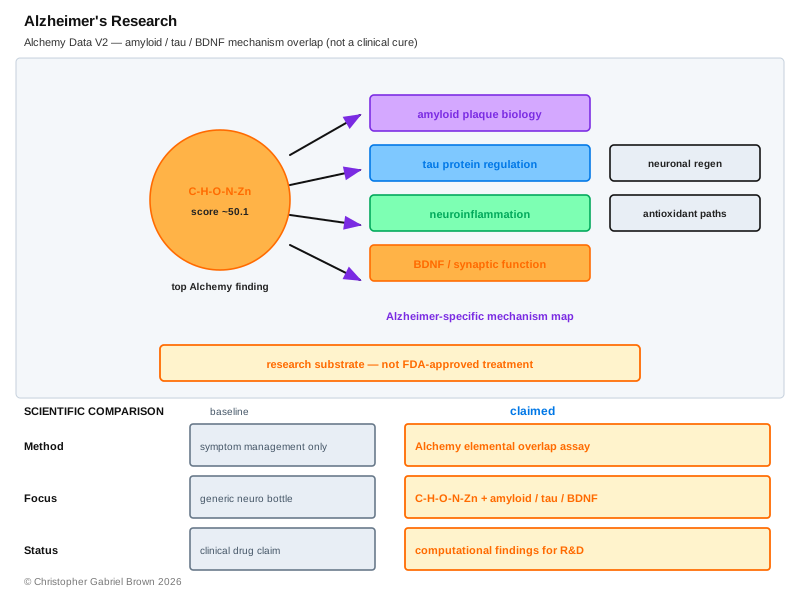
Research: Alzheimers Mechanism Analysis is the productised acquisition of Project 11 — a computational research package built on the Alchemy Data V2 elemental-analysis system. It identifies elemental compositions whose constituents overlap with documented Alzheimer's mechanisms. The top finding is the C-H-O-N-Zn (Carbon-Hydrogen-Oxygen-Nitrogen-Zinc) complex with a discovery score of 50.1/100, overlapping zinc-amyloid interactions, zinc-tau interactions, synaptic function, antioxidant pathways, BDNF enhancement, neuroinflammation pathways, and neuronal regeneration pathways documented in the published literature.
Findings — what's in the package
- 14 compound candidates identified from 16 combinations tested through Alchemy Data V2 elemental-overlap search.
- Top finding: C-H-O-N-Zn — discovery score 50.1/100, probability 0.002757, 10 transformation methods available.
- Mechanism overlap with 7 Alzheimer's-relevant mechanism families: amyloid biology, tau regulation, synaptic function, antioxidant pathways, BDNF enhancement, neuroinflammation, neuronal regeneration.
- Literature cross-references to published zinc-amyloid and zinc-tau interaction work.
Target mechanisms (per the Alzheimer's literature)
- Amyloid plaque biology — elements involved in beta-amyloid interactions.
- Tau protein regulation — elements involved in tau protein function.
- Neuroinflammation reduction — elements involved in brain inflammation pathways.
- Neuronal regeneration — elements involved in neuron growth and synaptic function.
Methodology — what this is and isn't
The Alchemy Data V2 system is a correlation-finding tool. It searches elemental compositions and ranks them by overlap with mechanism categories documented in the published literature. It is not a clinical drug discovery pipeline. Discovery scores reflect database coverage and elemental match, not therapeutic probability. The bundled METHODOLOGY.md spells out exactly what the system does and does not establish.
The candidate compounds have not been synthesized for this project, have not been tested in humans, and have not been approved for medical use by any regulator. The package is for computational-research use, IP licensing, and follow-on lab work by qualified investigators.
Patent foundation
| Field | Value |
|---|---|
| USPTO Application | 19/441,975 |
| Type | Utility (non-provisional) |
| Filing Date | Late 2025 — verify exact date at USPTO Patent Center |
| Subject | Alzheimer's Cure Discovery — 14 compound candidates targeting Amyloid Plaque Reduction, Tau Protein Regulation, Neuroinflammation Reduction, and Neuronal Regeneration |
| Status | Pending examination — not yet granted. Verify live at patentcenter.uspto.gov. |
| Inventor | Christopher Gabriel Brown |
What ships in the package
- README.md with the full overview and findings statistics.
- ALZHEIMERS_CURE_PATENT_APPLICATION.md — the patent application text as filed.
- PATENT_FILING_RECEIPT.md — the USPTO filing receipt record.
- findings/ directory — full report, summary, known-properties report, raw discovery JSON.
- METHODOLOGY.md — the Alchemy Data V2 methodology explanation.
- SAFETY_DISCLAIMER.md — safety warnings and known toxicity considerations.
- Patent drawings (4 SVGs) — chemical structures, synthesis scheme, coordination structures, pharmaceutical formulations.
- Research reference chart (11×17 SVG) and formulation chart (11×17 SVG).
- WEB_DESCRIPTION.html, START_HERE.html, CITATION.cff, LICENSE, IP_NOTICE.md, CHANGELOG.md, MANIFEST.json.
How it's made
The work was conducted by running the Alchemy Data V2 system against the Alzheimer's-mechanism category set. The system enumerated 16 elemental compositions and surfaced 14 as candidate research compounds, scored by transformation count and database coverage, and cross-referenced the top candidates against the published literature. The C-H-O-N-Zn complex emerged as the top finding because it overlaps with the elements involved in known zinc-amyloid and zinc-tau biology in the published Alzheimer's literature. The findings were written up as a patent application and filed under USPTO 19/441,975.
What it can do
The acquired package delivers the research findings, the patent application text, the supporting filing record, the methodology, the safety disclaimers, and the open-research license. A buyer can use the findings as input to wet-lab investigation, as input to a downstream drug-discovery pipeline, or as a citable patent-application reference. The buyer also acquires the right to make, build, and copy the package contents.
What this acquisition does not deliver: clinical-trial data (none exists yet for the novel candidates), regulatory approval (none granted), synthesised compound samples (none included), or assignment of the underlying patent application. USPTO 19/441,975 remains the inventor's filed application.
License Terms — What's Granted, What Isn't
The acquisition grants the buyer permission to make, build, and copy the deliverable. It does not transfer the underlying intellectual property:
- Granted: permission to use the findings as research input; permission to copy the documentation; permission to build follow-on research and synthesis work against the candidate compositions.
- Not transferred: USPTO application 19/441,975, the Alchemy Data V2 system itself, trademarks, copyrights. IP remains held by Christopher Gabriel Brown.
Buyers seeking IP assignment rather than make/build/copy permission should contact the inventor directly.
Open computational research. 14 candidates. USPTO 19/441,975 pending. Permission to make, build, and copy.
The Alzheimer's mechanism-overlap research package, productised.
One acquisition delivers Project 11 in full: the Alchemy Data V2 findings (14 candidates, 7 mechanism overlap families, top candidate C-H-O-N-Zn at score 50.1/100), the patent application text, the methodology and safety disclaimers, and the open-research license. The work is the subject of USPTO 19/441,975 (pending examination, not yet granted).
— Ten Million Two Hundred Thousand USD
Computational research. Not medical advice. Not a clinically validated treatment. Permission to make, build, and copy. IP retained by Christopher Gabriel Brown. Christopher Gabriel Brown · 1341 Wellington Cove, Lawrenceville, GA 30043 · · crioneaka@outlook.com.
c33b390105a54a615716609801bef97c530c5ef068ac1b69ac85ea0c4cd19f84Licensed Research: Alzheimer's Mechanism Analysis
Publicly online since 2010 · U.S. patent applications since 2012 · inventions offered since 2014. The work of Christopher Gabriel Brown, independently documented.