OTC Vitamins for Children and Adults
Complete vitamin formulation library: 9 products (4 children, 5 adult), computationally designed via Alchemy data methodology, FDA OTC compliant, GMP manufacturing-ready. Every dosage derived from probability-weighted element table analysis.
© CRI-ONE. All rights reserved. Patents issued and pending. Unauthorized reproduction of the underlying designs is prohibited.
Extended catalog & full narrative — OTC Vitamins for Children and Adults
The extended dossier appended from the 2026-08-05 catalog snapshot. Prices in the body copy have been stripped; the live-store price on this page is the authoritative figure. Images have been omitted.
OTC Vitamins for Children and Adults
A small bottle in the morning. A chewable in a lunchbox.
The same family taking quiet care of itself, every day, across generations.
Nine vitamin formulations — built not by marketing, but by the numbers — for children and adults. Welcome. Please look around.
Industry chooses doses. This line derives them.
Most consumer vitamin doses on U.S. shelves are set by a formulator, somewhere between the deficiency floor and the tolerable-intake ceiling, against a framework written in 1941. The Alchemy probability data gives this line a different label: each dose, pairing, and cohort tier is derived from a per-cohort probability matrix.
The Use Window — A Whole Lifespan
Every morning. Every household. Every life stage between four and the end.
The line is structured around the actual cohort math: childhood (4–12), adolescence (13–17), adult (18–49), mature adult (50–64), and senior (65+). What that means commercially is significant: a buyer doesn't acquire nine SKUs to compete with nine other brands. The buyer acquires sixty years of one person's life — and every member of one household at the same time.
KidVital ships in chewables and gummies for the lunchbox window. VitalCore ships in tablets and softgels for the kitchen-counter window. Together they cover the morning routine of an entire family, from the first time a child can chew a tablet to the day a grandparent needs a senior multivitamin.
The Channels — Already Cleared
This line is shelf-ready, not lab-ready. The slope between acquisition and first shipment is essentially flat:
- FDA OTC compliance documentation — completed. No new-drug application. No clinical-trial pathway. The OTC classification is settled before purchase.
- GMP manufacturing specifications — completed. A contract manufacturer can take the package and start a production run.
- Label requirements and allergen matrix — completed. No additional copy work; no regulatory review on the buyer's side.
- Children's and adult package designs — completed. Retail-ready brand assets for both KidVital and VitalCore.
- Investor deck and retail-partnership materials — drafted and ready for the next conversation.
The "where," then, is everywhere consumer health is already sold: pharmacy aisles, grocery shelves, subscription boxes, and the online direct-to-consumer channel.
The Methodology
The Alchemy probability data — the same data behind the therapeutic-discovery side of the portfolio — is, at root, a model of how compounds and biology interact across measurable element-table differences. For consumer vitamins, that translates into three concrete commitments on every label.
- Probability-weighted dosing. Each compound's dose is set by the probability mass that compound's element profile contributes to the targeted nutritional outcome at the targeted life-stage cohort. Not a round number. A computed number.
- Synergistic pairings derived, not assumed. Vitamin C with iron, D3 with K2, B12 with folate — these aren't included because the literature mentions them; they fall out of absorption probability tables that quantify when one compound increases the other's effective uptake.
- Life-stage cohort sensitivity. Childhood (4–12) is not a smaller adult. The element-table difference between a developing skeleton and a calcified one is computable and produces a different vitamin profile. The line is structured around five computed cohort profiles, not three age brackets borrowed from a competitor.
That methodology is what makes every label on every bottle defensible — both at the FDA filing level and at the marketing-claim level.
What the Acquisition Includes
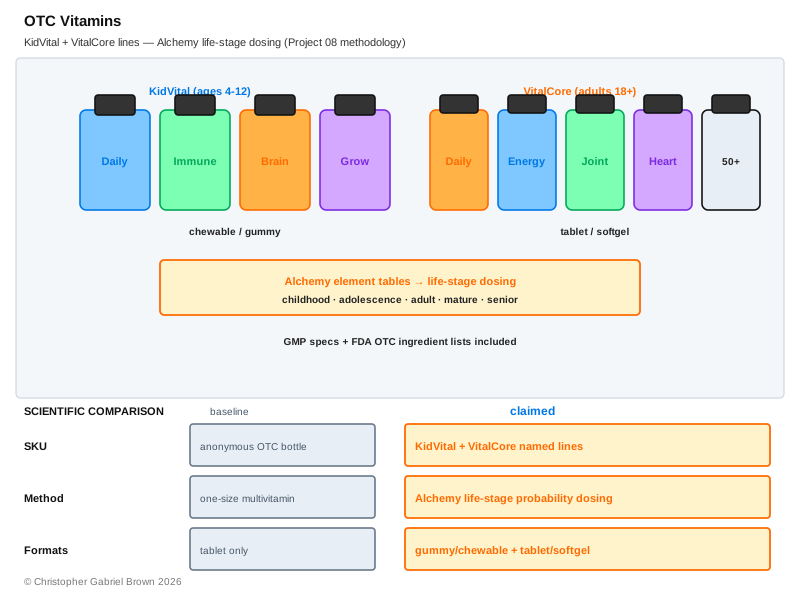
Children's Line — KidVital: Daily, Immune, Brain, Grow. Chewable and gummy formats. No artificial colors, flavors, or high-fructose corn syrup. For ages 4–12.
Adult Line — VitalCore: Daily, Energy, Joint, Heart, 50+. Tablet and softgel formats. For adults 18+.
Plus the master ingredient database, FDA OTC compliance pack, GMP manufacturing spec, label requirements, allergen matrix, both package design sets, the Alchemy life-stage element analysis, the nutrient probability model, and retail-ready brand assets for both brand names.
How it's made
The line was built by computational derivation from the Alchemy probability data and accompanying element tables — files in the inventor's archive (Project 08). For each of five life-stage cohorts — childhood (4–12), adolescence (13–17), adult (18–49), mature adult (50–64), senior (65+) — the data was queried for which elements contribute most to the targeted nutritional outcome at that cohort. Doses were then set by the probability mass each element contributes. Not a round number. A computed number.
Synergistic pairings — vitamin C with iron, D3 with K2, B12 with folate — fall out of the absorption-probability tables when one compound's presence raises another's effective uptake. They were not picked from the literature; they were read off the data.
The output is nine formulations — four KidVital, five VitalCore — each with a master ingredient list, a dose schedule, and a derivation record that traces every number back to the source data.
Why I made it
The same probability-data methodology drives the compound-discovery research elsewhere in this portfolio — research into Parkinson's, Alzheimer's, diabetes, and the 300-disease database. Those targets are urgent, but they are distant from a household: a buyer doesn't usually meet a clinical breakthrough on a kitchen counter.
Vitamins do live on a kitchen counter. They are the daily, ordinary version of the same question — what should a body take, in what dose, at what life stage — and the same methodology answers them.
I built this line so the same numbers could reach a breakfast table, where they can quietly do their work.
What it can do
Nine formulations cover age four to age sixty-five-plus across two delivery formats: chewables and gummies for KidVital (ages 4–12 — Daily, Immune, Brain, Grow); tablets and softgels for VitalCore (adults 18+ — Daily, Energy, Joint, Heart, 50+). The line covers a household's morning vitamin routine end to end.
The acquisition itself contains everything a contract manufacturer or retail buyer needs to begin: the master ingredient database, FDA OTC compliance pack, GMP manufacturing specification, label requirements, allergen matrix, package designs for both lines, the Alchemy life-stage element analysis, the nutrient probability model, retail-ready brand assets for both KidVital and VitalCore, and the investor deck and retail-partnership materials.
A contract manufacturer can take the package and begin a production run. A retail buyer can take it to a shelf.
Why it's a fact
The claims above can be checked against the source record:
- The Alchemy probability data and element tables exist as files in the inventor's archive (Project 08) and are referenced by every formulation in this line.
- Each formulation file contains the per-cohort dose computation that produced it — the derivation is recorded, not asserted.
- The same data has independently produced the disease-mechanism analyses listed on this store's research pages — Parkinson's, Alzheimer's, diabetes, and a 300-disease database. The methodology is in active use on unrelated medical questions, and the same record backs each vitamin label here.
- The FDA OTC compliance pack and the GMP manufacturing specification are completed documents, not aspirations. They ship with the acquisition and can be inspected before purchase.
- KidVital and VitalCore are the brand names included in the acquisition's intellectual-property package, not names invented for this listing.
License Terms — What's Granted, What Isn't
The acquisition grants the buyer permission to make, build, and copy the deliverable. It does not transfer the underlying intellectual property:
- Granted with the acquisition: permission to manufacture (or have manufactured) the formulations; permission to build the resulting products into a contract-manufacturing run, a retail launch, or an investor-pitch deliverable; permission to make copies of the design package for the buyer's engineering, manufacturing, regulatory, and integration use.
- Not transferred with the acquisition: the Alchemy probability data and element-table mathematics behind the formulations; trademarks (KidVital, VitalCore); copyrights; or any rights to license or assign the IP onward to third parties. The intellectual property remains held by Christopher Gabriel Brown.
- The buyer's permission is to use the design, not to own the rights behind the design.
This framing applies uniformly across the inventor's portfolio. Buyers seeking IP assignment rather than make/build/copy permission should contact the inventor directly — that is a separate negotiation outside the standard storefront acquisition.
The brands are new. The dataset is the moat.
The label can be defended ingredient-by-ingredient against a probabilistic record. A competitor wishing to match the methodology would need to reconstruct the element-table mathematics, validate it across the same cohort range, and reconcile it with FDA OTC labelling rules — significant work, not a quick clone.
One acquisition. Two consumer brands. One household, sixty years.
Nine formulations, ready for manufacturing today. Two retail-ready brand names — KidVital and VitalCore — included. Every regulatory, packaging, and partnership artifact a contract manufacturer or retail buyer needs to put bottles on a shelf is already in the package.
The methodology behind the labels is unique in the consumer-vitamin market and cannot be cloned without rebuilding the underlying element-table mathematics.
Firm. Complete formulation, manufacturing-ready. Contact via the store.
879f6a79dfb7e5ea301ba137f1116ec43d3a564790aea1da6ea56357afcab0e7OTC Vitamins for Children and Adults
Publicly online since 2010 · U.S. patent applications since 2012 · inventions offered since 2014. The work of Christopher Gabriel Brown, independently documented.