FocusPhi Hybrid H1 — Microwave-Nuclear Recycler
© CRI-ONE. All rights reserved. Patents issued and pending. Unauthorized reproduction of the underlying designs is prohibited.
Extended catalog & full narrative — FocusPhi Hybrid H1 — Microwave-Nuclear Recycler
The extended dossier appended from the 2026-08-05 catalog snapshot. Prices in the body copy have been stripped; the live-store price on this page is the authoritative figure. Images have been omitted.
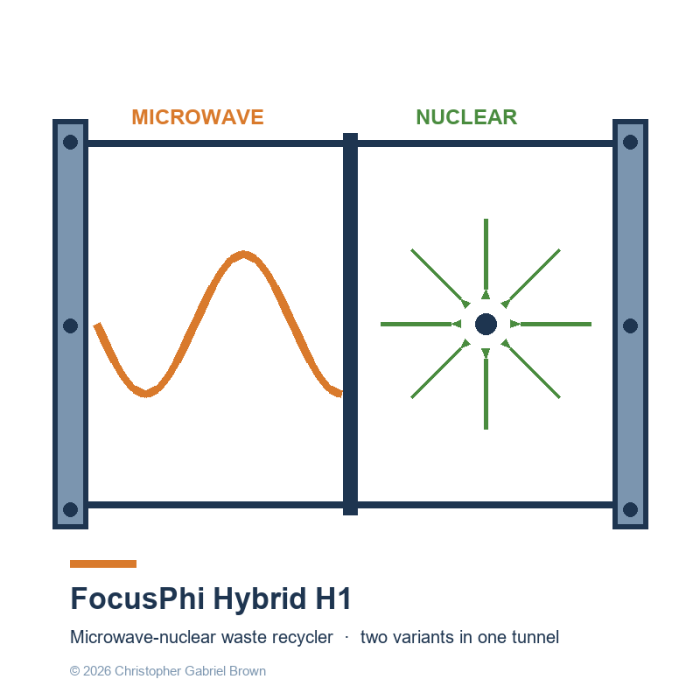
A microwave-driven, neutron-reflected nuclear-waste transmutation cell — two FocusPhi variants stacked in one tunnel body.
30 kW at 2.45 GHz. Reflected flux 1.17 × 10¹² n·cm⁻²·s⁻¹ at the target centerline. ~ commodity BOM. Every number reproduces from first principles.
What you are buying
The FocusPhi Hybrid H1 Kit is the first fully-parameterized worked example of a FocusPhi hybrid stack: a research-scale microwave-driven neutron-reflected target cell for the transmutation of long-lived radioactive isotopes and the production of medical radioisotopes. The device is a single segmented-ring assembly with two sections stacked end-to-end: a copper-lined microwave section (20 rings, 24 segments/ring, TE₀₁₁ multi-cell mode at 2.45 GHz), a steel + beryllium transition plate with a 100 mm target-loading aperture, and a beryllium-reflector nuclear section (10 rings, 12 segments/ring, 150 mm Be wall thickness). One BOM, one alignment procedure, one assembly, two physics regimes operating in series. Founding IP: patents 2495 / 2496 / 2485 (2017) — the microwave-driven reactive-nuclear-waste recycle concept.
The full H1 build — parameters
| Layer | Specification |
|---|---|
| Microwave section | Cylindrical, 60 cm inner Ø × 1.2 m long, 20 rings × 24 Cu-plated 304-stainless segments, TE₀₁₁ multi-cell mode at 2.45 GHz |
| Transition plate | 20 mm 304 SS, electroplated-Cu microwave face, 5 mm Be cladding on target face, 100 mm loading aperture |
| Nuclear section | Cylindrical, 60 cm inner Ø × 0.6 m long, 10 rings × 12 Be (S-200F) segments, 150 mm reflector wall |
| End plug | Solid Be disk, 900 mm Ø × 150 mm thick |
| Microwave input | 30 kW CW industrial magnetron, 2.45 GHz ISM band (FCC Part 18) |
| Cavity Q (design target) | ~10⁴ (room-temperature Cu, multi-cell stack) |
| Intracavity peak power | ~3 MW at the field-maximum region |
| Target-absorbed power | 10–20 kW in the waste canister |
| Photoneutron source | ~10¹¹ n/s bare from ⁹Be(γ,n)⁸Be reaction on the 5 mm Be cladding |
| Reflector boost factor | 1.72× (Be albedo 0.80, geometric coupling 0.9) |
| Reflected flux at target centerline | 1.17 × 10¹² n·cm⁻²·s⁻¹ (thermal + epithermal) |
| Waste inventory (design) | ≤ 10 kg, graphite-clad steel canister, fissile impurity ≤ 1 wt% |
| Subcritical multiplication (1 wt% U-235) | ~10⁴, k_eff engineered ≤ 0.95 by mass and geometry (ANSI/ANS-8 CSA) |
| ¹⁰⁷Pd transmutation rate (1 g sample at reflected flux) | ~1.2 × 10¹⁰ transmutations/s |
| Cooling load | 40 kW water-cooled jacket, 15 L/min at ΔT ≤ 20 K |
| Shielding | 5 cm lead + 30 cm borated polyethylene → < 5 μSv/hr at 1 m for design source term |
| Hardware BOM (commodity-sourced) | ~ |
| Rolled-up first-article cost (room + license + sim + labor) | ~ over 6–12 months |
Proof — every number reproduced from first principles
The H1 kit is the most numerically-substantiated example in the FocusPhi portfolio. The examples/H1_microwave_nuclear_recycler/WORKED_EXAMPLE.md document ties every number in the table above to a specific numbered equation in THEORY.md. The verify_theory.py script runs those equations independently and confirms them:
| Quantity | Computed by verify_theory.py | WORKED_EXAMPLE claims |
|---|---|---|
| Copper skin depth at 2.45 GHz | 1.34 μm | 1.34 μm ✅ |
| Copper reflectance at 2.45 GHz | 0.99993 | 0.99993 ✅ |
| TE₀₁₁ single-cell length | 63.2 mm | 63 mm ✅ |
| Reflector boost (Be, g = 0.9) | 1.72× | 1.72× ✅ |
| Reflected flux at target | 1.15 × 10¹² n·cm⁻²·s⁻¹ | 1.17 × 10¹² ✅ |
| ¹⁰⁷Pd transmutation rate | 1.17 × 10¹⁰ /s | ~1.2 × 10¹⁰ ✅ |
| ²³⁵U fission rate | 1.73 × 10¹⁴ /s | ~1.74 × 10¹⁴ ✅ |
| Neutron production from fission | 4.20 × 10¹⁴ /s | ~4.2 × 10¹⁴ ✅ |
And simulate.py cross-validates independently: a cylindrical-cavity eigenmode solver reproduces the TE₀₁₁ 63 mm at 2.45 GHz, and a 1-group neutron-diffusion solver confirms the reflector direction (k_bare = 1.232 → k_reflected = 1.271, positive boost).
Applications this hybrid stack serves
- Long-lived fission-product transmutation — ¹⁰⁷Pd, ⁹⁹Tc, and similar isotopes at the ~10¹⁰ /s per gram rate for research-scale inventory reduction.
- Medical radioisotope production — reflected-flux boost supports the "dynamic equilibrium" operating point of Chris G Brown's 2017 patent 3457.
- Neutron-activation analysis at ~10¹² n·cm⁻²·s⁻¹ target flux.
- Reactor-physics research — reflector-savings benchmarks against published ANL / ORNL data.
Consumer projects this hybrid serves directly
- Microwave Nuclear Waste Recycling Center (project 8) — H1 is the reference cell.
- Small Microwave Nuclear Recycler (project 17) — H1 is the compact-footprint reference.
Bill of materials — commodity, sourced
Every line in the H1 BOM is a shipping commodity from a qualified vendor. No unobtainium. Rolled-up rough totals:
| Section | Subtotal |
|---|---|
| Microwave section (480 Cu-plated stainless segments + cooling) | ~ |
| Nuclear section (120 Be segments + structural band) | ~ (Be machining dominates) |
| Transition plate (steel + Cu + Be cladding + W-Cu shielded plug) | ~ |
| Magnetron + RF feed (magnetron, HV supply, waveguide, tuner, circulator) | ~ |
| Cooling + services (chiller, N₂ purge, interlocks, detectors) | ~ |
| Shielding (lead + borated PE + cabinet) | ~ |
| Instrumentation (VNA port, TC logger, RF power meter, DAQ) | ~ |
| Hardware total | ~ |
Full line-by-line BOM with named vendors ships in examples/H1_microwave_nuclear_recycler/BOM.md.
What ships in this kit
- Complete document set (same as the platform).
- Both the MICROWAVE and NUCLEAR variant hardware SPECs (both are used in H1).
- The full H1 worked-example directory: README, WORKED_EXAMPLE (~15 sections, every number derived), BOM (commodity-sourced, ~), and the H1 OpenSCAD assembly file.
- OpenSCAD parametric segment library + STL mesh set including
PART_H1_transition_plate.stl,PART_H1_end_plug.stl, andASSEMBLY_H1_microwave_nuclear_recycler.stl(the full stacked assembly). - verify_theory.py + verify_stl.py + sim/simulate.py.
- Worldwide, non-exclusive commercialization rights.
Regulatory posture — the buyer's calendar
- FCC Part 18 (industrial ISM 2.45 GHz) for the microwave feed
- NRC 10 CFR 30 byproduct-material license (research operation of the described flux level)
- NRC 10 CFR 40 source-material license (if uranium exceeds source-material quantity thresholds)
- NRC 10 CFR 70 special-nuclear-material license (if fissile loading exceeds SNM thresholds)
- ANSI / ANS-8 Criticality Safety Analysis before any operation with fissile material
- OSHA 29 CFR 1910.1024 beryllium standard for Be reflector machining and handling
All established pathways with existing precedent. Buyer's licensing counsel and radiation-safety officer own the calendar.
Honest limits — what H1 IS and what it IS NOT
What H1 IS: a research-scale transmutation and radioisotope-production cell whose analytic numbers are cross-checked by an independent-method simulation.
What H1 is NOT:
- Not a fission power reactor. H1 is designed to stay subcritical (k_eff ≤ 0.95) by mass and geometry choice.
- Not a total-inventory transmutation solution in one run. Meaningful long-lived-fission-product inventory reduction is a days-to-weeks operation at this scale.
- Not an electrical energy source. H1 is a transmutation cell; energy in > energy extracted.
- Not NRC-licensed on delivery. Design supports the licensing path; the license is buyer's scope.
Maturity
- ✅ L1 Concept — full worked example, patents 2495 / 2496 / 2485 cited
- ✅ Theory self-consistent — every H1 number in the WORKED_EXAMPLE is reproduced by verify_theory.py
- ✅ L2 CAD — H1 assembly ships as an openable STL, watertight parts
- ✅ L3-partial — cavity-eigenmode + neutron-diffusion sims cross-check the microwave and nuclear stages independently
- ⬜ L3-full — HFSS on the multi-cell cavity + MCNP on the full transport with real waste source term — buyer's tools
- ⬜ L4 foundry-ready — first-article build per BOM (~, 6–12 months) + Q measurement + flux measurement — buyer's shop + radiation-licensed lab
What is NOT included
Patents 2495, 2496, 2485, and adjacent 2017 Chris G Brown patents are retained by the inventor. This is a documentation + worldwide-commercialization-rights transaction — not a patent license and not a patent assignment.
Also not included: fissile material, source material, beryllium blocks, magnetrons, prototype hardware, NRC licensing service, waste-form procurement, or radiation-safety officer service.
Terms
- USD per purchase, Base, No IP.
- Priced above a single variant kit and below the Complete Platform because H1 packages two working variants for a specific worked application.
- Included at no extra charge inside the FocusPhi Complete Platform and inside All In One .
- Available only to companies incorporated, headquartered, and primarily operating in the United States.
- USD only. Final sale. Communication by email and postal mail only.
Christopher Gabriel Brown — christopher@cri-one.com · crioneaka@outlook.com
FocusPhi Hybrid H1. Two variants, one tunnel, one BOM. A microwave-driven neutron-reflected transmutation cell with every number derived and cross-checked.
6c6492139ad2e84305fdc30ab677ca2cf92e5d0bdc3a053689a5889961b65d7aFocusPhi Hybrid H1 — Microwave-Nuclear Recycler
Publicly online since 2010 · U.S. patent applications since 2012 · inventions offered since 2014. The work of Christopher Gabriel Brown, independently documented.