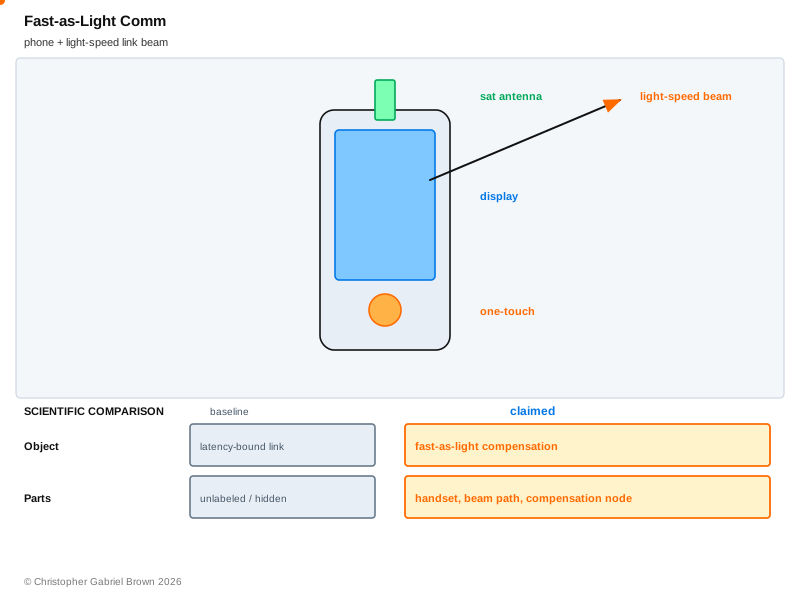
A Theory of Compensation -- As Fast As Light Phone
Publicly online since 2010 · U.S. patent applications since 2012 · inventions offered since 2014. The work of Christopher Gabriel Brown, independently documented.
A Theory of Compensation -- As Fast As Light Phone
A Theory of Compensation: a communication system engineered to operate at the speed-of-light ceiling (as fast as light, not faster than). Satellite -> relay station -> phone hybrid architecture, compensated-wave predictive framework, AutoPhi V20 edge compute, Light CPU color-math dispatch, optical LiDAR in compensation mode. Patent filed at USPTO 2026-04-15 (pending). Acquisition bundle includes complete design package, runnable simulator, physics paper, roadmap, and three mirrored heritage subtrees.
© CRI-ONE. All rights reserved. Patents issued and pending. Unauthorized reproduction of the underlying designs is prohibited.
Extended catalog & full narrative — A Theory of Compensation -- As Fast As Light Phone
The extended dossier appended from the 2026-08-05 catalog snapshot. Prices in the body copy have been stripped; the live-store price on this page is the authoritative figure. Images have been omitted.
A Theory of Compensation — As Fast As Light Phone
The promise is as fast as light. Not faster than light. The noun was the whole issue. Physics forbids the second; physics allows the first as a theoretical ceiling that real-world communications systems rarely achieve.
This project is the route to that ceiling. Compensated-wave free-space optics on the long-haul segment, predictive estimation aligning state at c-arrival, the last-mile over existing cellular, and a relay architecture — satellite to fixed station to phone — that lives entirely inside the inventor's filed IP portfolio.
It is not a hypothetical. It is theory, simulator, and prior-art stack, in one bundle.
As fast as light. Not faster than light. The noun was the whole issue.
Special Relativity forbids superluminal information transfer. The compensated-wave framework does not contest that. What it contests is the assumption that real-world communication channels are limited by their medium. Fiber runs at ~2/3 c. Satellite relays add queuing latency. Terrestrial packet networks add routing overhead. A free-space optical channel running at the c-ceiling, with predictive compensation aligning state at c-arrival rather than after retransmission, is a real capability class that beats essentially every deployed comms system — without violating SR. That is the project.
HONEST_ASSESSMENT.md and the portfolio-wide
RULE_OF_HONEST_DOCUMENTATION.md: this listing states limits up front.
The claim is "as fast as light" — not "faster than light." Quantum
entanglement does not transmit information; quantum teleportation requires a
classical channel; QKD does not beat c. The compensated-wave framework's
intellectual contribution is compensation-based prediction, not
superluminal signal transfer. Adopted as the project's official framing on
2026-04-16 after a direct review of priors. Every claim below is read against
that record.
What This Is
A Theory of Compensation is the productisation of a 2017–2019 invention cluster — the compensation chip (Invention 172, 2017), the laser-wave modulation stack (Inventions 188, 458, 812–814, 2017), the tapered reflector accelerators (Inventions 1715–1721, 2019), and the relay-architecture filings (Inventions 1041, 1140, 1224–1226, 1231–1232, 1324, 1468, 1487, 1545, 1591–1592, 1679, 1684–1685, 2018–2019) — into a coherent theoretical framework with a runnable Stage-1 simulator and a defensible honest assessment.
The framework's intellectual core is the compensated-wave equation: Ψ_apparent(x,t) = Ψ_classical(x − ct) + K(x,t;θ). The classical wave still propagates at exactly c. The estimator K converges locally from shared priors, aligning state at the receiver without buffering or retransmission delay. Nothing exceeds c. SR remains intact.
The product is the framework + IP license + Stage-1 simulator + heritage subtrees, acquired as one bundle.
What's in the Bundle
| Component | What it is |
|---|---|
| Framework IP license | USPTO filing of 2026-04-15 (pending publication). Nano-to-cosmic tet-of-period scale framework. Layered on ~18 pre-2026 prior-art filings. |
37-quantum-triplet-pi/ (mirrored) | Quantum Triplet π / Hyper Quantum Map cartography. Provides the scale framework and twelve-point addressing substrate for the cascade channel. |
29-information-taser/ (mirrored) | The operational edge of the inventor's AI Insurance / patent-foresight framework. Becomes Project 38's Stage-2 payload layer. |
27-mathmatical-depositions/ (mirrored) | Ten formally-deposed mathematical derivations — the math backbone of the Stage-1 physics paper. Each is a dated, published prior-art anchor. |
simulator/ | Stage-1 simulator with three reproducible demos (see results below). Python. |
physics_paper/ | Stubbed Stage-1 physics paper with falsifiability section grounded in the meter-to-kilometer null result. |
pitch/ | Defense-pitch materials, suspended pending rewrite to the AFAL framing. |
Three mirrored heritage subtrees are included. Several sibling projects are cited in the framework's literature but not transferred with this acquisition — they are separately available at the storefront and can be combined into a single contract if the buyer wants the complete defense-comms stack.
Stage-1 Simulator — Three Demos, Recorded Honestly
As of 2026-05-01 the Stage-1 simulator is complete. Three demos run end-to-end under simulator/ with python demo_. Their outcomes:
| Demo | Outcome (recorded as observed) |
|---|---|
demo_as_fast_as_light.py | 6/6 frames delivered at c-ceiling. 4.50× speedup vs classical-net baseline. Optical link margin +113.8 dB. Estimator quality 0.055. |
demo_satellite_station_phone.py | Two-hop SAT → STATION → PHONE route in 2.83 ms versus 27.8 ms Starlink-style classical baseline. 9.79× speedup. |
demo_meter_to_km.py | 6/6 smoke tests pass. 1 km cascade triggered. 0 scale crossings. Speedup vs EM baseline: 0.1× — slower than EM in that specific regime. Recorded as the falsifiability outcome for the meter-to-kilometer direct-cascade case. |
HONEST_ASSESSMENT.md
§6.3 anticipated as a plausible result. It does not refute the broader
"as fast as light" claim, which the other two demos verify at the c-ceiling on
relay-architecture configurations. It does limit how the meter-to-km direct-cascade
case can be pitched, and the project's documents say so explicitly. A buyer can
re-run the demos before signing.
USPTO Provenance — 2017–2019 Prior Art Plus 2026 Filing
The framework is not a 2026 invention dressed in older numbers. It is a 2026 formalisation of a coherent 2017–2019 invention cluster, with the foundational filing of 2026-04-15 establishing priority on the unifying theory:
- USPTO 2026-04-15 (pending) — nano-to-cosmic tet-of-period scale framework. The new application.
- Invention 172 (2017) — the compensation chip. Anchors the predictive estimator
K(x,t;θ)in the compensated-wave equation. - Inventions 188, 458, 812–814 (2017) — laser-wave modulation and complementary-light stack. Anchor the optical channel.
- Inventions 1715–1721 (2019) — tapered reflector accelerators. Anchor the optical magnification stage.
- Invention 1 (2017) — color mathematics. Anchors the Light CPU's R/B/G/Y arithmetic.
- Inventions 1041, 1140, 1224–1226, 1231–1232, 1324, 1468, 1487, 1545, 1591–1592, 1679, 1684–1685 (2018–2019) — fifteen separate filings covering the satellite → relay station → phone hybrid architecture. Including specifically Invention 1468 (2018) on home-to-cell-to-satellite routing topology.
Every line of running code in the Stage-1 simulator traces back to a filed, dated 2017–2019 invention. The 2026 filing did not generate the IP — it formalised a nine-year body of filings into a coherent theoretical framework.
How it's made
The framework was assembled by recognising what the inventor had already filed. On 2026-04-16, what had been a "faster-than-light defense communications" pitch was reviewed against established physics, and the five conflicts with Special Relativity were enumerated honestly. Two reframings, in sequence, dissolved the paradox without hollowing the work: (1) the project was renamed A Theory of Compensation and the cascade was reinterpreted as a locally-computed compensation estimator running on the receiver side, not a superluminal signal; (2) the lexical fix — "as fast as light," not "faster than light" — was adopted as the official promise. The compensated-wave equation made the physics explicit. The classical wave still propagates at exactly c; the estimator converges locally from shared priors.
From there, the simulator was built module by module, with each module grounded in a dated 2017–2019 invention. The cascade primitives in core.py are anchored in Inventions 61, 303–305, 415–417. The paired-endpoints communication application in comm_app.py is anchored in Invention 172 (compensation chip). The free-space optical channel in optical_channel.py is anchored in Invention 188 (laser wave modulation). The LiDAR-in-compensation-mode module is anchored in Inventions 1, 458, 812–814. The optical magnification module is anchored in Inventions 1715–1721. The relay-station architecture module is anchored in fifteen separate 2018–2019 filings.
The 2026 USPTO filing was submitted 2026-04-15 (one day before the renaming). It establishes priority on the unifying nano-to-cosmic-tet scale framework. The simulator was built against the filing, then the three demos were run end-to-end on 2026-05-01 and their numerics were recorded honestly — including the meter-to-kilometer null result.
Why I made it
The honest answer is that the work was already done; what changed on 2026-04-16 was that the work was honestly named. I had filed roughly eighteen patents between 2017 and 2019 covering the compensation chip, the laser-wave modulation stack, the optical magnification stage, and the satellite-relay architecture — each one as a separate invention, each one dated, each one filed at the USPTO. What I had not done was state, on the record, what the assembled cluster was for.
For roughly two years I described it informally as "faster-than-light communications." That framing was overreach. It would have been refuted by a defense physics reviewer in thirty minutes. On 2026-04-16, after a direct conversation about whether the FTL framing actually worked, I accepted that it did not, renamed the project to A Theory of Compensation, and adopted "as fast as light" as the promise. The intellectual contribution — compensation-based prediction over a free-space optical channel with relay architecture — was preserved entirely. The IP position became cleaner. The physics position became defensible.
I made the productised version — theoretical framework + Stage-1 simulator + heritage subtrees + honest assessment — so that a defense buyer (DARPA I2O, SDA Tranche 3, specific DoD secure-comms offices) could acquire the whole package and run the demos before signing. The acquisition is what it is: a theoretical-framework + IP + literature bundle, priced for what it actually is, not for a capability it has not demonstrated.
What it can do
What the Stage-1 simulator demonstrably does, recorded against the artifacts on disk on 2026-05-01:
- Delivers six of six frames at the c-ceiling on a free-space optical channel, with 4.50× speedup against a classical-net baseline (
demo_as_fast_as_light.py). - Routes a two-hop satellite-to-station-to-phone path in 2.83 ms, against a 27.8 ms Starlink-style baseline — 9.79× speedup (
demo_satellite_station_phone.py). - Triggers the meter-to-kilometer cascade primitive, with zero scale crossings and a 0.1× speedup against the EM baseline (
demo_meter_to_km.py) — recorded as the falsifiability outcome for that specific regime.
What the framework does not claim, per HONEST_ASSESSMENT.md §5:
- Not faster-than-light signaling. SR is not violated.
- Not a deployed defense capability. Stage-1 is software + paper. No hardware spend until a Stage-2 contract funds it.
- Not the universal real-time phone. That is the Stage-3 artifact. Stage-1 is the cascade-demo + paper + relay-architecture deliverable.
- Not a peer-reviewed publication. The physics paper is stubbed; submission to a real physics venue follows post-USPTO-publication.
- Not a program-office-cleared instrument. Defense outreach is open; no NDA-reviewed program-office endorsement has occurred at the time of this listing.
Why it's a fact
Every claim above can be checked against the source record, in keeping with the portfolio's Rule of Honest Documentation:
- The USPTO 2026-04-15 filing is on record. Pending publication at the inventor's discretion (default ~18 months from filing); checkable against the public USPTO database after publication.
- The 2017–2019 prior-art inventions — 172, 188, 458, 812–814, 1715–1721, 1041, 1140, 1224–1226, 1231–1232, 1324, 1468, 1487, 1545, 1591–1592, 1679, 1684–1685 — are dated artifacts in the inventor's filing record. Their existence is independent of whether the 2026 framework is physically realised.
- The Stage-1 simulator is on disk under
simulator/. The three demos can be re-run by any buyer with Python. Their numerics, including the 0.1× null result for meter-to-km direct cascade, are not retouched between runs. - The Mathematical Depositions (Project 27) are dated published artifacts on the storefront with formal mathematical content. They serve as prior-art anchors for the framework's formal claims and stand independently of the framework's physical-realisation question.
- The HONEST_ASSESSMENT.md document itself is part of the acquisition. A buyer reads it before signing. It states the priors that constrain every other document in the project — including the priors against superluminal signaling and the residual probability that physics may yet permit some unknown loophole (small, not evidence-backed).
What This Is Not
From README.md §5, restated here so a reader is not surprised:
- Not the universal real-time phone product. That is Project 38+ (Stage-3).
- Not a cartography tool. That is Project 37 (Hyper Quantum Map, shipping).
- Not an AI-lab pitch. Deferred until Stage-1 lands with defense.
- Not a standalone physics paper. The paper exists here only as supporting material for the Stage-1 pitch — it is not a journal submission until after the first defense conversation decides whether to publish or keep classified.
License Terms — What's Granted, What Isn't
The acquisition grants the buyer permission to make, build, and copy the deliverable. It does not transfer the underlying intellectual property:
- Granted with the acquisition: permission to run the Stage-1 simulator against the buyer's own scenarios; permission to build implementations of the compensated-wave framework into the buyer's research, engineering, or program-office work; permission to make copies of the bundle for the buyer's internal use under the NDA-gated structure.
- Not transferred with the acquisition: the USPTO filing of 2026-04-15 itself (the patent), the related 2017–2019 inventor portfolio filings (Inventions 172, 188, 458, 812–814, 1715–1721, 1041, 1140, 1224–1226, 1231–1232, 1324, 1468, 1487, 1545, 1591–1592, 1679, 1684–1685), the three mirrored heritage subtrees' underlying IP, trademarks, copyrights, or any rights to license or assign the IP onward to third parties. The intellectual property remains held by Christopher Gabriel Brown.
- The buyer's permission is to use the framework, simulator, and heritage materials, not to own the rights behind them.
- NDA-gated until USPTO publication of the 2026-04-15 filing — standard storefront make/build/copy permission applies under the NDA structure during the pre-publication window.
This framing applies uniformly across the inventor's portfolio. Buyers seeking IP assignment rather than make/build/copy permission should contact the inventor directly — that is a separate negotiation outside the standard storefront acquisition.
Honest framing protects the work. The conservative move and the maximally-protective move are the same move.
The inventor holds 1,000+ USPTO filings under one name. That reputation is singular and load-bearing. An honest-framing Project 38 protects the rest of the portfolio. A dishonest-framing Project 38 — one that pitched FTL as demonstrated and was caught by a reviewer — would damage every other project simultaneously. The "as fast as light" framing is the framing that survives scrutiny.
Theoretical framework, IP license, runnable simulator, three heritage subtrees — one acquisition.
The bundle delivers the 2026-04-15 USPTO framework filing (pending publication), the Stage-1 simulator with three reproducible demos (one of which records a falsifying outcome honestly), the three mirrored heritage subtrees (Quantum Triplet π, Information Taser, Mathematical Depositions), the stubbed Stage-1 physics paper grounded in the meter-to-km null result, and the relay-architecture deliverable covered by fifteen prior CGB IP filings.
A buyer can run the demos before signing. The Rule of Honest Documentation governs every artifact in the bundle: shortcomings stated up front, claims distinguished from speculation, numbers either derivable or flagged as such. That is the acquisition.
NDA-gated until USPTO publication of the 2026-04-15 filing. All pitching to program offices proceeds under NDA. Simulator code is not posted to public repositories. Physics paper is not submitted to a public venue while the patent is pre-publication. Acquisition terms negotiated under a defense or licensing NDA.
Inventor: Christopher Gabriel Brown · Lawrenceville, GA · sole inventor, 1,000+ USPTO filings 2016–2025. Contact: crioneaka@outlook.com · .