
97-magnetic-torque-transmission
Three articulated transmissions for the 30-plate Autocar torque-plate ring. The plates themselves are the joint. MTT-1 single-plane joint, MTT-2 gimbaled twin-joint, MTT-3 distributed-flexure ring (IP lead). Complete blueprint package: specs, drawings, firmware pseudocode, FMEA, operating envelope, budgets, CAN spec, parametric OpenSCAD CAD source, draft patent claims, honest prior-art verdict, buyer-diligence document, perpetual worldwide non-exclusive manufacturing license. Companion to USPTO 19/439,525 (01 Autocar Platform, pending).
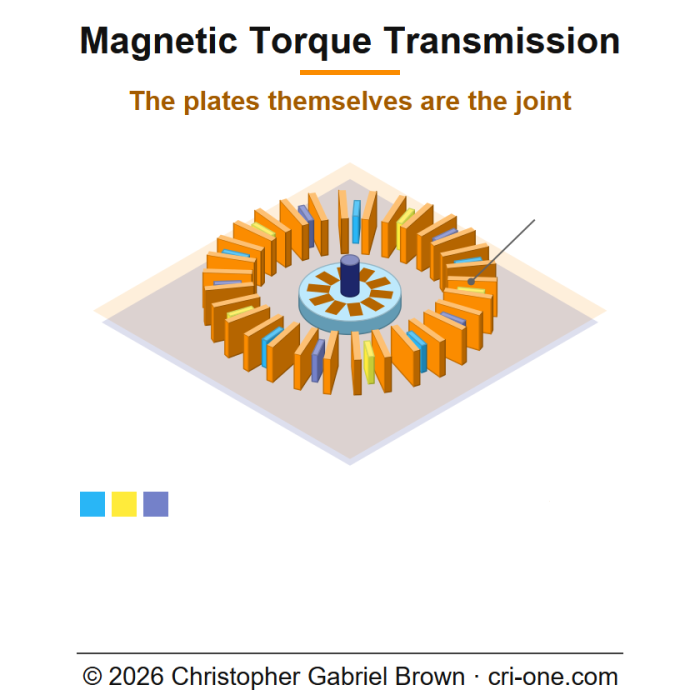
The thirty torque plates that power the Autocar jet already make thrust as hard as anything made, pulling and pushing on one another with impulses round a ring. What it couldn't do until now was bend. The Magnetic Torque Transmission is the first family of jointed versions of that drive — plates that can elbow sideways, swivel through a full forward hemisphere, or ripple round the ring like a muscle. The novelty every member shares: the plates themselves are the joint. There is no bellhousing taking the reaction load, no cradle holding the plates in a cage. The plates bend, and they still make full thrust while they bend. The distributed-flexure member even gains a little extra push from the ripple itself, pumping the air it travels through like a jellyfish bell. Three members: one simple hinge, one full-hemisphere gimbal, one continuously-deformable ring. All built to drop onto the Autocar drive. All with the same brand of engineering care you've seen in the rest of this portfolio.
Complete specifications for all three MTT members, a shared sequencing-logic document (triplet vs double-action, with the reasoning), a 14-section exhaustive engineering blueprint, firmware pseudocode for all three controllers, failure-mode and effects analysis with S/O/D/RPN per component, operating envelope maps across vector angle / altitude / ambient temperature, mass / power / thermal budgets, bit-level CAN specification, build guide across four phases, draft patent claims ready for an attorney, parametric OpenSCAD CAD source for all three members plus the family view, five SVG blueprints, and a machine-readable MANIFEST.
Description
Companion
Builds directly on the 01 Autocar Electronic Automotive Platform (USPTO Application 19/439,525, filed 2026-01-05, pending). Uses 01's existing plate design, 3-phase winding specification, Field-Oriented Control with Space Vector PWM, and liquid cooling loop unchanged. The 150×150×20 mm standard plates work for all three members; the 250×250×30 mm military plate variant is recommended for MTT-1.
MTT-1 · single-plane joint | ~405 kN at ±30° | ~79% | Baseline. Fastest to bench.
MTT-2 · gimbaled twin-joint | ~400 kN at 45° off-axis | ~77% | DoD-adjacent full-hemisphere vectoring with cancelled mount reaction.
MTT-3 · distributed-flexure ring | ~410 kN at ±60° | ~81% | Keeps the flat-ring efficiency through the full vector. The novel IP piece.
Triplet sequencing (MTT-3)
The fifteen pair-flexures divide into three groups of five, actuated 120° out of phase, phase-locked to 01's existing three-phase electrical cycle. This produces a traveling peristaltic wave round the ring. In atmospheric operation the wave pumps surrounding fluid like a jellyfish bell, adding 5-12% secondary thrust on top of the baseline electromagnetic thrust. In vacuum it is a no-op.
Prior-art position
Searched across USPTO, Google Patents, WIPO, and the open technical literature on 2026-10-01. MTT-1 is moderate-risk — distinguishable over flexible electromagnetic robotic joints by emphasizing axial propulsion generated by the hinge plates themselves. MTT-2 is clear as framed, since existing EM-thruster gimbals mount a rigid thruster on an outboard gimbal rather than making the plate stack itself the joint. MTT-3 is clear with no close propulsion prior art — the nearest neighbors are deformable mirrors and soft magnetic muscles, neither of which generate thrust. The parent 01 Autocar platform is not anticipated by any third-party filing surveyed.
Patent position
None of 01's existing claims cover articulation, bending, hinges, or thrust vectoring. The MTT family is cleanly additive to 19/439,525, not duplicative and not conflicting. The buyer takes the blueprint package under a perpetual worldwide non-exclusive manufacturing license; the patents stay with the inventor; prosecution burden stays with the inventor.
Footnotes
- Product number 10338.
- Family: electromagnetic propulsion.
- Purchase: When you buy, you buy the use of that blueprint only.