
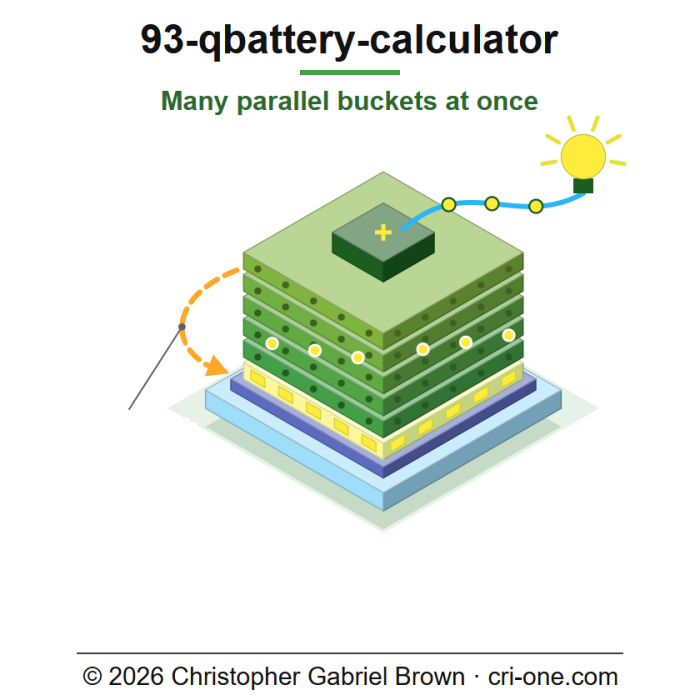
93-qbattery-calculator
Think of a battery not as a can you plug in and wait on, but as a filling curve. A regular battery fills one bucket at a time — one power line in, one bucket getting fuller. A quantum battery, on the same power line, quietly opens many parallel buckets at once, so the same amount of energy ends up stored in a fraction of the time.
Think of a battery not as a can you plug in and wait on, but as a **filling curve**. A regular battery fills one bucket at a time — one power line in, one bucket getting fuller. A quantum battery, on the same power line, quietly opens **many parallel buckets at once**, so the same amount of energy ends up stored in a fraction of the time. This calculator is the desk tool that takes a customer's cell size, capacity, voltage class, colour of light doing the charging, how many parallel paths they want, and what the cell is for — an IoT sensor, a wearable, a medical implant, a smartphone, an EV traction pack, a grid-storage stack — and hands back stored energy, current draw, how long the ordinary way of charging would take, how long the parallel-paths way would take, the speedup factor between them, projected cycle life, cost, and weight. It also emits the paperwork the customer's engineering team actually needs: a validated configuration row and a synthesizable circuit description for the piece of silicon that scavenges leftover energy from the LEDs doing the charging so almost nothing gets thrown away. The buyer's team gets a physics story a procurement officer can read, a schema that covers a hundred pre-validated cell configurations, and a foundry-ready silicon handoff that already plugs into the open-source chip-design flow used by Intel, TSMC, and SkyWater. The physics and the reference implementations behind those numbers are ported verbatim from the inventor's own source and cited step by step — every number the calculator returns has a paper trail, not a black-box shrug — and the specific coefficients that make those numbers reproducible stay with the inventor until an acquisition contract closes.
Description
Details
- Patent posture. Patent-pending on the parallel-quantum-paths charging model, the quantum-speedup metric, the 100-configuration schema, and the LED-power-recycling foundry-handoff RTL emitter, filed under the inventor's own name; specific numbers on file with the inventor and disclosed under diligence NDA. No issued patent numbers yet in this pack; catalog entry lives on the CRI-ONE Magento store as SKU 05-quantum-battery.html.
- Architecture summary (categories only).
- Physics port: photon-energy relation, photon-flux relation, classical charging-time baseline, parallel-quantum-paths charging-time baseline, quantum-speedup ratio, stored-energy relation, current-draw relation, geometry/weight, cost model, cycle-life projection, self-discharge estimate.
- Schema: 100 pre-validated configurations, one seven-input form.
- RTL emitter: synthesizable LED-power-recycling top module with TEG harvester front-end, photodetector harvester front-end, leakage-recovery input path, reverse-recovery pulse-energy input path, boost-converter feedback path, boost-duty output driver, harvest-enable output, and accumulated-picojoule counter.
- Storefront: three named sections — Section A (Quantum Battery Calculator), Section B (Quantum Battery Handoff Bundle), Section C (Enterprise Pricing).
- Revenue modules: pay-per-calculation ($499), mutual-NDA-bound engagement ($499), non-refundable bespoke retainer ($10,000).
- NDA + compliance package: CRI-ONE Mutual NDA v1, U.S. E-SIGN + UETA click-through binding, three-year term, Georgia venue, USA-only enforcement, EAR/BIS awareness.
- Integration surfaces: OpenLane2 with Yosys synthesis; named foundry integration paths — Intel Foundry Services (IFS), TSMC Open Innovation Platform (OIP), SkyWater MPW.
- Sibling domains. The six application presets serve six named commercial and R&D domains: consumer IoT, wearables, medical-device R&D (implant power), consumer mobile handsets, electric-vehicle traction, and utility-scale grid storage.
- Sibling separate sales. Projects 89, 90, 91, 92, 94 each carry their own complete-sale pack; each is a separate sale, cross-referenced but never bundled with this one. Bundling belongs to Project 88 — Fast Bot Data. The tech-source project Project 05 — Quantum Battery is the origin of the physics port, the 100-configuration schema, and the LED-power-recycling RTL emitter; it is cross-referenced as provenance, not bundled into this sale.
- IP retention. IP-retained until close, then transferred cleanly under a signed asset-purchase agreement. Retained-inventor rights (name in provenance, prior-art position, right to reference authorship in future work) survive close.
- Provenance. Christopher Gabriel Brown is the originator and author of the Q-Battery calculator, its physics port, its 100-configuration schema emitter, its LED-power-recycling RTL emitter, its storefront code, its NDA infrastructure, its brand assets, and its outreach records.
More Information
Attribute | Value Manufacturer | CRI-ONE / Christopher Gabriel Brown Product line | qbattery Calculator — Complete Sale Licensing model | Whole-business acquisition, IP-retained until close Deliverable format | Signed asset-purchase agreement; source, storefront, brand and outreach handoff transfer at close Jurisdiction | USA-based buyers only; USD only Warranty | None; numbers are design targets, not warranties Delivery | Email + postal mail only. No phone. Subject line | Project 93 · Q-Battery · Complete Sale Anti-Skynet | See ../88-fast-bot-data/ANTI-SKYNET.md — safe-controlled ICs, driven by directions, no self-reproducing of material, will hold and defend the owner
For the curious
A quantum battery, on the same power line as an ordinary one, quietly opens many parallel buckets at once — and the same energy ends up stored in a fraction of the time. A drone-fleet designer needs to know whether a 12 Wh cell charging in 90 seconds is physically possible or a marketing lie. This calculator answers: yes — at 480 nm across 96 parallel paths, cycle life ~1,200, mass 42 g — and here's the LED-recycling circuit synthesized in Verilog for the chip that runs the show. The design brief gets shorter and the meeting gets shorter with it.
Footnotes
- Product number 10321.
- Family: energy.
- Purchase: When you buy, you buy the use of that blueprint only.