
All In One
All In One is the entire cri-one.com portfolio in one non-exclusive purchase: 92 projects across chips, energy, medicine, environment, communications, defense, software, and more, plus 1,000 IC foundry-handoff designs and 1,755 mathematical depositions. Ask is $5 trillion USD; structured floor is $1 trillion USD. Base, No IP stance: copy and worldwide commercialization rights convey; patents and underlying IP are retained by the inventor. US-incorporated buyers only, USD only, non-exclusive.
Imagine one workshop, one person, ninety-two projects on the bench, from a chip that runs on light to a plan for repairing a dead watershed, and one term sheet that takes all of it. That is All In One. It is a single closing that transfers the entire cri-one.com portfolio to one company: every project in the product documentation plus the two newest, AutoPhi V21 Ascension and the AutoPhi Safety Drivers; every WonderPhi permanent-software licence; all one thousand integrated-circuit foundry-handoff designs; and all one thousand seven hundred fifty-five mathematical formulas stamped into the chips. One term sheet, one closing date, one delivery schedule.
Grouped by what they do, the chips are the load-bearing category: twenty-five projects whose processors run on light and power themselves, with everything else sitting on top. Energy makes power without burning anything, from a battery charged by light trapped inside it to small farms a single building could own. Environment and cleanup mines old landfills and breaks down nuclear waste with tuned microwaves. Health and medicine is eight projects of discovery work: research notes on diabetes, Alzheimer's, Parkinson's, brain chemistry and recovery, letting computed chemistry look where trial and error has not. Every project is designed, documented and ready for its next step: a foundry, a system build, or continued research.
This is for US-incorporated buyers, US dollars only, and it is non-exclusive: more than one buyer can have it. Under the base stance, copy and worldwide commercialization rights convey; the patents and underlying IP stay with the inventor. Between the ask and the structured floor is a conversation; every closing is bespoke.
Valuation
Pre-production blueprint usage right, patent pending, non-exclusive. The analog this product is closest to in the market is full-portfolio IP acquisitions — the entire cri-one.com estate in a single instrument.
Patent landscape
All component technologies retain their individual patent-pending status; the bundle itself is uniquely novel at this scale.
Market opportunity
- Addressable buyer universe: 10–20 global strategic acquirers (Big Tech, defense primes, sovereign funds).
Comparable transactions
- Microsoft → Activision (2023): $68.7B portfolio acquisition.
- AMD → Xilinx (2022): $49B.
- IBM → Red Hat (2019): $34B.
- Nvidia → Mellanox (2019): $6.9B.
Estimated valuation range
Realistic clearing band for a non-exclusive blueprint usage right: $1T (research / single-buyer evaluation) → $5T (strategic non-exclusive with manufacturing / deployment rights).
Listed catalog price: $5,000,000,000,000 — public anchor for direct enquiry; actual clearing price negotiated inside the range above with the buyer, scope (non-exclusive, territory, field-of-use), and milestone structure.
Description
All In One
Every project. One transaction. One closing. One delivery.
Ninety-two projects. One person. One workshop. One transaction to acquire every one of them.
All In One is exactly what the name says: a single closing that transfers the entire cri-one.com portfolio to one company. Every project across all five parts of the About the Products documentation, plus the two newest additions — AutoPhi V21 Ascension and AutoPhi Safety Drivers. Every WonderPhi permanent-software licence. Every one of the one thousand integrated-circuit foundry-handoff designs. Every one of the one thousand seven hundred and fifty-five mathematical formulas that get stamped into the chips. All of it, delivered together, on one term sheet, on one closing date, on one delivery schedule.
The ask is five trillion United States dollars . The structured floor — the lowest number the seller will consider for a milestone-based or joint-venture structure — is one trillion United States dollars . Anything in between is a conversation. Every closing is bespoke.
What is in it, in plain words
Ninety-two projects, grouped here by what they do rather than by what they are made of. Every project is designed, documented, and ready for the next step — foundry production, system development, or research continuation.
Health & Medicine (eight projects)
These projects aim to understand — and ultimately address — diseases that medicine has not solved yet.
- 02 OTC Vitamins. A system for delivering medicine through vitamins you can buy without a prescription. The idea: get healing compounds into your body through something as simple as a daily vitamin.
- 10 Diabetes Discovery. Research into addressing diabetes — not just managing it with insulin, but actually fixing the underlying problem so the body regulates its own blood sugar again.
- 11 Alzheimer’s Discovery. Research into reversing Alzheimer’s — the condition that slowly erases memory and personality. The goal is restoration, not just slowing it down.
- 12 Parkinson’s Discovery. Research into addressing Parkinson’s — the condition that causes uncontrollable shaking and difficulty moving. Same principle: fix it, do not just manage it.
- 13 Disease Research. A broader research effort covering multiple diseases beyond the big three above. The approach uses computed chemistry — letting math find the answers instead of trial and error.
- 22 Brain Chemistry. Studying how the brain’s chemical signals work, with the goal of treating mental health conditions, addiction, and neurological damage at the chemical level.
- 33 Health Recovery. Systems for helping the human body heal faster and more completely after illness or injury. Think of it as accelerated recovery using computed formulas.
- 56 Cessation Database. A database of chemical compounds and methods for helping people quit addictive substances — smoking, alcohol, opioids. The data tells you what combination works for what person.
Energy (five projects)
Making power in new ways — without burning anything.
- 05 Quantum Battery. A battery that charges itself using light trapped inside it. Not solar panels on the outside — actual light particles bouncing around inside the battery, generating power continuously.
- 20 NewStar Cell. An energy cell that mimics how stars make power (nuclear fusion), but at a safe, tiny, controllable scale. A star in a box.
- 32 Quantum Battery Seed Two. The second generation of the quantum battery. Smaller, more efficient, designed to be manufactured at scale. Same concept: light powers itself.
- 48 Private Energy Farms. Small-scale power generation systems that a single building, home, or neighborhood could own and operate — no utility company needed. Energy independence.
- 49 Solo Negative Microwave. A device that uses microwave energy, precisely controlled, to generate clean power from otherwise useless materials.
Environment & Cleanup (ten projects)
Cleaning up what humanity broke.
- 08 Microwave Nuclear Waste Recycling. Using precisely tuned microwaves to break down nuclear waste into harmless materials. The most dangerous garbage on Earth, made safe.
- 15 Landfill Recycling Mine. Treating old landfills as mines — digging them up and extracting valuable materials (metals, chemicals, fuel) from what was thrown away decades ago.
- 16 Chemical Cooker. A machine that breaks down toxic chemicals into safe, usable components using controlled heat and pressure. Poison in, harmless materials out.
- 17 Small Microwave Nuclear Recycler. A portable, smaller version of project 08. Something that could fit in a shipping container and process nuclear waste on-site instead of transporting it.
- 25 Landfill Recycle Center. The full facility design for project 15 — the building, equipment, and processes needed to commercially mine a landfill.
- 34 Environment Restoration. Methods for restoring damaged ecosystems — soil, water, air — using computed chemistry to figure out exactly what is missing and put it back.
- 60 Counter-Chemical Base. A library of chemicals that neutralize pollutants. For every poison, there is a counter-agent. This catalogs them and tells you how to deploy them.
- 61 Outcome Chemical Base. A database that predicts what happens when chemicals meet — if you mix A and B, what do you get? Used for cleanup, manufacturing, and safety.
- 62 Dimensional Compound Discovery. Finding new chemical compounds by computing molecular shapes in three-dimensional space. Sometimes the shape of a molecule matters more than what it is made of.
- 80 Global Landscaping. Large-scale environmental restoration — the plan for how to repair entire regions: deserts, dead zones, polluted watersheds. The big picture.
Computer Chips (twenty-five projects)
The core technology. Chips that run on light and power themselves. This is the largest single category, and it is also the load-bearing one — the chips are what the software, the disease research, the batteries, the satellites, and everything else run on top of. The final two entries (85 and 86) are the newest additions to the portfolio and are not in the older enumeration.
- 02 AutoPhi Modern. The foundational chip design. A computer processor that uses light instead of electricity to do math. This is where it all started.
- 18 AutoPhi Future. The next-generation chip architecture. Everything from project 02, but faster, more efficient, and designed for manufacturing at scale.
- 23 Zetta-Flops. A chip designed to hit “zetta” speed — a one followed by twenty-one zeros operations per second. For context, today’s fastest supercomputers are just reaching “exa” (eighteen zeros).
- 26 AutoPhi On-Demand Two. A chip that can be reconfigured after manufacturing — it adapts to whatever job you give it. Like a Swiss Army knife instead of a single blade.
- 30 AutoPhi On-Demand Three. Third generation of the adaptable chip. Faster reconfiguration, more modes, same idea: one chip, many jobs.
- 31 AutoPhi Electromagnetic IC. A chip that uses electromagnetic fields (invisible force fields) to move data and cool itself at the same time. No fans, no heat sinks.
- 35 AutoPhi Quantum PCIe5. A quantum-powered chip that plugs into a standard computer slot (PCIe 5.0). You could put this in a regular desktop computer.
- 36 WonderPhi. A chip architecture designed for consumer devices — phones, tablets, laptops. All the self-powering light technology, shrunk down for everyday use.
- 37 Quantum Triplet Pi. A chip that uses three quantum particles working together (a “triplet”) to store and process information. Three is more stable than one.
- 39 AutoPhi PCIe5-256. A 256-pin chip card that plugs into standard computer hardware. Two hundred and fifty-six pins means 256 simultaneous data connections.
- 40 AutoPhi BGA-256. Same chip, different package. BGA means the connections are tiny balls of metal on the bottom (Ball Grid Array) — how chips are attached to circuit boards.
- 44 AutoPhi PCIe5-1536. The big version. One thousand five hundred thirty-six pins. Six times more connections than the 256-pin version. For servers and data centers that need maximum bandwidth.
- 45 All AutoPhi Boards. The complete collection of circuit board designs that these chips sit on. Every size, every configuration, ready for manufacturing.
- 50 PCIe 8 Standard. A next-generation connection standard that does not exist in the industry yet. Faster than PCIe 5, 6, or 7. Designed for chips that need more bandwidth than today’s standards allow.
- 53 UniPhi Wide Adapters. Adapter chips that let the new light-based processors talk to older, traditional electronics. A translator between the new world and the old.
- 54 ExitPhi Accelerators. Specialized chips that do one thing extremely fast — they “accelerate” specific calculations. Like a turbo button for math.
- 55 AeroPhi Fractal QBeam. A chip that uses fractal geometry (repeating patterns at every scale) to organize its light pathways. Nature uses fractals in trees, rivers, and lungs — this chip does too.
- 75 1536 Interposer. The “bridge” that connects the 1,536-pin chip to the circuit board. Like an adapter plate that translates between the chip and the board.
- 76 QBeam Transfer. The technology for moving data between chips using light beams (“QBeam”). Like fiber optic cables, but built directly into the chip — no cables needed.
- 77 QPhy PCIe Card. A physical card you plug into a computer that adds quantum-light processing capability. Upgrade any computer with a single card.
- 78 Reflective Tunnel. A microscopic tunnel inside the chip that bounces light back and forth — keeping photons alive longer so they can do more work before fading.
- 83 AutoPhi QBeam 2. Second-generation light-beam interconnect. Faster, lower latency, and the basis for the PhantasmPhi product line currently in the store.
- 84 PhantasmPhi CPU. A complete processor — not just a co-processor or accelerator, but a full CPU that can run programs by itself. Built on all the light-based technology. Ships with eleven included technologies from the chip catalog (QBeam interconnect, reflective tunnel, quantum triplet, ExitPhi accelerator, and seven more) integrated into one working part.
- 85 AutoPhi V21 Ascension. The current top-of-line AutoPhi chip revision. Everything the V18 line delivered, with the performance, thermal, and manufacturability improvements the V21 program was built around.
- 86 AutoPhi Safety Drivers. The newest addition to the portfolio: a family of AutoPhi-based control drivers for automotive and industrial safety systems. Drivers that sit between the AutoPhi chips and the physical actuators, motors, or brakes they command — making the light-based processors usable in the safety-critical control paths cars, trucks, and industrial equipment depend on.
Chip Design Tools (six projects)
Software for designing, verifying, and manufacturing chips. Every chip in the catalog above passed through these tools.
- 57 ChipWrite. Software that writes chip designs. You describe what you want; it generates the layout. Like a word processor, but for computer chips.
- 58 WritePhi Devices. A library of pre-designed components that ChipWrite can use. Building blocks you snap together to make a complete chip.
- 59 VerifyPhi. Software that checks if a chip design will actually work before you spend millions manufacturing it. The quality-control inspector for chip blueprints.
- 67 GDSII Generator. Software that converts chip designs into the exact file format that factories need (GDSII). Like “Export as PDF” — but for chip manufacturing.
- 74 BGA Library Validate. A tool that checks if chip packages (the physical housings) are designed correctly and will connect properly to circuit boards.
- 79 WritePhi 2. Second generation of the chip-writing software. Faster, smarter, handles larger designs.
Data & Mathematics (eight projects)
The formulas and data systems that power everything else. Sitting underneath every chip in the catalog is a corpus of mathematical work called the depositions.
- 07 Alchemy Probability Data. A system that uses probability math (the math of “how likely is this?”) to predict outcomes in chemistry, physics, and medicine.
- 27 Mathematical Depositions. The master list of all 1,755 formulas that get stamped into the chips. Each one is a “deposition” — a formally recorded mathematical statement. This is what makes the light-based chips do work.
- 41 Alchemy Data Three. Third generation of the probability data system. More formulas, faster computations, broader coverage of real-world problems.
- 42 Software-Driven Data. A data storage platform designed specifically for these chips. Not a regular hard drive — one that is optimized for probability math and quantum data.
- 42 Software-Driven SSD. The solid-state-drive variant of project 42 — the same platform, packaged in the industry-standard SSD form factor for slot-in installation on existing systems.
- 63 Prospecting Data. Using math to find valuable things — mineral deposits, chemical compounds, market opportunities. Like a metal detector, but powered by probability.
- 81 Alchemy Calculator. A calculator app that runs the 1,755 deposited formulas. You pick a formula, enter your numbers, get an answer.
- 82 Alchemy Calculator Two. Second generation. More formulas accessible, better interface, can chain calculations together (output of one feeds into the next).
Communications (four projects)
Sending messages and data across distances.
- 06 Super-Dome Communication Blockchain. A communication network built like a dome over a region. Every message is recorded in a chain (like a receipt book) that cannot be altered. Unhackable messaging.
- 07 One-Touch Pagers. A simple device — you press one button, it sends a message. No apps, no passwords, no screens. Press and it is sent. For emergencies, for elderly, for simplicity.
- 19 Communications Satellite. A satellite designed to relay the light-based chip signals from space. Coverage everywhere on Earth, using the same quantum-light technology.
- 38 Fast-As-Light Communications. A system that sends data at literally the speed of light through open air — not through cables, not through fiber. Point-to-point light beams.
Defense & Security (three projects)
Protecting people and nations.
- 04 War Satellite. A defense satellite that can detect, track, and respond to threats from orbit. Uses the chip technology for real-time processing at speeds no traditional computer can match.
- 29 Information Taser. A device that disables enemy electronics without physical damage — like a taser for computers. It stuns machines, not people.
- 52 Defense Data. Classified-grade data processing for military applications. The same chip technology, hardened for combat environments.
Transportation (two projects)
Moving people and things.
- 01 AutoCar Electronic Automotive Platform. A complete electronic system for cars. Not just a chip — the entire brain of the vehicle: sensors, controls, communication, power management. One platform runs the whole car.
- 03 Electric Jet. An aircraft engine that runs on electricity instead of jet fuel. Powered by quantum battery technology. Zero-emissions flight.
Everyday Products (three projects)
Things regular people would use in daily life.
- 09 Smart Shoe Platform. Shoes with built-in electronics that monitor your health (heart rate, blood oxygen, movement) and generate power from your steps. Walk and charge.
- 43 Redaction Pen. A pen that permanently blacks out sensitive text on paper — and also digitally erases the scanned version. Physical and digital privacy in one tool.
- 47 16-Digit American. A new kind of identification system for Americans — a sixteen-digit number that replaces the nine-digit Social Security Number with something more secure and harder to steal.
Manufacturing & Materials (five projects)
Making things and finding new materials.
- 14 Semiconductor Material Discovery. Finding new materials to build chips from. Silicon works, but there might be something better. This project computes which atomic combinations would make ideal chip materials.
- 15 SMD (Surface Mount Discovery). Research into new ways to attach tiny components to circuit boards. The smaller and more reliable the attachment, the better the chip performs.
- 21 Day One Fabrication. The plan for manufacturing the very first physical chip. Day One = the day a factory presses “go” and the first real chip comes off the line.
- 24 Parts Future. Designing the individual components (resistors, capacitors, connectors) that will surround the chips on future circuit boards.
- 28 New Path Heights. Research into making chip pathways (the tiny “roads” that signals travel on) taller instead of wider. Vertical wiring for denser chips.
Software & Platforms (nine projects)
The programs and systems that run on top of the hardware. Together these form the WonderPhi family — a full software stack designed for the light-based chips.
- 64 SellPhi. The commerce platform for selling chip licences. The digital storefront and transaction system.
- 65 WonderPhi Library. A software library (a collection of reusable code) that programmers use to write applications for WonderPhi chips.
- 66 WonderPhi Compute. Cloud computing powered by WonderPhi chips. Like Amazon Web Services or Google Cloud, but running on light-based processors.
- 68 WonderPhi Office. An office software suite (documents, spreadsheets, presentations) that runs on WonderPhi hardware. Like Microsoft Office, but built for light-speed computing.
- 69 WonderPhi Server. Server software that turns WonderPhi hardware into a web server — the kind of machine that hosts websites and runs online services.
- 70 WonderPhi Host. Hosting infrastructure — the system that lets other people rent computing power from WonderPhi hardware over the internet.
- 71 WonderPhi Vault. Secure storage. A digital safe powered by quantum encryption — data locked away so securely that breaking in would take longer than the age of the universe.
- 72 WonderPhi Ledger. A financial recording system — every transaction written permanently and unalterably. Like blockchain, but faster because it runs on light.
- 73 WonderPhi Phone. A smartphone powered by WonderPhi chips. Self-charging (from the quantum battery inside), unhackable (math in silicon), and faster than anything else.
Business & Regulatory (three projects)
Getting the products to market legally and professionally.
- 45 FDA Rebuttals & Ad Work. Legal documents responding to the FDA (Food and Drug Administration) about the medical products, plus advertising materials to explain them to the public.
- 46 FDA to Store. The pipeline from FDA approval to products appearing in the online store. The legal-to-commerce bridge.
- 51 PCIe 8 Standard — Performance. Performance benchmarks and documentation for the PCIe 8 standard — proving it works as fast as claimed. The evidence file.
Also included — the foundry designs and the depositions
Beyond the eighty-four named projects, All In One transfers two large blocks of engineering work that sit underneath them and make them buildable:
- One thousand integrated-circuit foundry-handoff designs. Individual chip layouts, each one already prepared in the format a semiconductor factory needs to press a first physical chip. These are not concepts. They are files a fab could accept tomorrow.
- One thousand seven hundred and fifty-five mathematical depositions. The formulas that get stamped into the chips. Each one is a formally recorded mathematical statement. Together they are what makes the light-based processors actually compute. Without the depositions, the chips are metal. With them, the chips do work.
What conveys — and what does not
Base, No IP.
The acquiring company receives:
- The engineering copy for every project in the portfolio
- The complete documentation — specifications, schematics, source designs, foundry deliverables where applicable
- The one thousand IC foundry-handoff designs
- The one thousand seven hundred and fifty-five mathematical depositions
- Worldwide commercialization rights where applicable
The acquiring company does not receive:
- Patents on any project
- Copyrights on the inventor’s underlying works
- Any assignment of intellectual property
- Any patent licence, express or implied
All underlying intellectual property is retained by the inventor. Nothing in this description is a patent licence or an assignment of ownership. This is the same “Base, No IP” stance every product on cri-one.com is sold under, applied at portfolio scale.
The ask, in numbers
The ask is five trillion United States dollars — $5,000,000,000,000.
The structured floor — the minimum number the seller will consider for a milestone-based, joint-venture, or revenue-share closing — is one trillion United States dollars — $1,000,000,000,000.
Anything between one trillion and five trillion is a conversation about structure, timeline, and milestones. The seller expects offers below five trillion to compensate through structure — equity, milestone payments, revenue share, or joint venture — rather than through simple discount.
For reference, the individual project valuations on the store add up to substantially more than five trillion. The five-trillion ask is a one-transaction discount — the reward for taking the entire portfolio in a single instrument rather than negotiating eighty-four separate deals. The one-trillion floor reflects the minimum the seller will accept as the guaranteed floor of a structured deal whose upside is milestone-based.
Terms of purchase
- United-States-incorporated buyers only. Available only to companies incorporated, headquartered, and primarily operating in the United States.
- USD only. No foreign currency, no cryptocurrency, no barter.
- Email and postal mail only. No phone calls. No brokers. No intermediaries. No agents. Direct correspondence with the inventor only.
- Structure can be tailored to the acquiring organization — asset purchase, non-exclusive licence, joint venture, revenue share, milestone-based closings, or a hybrid of any of the above.
- Non-exclusive. All In One is not sold to one buyer only: a sale does not take it off the list, and other buyers can buy it too. If it is listed, it is available.
- Base, No IP. Every closing carries the stance stated above: copy and worldwide commercialization rights convey; patents and underlying intellectual property are retained by the inventor.
Path to close
- Introduction by email or postal mail. Include the company name, US incorporation state, the primary contact, and a one-page description of the acquiring organization and its intended use.
- NDA and data-room access. Qualified parties receive access to project data rooms for due diligence on the projects that matter to the acquiring organization — including the trade-secret and NDA-gated entries.
- Term sheet. Structure, payment schedule, and milestone map are negotiated in writing. Nothing verbal is binding.
- Executed agreement, closing, and delivery. Complete engineering documentation is delivered on the schedule the executed agreement names, in the format the executed agreement names, to the escrow or storage the executed agreement names.
Why one transaction, not eighty-four
Every project in the portfolio depends on other projects in the portfolio. The chip-design tools consume the chip designs. The nine WonderPhi software products all run on the same WonderPhi chip. The Alchemy Calculator reads data produced by five other projects. The one thousand foundry-handoff IC designs use the one thousand seven hundred and fifty-five mathematical depositions. The AutoPhi lineage extends the AutoCar. Environmental restoration uses the counter-chemical base. The satellites use the chips. The disease research uses the computed chemistry. The batteries use the light-transfer technology. Every part of the estate touches other parts of the estate.
Buying pieces means chasing dependencies. Every piece purchased separately would surface a chain of “you also need this to make it work” that the buyer would have to license one deal at a time. Buying All In One means every dependency is already inside. There is nothing to license separately, nothing to purchase to complete a chain, nothing to negotiate a second time.
The second reason is the transaction cost. Running eighty-four separate negotiations, eighty-four term sheets, eighty-four closings, and eighty-four deliveries is a multi-year enterprise for both sides. All In One is one closing, one delivery, one instrument. The acquiring company takes the entire cri-one.com engineering estate in one motion and allocates it across their own product roadmap on their own timeline, not the seller’s.
The third reason is that the pieces support each other. The mathematical depositions make the chips work. The chips make the software real. The software makes the platforms usable. The platforms make the disease research, the batteries, the satellites, and the cleanup possible. Owning any one part of the chain forces the buyer to license the rest. Owning the whole chain means nothing is missing.
Honest maturity reporting
Every project in the About the Products documentation carries an explicit maturity report. Where a project is unfinished, the entry says so and quantifies it. Some projects are LIVE and running on the store today. Some are foundry-handoff-ready but have not been fabricated. Some are research discoveries whose implementation is still open. Some entries are behind trade-secret and NDA gating — those are visible only to qualified parties inside the data room. The buyer sees the same maturity reports the inventor sees. An honest maturity report is more useful than an optimistic one.
Communication by email and postal mail only. No phone calls, no brokers, no intermediaries.
Available only to companies incorporated, headquartered, and primarily operating in the United States. USD only.
Structure — asset purchase, non-exclusive licence, joint venture, revenue share, milestone-based — can be tailored to the acquiring organization. All In One is Base, No IP : the copy and worldwide commercialization rights convey; patents and underlying intellectual property are retained by the inventor.
Ninety-two projects. One person. One workshop. Every one of them designed, documented, and ready for the next step. Non-exclusive: more than one buyer can have it.
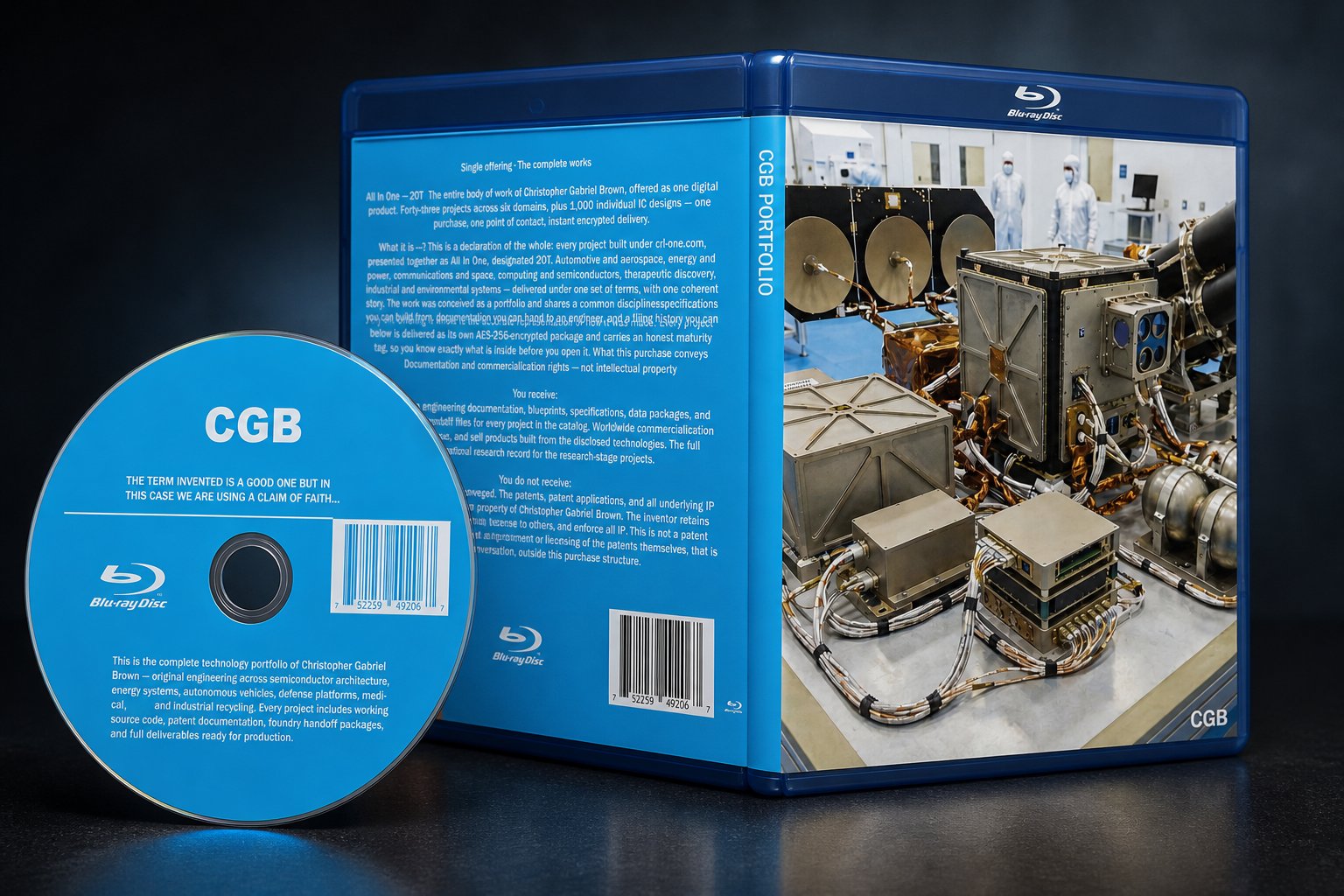
Photo
Footnotes
- Product number 8541.
- Family: none.
- Purchase: When you buy, you buy the use of that blueprint only.