
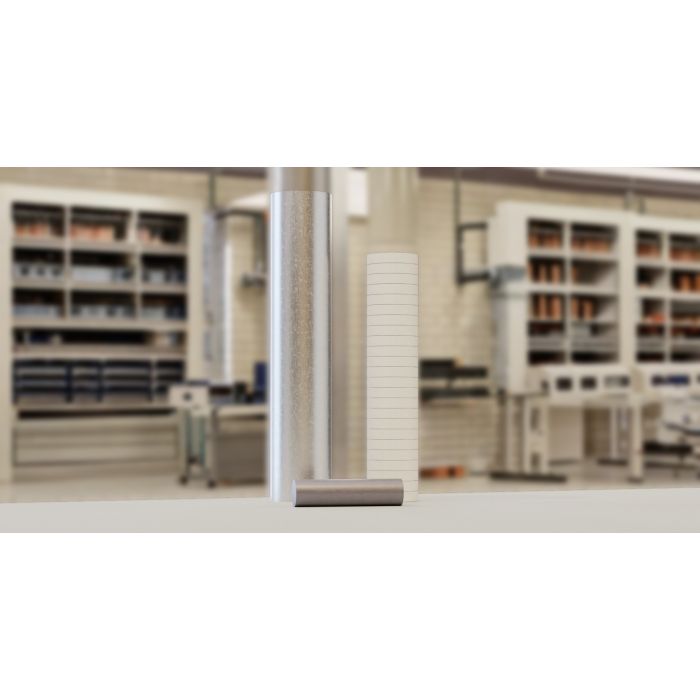
Magnetic Torque Rod
Why you'd want it
Blueprints for receiving rods that take load from the Autocar torque-plate ring and report reaction force, with a manufacturing licence.
- Who it's for: engineering firms building Autocar torque-plate systems that need to capture and measure reaction load.
- The problem it solves: turning reaction load on the ring into usable work, with live force readings for control.
- What you get: blueprints, OpenSCAD CAD, firmware pseudocode, prior-art verdict, perpetual manufacturing licence. Rod A ready; rod B parked.
Two load-coupled receiving-rod options for the Autocar torque-plate ring. The rod can only work if there is work to be done. RTR-A reaction-end rod (shipping) + RTR-B through-ring receiver rod (parked pending IP rewrite, four candidate rewrite frames documented). Complete blueprint package: specs, firmware integration pseudocode, honest prior-art verdict, parametric OpenSCAD CAD source, buyer-diligence document, perpetual worldwide non-exclusive manufacturing license. Companion to USPTO 19/439,525 (01 Autocar Platform, pending). Sibling to 97 MTT.
Explore the store
- PhantasmPhi
- AutoPhi
- ICWritePhi
- PCBWritePhi
- PCBWrite
- WonderPhi
- QBeam
- Normal Resonance Status
- Quantum Battery
- Alchemy
- LAN Lifeline
- OFFICE-RAG
- ScopePhi
- WritePhi
- VerifyPhi
- UniPhi
- ExitPhi
- AeroPhi
- SellPhi
- Seed
- calculators
- PCIe
- BGA
- interposer
- chips
- satellites
- recycling
- microwave
- magnetic
- torque
- resonance
- stencils
- printers
- energy
- fabrication
- hobbyist
- wartime
- read-alongs
- blueprints
- quantum
- FDA
- AI
The thirty torque plates that power the Autocar jet make 440 kilonewtons of thrust, pulling and pushing on one another round a ring. What it has never had, until now, is a way to hear itself work. The Magnetic Torque Rod is a small, elegant trick: a rod that can only work if there is work to be done. When the drive is pushing against nothing, the rod is quiet. When something resists — a headwind, a load, a mountain of air — the rod wakes up and starts generating. Two options come in the package. The reaction-end rod lives at the output face and uses two different materials in one housing to turn mount strain into real-time telemetry and a small amount of recovered power. The through-ring receiver rod runs round the ring through the center of every plate and acts as a hidden transformer secondary that only draws power when a load circuit asks for it — honest heads-up though, that one is parked while the IP position gets rewritten. Both options are passive-until-loaded. Neither drags on the drive when idle. Together they let the Autocar propulsion controller stop running open-loop and start running on measurement.
Complete specifications for both receiving-rod options, the honest prior-art verdict with every citation, four candidate RTR-B rewrite frames inherited at close, firmware-integration pseudocode for RTR-A's feedback loop into 01's power scheduler, parametric OpenSCAD CAD source for both options, buyer-diligence document, blueprint-license form of terms, and a machine-readable MANIFEST.
Valuation
Pre-production blueprint usage right, patent pending, non-exclusive. The analog this product is closest to in the market is ultra-high-performance axial-flux electric drive topology (disc-stacked stators/rotors with extreme torque density); at the aerospace end the closest analog is electromagnetic ramjet / hypersonic launch work (US5052638, US5093313 and derivatives).
Patent landscape
Hypersonic-vehicle filings sit at ~390–760 active families with Boeing holding a commanding share. Automotive axial-flux and in-wheel-motor filings are dense (OEMs file aggressively), but specific plate-stack configurations with novel FOC controller topology still have strong probability of grant.
Market opportunity
- Global electric powertrain market: $81B (2026) → ~$385B (2031) at 19% CAGR (Visiongain).
- Automotive traction motor segment: $34.6B (2026) → $104.2B (2035), with the Above 400 kW tier called out as a growth band (Global Market Insights).
- Addressable buyers: ~20 global OEMs plus top-tier eVTOL / aerospace propulsion houses.
Comparable transactions
- YASA → Mercedes-Benz (2021): axial-flux motor company acquired outright, estimated $150M–$300M. Aerospace rights spun into Evolito separately.
- Li-ion Motors → LEVC (2010): 10-year non-exclusive EV patent license, $6.75M total ($500K/yr + $1.75M lump).
- Toyota open-license pledge: ~24K hybrid patents royalty-free — defensive-moat end of the market.
Estimated valuation range
Realistic clearing band for a non-exclusive blueprint usage right: $2.5M (research / single-buyer evaluation) → $25M (strategic non-exclusive with manufacturing / deployment rights).
Listed catalog price: $569,500,000 — public anchor for direct enquiry; actual clearing price negotiated inside the range above with the buyer, scope (non-exclusive, territory, field-of-use), and milestone structure.
Description
Companion
Builds directly on the 01 Autocar Electronic Automotive Platform (USPTO Application 19/439,525, filed 2026-01-05, pending). Sibling to the 97 Magnetic Torque Transmission family.
RTR-A · Reaction-end rod | Hub output face of the 01 ring, on the central (thrust) axis | Compressive load from external reaction (5-50 kW at typical mission loads) + real-time reaction-force telemetry | SHIPPING. Moderate IP risk; filable with narrow claims.
RTR-B · Through-ring receiver | Round the ring through center bore of all 30 plates | Induced current from the ring's own field, when SiC contactor completes load circuit (100-200 kW) | PARKED. Tubular linear induction motor prior art covers the geometry and the switching trick. Four rewrite candidates documented.
Not mutually exclusive. A full 30-plate ring can host both at the same time.
Prior-art position
Searched 2026-10-01 across USPTO, Google Patents, WIPO, and open literature. RTR-A moderate risk, filable with narrow claims around the dual-material combination plus the feedback-scheduling loop. RTR-B high risk; not recommended for filing as drafted; four rewrite candidates listed in the specification file. The IP ranking changed after the search — RTR-B was positioned as the stronger piece before, then downgraded by the OSTI wound-secondary LIM finding, and the scaffold was honestly updated on 2026-10-01 to reflect that.
Patent position
None of 01's filed claims cover reaction-force harvesting, through-ring induction pickup, or load-coupled passive elements. MTR is cleanly additive. The buyer takes the blueprint package under a perpetual worldwide non-exclusive manufacturing license; the patents stay with the inventor; prosecution burden stays with the inventor.
Footnotes
- Product number 10339.
- Family: electromagnetic propulsion.
- Purchase: When you buy, you buy the use of that blueprint only.
-
 Normal Resonance
Keeps a chip in its safe heat band and cuts power cleanly.
Special Price $105,250,000.00 Regular Price $421,000,000.00 -
 Magnetic Torque Transmission
Jointed transmissions that let the torque-plate ring steer thrust.
Special Price $105,250,000.00 Regular Price $421,000,000.00 -
 Performance Ratio
How hard a layered carrier can safely run, measured and dated.
Special Price $77,000.00 Regular Price $308,000.00 -
 QBattery Calculator
Acquire the Q-Battery calculator that also writes circuit code.
Special Price $21,950,000.00 Regular Price $87,800,000.00
-
 The Fast as Light Comm
Phone signals approaching, never exceeding, the speed of light.
Special Price $485,000,000.00 Regular Price $1,940,000,000.00 -
 Outcome Chemical Base
A ready acid-base data set with 116 pH landmarks.
Special Price $151,500,000.00 Regular Price $606,000,000.00