
100-performance-ratio
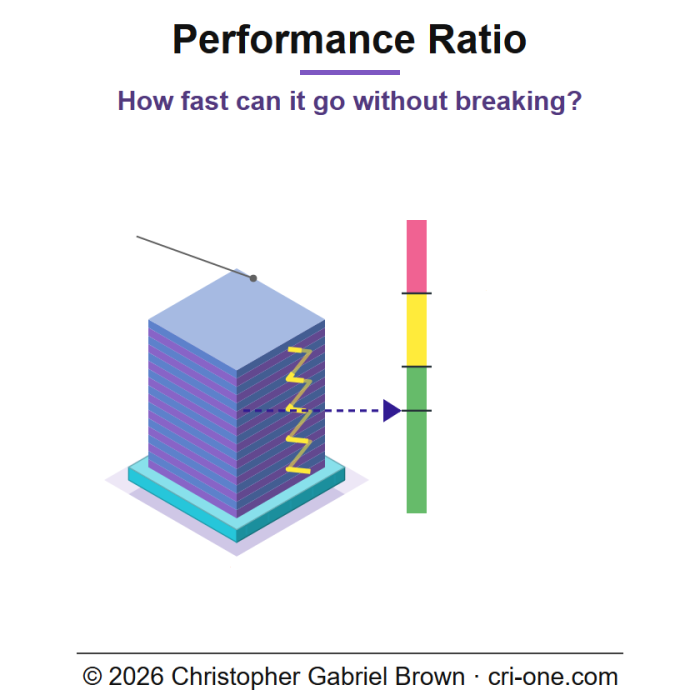
The performance side of a twin pair: a bronze-with-electricity carrier, thousands of layers tall, pinned to one envelope and held by two governors, performance ability and material substance, under a stay-solid condition that is never ridden. Ships with the standard, the recipe, the truth-of-functions brief, and a dated home study that runs the recipe end to end against the thermal partner's envelope and says where the honest cursor stops.
Every chip has a speed it can go, and a speed past which it stops being itself. This project pins the first and refuses the second. The carrier is bronze with electricity running through it; the stack is thousands of layers tall; a cooling partner holds it at a hand's warmth and a power partner feeds it from a bounded reservoir. The study inside asks one plain question, how fast can it go without breaking, and answers with a cursor that walks up the load until the partner says stop at thirty-seven degrees, long before the bronze would ever soften. Then it asks what happens if the partner is lost, and times the answer in milliseconds. Every number is on paper a reader can redo. Nothing was measured; everything was derived, and the record says so on every line.
Project 100 collapses the general 7T Seed ratio of instruction set to calculation into one pinned point, held by exactly two governors: performance ability (what the device can demonstrably do under exchange) and material substance (the carrier it is made of). The declared carrier class is bronze with electricity, built as a thousands-of-layers vertical stack. The one physical goal is to stay solid. Breaking the carrier's thermal ceiling is treated as catastrophic and unrecoverable, so operating points keep a margin to it and never ride it.
Material substance | The floor the class always clears and the ceiling it cannot be pushed past
Lower-of-both rule | Where the two would support different figures, the lower one is quoted; where either is absent, nothing is quoted
Stay-solid condition | The governor's governor: the bracket holds only while the carrier stays solid, with margin
Description
Partners and hosts (cited at the project level)
Thermal partner: Normal Resonance (project 99, standard NRS-1: 30.0 °C reference, 20–40 °C normal band, protector trips above 45 °C, Peltier nano-magnetic cooling, no heat sinks). Power partner: the AutoPhi quantum battery line, read through the published Part III essay as a bounded pulse-power cycler (3.0–4.2 V storage window, 4.5 V hard ceiling, 80–90 % round trip, no amplification). Calc hosts: AutoPhi Future (18) for the seed matrix, AutoPhi Modern (02) for the modern calculator, Alchemy Calc Two (82) for the data processing. Material twin: Semiconductor Material Discovery (14, USPTO application filed 2026-01-14).
The home study: the fastest without breaking
A dated run record (2026-10-02) applies RECIPE.md to the hosts' and partners' own written figures, each input recorded with its source file. Under the NRS-1 drive law the die sits at 30 + 20·u °C, where u is the load as a fraction of the cooler's full-drive capacity: NORMAL ends at u = 0.50, the protector trips at u = 0.75, and with the project's margin M = 0.3 the honest cursor stops at u = 0.35, die 37.0 °C. Bronze's own ceiling is never reached while the partner holds; the carrier only decides how fast things go wrong if the partner is lost (about 40 ms to the 45 °C trip at the honest operating power, seconds to melting). The record gives, per thousands-of-layers generation, the per-layer budget, the honest throughput, the two-sided bracket (public-anchored floor, host-anchored pin, Landauer ceiling), the conduction and adiabatic time-to-break tables, the di/dt ramp limit, the power partner's loss folded inside the thermal envelope, and what the Alchemy calculator says about the two bronze intermetallics.
The brief | README, STANDARD, PRODUCT_BRIEF, SAFE-SCOPE-AND-NOT-DONE, GLOSSARY, TRUTH-OF-FUNCTIONS, SOURCES, RECIPE, RESULTS.html, SMART-PERFORMANCE-CHART.html, MANIFEST.json, _TOC
The home study | RUN_RECORD_2026-10-02.md and .html (charts and table views), inputs_2026-10-02.json, the study script and renderer
The home RAG tooling | homerag/ (SQLite FTS5 retrieval, hybrid search, Claude answer mode, MCP server for Cursor and Claude Code); the buyer points it at their own copy of the folders
The power partner's essay | a fetched copy of Part III — The Architecture, Revealed, with its source URL and fetch time
Designed, drafted, checked in simulation, narrowed, revised. Not built, not fabricated, not measured, not benchmarked on hardware, not externally reviewed, not certified or qualified by any third party. The study is study only: every input is the hosts' and partners' own written figure, public physics, or a declared assumption, and the record marks which. No alloy composition, treatment, geometry, process node, foundry, supplier or named technique beneath the declared class is disclosed.
License posture
What is sold is a licensed copy of the pin and its documentation. The intellectual property, the originals and all design rights are retained by Christopher Gabriel Brown and are not transferred. US organizations; USD; contact by email or postal mail.
Footnotes
- Product number 10341.
- Family: resonance.
- Purchase: When you buy, you buy the use of that blueprint only.