
08-microwave-nuclear-waste-recycling
Asset valuation: $9,000,000,000. Status: Complete Engineering Package - Ready for Construction The Microwave Nuclear Waste Recycling System is a comprehensive facility design for safely and efficiently recycling nuclear waste using advanced microwave technology. The complete package includes facili
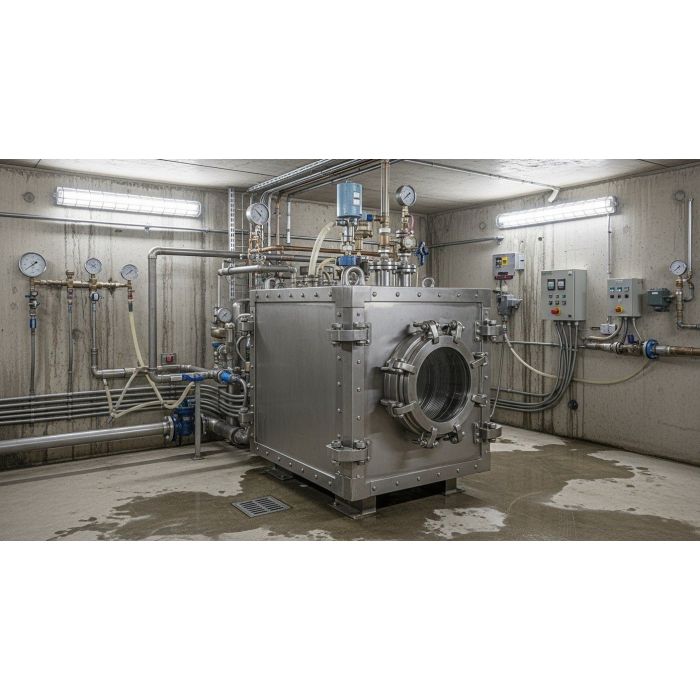
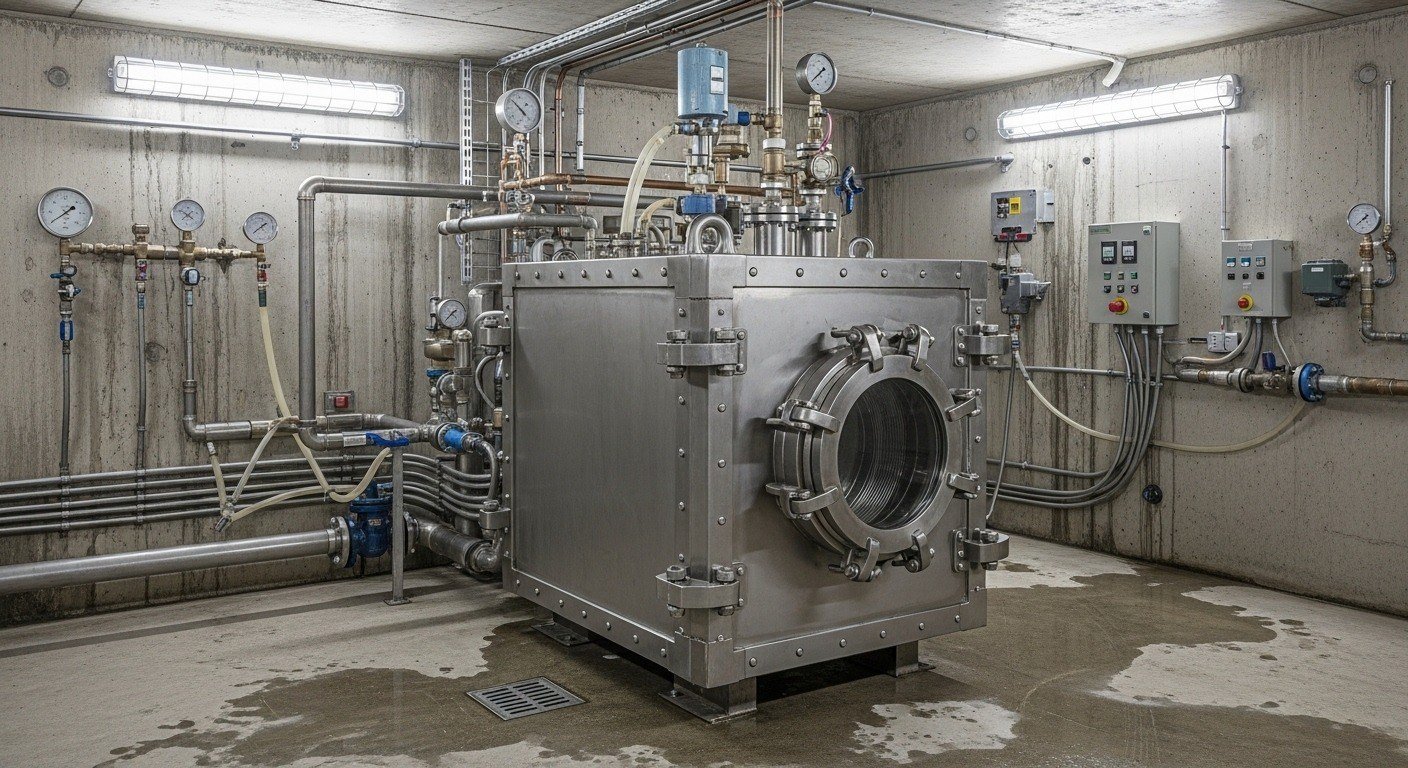
Imagine a sealed room three meters on a side and four meters tall, its walls half a meter thick in layers of boron carbide, lead, stainless steel and microwave-transparent ceramic. Around it sit twenty-four magnetrons in a four-by-six grid, each tunable and phase-locked to the rest. Nuclear waste goes in. The array runs a negative phase to loosen the bonds in the material and a positive phase to push it toward the isotope you want, and it can alternate between the two on a timed cycle. That is the Microwave Nuclear Waste Recycling System, model MWNRS-1000, written up as a complete engineering package, ready for construction.
The plant does three jobs in one building: it produces the medical isotopes hospitals run short of (technetium-99m, iodine-131, molybdenum-99, cobalt-60), recharges depleted uranium to three to five percent uranium-235, and puts out more electricity than it uses while cutting the waste volume by ninety to ninety-five percent. The documentation carries the chamber drawings and material specifications, the emitter-array drawings, and fifteen wave-and-frequency data tables covering isotope targeting, timing sequences, penetration depth, safety parameters and sweep protocols.
This is for an engineering buyer or facility operator who wants the drawings, the tables and the patent position in one place. Three core inventions and eight supporting ones from the register are included, and a non-provisional utility application was filed with the USPTO in December 2025 and is pending examination. The buyer walks away with the full engineering package; Christopher Gabriel Brown remains the inventor and sole owner of record.
Description
Microwave Nuclear Waste Recycling — Complete Engineering & IP Package (SKU 2035)
Invention Nos. #105, #1066, #1067 (core), plus related patents #130, #131, #132, #1402, #1403, #1404, #1405, #141. USPTO Non-Provisional Utility Patent Application 19/419,022 , filed 14 December 2025 (Micro Entity, pending examination) — Automated Energy Recycling and Management System for Nuclear Waste Processing Facilities . Inventor and sole intellectual-property owner: Christopher Gabriel Brown , Lawrenceville, GA, USA. Published reference: Brown, C. G. (2025). Buy-Invent-2025 — Amazon ASIN B0F332TZHD. Model designation: MWNRS-1000 v1.0 . Document-control number: MWNRS-INDEX-001. IP-only pre-operational valuation: US $300–450 million ; single operational facility: $1–3 billion; ten-facility business: $10–30 billion; integrated multi-stream system: $15–50 billion.
Overview
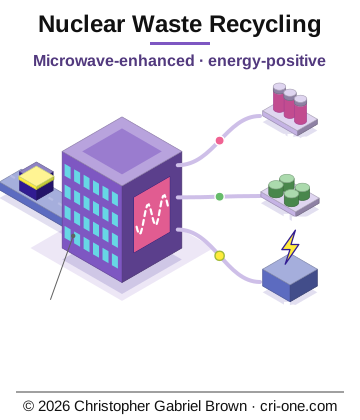
The Microwave-Enhanced Nuclear Waste Recycling & Medical Isotope Production System is the first-of-its-kind integrated facility that transforms nuclear waste into valuable medical isotopes, recycled uranium and clean electricity—all in a single, fully automated, energy-positive plant. The system combines three core inventions (#105, #1066, #1067) covering nuclear-waste recycling into medical-radiology isotopes in dynamic equilibrium, microwave processing of fossilised nuclear waste using negative and positive reactive-wave phases, and microwave-driven uranium recharging of both depleted and non-depleted material. Eight additional patents provide supporting coverage for nuclear smelting, microwave reactor technology, depleted-uranium re-examination, reconstituted nuclear-element regeneration, and precious-metal atom-mining.
The package addresses four global challenges simultaneously: (1) critical medical-isotope shortages (Tc-99m, I-131, Mo-99, Co-60); (2) the nuclear-waste storage crisis (90–95 % volume reduction); (3) uranium-resource conservation (depleted U-238 recharged to 3–5 % U-235); and (4) clean energy generation (0.5–8 MW net electrical output). Five revenue streams—medical isotopes, uranium recycling, waste processing fees, energy sales, and automated-optimisation value—yield projected annual revenue of US $45.2–1,874 million with 25–55 % ROI and a 1.5–4-year payback.
Welding GTAW / TIG, ER316L filler (AWS A5.9), WPS-001 qualified per ASME IX; 100 % visual + PT + RT
Tolerance ±2 mm (±0.08 in)
Magnetron materials 316L housing, thoriated-tungsten cathode, copper anode, NdFeB permanent magnet
Mounting plate (per emitter) Al 6061-T6, 200 mm × 200 mm × 25 mm, ±0.1 mm tolerance, Ra ≤ 0.4 μm
Drawing numbers MWNRS-DWG-003 (plates), MWNRS-DWG-004 (magnetron), MWNRS-DWG-005 (waveguide), MWNRS-DWG-006 (phase shifter)
Negative Phase 915 MHz ± 50 MHz 180° offset 30–100 kW Destabilise nuclear bonds; break molecular structures
Positive Phase 2.45 GHz ± 100 MHz 0° reference 30–100 kW Promote desired reactions; enhance isotope transformation
Alternating 915 MHz / 2.45 GHz 0° / 180° 20–80 kW each Combined destabilise-then-transform processing
Switching frequency: 1 Hz–1 MHz. Phase-modulation timing sequences range from Rapid Alternating (10 ms negative / 40 ms positive, 1 ms transition, 50 ms cycle) through Standard Alternating (100 ms / 400 ms, 10 ms transition, 500 ms cycle) to Slow Alternating (1 s / 4 s, 100 ms transition, 5 s cycle), plus Pulsed Negative (1–10 μs), Pulsed Positive (50–500 μs), Continuous, and Complex Modulation modes. All 24 emitters are phase-locked with independent frequency/phase/power control. The documentation includes 15 comprehensive wave-and-frequency data tables covering primary frequencies, phase-modulation parameters, isotope-specific targeting, waste-type processing parameters, emitter-array configuration, penetration depth by frequency, processing parameters by frequency, phase-modulation timing, frequency combinations for specific reactions, power-density calculations, resonance frequencies for common isotopes, temperature-vs-frequency optimisation, safety parameters, processing-efficiency matrix, and frequency-sweep protocols.
Tc-99m Up to 500 Ci/day Mo-99 decay (66 h half-life) 6 hours 100–1,000 generators/day >99.9 %
Multi-stage purification: (1) Chemical extraction (95 % purity) → (2) Ion-exchange resin columns (99 %) → (3) Distillation / sublimation (99.9 %) → (4) Membrane filtration (99.99 %). Quality control: gamma spectroscopy, mass spectrometry, calibrated ionisation-chamber activity measurement, sterility testing, pyrogen testing (USP standards, FDA-compliant, GMP-qualified).
Separation methods Magnetic (0.5–5 T superconducting), centrifugal (10,000–100,000 RPM, up to 10&sup6; g), chemical (solvent extraction, ion exchange, precipitation)
1 (outer) Lead (Pb), 99.9 % pure (ASTM B29) 100 mm ≥11.34 g/cm³; modular 1,000 mm × 1,000 mm panels, tongue-and-groove joints Gamma radiation attenuation >99.99 % (10 MeV)
5 (inner) Borated polyethylene (5 % B by wt.) 200 mm HDPE + B₄C/B(OH)₃; density ≥0.95 g/cm³; B-10 ≥19.9 % of total B Neutron shielding >99.9 % (thermal to 10 MeV)
Additional shielding performance: Beta attenuation >99.99 %; Alpha containment 100 % (no alpha escape); RF shielding effectiveness >100 dB at 2.45 GHz; RF leakage Waste Classification & Analysis System
Neutron Activation Analysis Source: ¹&sup4;Am-Be or ²&sup5;²Cf; flux 10&sup6;–10&sup8; n/cm²/s; scintillation detectors; ppb sensitivity
ICP-MS Mass range 1–300 amu; resolution
AI Classification Machine-learning algorithm; 10,000+ known waste compositions; 95 % accuracy
Feedback loops Waste input rate, isotope production rate, uranium output rate, temperature/pressure, radiation levels
Steady-state stability ±2 % variation
Processing throughput Waste input 100–1,000 kg/h; isotope output 1–10 Ci/h; uranium output 50–500 kg/h
System uptime ≥95 % availability, fully automated 24/7
Organic Rankine Cycle (ORC; R245fa/Toluene/Siloxane; 10,000–30,000 RPM) 150–300 °C 15–25 % 0.3–2.5 MW High
Thermoelectric Generator (TEG; Bi₂Te₃ modules, 100–1,000 units) 200–600 °C 5–10 % 10–500 kW Very High (no moving parts)
Radioisotope Thermoelectric Generator (RTG; Pu-238/Sr-90/Cs-137) 400–800 °C 5–8 % 5–80 kW Very High (5–50 yr lifetime)
Stirling Engine (Alpha/Beta/Gamma; He/H₂ working gas; 1,500–3,000 RPM) 400–800 °C 25–40 % 2.5–200 kW High
Combined net output: 0.5–8 MW electrical (system is energy positive in all scenarios). Battery storage: 1–10 MWh. Surplus exported to grid. Annual energy value: $1.37–4.99 million (sales + cost savings). CO₂ reduction: 3,000–10,000 tonnes/year.
Optimisation engine Neural network: ≥30 input neurons, 3–5 hidden layers (50–100 neurons each)
Recovery-method selection Automatic, based on temperature (100–800 °C), power level, efficiency, cost
Grid integration Price-based automatic connect/disconnect; revenue-maximising dispatch
Input parameters Reactant concentrations [A]₀, [B]₀ (0.1–100 mol/L); temperature (200–1,200 °C); pressure (1–50 atm); negative/positive phase power & frequency
Supported reaction types U-238 Activation, Tc-99m Generation, Mo-99 Production, I-131 Extraction, Co-60 Production, Uranium Enrichment, Waste Breakdown, Isotope Separation (8 types with calibrated coefficients)
Modified activation energy Eₐ(combined) = Eₐ₀ × (1 − Rₚ × α₋ × P₋ × f₋/f₀ − (1−Rₚ) × α₊ × P₊ × f₊/f₀)
Key functions estimate() , optimize_parameters() , calculate_optimal_ratio() , calculate_yield() , generate_recommendations()
Depleted Uranium 915 MHz / 1.2 GHz 50–100 kW Positive 700–1,000 °C 10–30 atm 6–24 h 100–500 kg
Spent Nuclear Fuel 1.2 GHz / 2.45 GHz 60–120 kW Alternating 800–1,200 °C 20–50 atm 12–48 h 50–200 kg
Low-Level Waste 2.45 GHz / 915 MHz 20–60 kW Positive 200–600 °C 1–10 atm 2–8 h 200–1,000 kg
Intermediate Waste 1.8 GHz / 2.45 GHz 40–80 kW Alternating 400–800 °C 5–20 atm 4–16 h 100–500 kg
High-Level Waste 1.2 GHz / 1.8 GHz 80–150 kW Neg./Pos. 900–1,200 °C 30–50 atm 24–72 h 50–200 kg
Medical Isotope Targets 1.8 GHz / 2.8 GHz 30–60 kW Positive 300–600 °C 5–15 atm 1–6 h 10–100 kg
Uranium Ore 915 MHz / 1.2 GHz 40–80 kW Positive 600–900 °C 10–25 atm 4–12 h 200–800 kg
Transuranic Waste 1.0 GHz / 1.5 GHz 70–120 kW Alternating 800–1,100 °C 25–45 atm 18–48 h 50–150 kg
Support frame 5,000 mm × 4,000 mm × 3,500 mm; 50,000 kg capacity; AISC 360 + ASCE 7 seismic
Radiation monitoring 50+ gamma/neutron/alpha/beta detectors; 8 scintillation detectors (NaI/LaBr₃); continuous real-time
ESD triggers Radiation leak, RF leakage, overpressure (>60 atm), over-temperature (>1,300 °C), loss of cooling, power failure
Fire suppression Automatic CO₂ or FM-200; inert-atmosphere (Ar/He) in processing chamber
Personnel protection Remote operation (100 m distance); robotic handling; real-time dosimeters; interlocked doors
NRC Materials Licence (Category 1); Safety Analysis Report; ALARA radiation-protection programme; NQA-1 quality assurance; security plan; emergency plan
FDA NDA / Abbreviated NDA for medical isotopes; GMP manufacturing; USP purity & sterility; pyrogen testing; radiochemical purity >99 %; radionuclidic purity >99.9 %
EPA RCRA compliance; hazardous-waste handling; air/water discharge permits; emissions monitoring
Design codes ASME BPVC Section III Div. 1; ASME B31.1 (power piping); ASME NQA-1; ISO 9001; ISO 14001; ISO 45001; IEEE 323; IEC 61508; NEC/NFPA 70; AISC 360; ASCE 7
Temperature sensors (Type K thermocouple) MWNRS-DWG-011 12 Inconel 600 sheath, 0–1,500 °C, ±2 °C,
Pressure transmitters MWNRS-DWG-012 4 0–60 atm, ±0.1 % FS, 4–20 mA, 316L wetted parts, linearity/hysteresis/repeatability ≤0.05 % FS
Gamma detectors (NaI/LaBr₃) MWNRS-DWG-013 8 50 keV–10 MeV, ≥30 % efficiency, ≤7 % FWHM, up to 10&sup6; cps; lead-collimated, nuclear-grade cable
Isolation valves (ball, full-port) MWNRS-DWG-014 12 8 × DN50, 4 × DN100; 316L; ANSI Class 600; Class VI leak; electric actuator, fail-closed,
Control valves (globe) MWNRS-DWG-015 6 4 × DN25, 2 × DN50; 316L; ANSI Class 600; Cv 10–100; 4–20 mA positioner; linearity ≤2 %
Cooling jacket MWNRS-DWG-009 1 Double-wall 316L; 50–200 L/min deionised water; 500–2,000 kW heat removal; 20 mm × 20 mm channels
Heat exchanger (shell & tube) MWNRS-DWG-010 1 316L; 50–200 m² heat-transfer area; 500–2,000 kW; ≥85 % effectiveness; 10 atm design pressure
Access ports MWNRS-DWG-002 6 4 × DN150, 2 × DN300; ASME B16.5 Class 600 flanges; metal C-ring gaskets; leak
WR975 (for 915 MHz) 247 mm × 124 mm; copper C11000 ≥99.90 % Cu; 3 mm wall; 5–10 μm silver plating; Ra ≤ 0.2 μm
Phase shifter (digital, per emitter) 0–360° continuous; 0.1° resolution; ±1° accuracy;
E-Waste Recycling Recover Au, Ag, Pt, Pd, Rh, Ru, Cu, Al, Sn, Pb, Zn, Ni, Ta, Ga, In, Ge, REE; 80–97 % recovery; 1,000–10,000 tonnes/day $97–564 M/yr (medium scale)
Gas Recycling & Organic Processing Noble gases (He, Ar, Kr, Xe, Ne) + process gases (N₂, H₂, O₂); cryogenic distillation, PSA, membrane separation; 85–95 % efficiency; biogas, bioethanol, compost, biochar $135k–314 M/yr
Water Recycling Sewage & river-water treatment via microwave-enhanced technology; nutrient (N, P, K) & metal recovery; high-quality recycled water Included in operational savings
Additional Byproducts Vitrified ceramics, carbon/graphite products, fibre-optic materials, composite materials, recycled plastics/polymers, environmental credits $0.9–31.5 M/yr (gases alone)
Critical spares (Level 1) MWNRS-EM-001 Magnetron ($50k), MWNRS-EM-007 Phase Shifter ($25k), MWNRS-PC-005 Chamber Lining ($100k), MWNRS-CS-002 Heat Exchanger ($80k), MWNRS-SS-001 HPGe Detector ($40k), MWNRS-SS-004 ESD System ($25k) ~$785,000
Recommended spares (Level 2) MWNRS-IN-001 Temp Sensor ($500), MWNRS-VL-001 Valve DN50 ($3k), MWNRS-EL-003 Transformer 500 kVA ($15k), MWNRS-ME-002 Mechanical Seal ($1k) ~$120,000
Consumables (Level 3) MWNRS-FL-001 Cooling-water filter ($200), MWNRS-SG-001 Door seal DN150 ($500), MWNRS-EC-001 Fuses ($50), MWNRS-IC-001 Calibration gas ($500) ~$24,000/year
Part-number system: MWNRS-XX-XXX where XX = system code (EM Emitter, PC Chamber, CS Cooling, CT Control, SS Safety, IN Instrumentation, VL Valves, EL Electrical, ME Mechanical, FL Filters, SG Seals/Gaskets, EC Electrical Consumables, IC Instrumentation Consumables).
Manufacturing cost per system $15.5–39 M (materials $8–20 M, labour $4–10 M, overhead $2–5 M, testing $1–3 M)
Welding procedure WPS-001: GTAW of 316L; ER316L filler; DCEN; Ar 99.99 %; interpass ≤150 °C; qualified per ASME IX
NDT requirements 100 % visual + PT (Art. 6) + RT (Art. 2); UT per requirements (Art. 4); 100 % helium leak testing; Level II ASNT-TC-1A personnel
Assembly tolerances Alignment ±2 mm; squareness ±1 mm/m; level ±1 mm/m
Facility requirement ASME Certificate of Authorisation (Nuclear Components); ISO 9001; clean-room ISO 7; 5-axis CNC; TIG/MIG/EBW; CMM
Six training modules with detailed lessons, materials inventory, and certification examinations are included in the package.
Annual operating costs $7.05–24.72 M (personnel $3.1–7.12 M; utilities $0.25–1.7 M; materials $2.5–11 M; maintenance $1–3 M; regulatory $0.2–0.9 M)
Throughput 90 % of rated capacity Continuous monitoring Performance credits or equipment replacement
Isotope yield ±5 % of specification Activity measurement Performance credits or process optimisation
Product purity >99 % for medical isotopes Chemical analysis Process adjustment or product rejection
System uptime ≥95 % availability Operating time / total time Service credits or extended warranty
Energy generation ±5 % of specification Power output monitoring Performance credits or system optimisation
What Is in the Package
The deliverable totals 172 files across three directories ( blueprints/ , patent-receipts/ , sales-pitches/ ) and comprises:
File Type Count Content
Markdown documentation (.md) 104 Core system spec, regulatory suite (SAR, EIS, Security Plan, Emergency Response, Cybersecurity, Waste Management), operational manuals, QA plan, risk assessment, detailed test procedures, manufacturing specs, electrical schematics, foundation drawings, spare-parts catalogue, training materials (6 modules), customer proposals, warranty/service templates, business valuations, product-development roadmap, glossary, master index, IP-technology mapping, patent analysis, elemental recycling analysis, additional byproducts, gas recycling, water recycling, integrated system overview, FEED package, detailed engineering package, EPC execution plan, target-customer analysis, product-disclosure document, contact information, and more
HTML interactive tools (.html) 22 ROI Calculator, DVD Navigation Menu, Facility External View, Comprehensive Sales Summary, Facility Location Analysis, Executive Summary, Comparison Matrix, Timeline Visualisation, Product Descriptions, Store Product Description, Vault Delivery Instructions, 10 Proof-of-Function demonstrations
SVG engineering drawings (.svg) 19 System diagrams (2D, 3D, cutaway, process-flow, scientific realistic, scientific cross-section), facility illustration, manufacturing drawings (chamber assembly, emitter array, P&ID, electrical schematic, foundation), engineering-package diagrams (structure, flow, documents, detailed drawing), patent Figure 1 system architecture
Python software (.py + .pyc) 4 automated_energy_recycling.py (928 lines, production-ready), chemical_balance_estimator.py (object-oriented, 8 reaction types), generate_tower_recycle_center_png.py , compiled cache
PDF files (.pdf) 5 USPTO receipt N417-19419022, PTO/AIA/34, PTO/SB/16, PTO/SB/01, Fee Transmittal (all filled, filed 14 Dec 2025)
Text files (.txt) 7 Abstract page, USPTO patent application text, fee transmittal form, oath/declaration, light-trigger reference, new text document
DOCX 1 Utility Patent Application — Automated Energy Recycling (formatted for USPTO submission)
PNG 2 Tower recycle-centre rendering, additional illustration
Sales-pitch package 8 .md + 12 .html Investor pitch deck, licensing proposal, sales package, complete-package-sale guide, individual-sales guide, outreach e-mails, sales summary, master price sheet, agreement tracker, communication policy, NDA e-mail campaigns, 10 Proof-of-Function interactive demonstrations
Estimated total documentation: 2,000+ pages across 50+ structured documents. FEED package alone: 50–100 drawings, 20–50 documents, 500–1,000 pages. Detailed Engineering package: 500–2,000 drawings, 200–500 documents, 5,000–15,000 pages, 5–50 GB 3D plant model (10,000–50,000 components).
How this is delivered
This package ships on a single Blu-ray disc, posted to the delivery address on your order. The archive on the disc is AES-256 encrypted; the passphrase is sent separately, by email, once the disc is despatched — so the disc alone is of no use to anyone who intercepts it.
Discs are despatched by tracked, signed-for post. Allow 5 business days for mastering and verification before despatch.
© 2026 Christopher Gabriel Brown
Photo
Footnotes
- Product number 8454.
- Family: microwave energy recovery.
- Purchase: When you buy, you buy the use of that blueprint only.