
80-global-landscaping
Asset valuation: $6,000,000,000. By Christopher Gabriel Brown · Copyright © 2010–2026 · Patents issued and pending · All prosecution and enforcement rights retained by the inventor. Resolved this session: the environmental-landscaping program is
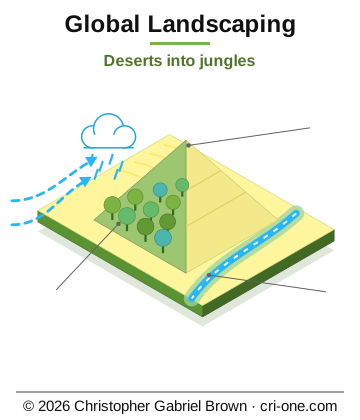
Think of a mountain as a machine for making rain. Moist air climbs the windward face, cools, and drops its water; the far side goes desert or valley depending on the geometry. In 2017 the inventor set down one sentence in his depositions: build a mountain of debris on a desert and you have installed a precipitation valve. The windward face grows a forest inside a decade, the leeward valley becomes the drainage, and the desert turns into a jungle by geometry alone. This package is that sentence unpacked at every scale.
It is a versioned, cross-joinable environmental corrective-controller database. It starts at the lawn under your feet - forty million U.S. acres producing nothing edible - and climbs through watershed, pond, river and ocean to the planet's oxygen-carbon-hydrogen budget and the making of new land where the coasts will not hold. Underneath sits the reservoir-flux frame Sydney Chapman derived for stratospheric ozone in 1930, extended to every element cycling between air, water, soil and biomass. Every claim joins back through the ledger to a peer-reviewed source or an IP filing. Nothing floats.
It is for engineering buyers and licensees who plan land, water and air. They walk away with the eleven-table database, seven essays totalling over ninety thousand words, fifty-six documented chemical reactions, the HydroPhi chip block diagram, four browser apps, two Python simulators, three live-data adapters and a SHA-256-verified manifest, offline on any laptop. The inventions are anchored in depositions from 2017 to 2019; all prosecution and enforcement rights stay with the inventor.
Description
80 — Global Landscaping & Environmental Corrective-Controller Database (SKU 2111)
Inventor: Christopher Gabriel Brown · Status: U.S. patent applications filed; inventions publicly online since 2010; U.S. patent applications since 2012; inventions offered since 2014. Anchored in U.S. invention depositions from 2017–2019 under the “80-global-landscaping” heading. All prosecution and enforcement rights are retained by the inventor. Copyright © 2010–2026 Christopher Gabriel Brown, CRI-ONE.
Overview
The 80-global-landscaping package is the complete, versioned, cross-joinable environmental corrective-controller database that takes the practice of landscape decision-making from the lawn under your feet to the ocean floor to the oxygen–carbon–hydrogen budget of the planet, and to the deliberate creation of new land where the coasts we have will not hold. It is an end-to-end auditable system: every claim on any product page joins back through the ledger to a peer-reviewed source or an IP filing. Nothing floats.
Built on the reservoir-flux frame Sydney Chapman derived for stratospheric ozone in 1930 — extended by this database across every element that cycles between air, water, soil, and biomass — the package delivers:
- Words — seven companion essays totalling over 90,000 words of synthesis, from the lawn-to-ocean narrative to per-install performance sheets.
- Blueprints — engineering artifacts including the HydroPhi chip block diagram (SVG & printable HTML), cascade simulators, and live-data adapters.
- Equations — 56 documented chemical reactions from lab bench to stratosphere, each traced to its hypothesis, its actuator, and its scientific source.
- Coding ability — four browser apps, two Python simulators, three live-data adapters, a package builder, and a SHA-256-verified manifest system — all wired together and running offline on any laptop.
The Seed Idea (2017)
“Ecology-scale landscaping will change deserts into jungles by that mountain of debris built by synthesizing a mountain and valley precipitation valve.” — C. G. Brown, deposition entry 1111, patent #2451, 2017.
That single sentence is what this entire package unpacks. A mountain range is a precipitation machine — moist air is forced up its windward face, cools, drops its water on the near slope, and the leeward side becomes either a rain-shadow desert or a river valley depending on the geometry. Building a mountain out of accumulated debris on top of a desert installs a precipitation valve . The windward face grows a forest inside a decade. The leeward valley becomes the drainage. The desert is converted into a jungle by pure geometry against the atmosphere’s water. Everything in this package is a scaling exercise on top of that idea: from the lawn to the ocean to the troposphere, and the decisions at every scale accumulate into the decisions at every larger scale.
The Continuous-Scale Frame
Environmental landscaping is the practice of deciding what the ground — and the water and the air above it — is allowed to be, and what has to be built to compensate for what it is not allowed to be. This package documents that decision at every scale:
Scale Domain Key Insight
Lawn Residential ~40 million acres of U.S. lawn — the largest single “crop” by area, producing nothing edible, sequestering less carbon than the field it replaced. A lawn is a decision.
Neighborhood Watershed 10,000 lawns is a watershed. If 30% were native prairie, the retention pond shrinks by one-third. The pond is a materialisation of what the lawns refused to be.
Reservoir & Pond County Ponds are biological converters — the tissue between the lawn and the river. Synthetic underwater current makers (deposition 166, patent #3396) refresh stagnant ponds to prevent algal overload.
River & Delta Basin / State Watershed restoration: removing obsolete dams, reconnecting floodplains, rebuilding sediment loads. Louisiana’s Mid-Barataria Sediment Diversion is the canonical example.
Ocean Basin / Planet Four simultaneous ocean-landscape systems: coral reefs, estuaries & mangroves, pelagic dead zones, currents & deep sea. Offshore submerged ocean-current electric generators (depositions 478/479/481, patents #3084/#3083/#3081).
Atmosphere Planet The O/C/H ledger: photosynthesis, carbon sinks, water cycle. The three elements the planet actually accounts for. Condensation water farms (depositions 529 & 530, patent #3033). Microwave ecology (deposition 1707, patent #3715).
New Land Planet Deliberate land creation — polders, artificial islands, sediment diversions, precipitation-valve mountains. The 2017 seed (deposition 1111, patent #2451).
IP Foundations — Depositions & Patents
The following inventions are anchored in this package. All were filed by Christopher Gabriel Brown between 2017 and 2019:
Deposition Patent # Year Invention
1111 2451 2017 Ecology-scale landscaping — deserts to jungles via a mountain-and-valley precipitation valve
310 3252 2017 Plastic degradation & incineration for electricity with sooty-carbon commercial by-product
163 3399 2017 Water cycle / data cycle analogy — fresh-water storage as server, sea water as worldwide data, tides as sync clock
529 & 530 3033 2017 Condensation water farms — cooling and heating the air to generate water where rainfall is scarce
478, 479, 481 3084/3083/3081 2017 Offshore submerged ocean-current electric generator farms (single, farm-scale, centrifugal-force variant)
1707 3715 2019 Microwave ecology — light particles and oxygen from microwave stable and unstable optical combustion
The core of this package is a structured, cross-joinable database of every claim the environmental-landscaping programme makes. Every row in every table cross-joins to the row that anchors it. No claim floats.
Table Rows Purpose
studies.csv 37 Anchor citations: project IP filings, peer-reviewed papers, agency reports, case studies. Every claim traces to a row here.
accruments.csv 19 Measured or target outcomes — hectares of wetland restored, gigatons of carbon fixed, kilometres of coastline added. Each linked to a study.
elements.csv 42 Global reservoir inventories for O · C · H · N · P · S · Si · Fe — with mass (Pg), residence time (years), and source citation per row.
probabilities.csv 40 Top-10 compounds per category from the Alchemy Probability Database (metals, gases, objects, solvents) with formula, novelty score, probability, hardness, cost, and uses.
planet.csv 12 Earth’s layers: atmosphere, ocean, cryosphere, biosphere, freshwater, continental crust, oceanic crust, mantle, outer core, inner core, whole-Earth totals, and the 20 km habitable envelope.
hypotheses.csv 29 Proposed interventions: element × reservoir × mechanism × probability × actuator. From dissolved-O 2 restoration (p=0.95) to precipitation-valve mountains (p=0.15).
reactions.csv 56 Chemical actions from lab to stratosphere. Each reaction carries equation, scale, catalyst, rate note, actuator ID, hypothesis ID, and study anchor.
cascades.csv 16 Chained pipelines where one actuator fertilises the next. The canonical cascade: AtmoPhi → OzonePhi → AquaPhi. The full four-actuator loop: AtmoPhi → OzonePhi → AquaPhi → HomePhi.
valuations.csv 14 Row per product × damage class, with annual damage cost, NPV of avoided damage, value-of-information band (1–5%), current proof state, next proof step, proof cost, and valuation lift.
vocabulary.csv 22 Colloquial symptom (“the river is dead”) → technical mechanism → actuator lookup. The corrective controller’s natural-language entry point.
per_install.csv 15 Per-unit throughput, energy (kWh/day), CapEx, OpEx, and per-element flux for each actuator.
The Four AutoPhi-ENV Actuators
Four engineered environmental actuators sit beneath the corrective-controller frame. Each handles a different segment of the O/C/H/N/P/S elemental ledger:
AquaPhi — River Water Restoration System (AUTOPHI-ENV-AQUAPHI-34)
Fe flux (heavy-metal recovery) +33 kg total heavy metals/yr (Fe 3 O 4 @DMSA nanoparticle EM capture)
O flux (dissolved-O 2 lift) +1,460 kg O 2 /yr (+4 mg/L average DO lift)
Key reactions Fe 3 O 4 @DMSA + Pb 2+ → Fe 3 O 4 @DMSA-Pb; NH 4 + → NO 3 - → N 2 ; O 3 + H 2 O → O 2 + 2 ·OH; Al 3+ + PO 4 3− → AlPO 4
Native scale Watershed — 1 module fixes 1 river reach in days; 50 modules reverse hypoxia across a state’s rivers in ~1 year
AtmoPhi — Air Smog Remediation System (AUTOPHI-ENV-ATMOPHI-34)
S flux (SO 2 scrubbing) −25 kg SO 2 /yr (wet-limestone FGD, 95% removal; ~1,000 kg gypsum by-product/yr)
Key reactions NO + O 2 + hν → NO 3 − on TiO 2 ; CaCO 3 + SO 2 + ½ O 2 + 2 H 2 O → CaSO 4 ·2H 2 O + CO 2 ; CH 4 + ·OH → CH 3 + H 2 O
Native scale Point source / airshed — 1 unit at a freeway ramp measurably cleans local air the same day; 240 units deliver 1% of a city’s NO x
OzonePhi — Reverse Calvin Cycle Cu-Al Ozone Purifier (AUTOPHI-ENV-OZONEPHI-34)
Key reactions 2 KOH + 5 O 3 → 2 KO 3 + 5 O 2 + H 2 O; Chapman cycle (O 2 + hν → 2 O; O + O 2 + M → O 3 + M); CO 2 + Cu-Al → Cu-Al-CO 3 (“reverse Calvin” analog)
Native scale Stratospheric O 3 restoration — ~50,000 production-scale reactors for 1% of global O 3 production; precedent: Montreal Protocol ($40B, 30-year visible recovery)
HomePhi — Complete Home Infrastructure System (AUTOPHI-ENV-HOMEPHI-34)
C flux (CO 2 avoided) −5,600 kg CO 2 /yr (80% cut via rooftop solar + battery + heat-pump HVAC)
Subsystems Mini-AquaPhi (grey-water/rainwater), mini-AtmoPhi (HRV + CO 2 + PM 2.5 + VOC), mini-OzonePhi (in-envelope O 3 disinfection), plus rooftop solar + battery + smart-breaker + HVAC + composting + telemetry
Key reactions 2 H 2 O + energy → 2 H 2 + O 2 (electrolysis); 2 H 2 + O 2 → 2 H 2 O + energy (fuel cell); C 6 H 12 O 6 + 6 O 2 → 6 CO 2 + 6 H 2 O + heat (aerobic composting)
Native scale Household → neighbourhood → national. 1 million households = 5.6 Mt CO 2 /yr avoided (~0.1% of U.S. anthropogenic emissions). 2.5 million households = 1% of U.S. flux — comparable to DOE Weatherisation programme (7 M homes since 1976).
Cross-Actuator Cascades
The four actuators are not independent. Sixteen documented cascades show how one actuator’s output fertilises the next. Key cascades include:
Cascade Chain Element Thread Amplification
c-atmo-ozone-aqua AtmoPhi captures NO x /SO 2 → OzonePhi generates O 3 → AquaPhi injects O 3 to oxidise river contaminants O 1 kg NO x removed at street ≈ 50–200 kg river water disinfected downstream
c-fert-atmo-nox-crop AtmoPhi wet-scrubs NO x → HNO 3 stream → KNO 3 /NH 4 NO 3 fertiliser N ~30 kg N per tonne NO x recovered; substitutes for Haber-Bosch N
c-fert-aqua-po4-crop AquaPhi alum-precipitates PO 4 → AlPO 4 sludge → dried and land-applied P 90% of dissolved-P recovered as land-applicable; relieves phosphate-rock reserve pressure
c-fert-home-compost-soil HomePhi composting → stable humus → prairie root expansion → deeper C fixation N ~2 kg N/home/yr amplifies to ~1–3 t C/ha/yr sequestration
c-fert-precip-mountain-jungle Engineered debris mountain → orographic rainfall → pioneer vegetation → forest H ~1 ha debris pile → ~10,000 ha biome converted (theoretical)
c-fert-full-loop AtmoPhi → OzonePhi → AquaPhi → HomePhi (full four-actuator loop) O, H, C, N Air scrubbed → O 3 generated → river cleaned → water to home → compost returns to soil → plants uptake → transpire → back to atmosphere. Loop closes on ~1-year timescale.
Planetary Element Inventory
The elements.csv table tracks 42 reservoir entries across eight elements. Selected entries from the planetary ledger:
The planet.csv table documents 12 layers of the Earth’s structure plus the 20 km habitable envelope:
The valuations.csv table frames each product against a specific damage class and calculates the value-of-information band using 1–5% of NPV of avoided damage. Selected rows:
Effort vs. Time — At What Deployment Fraction Does the Ledger Shift?
HydroPhi is the environmental-simulation chip in the AutoPhi Modern family. It is a V20-Epiphany derivative with one new hard-block IP added: the reservoir-flux integrator. Three silicon primitives, hard-coded on die, run in parallel across all reservoirs the ledger indexes:
Primitive Function Performance
1 — Exponential-decay integrator Steps each reservoir R forward by dt: dR/dt = F in (t) − R/τ ~1.2 × 10 13 reservoir-steps/sec at 12 GHz × 1024-wide parallelism — 100 years of planetary O/C/H/N/P/S/Si/Fe cycle at 1-day resolution in ~7 seconds wall-clock
2 — Mass-balance closer Tree-reduction sum of all reservoir instances per element per timestep; flags imbalance >0.1% Every timestep, not end-of-run — drift caught the moment it appears
3 — Actuator-injection port Memory-mapped buffer for fleet-scale F eng per (actuator × element × reservoir); WonderPhi driver writes, simulator incorporates at next dt Live-queryable: user picks fleet size, chip returns multi-year trajectory in milliseconds
The chip ships with the WonderPhi driver stack (API: hydrophi_load_ledger() , hydrophi_inject_actuator() , hydrophi_step() , hydrophi_read() ), and the full block diagram as SVG plus printable HTML. A software emulator in Python ( hydrophi_emulator.py ) runs the identical reservoir-flux ODE on a general-purpose CPU for verification.
Measured Accruments
The accruments.csv table records 19 measured or target outcomes tied to the studies table. Selected entries:
U.S. wetland loss (1780–1980) Degradation 530,000 km² Continental U.S.
Precipitation-valve mountain — biome conversion Theoretical 10,000 km² per installation Per-project
The studies.csv table holds 37 anchor citations spanning IP filings, peer-reviewed sources, case studies, and government reports:
Category Count Examples
CRI-ONE IP filings 14 Depositions 104, 131, 132, 163, 166, 250, 267, 310, 478–481, 529/530, 1082, 1111, 1204, 1707
Peer-reviewed papers 15 Schlesinger & Bernhardt 2020; IPCC AR6 2021; Falkowski 2000; Sarmiento & Gruber 2006; Jackson 2017; Hugelius 2014; Beer 2010; Field 1998; Global Carbon Budget 2024; Gruber & Galloway 2008; Filippelli 2008; Tréguer 2013; Boyd & Ellwood 2010; Bar-On 2018; Charette & Smith 2010
Case studies 5 Dutch polders (800 yr); Mid-Barataria Sediment Diversion; Hulhumalé; Palm Jumeirah; Gulf of Mexico dead zone
Government reports 3 NOAA annual dead-zone report; U.S. FWS wetland loss (Dahl 1990); NASA Earth Fact Sheet
Alchemy Probability Data Integration
The probabilities.csv table surfaces the top-10 compounds per category from the Alchemy Probability Database (07-alchemy-probability-data, $5B USPTO-filed). This database of 2,609 files and millions of compound combinations feeds the discovery pipeline that anchors every downstream materials, medicine, and semiconductor filing. Selected top-ranked compounds:
Category Rank 1 Formula Novelty Hardness (Mohs) Uses
Metals FeSiZn Si(FeZn) 6.50 7.0 Semiconductor / photovoltaic; hardfacing / cutting-tool composite
controller.html English in, mechanism + actuator + ledger cross-join out — the corrective controller’s natural-language interface
calc.html Symptom + fleet + horizon in, CapEx / OpEx / cumulative flux / % of reservoir out — the fleet-scale calculator
phi-prescriber.html One-sentence Phi-language prescription for any symptom
hydrophi_emulator.py Forward-integrates the reservoir-flux ODE for pool → ocean pH scenario, prints ASCII trajectories, matches published biogeochemistry
hydrophi_scenarios.py Runs five canonical scenarios (pH, N in a river, PM 2.5 in a city, stratospheric O 3 , household CO 2 ) and prints prescription tables
multi_cascade.py Runs AquaPhi + AtmoPhi + OzonePhi + HomePhi on one shared watershed; verifies cross-actuator amplification claims in cascades.csv
live_ledger.py USGS NWIS + EPA Envirofacts + NOAA GML adapters; feeds today’s real numbers into the simulator; fully anonymous federal-source pulls
environmental-landscaping-lawn-to-ocean.md The synthesis: continuous-scale frame from lawn to ocean to atmosphere to new land, with three design principles
valuation-and-proof-burden.md What environmental agencies actually buy (validated proof, defensible IP, cost-avoided arithmetic) and the $1–5T NPV-of-avoided-damage frame
what-we-deliver.md The four-pillar delivery: words + blueprints + equations + coding ability, per product
homephi-honest-critique.md Element-by-element critique of HomePhi: magnetocaloric HVAC repriced to TRL 4–5; indoor-CO 2 subsystem promoted to headline
per-install-performance.md Per-unit performance sheet in AutoPhi-SKU format: throughput, energy, CapEx, OpEx, per-element flux, fleet arithmetic
effort-and-time.md At what deployment fraction does the ledger shift? Reservoir-flux physics applied per actuator per scale
hydrophi-planetary-simulator-chip.md AutoPhi-family chip spec for the reservoir-flux integrator: three silicon primitives, data-flow, hydrology references
What Is in the Package
The delivery consists of six interlocking component packages, each shipped as a ZIP archive with README, LICENSE_IP_NOTICE, manifest.json (SHA-256 per file), and every source needed to run it offline:
# SKU Package Contents
1 CRIONE-CORRECTIVE-CONTROLLER-01 Corrective Controller Suite Four browser apps (prescriber, controller, calculator, viewer) + 11-table ledger + 7 companion essays + launcher scripts ( start.py , start.bat , start.sh ). 41 files. Rev C.
2 CRIONE-CASCADE-SIM-01 Multi-Actuator Cascade Simulator Python simulator ( multi_cascade.py ) + HydroPhi emulator ( hydrophi_emulator.py , hydrophi_scenarios.py ) + ledger subset + sample outputs (default/pilot/state-scale fleet). 15 files. Rev C.
3 CRIONE-LIVE-LEDGER-01 Live-Data Adapter Three adapters ( usgs_nwis.py , epa_envirofacts.py , noaa_ozone.py ) + live_ledger.py orchestrator + snapshot data + parameters documentation. 10 files. Rev C.
4 AUTOPHI-ENV-HYDROPHI-34 HydroPhi Silicon Blueprint V20-Epiphany-derivative die spec + block diagram (SVG + printable HTML) + chip spec document + driver API specification. 6 files. Rev C.
5 CRIONE-DOSSIER-01 Agency Pitch Dossier Single print-ready HTML ( dossier.html , 100 KB) + build script + five source essays + full ledger + three app screenshots. 25 files. Rev C. Aimed at a federal contract officer or strategic acquirer.
6 CRIONE-DB-01 CRI-ONE Database (Umbrella) All five component packages assembled into one deliverable with INDEX.txt, LICENSE_IP_NOTICE.md, README.md, and SHA-256-verified manifest. The complete versioned cross-joinable environmental corrective-controller database. 8 files at umbrella level + 5 component ZIPs.
Key Chemical Reactions (Selected from 56 in reactions.csv )
Lead capture on Fe 3 O 4 @DMSA Fe 3 O 4 @DMSA + Pb 2+ → Fe 3 O 4 @DMSA-Pb Neighbourhood AquaPhi
Wet-limestone FGD CaCO 3 + SO 2 + ½ O 2 + 2 H 2 O → CaSO 4 ·2H 2 O + CO 2 Industrial AtmoPhi
Cu-Al CO 2 chemisorption CO 2 + Cu-Al (surface) → Cu-Al-CO 3 ; regen → CaCO 3 Industrial OzonePhi
Magnetocaloric refrigeration Gd (magnetised) + Q → Gd (demagnetised) + cold Industrial HomePhi
Orographic precipitation H 2 O(vapour) + rise + adiabatic cool → H 2 O(liquid) → rain on windward Planet —
Plastic pyrolysis C-plastic + heat (400–800 °C) → C-liquid + C-gas + C-char Industrial —
Microwave-driven O 2 dissociation (CRI-ONE IP) O 2 + microwave → 2 O; recombine → O 3 Industrial OzonePhi
The Vocabulary Layer — Corrective Controller Entry Points
The vocabulary.csv table maps 22 colloquial symptoms to their technical mechanisms and the actuator that addresses them. Examples:
Symptom (What the Person Says) Technical Mechanism Actuator
“The river is dead / dead fish everywhere” Dissolved O 2 below 2 mg/L (hypoxia) from upstream nitrate + phosphate loading AquaPhi
“Smog / brown haze / it burns to breathe” Photochemical smog: NO x + VOCs + sunlight = tropospheric O 3 + PM 2.5 AtmoPhi
“The ozone took my skin / melanoma warning” Thin stratospheric ozone lets UV-B through (STRATOSPHERIC problem — we want MORE ozone up there) OzonePhi
“The house feels stuffy / can’t think clearly indoors” Indoor CO 2 above 1000 ppm impairs cognitive function HomePhi
“My power bill is insane” 7 t CO 2 /yr from grid mix + gas heat HomePhi
“Nothing to do about it / it is what it is” Learned helplessness from decades of environmental rhetoric The corrective controller itself
Three Design Principles
- Nothing you do to land is local. The lawn drains into the pond, the pond into the river, the river into the delta, the delta into the estuary, the estuary into the reef, the reef into the fishery, the fishery into the coast, the coast into the atmosphere, the atmosphere into every next lawn. There is no such thing as a private landscape decision at any scale.
- The design goal is ecological work per acre — measured in the O/C/H ledger — not aesthetic uniformity per acre. A working wetland does more environmental labour than a mown lawn by a factor of thousands. A restored oyster reef does more than a maintained seawall by a factor of hundreds.
- New land, when it is called for, is a last resort with a real ledger. A sediment-diverted delta grows land as a co-product of restoring a fishery. A dumped-fill artificial island grows land as a substitute for the reef it destroyed. Both create new land. Only one still has a functioning ecology after the crane leaves.
Database format UTF-8 CSV, comma-separated, RFC 4180 compliant, cross-joinable via foreign keys
AutoPhi silicon line V18 Achievement, V19 Pinnacle, V20 Epiphany, AutoPhi Modern, Electromagnetic IC, WonderPhi runtime
HydroPhi positioning V20-Epiphany derivative with reservoir-integrator hard-block; ships as AutoPhi Modern-family SKU with WonderPhi driver stack
Live-data sources USGS NWIS (river discharge + water quality), EPA Envirofacts (air quality + facility emissions), NOAA GML (stratospheric ozone column)
Purchase Eligibility
Available exclusively to companies incorporated, headquartered, and primarily operating in the United States of America . USD only. Communication by email and postal mail only. No phone calls, no brokers, no intermediaries.
How this is delivered
This package ships on a single Blu-ray disc, posted to the delivery address on your order. The archive on the disc is AES-256 encrypted; the passphrase is sent separately, by email, once the disc is despatched — so the disc alone is of no use to anyone who intercepts it.
Discs are despatched by tracked, signed-for post. Allow 5 business days for mastering and verification before despatch.
© 2026 Christopher Gabriel Brown
Photo
Footnotes
- Product number 8530.
- Family: environment.
- Purchase: When you buy, you buy the use of that blueprint only.