
45-fda-rebuttles-and-adwork
Asset valuation: $1,000,000,000. Why this file exists. The six per-project FDAREBUTTAL.md memos argue a defensible position. But that position only holds if it is executed — a rebuttal is worthless if a single "Research Notes" file survives into public view, or a
Imagine writing the objection before the regulator does, and answering it in the same file. That is what this package is. Six health-science sub-projects sit underneath: three disease-mechanism research dossiers for diabetes, Alzheimer's and Parkinson's, a 300-disease mechanism-research database, the NeuroElement brain-chemistry system, and the Health Recovery portfolio with the Alchemy Data V2 engine. On top of them sits the layer this product is about: FDA and FTC positioning memos, objection-by-objection rebuttal notes, red-team and steelman proof pairs, corrected public-facing language, a compliance checklist with automated validation scripts, and the marketing side, essays, sales pitches, investor materials, licensing proposals and outreach templates. That is 810 files across seven directories, with six pre-built product ZIPs.
The thesis is simple: correct positioning is the rebuttal. No consumable is sold. Every biological statement points to cited third-party literature. The research is licensed business-to-business under NDA, and legacy disease-claim naming is flagged as the top liability and corrected on every public surface. The red-team files assume the work does not hold and attack each claim; the steelman files build the strongest defensible case; the verdict stays honest, a structured hypothesis and nothing more. Two USPTO applications are on file for the Alzheimer's and Parkinson's metal-amino-acid complexes, with the diabetes, NeuroElement and integrated-system applications prepared.
This is for licensees and research developers who want the science and the defense of the science in one hand. The buyer walks away with the full overlay and the underlying research content; the inventor, Christopher Gabriel Brown, keeps his name on the work.
Description
FDA Rebuttals & Adwork — Regulatory–Positioning & Marketing Package (SKU 2076)
Inventor & sole author: Christopher Gabriel Brown, Lawrenceville, Georgia. This package assembles six health–science sub–projects — three dedicated disease–mechanism research dossiers (diabetes, Alzheimer’s, Parkinson’s), a 300–disease mechanism–research database, the NeuroElement brain–chemistry system, and the Health Recovery portfolio (OTC vitamins plus the Alchemy Data V2 engine) — together with the FDA/FTC regulatory–positioning memos , adversarial red–team and steelman proofs, prepared rebuttal notes, marketing essays, sales pitches, investor materials, and a cross–cutting compliance checklist and automated validation tooling that collectively constitute the “FDA Rebuttals & Adwork” overlay. The archive contains 810 files across seven top–level directories plus three root–level tooling files and six pre–built product ZIPs.
Patent status: Two USPTO patent applications are on file. Application 19/445,644 (“Novel Metal–Amino Acid Complexes and Methods for Treating Parkinson’s Disease,” 20 claims, 4 drawings) was filed January 12, 2026 and received by the USPTO at 1:28:59 AM ET (confirmation 4455, Patent Center 73928275). Application 19/441,975 (“Novel Metal–Amino Acid Complexes and Methods for Treating Alzheimer’s Disease,” 20 claims, 4 drawings) is on record. A third application covering the integrated eight–part technology system is prepared with oath, fee transmittal ($425 micro–entity), and abstract. Diabetes (20 claims, 4 drawings) and NeuroElement (24 claims, 9 drawings) applications are ready for filing. All patent documents name Christopher Gabriel Brown as sole inventor.
Overview
This product is distinct from the individual research dossiers and the Health Recovery bundle sold elsewhere in the catalog. Its value is the regulatory and go–to–market layer built on top of those sub–projects: the legal analysis, the prepared objection–by–objection FDA/FTC rebuttals, the adversarial testing (red–team/steelman proof pairs), the corrected public–positioning language, the compliance validation scripts, and the advertising/marketing collateral (essays, rebuttal notes, sales pitches, investor decks, licensing proposals, outreach templates). The package also includes the full underlying research content so it can stand alone as a self–contained deliverable.
The regulatory thesis throughout is: correct positioning is the rebuttal. Each disease dossier is a computational research–IP product, not a consumable, so the exposure is claim–based rather than product–based. The memos establish that (a) no consumable is sold, (b) every biological statement is attributed to cited third–party literature, (c) the research is licensed B2B under NDA, and (d) legacy disease–claim naming is identified as the top liability and corrected on all public surfaces.
Sub–Project 1 — Diabetes Mechanism Research (Project 10)
A computational research dossier that used the Alchemy Data V2 system to search millions of elemental combinations and surface those whose chemistry overlaps the known biology of type 2 diabetes — then cross–referenced results against published peer–reviewed literature. The archive contains 39 files .
Category Detail
Top finding C–H–O–N–Zn (zinc–amino–acid coordination complex); discovery score 50.5/100; probability 0.010094
Compounds discovered 11 research–focused compounds; 9 candidate mechanisms identified
Mechanism coverage Cell regeneration, beta–cell regeneration, insulin regeneration, growth factors, glucose metabolism restoration, insulin signaling pathway activation, glycogen synthesis, insulin sensitivity improvement
Top 5 compounds C–H–O–N (50.5); C–H–O–N–S (50.2); C–H–O–N–P (50.2); C–H–O–N–Zn (50.1); C–H–O–N–Mg (50.1)
Patent claims 20 total — 4 independent (single–metal zinc, dual–metal Zn–Mg/Ca–Zn, sulfur/phosphorus–zinc, multi–mineral) + 16 dependent (amino–acid specificity, pharmaceutical compositions, methods of treatment, synthesis methods, use for medicament)
Formulation types Oral (capsule/tablet), injectable (subcutaneous), transdermal (patch/gel)
Combination therapy Metformin, sulfonylureas, GLP–1 receptor agonists (semaglutide, liraglutide), SGLT2 inhibitors (empagliflozin, dapagliflozin), DPP–4 inhibitors (sitagliptin, linagliptin), insulin
Key PMIDs cited 11383627 (Yoshikawa, Zn–L–threonine in KK–Ay mice); 18989849 (Karmaker, Zn/poly–γ–glutamic acid, 21–day normalization); 18397984 (Zhang, berberine RCT n=116)
GlucoElement formulation Zinc L–Carnosine 75 mg, Magnesium Bisglycinate 400 mg, Chromium Picolinate 400 mcg, Alpha–Lipoic Acid 600 mg, Berberine HCl 1,000 mg, Cinnamon Extract 500 mg — split AM/PM across 4 HPMC size–00 capsules/day
Patent drawings 4 SVG figures — chemical structures, synthesis scheme, coordination structures, pharmaceutical formulations
11×17 charts DIABETES_FORMULATION_CHART_11x17.svg; DIABETES_RESEARCH_REFERENCE_CHART_11x17.svg
FDA 1 — legacy project naming = explicit disease claim Product is a research dossier and patent position, not an article for ingestion. The old title is legacy internal naming; corrective: rename all public assets to “Diabetes Mechanism Research.”
FDA 2 — Insulin–mimetic effects are drug claims Statements are descriptions of published third–party research (cited PMIDs), not claims that this package’s compounds produce those effects. Complexes were never synthesized or tested.
FDA 3 — Informational materials can establish intended use Licensed B2B under NDA to researchers/developers; not paired with any consumable; carries no dosing protocol marketed to patients.
FTC 4 — Commercial promotion requiring substantiation Commercial object is the IP and research; substantiation matches the claim made: computationally identified, literature–checked hypothesis set with a filed 20–claim patent.
Diabetes Adversarial Testing
Red–team proof (DIABETES_REDTEAM_PROOF.md): Assumes the GlucoElement formulation does not work and attacks each claim. Finds: (1) C–H–O–N–Zn human evidence is for zinc salts , not the specific coordination complexes; (2) the chart’s zinc source (polaprezinc, CAS 107667–60–7) is approved for ulcers, not diabetes; (3) berberine is the load–bearing ingredient with drug–like CYP3A4/CYP2D6 inhibition risk; (4) legacy disease–claim naming contradicted by the package’s own data; (5) chromium and cinnamon evidence is weak (★★); (6) the 6–component combination has never been tested as a unit. Verdict: at most a structured hypothesis , not a proven therapy.
Steelman proof (DIABETES_STEELMAN_PROOF.md): Builds the strongest defensible case. Finds: (1) target identification correctly aligns with 20+ years of independent literature; (2) every component carries published human or strong preclinical support; (3) multi–target design matches T2D’s multi–mechanism biology; (4) genuinely safety–bounded (chromium sub–ceiling, iron excluded, copper addressed, AM/PM split); (5) pharmaceutical–quality manufacturing spec (HPMC capsules, ±5% fill, USP , USP , ICH Q1A 24–month stability). Verdict: strong, coherent, safety–bounded hypothesis worth formal study.
Sub–Project 2 — Alzheimer’s Mechanism Research (Project 11)
Applied Alchemy Data V2 to Alzheimer’s biology. Flagged C–H–O–N–Zn as the top elemental signature, then the package’s own corrected V2 report caught and reversed the system’s interpretive error — zinc promotes amyloid–β aggregation rather than preventing it. The archive contains 38 files .
Critical correction (V2) Zinc bridges amyloid–β monomers into aggregates (Bush et al. 1994, Science 265:1464; Chen & Bhattacharyya 2010, PNAS ); drives tau hyperphosphorylation via PP2A inhibition (An 2005; Sun 2012). Supplementation reading is wrong; chelation is the mechanistically–implied direction.
Chelation outcome Clioquinol/PBT1 and PBT2 showed no cognitive benefit; deferiprone actually worsened cognition in a controlled trial. Package makes no disease–modifying claim.
USPTO application 19/441,975 — 20 claims, 4 drawings. 4 independent claims: zinc–amino acid (amyloid + tau), copper–amino acid (amyloid clearance), multi–metal Fe–S/Fe/Fe–Cu (mitochondrial), mineral–enhanced Mg/Ca (neuroprotective).
Alzheimer’s mechanisms Beta–amyloid plaque reduction, tau protein regulation, neuroinflammation reduction, synaptic function restoration, neuronal regeneration, BDNF enhancement, antioxidant protection, cholinergic system support, calcium homeostasis, mitochondrial function, glutamate regulation
Formulation routes Oral (capsule/tablet), injectable (sterile solution), intranasal (nose–to–brain delivery)
Combination therapy Donepezil (Aricept), Memantine (Namenda), Rivastigmine (Exelon), Galantamine (Razadyne), Lecanemab (Leqembi), Aducanumab (Aduhelm)
Key PMIDs cited 22892311 (An, zinc & PP2A); 22334661 (Sun, tau phosphorylation)
11×17 charts ALZHEIMERS_RESEARCH_REFERENCE_CHART_11x17.svg; ALZHEIMERS_FORMULATION_CHART_11x17.svg
Alzheimer’s FDA/FTC Rebuttal
Heightened–scrutiny posture acknowledged (FDA/FTC run recurring sweeps against dementia claims; elderly are a protected, vulnerable audience). The package’s unusual advantage : its own V2 report states zinc supplementation is the wrong direction and that chelation has failed in clinical trials — a document that argues against a treatment claim is strong evidence of no therapeutic intent . Four objection–rebuttal pairs mirror the diabetes structure, with vulnerable–audience risk mitigated structurally via B2B NDA licensing and explicit anti–supplementation warnings.
Sub–Project 3 — Parkinson’s Mechanism Research (Project 12)
After correcting an early metal–supplementation framing, this dossier converges on C–H–O–N–S — the sulfur/glutathione/NAC axis — which carries the strongest human clinical evidence of any project in the catalog. The archive contains 58 files , including a complete USPTO filing package.
Critical correction (V2) Iron concentrates pathologically in the substantia nigra; manganese excess causes its own parkinsonism. Metal supplementation is the wrong direction.
Key human evidence Sian 1994 (PMID 8210224): glutathione depletion is the earliest detectable biochemical marker in PD substantia nigra. Monti 2019 (PMID 31048906): IV + oral NAC showed significantly increased dopamine–transporter binding on DaTscan SPECT. Monti 2016 (PMID 27708942): NAC improved GSH/GSSG ratio. Coles 2018 (PMID 29304084): IV + oral NAC raised measured brain glutathione by MR spectroscopy.
USPTO filing Application 19/445,644 , filed January 12, 2026 (confirmation 4455, Patent Center 73928275). 20 claims, 4 drawings. All documents submitted: specification (DOCX), claims, abstract, drawings, ADS (PTO/AIA/14), oath (PTO/AIA/01), transmittal (PTO/AIA/15), fee transmittal (PTO/SB/17), fees paid.
Independent claims 4 — halogen–containing complexes (Zn–F/Cl/Br/I), boron/silicon complexes (Zn–B/Si, Fe–B), multi–metal coordination (Fe–Cu–Zn, Fe–S–Cu, P–Mg–Zn), complex organic–inorganic hybrids (S–P–Zn, P–Fe–S)
Compound types covered 12 — 4 halogen complexes, 3 boron/silicon complexes, 3 multi–metal complexes, 2 complex hybrids
Formulation routes Oral, injectable, transdermal
Combination therapy Levodopa, carbidopa, dopamine agonists, MAO–B inhibitors, COMT inhibitors
Synthesis conditions pH 7–8, 60–80°C; amino acids include glycine, alanine, serine, threonine, cysteine, methionine, aspartic acid, glutamic acid, lysine, arginine, histidine, and combinations
11×17 charts PARKINSONS_RESEARCH_REFERENCE_CHART_11x17.svg; PARKINSONS_FORMULATION_CHART_11x17.svg (color + BW); PARKINSONS_RECIPE_BOOK_11x17.svg (color + BW)
Patent timeline Priority date: Jan 12, 2026. Expected publication: Jul 12, 2027. Expected first office action: Jan–Jul 2027. Patent term: 20 years (expires Jan 12, 2046 if granted).
Parkinson’s FDA/FTC Rebuttal
Acknowledges this is the strongest evidence package, making claim discipline more important. Parkinson’s–specific nuance: NAC’s own regulatory status is contested (FDA drug exclusion from 1963; 2020–21 warning letters; 2022 informal enforcement discretion). Implication: matters only if NAC is productized as a supplement; as sold here (research IP), the question does not arise. Four objection–rebuttal pairs provided.
Sub–Project 4 — 300–Disease Mechanism Research Database (Project 13)
A comprehensive database covering 300 non–opioid diseases across 12 categories, each with an individual mechanism–analysis research file. The archive contains 407 files .
Additional deliverables: drug studies cross–search summary, treatment categorization report, Alchemy compound matching (top 30 and all), final matching report, comparison with dedicated discoveries (Projects 10–12), top 2,000 semiconductor compounds (CSV), work quality assessment, 300–diseases overview (HTML), and a comprehensive Alchemy–driven research generation system with 63+ Python scripts for extraction, enhancement, categorization, verification, and expansion.
Sub–Project 5 — NeuroElement Brain Chemistry System (Project 22)
A multi–element neurotherapeutic composition, its formulation method, and a computational design method. The archive contains 106 files .
Category Detail
Composition (7 compounds) Magnesium L–threonate, zinc carnosine, ebselen, pyridoxal–5–phosphate (P5P), iron bisglycinate, N–acetyl–L–cysteine (NAC), citicoline
Formulation method Morning and evening capsules; mixing order manages element–element interactions, P5P light sensitivity, and iron–NAC chelation separation
Key discoveries Three–element dopamine assembly line; GABA synthesis bottleneck at P5P; evolutionary medicine timeline convergence across brain medicine categories
Database statistics 62 neurotransmitters; 19 brain–critical elements; 54 brain diseases; 25 observation diagnostic guides; 39 pharmaceutical drug entries
Patent application Nonprovisional utility patent prepared — 24 claims, 9 figures (composition block diagram, mechanism coverage, disease coverage matrix, computational method flowchart, dopamine assembly line, evolutionary medicine timeline, GABA synthesis bottleneck, formulation mixing method, divided dosing schedule)
Software tools Python CLI tool ( brain_research_tool.py ); modules for brain chemistry DB, compound analyzer, neurotransmitter DB, supplement facts, report generator, data loader, disease extractor
Research documents Brain chemistry master report, disease mechanism cross–reference, compound analysis report, evolutionary medicine timeline, external database connections, neurotransmitter reference, observation diagnosis guide
Combines the OTC vitamin formulations and the Alchemy Probability Data engine. The archive contains 153 files .
6a. OTC Vitamins — KidVital & VitalCore Lines
Nine complete formulations (4 children’s, 5 adult) built on the Alchemy probability data. Includes FDA OTC compliance documentation, GMP manufacturing specifications, packaging and label specifications, allergen matrices, life–stage element difference analyses, nutrient probability models, and age–cohort absorption rate studies. Ready for contract manufacturing, retail distribution, and DTC e–commerce.
6b. Alchemy Probability Data (Alchemy Data V2)
Compounds Millions of element combinations with multi–degree probability calculations (1st to 240th degree)
Synthesis methods 257,500+ known methods across 10 categories: enzymatic (100,000), named organic (50,000), catalytic (30,000), inorganic (20,000), materials synthesis (15,000), polymerization (10,000), electrochemical (8,000), alloy formation (5,000), photochemical (5,000), other (14,500)
Transformations 10,000+ transformation methods with complete “HOW TO” guides (conditions, catalysts, environments)
Access methods Web interface (HTML + Python API server), Python library ( BluRayDataReader ), interactive CLI, batch processing
Patent (8–part system) Integrated system comprising: (1) optical quantum battery (0.1–1 MJ/cm³, 40–60% self–recharge); (2) electromagnetic jet propulsion (440 kN thrust, Mach 3.19); (3) automated energy recycling with AI; (4) data transformation (257,500+ methods); (5) secure blockchain (SHA–256, USD); (6) smart device platform (WiFi, GPS, sensors); (7) nuclear–powered satellite (autonomous re–entry); (8) integrated circuit design (30 patent–pending architectures, 30,237 designs)
Entity status Micro entity; filing fees $425
FDA_REBUTTAL.md (×3) Projects 10, 11, 12 Objection–by–objection regulatory–positioning memos citing 21 U.S.C. § 321(g), FDCA §§ 502/505, FTC substantiation requirements
REBUTTAL_NOTES.md (×3) Projects 10, 11, 12 Prepared honest answers to the hardest skeptical questions; concede–and–defend format
ESSAY.md (×3) Projects 10, 11, 12 Narrative research essays by Christopher Gabriel Brown / CRI–ONE; define what was done, what evidence supports, where the boundary is, and why it has value as IP
DIABETES_REDTEAM_PROOF.md Project 10 Adversarial proof: assumes formulation is wrong, attacks 11 claims. Verdict table with 9 components graded.
DIABETES_STEELMAN_PROOF.md Project 10 Charitable proof: assumes formulation is right, defends 8 points. Both proofs converge on same boundary.
ALZHEIMERS_REDTEAM_PROOF.md Project 11 Red–team adversarial analysis of Alzheimer’s research claims
ALZHEIMERS_STEELMAN_PROOF.md Project 11 Steelman defense of Alzheimer’s research findings
NEUROGUARD–P_REDTEAM_PROOF.md Project 12 Red–team adversarial analysis of Parkinson’s formulation
NEUROGUARD–P_STEELMAN_PROOF.md Project 12 Steelman defense of Parkinson’s research findings
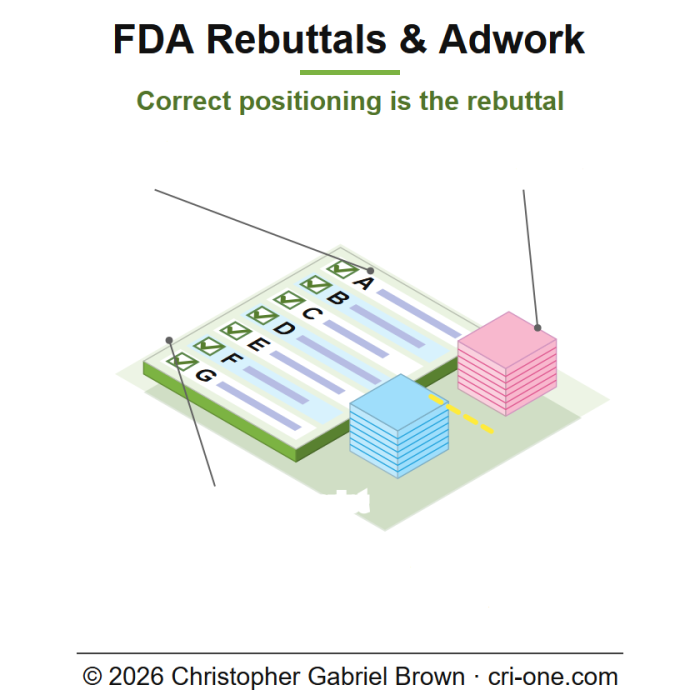
FDA_COMPLIANCE_CHECKLIST.md All projects Cross–cutting execution checklist: disease–claim naming scrub (A), NeuroElement ingredient eligibility gate (B), supplement labeling discipline (C), register separation (D), bundle structure (E), factual accuracy (F), distribution posture (G)
validate_rebuttals.py All projects Automated Pass 2–4 consistency checker: forbidden–string detection, disclaimer presence, therapeutic–claim leak scanning with safe–marker exceptions, PMID citation verification, claim–count validation
SAFETY_DISCLAIMER.md (×4) Projects 10, 11, 12, 13 Per–project safety disclaimers with specific toxicity ceilings and hazard warnings
METHODOLOGY.md (×4) Projects 10, 11, 12, 13 Transparent methodology disclosure: what the method is, what it is not, what “scores” and “probabilities” actually mean
Sales pitches 7+ files per sub–project Investor pitch deck, sales package, licensing proposal, complete package sale guide, individual sales guide, outreach email templates, sales summary
Store product descriptions *_STORE_PRODUCT_DESCRIPTION.html (×4) Pre–written HTML product descriptions for Projects 10, 11, 12, 22
Product cards *_PRODUCT_CARD.md (×4) Summary product cards for catalog use
Vault delivery instructions *_VAULT_DELIVERY_INSTRUCTIONS.html (×4) Buyer delivery and access instructions
Web descriptions WEB_DESCRIPTION.html (×5) Full web–ready product descriptions for each sub–project
Playbooks PLAYBOOK.md (×4) Internal sales playbooks with identity, hook lines, reply patterns, status tracking
11×17 reference charts 10+ SVG files Print–ready research reference charts and formulation charts for diabetes, Alzheimer’s, Parkinson’s (color and BW variants)
ACQ–33–HEALTH–SCIENCE–PORTFOLIO.zip Complete Health Recovery portfolio (OTC vitamins + Alchemy Data V2)
- Three dedicated disease–mechanism research dossiers (diabetes, Alzheimer’s, Parkinson’s) — each with discovery data, patent application (20 claims, 4 drawings), claims summary, methodology, safety disclaimer, research reports (V1/V2/V3), known–properties reports, 11×17 SVG reference and formulation charts, and Python discovery scripts
- Three FDA/FTC regulatory–positioning memos with objection–by–objection rebuttal tables citing 21 U.S.C. § 321(g), FDCA §§ 502/505, and FTC substantiation law
- Three rebuttal–notes files with prepared concede–and–defend answers to skeptical questions
- Three narrative research essays establishing the honest positioning, evidence boundaries, and IP value proposition
- Four adversarial proof documents (two red–team, two steelman) with claim–by–claim verdict tables
- One cross–cutting FDA compliance checklist covering the disease–claim naming scrub, ingredient eligibility gating, labeling discipline, register separation, bundle structure, factual accuracy, and distribution posture
- One automated validation script ( validate_rebuttals.py ) for hard–fail consistency checks, forbidden–string detection, disclaimer verification, leak scanning, and PMID presence checking
- 300–disease mechanism research database covering 12 disease categories with individual mechanism–analysis files, compound matching, and 63+ Python research scripts
- NeuroElement brain chemistry system with 7–compound neurotherapeutic composition, Python CLI and API tools, 62–neurotransmitter database, 54 brain diseases, 25 observation diagnostic guides, 9 patent drawings, and complete research documentation
- Health Recovery portfolio including 9 OTC vitamin formulations (KidVital + VitalCore lines) with FDA/GMP compliance docs, and the Alchemy Data V2 probability engine with 2,609 data files, 257,500+ synthesis methods, and web/API/CLI access tools
- Comprehensive sales and marketing collateral — store descriptions, product cards, vault delivery instructions, investor pitch decks, licensing proposals, outreach email templates, sales summaries, playbooks, START_HERE pages, citation metadata, manifests, and license files
- Six pre–built distribution–ready ZIP archives
- One product–ZIP generation script ( make_product_zips.py )
Important Disclaimers
FDA disclaimer: The research dossiers (diabetes, Alzheimer’s, Parkinson’s, 300–disease database) consist of computational research findings that have not been clinically validated . No compound discussed in this package has been synthesized or tested in cells, animals, or humans for these projects. Nothing in this package is a proven treatment or substitute for prescribed medical care. “Discovery scores” and “probabilities” are database–coverage and synthesis–feasibility calculations, not clinical success rates. Published literature references validate that the elements are relevant to the biology, not that these specific compounds are therapeutic. The OTC vitamin formulations and the NeuroElement supplement have not been evaluated by the U.S. Food and Drug Administration and are not intended to diagnose, treat, cure, or prevent any disease. Consult a qualified health professional before acting on any research finding contained herein.
Intellectual property note: Two sub–projects carry active USPTO patent applications (19/441,975 for Alzheimer’s; 19/445,644 for Parkinson’s, filed January 12, 2026). Diabetes (20 claims) and NeuroElement (24 claims) applications are prepared and ready for filing. All IP rights remain with Christopher Gabriel Brown. This is a single–tier purchase; intellectual property is not conveyed with purchase. IP–related terms require separate negotiation.
How this is delivered
This package ships on a single Blu-ray disc, posted to the delivery address on your order. The archive on the disc is AES-256 encrypted; the passphrase is sent separately, by email, once the disc is despatched — so the disc alone is of no use to anyone who intercepts it.
Discs are despatched by tracked, signed-for post. Allow 5 business days for mastering and verification before despatch.
File names inside the package may use older working titles.
© 2026 Christopher Gabriel Brown
Footnotes
- Product number 8495.
- Family: health research.
- Purchase: When you buy, you buy the use of that blueprint only.