
78-reflective-tunnel
Asset valuation: $2,000,000,000. Project 78 · cri-one.com portfolio · Author: Christopher Gabriel Brown Product-family name: FocusPhi. "Reflective Tunnel" is the descriptive subtitle. Live store page: https://cri-one.com/store/reflective-tunnel.html
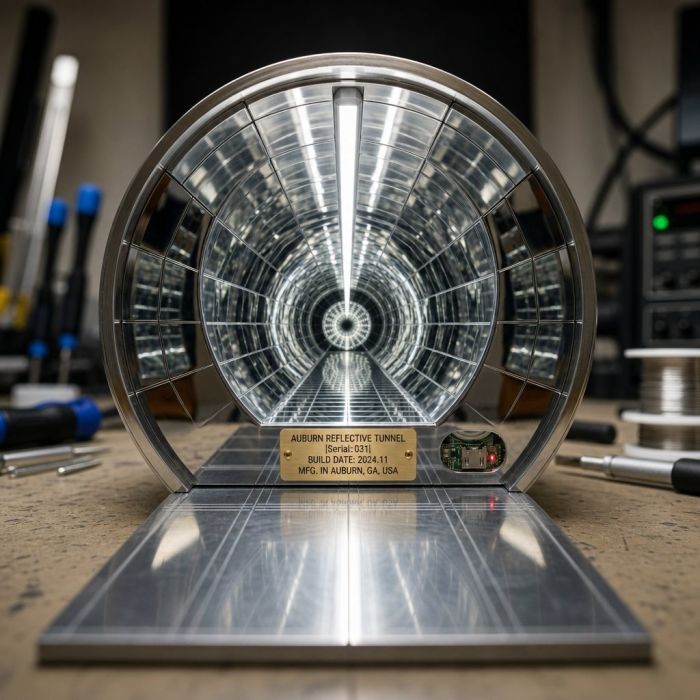
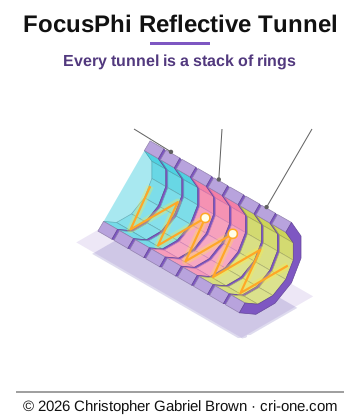
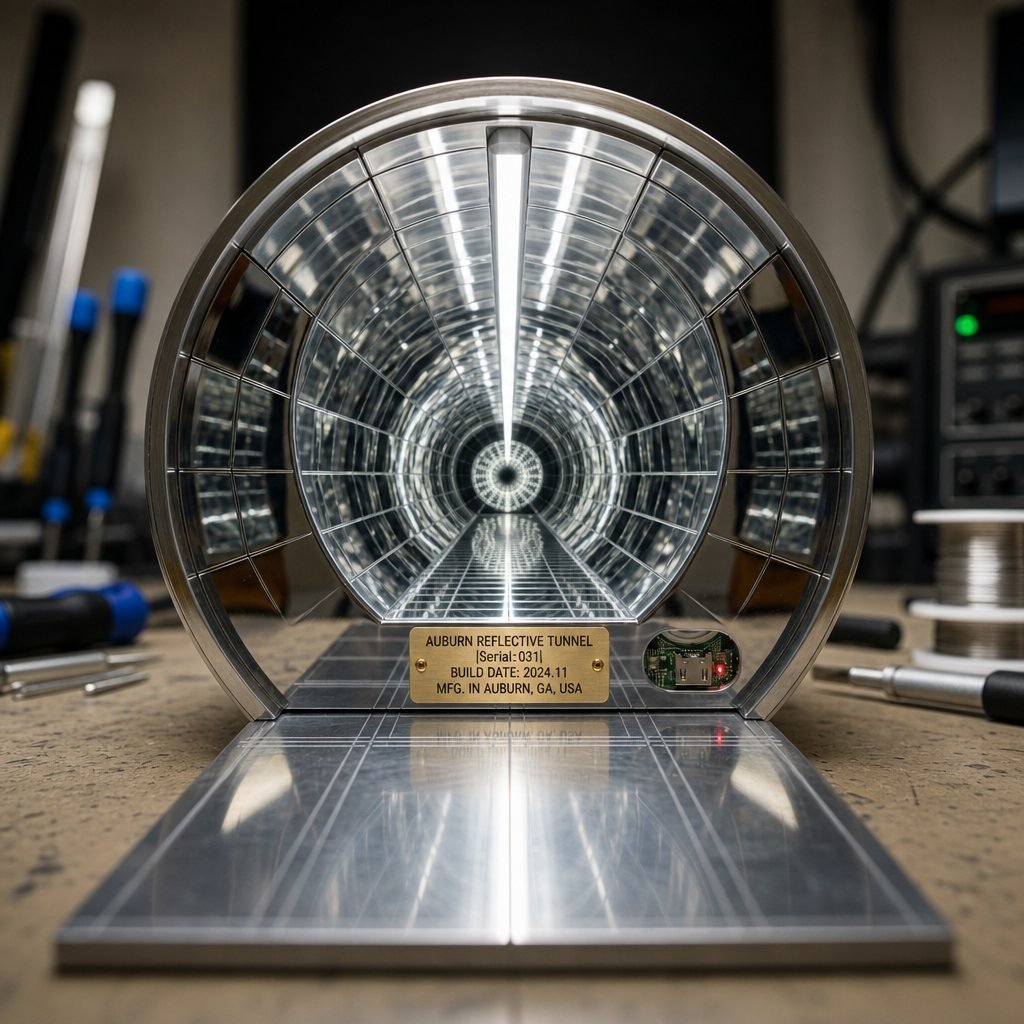
Think of a hallway lined with mirrors. Light that enters bounces, and every bounce adds to what is in the room. FocusPhi, the Reflective Tunnel, is that hallway built like a barrel: a stack of rings, each ring a set of segments joined edge to edge, with the reflective lining on each segment's inner face. That is Christopher Gabriel Brown's segmented-ring method. Add rings for length and choose the lining for the physics. A dielectric mirror makes it optical, a conductive metal lining makes it microwave, and a neutron-reflective liner of beryllium, graphite or heavy water raises the effective multiplication around a subcritical source. Rings can mix, so one stack can hold an optical input stage, a microwave target stage and nuclear containment.
The physics is honest and old: a passive tunnel creates no energy, only buildup, and passing unity gain takes a gain medium or driven source outside this project. What is new is the combination: the ring construction, the three linings, a CAD-parametric family of cylindrical, conical, spherical and toroidal shapes, and the hybrid stack. Inner diameters run from 20 mm to 2 m, lengths from 100 mm to 10 m, and the joints go from plain butt to keyed shoulder as alignment tightens. It is a concept-stage package for engineering buyers and licensees: the spec, the assembly method, the shape catalog, three variant hardware specs, worked examples, verification scripts and watertight STL meshes, all design targets, not hardware-validated results. The buyer walks away with worldwide commercialisation rights; the six 2017 founding inventions stay with the inventor.
Description
Project 78 — FocusPhi Reflective Tunnel — Optical · Microwave · Nuclear (SKU 2109)
Founding IP: Six Chris G Brown 2017 inventions — Patent 3561 (1 light trigger, staircase mirror chips, nanophotonics), Patent 2486 (reflect-amplify chip shaping), Patent 2485 (compressed modular energy sequence), Patents 2495 / 2496 (microwaved nuclear reactive waste recycle), Patent 3457 (nuclear waste → medical radiology, dynamic equilibrium). All from 1 light trigger.txt (1,752 invention-entry IP source ledger, © 2017 Chris G Brown). Patents and underlying IP retained by the inventor.
Status: Concept (L1) with L2 watertight CAD meshes, numerically self-consistent theory (20/20), and L3-partial reduced-order simulation (5/5). Design targets only — not simulation- or hardware-validated.
Construction method: Segmented ring assembly — Christopher Gabriel Brown’s segmented-ring method.
FocusPhi is a passive reflective cavity built as a segmented ring assembly — Christopher Gabriel Brown’s segmented-ring method applied to the physics regime. Every tunnel is a stack of rings; every ring is N trapezoidal or curved segments joined edge-to-edge; and the inner face of every segment carries the variant-specific reflective lining. Three interchangeable interior-lining variants let the same segmented tunnel transport, store, concentrate, and (with a gain medium) amplify energy across three physics regimes:
- Optical — dielectric-mirror lining. Light bounces many times through the cavity volume; effective interaction pathlength multiplied by the cavity finesse. Intracavity intensity ~600× at F ≈ 626. Founding IP: Patent 3561 (2017) — “1 light trigger + varied colored laser semiconductor & microchip cold light micro chip, digital optics by colored micro mirrors, add subtract mode to divide and multiply digital platforms, color mathematics and algorithms based on color reflections for process control, staircase mirror chips, nanophotonics.”
- Microwave — conductive metallic lining (waveguide-class cavity). Standing-wave buildup between reflector ends. Cavity Q from 10&sup4; (room-temperature copper) to 10¹⁰ (superconducting niobium at 2 K). Founding IP: Patent 2485 (2017) — “compressed modular sequence to build a jet action of energy.”
- Nuclear — neutron-reflective liner (beryllium, graphite, or D₂O per application). Boosts the effective neutron multiplication factor k eff around a subcritical or radiological source by 1.3–2.0× over the bare configuration. Founding IP: Patents 2495 / 2496 (2017) — “microwaved nuclear waste … negative and positive nuclear reactive waste recycle” and Patent 3457 (2017) — “recycling nuclear waste into medical radiology use in a dynamic equilibrium.”
The tunnel is sold as an engineering package: SPEC, segmented-assembly specification, CAD-parametric shape catalog, three variant hardware SPECs, IP references, sibling-portfolio cross-references, worked examples, runnable verification scripts, watertight STL meshes, and worldwide commercialisation rights.
Honest Physics
A passive tunnel does not create energy — energy is conserved. What the tunnel does create is buildup : intracavity intensity proportional to the cavity Q (optical & microwave) or the reflector-boosted k-effective (nuclear). To exceed unity gain requires a gain medium inside the tunnel (laser / maser) or an externally-driven active source (klystron beam, fissile mass, etc.). Supplying that gain medium is out of scope for this project; the tunnel is dimensioned to accept common gain-medium form factors. The physics is textbook — Fabry-Pérot resonator theory, classical waveguide cavity Q, neutron reflector albedo — all more than a century of established results. The invention is the combination : the segmented-ring construction method, the three-variant lining table, the CAD-parametric shape family, and the hybrid-stack capability.
Construction — Segmented Ring Assembly
The construction method is Christopher Gabriel Brown’s segmented ring assembly . A ring is N trapezoidal segments joined edge-to-edge to form a polygonal cross-section that approximates a circle. The tunnel is a stack of such rings. Each segment carries the variant-specific reflective lining on its inner face. Length is arbitrary (add or remove rings). Cross-section is arbitrary (pick the ring diameter). Segments and rings can mix variants for a hybrid tunnel — an optical input stage, a microwave target stage, and a nuclear containment stage all in one stack.
Cylindrical Straight trapezoid Flat Straight tunnel Standard multipass (flat-mirror Fabry-Pérot)
Cylindrical Straight trapezoid Concave Straight tunnel with focusing walls Stable resonator; light focuses toward axis on every pass
Cylindrical Straight trapezoid Convex Straight tunnel with diverging walls Uniform illumination; anti-focusing
Conical Slanted trapezoid Flat / Concave / Convex Concentrator cone or beam expander Winston-cone-class concentration or beam expansion
Spherical (dome) Curved-edge segment Spherically concave Sphere or hemisphere Integrating sphere — uniform intracavity intensity
Spherical Curved-edge segment Spherically concave, matched to radius Confocal spherical cavity Very high finesse; stable transverse mode
Toroidal Curved-edge segment Toroidally concave Ring / donut Recirculating cavity; whispering-gallery-adjacent modes
Keyed shoulder Chip-scale optical (patent 3561 staircase) Photolith-defined shoulder, sub-micron
Kinematic three-point mount with fine-adjust screws High-finesse optical / superconducting microwave
Vacuum-flange with metal gasket (Conflat-class) UHV optical / cryogenic microwave
The segmented ring assembly is scale-invariant in construction : the same segment / ring / stack method builds a cavity across nine orders of magnitude of length.
Band Inner Ø Length Natural Variant Fabrication
Nano (chip) 5–50 µm 20–500 µm Optical (folded staircase, patent 3561) Photolithography, e-beam, DUV
The optical variant is the direct engineering descendant of Patent 3561 (2017) and Patent 2486 (2017). Every segment’s inner face carries a multilayer dielectric mirror stack tuned to the operating wavelength.
Chip-scale (folded, patent 3561 staircase) Fused silica or single-crystal silicon Photolith-compatible, sub-micron dovetail joinery, low CTE
Benchtop lab Invar or Zerodur Very low thermal expansion, holds alignment across ambient swings
Larger optical (0.3–2 m) Invar or ULE glass Same reason at scale
Visible (400–700 nm) Alternating SiO₂ / TiO₂ or SiO₂ / Ta₂O₅, 40–60 layers r ≥ 0.9995 per surface
Coating vendors (public commodity): Alluxa, Layertec, Optical Coatings Japan (OCJ), Newport.
Effective interaction pathlength L eff 200 m in a 1 m tunnel THEORY §4.5, Eq. 12: L eff = L · F/π
- Input end: high-reflector disk (r ≥ 0.9999) — single-piece substrate with the same dielectric stack as the interior lining.
- Output end: partial output coupler (r ≈ 0.98–0.995 depending on required output coupling ratio).
- For stable-cavity builds, one or both end caps are concave spherical mirrors with radius of curvature R c matched to the tunnel length per the stability criterion 0 ≤ (1 − L/R₁)(1 − L/R₂) ≤ 1.
Charge/discharge photonics concentrator C4 integrating sphere / C5 Quantum Battery (project 5)
Chip-scale folded staircase-mirror stage C14 folded cylindrical on Si substrate AutoPhi Electromagnetic IC (project 31)
The microwave variant provides the emitter-target coupling stage for the microwave-nuclear recycling family (patents 2495 / 2496) and the containment cavity for Solo Negative Microwave (project 49).
Room-temperature Q Copper (OFHC) or silver-plated aluminium Low RF resistance at operating frequency
Very-high-Q Bulk niobium (superconducting below T c ≈ 9.2 K) Q > 10⁹ achievable per accelerator practice
Industrial (microwave recycler) Stainless outer, copper-plated inner Structural + RF surface
S / C / X band, room temperature Electroplated copper (30–50 µm) Commodity; standard microwave-cavity practice
S / C / X band, cryogenic Bulk niobium (segment substrate) Segment IS the lining
Industrial 2.45 GHz (ISM band) Copper-plated stainless Compatible with high-power magnetron feed
Millimetre wave (30+ GHz) Silver-plated Reduces surface resistance at frequency
- Shorting plate (default) — solid conductor plate at both ends; forms a closed cavity.
- Tuned reactive termination — for cavities requiring specific mode spacing or external circuit coupling.
- Iris coupling — small aperture in one end plate coupling to an external waveguide.
Microwave-nuclear recycler emitter Cylindrical or slightly conical Microwave Nuclear Waste Recycling Center (project 8) / Small Microwave Nuclear Recycler (project 17)
The nuclear variant is a neutron reflector geometry — the tunnel wall scatters incident neutrons back toward the tunnel interior. Applied around a subcritical or non-multiplying source, it boosts the effective neutron flux inside the tunnel by 1.3–2.0× over the bare configuration.
Thermal (E Graphite (nuclear-grade) or heavy water D₂O 0.70–0.95 Graphite ≈ 55 cm; D₂O ≈ 100 cm
Reflector material vendors: Beryllium — Materion (US), Ceradyne. Nuclear-grade graphite — Toyo Tanso, SGL Carbon. Heavy water (D₂O) — Isowater (Canada), Cambridge Isotope.
Reflector thickness ≥ 1 neutron migration length (Be ≈ 12 cm; graphite ≈ 55 cm; D₂O ≈ 100 cm)
Microwave-driven nuclear-waste recycle (patents 2495 / 2496) Cylindrical Microwave Nuclear Waste Recycling Center (project 8) / Small Microwave Nuclear Recycler (project 17)
- NRC licence (or agreement-state equivalent) appropriate to the source term (10 CFR 30 byproduct material or 10 CFR 40 source material).
- State radiation control programme registration.
- If source exceeds Type A quantity per 10 CFR 71: transport licensing per DOT HMR.
- If reflector contains beryllium: OSHA beryllium standard (29 CFR 1910.1024).
- If fissile loading exceeds SNM thresholds: 10 CFR 70 special nuclear material licence plus Criticality Safety Analysis per ANSI/ANS-8 series.
- All regulatory filings are buyer scope.
C1 Straight optical multipass Cy Opt Flat HR + OC (flat) Identity Absorption spectroscopy; laser resonator
C2 Confocal optical resonator Cy Opt Flat Concave R=L Position transposes across axis Fundamental laser cavity; largest stable mode volume
C3 Concentric optical resonator Cy Opt Flat Concave R=L/2 Position inverts through centre High-buildup spectroscopy; nonlinear conversion
C4 Integrating sphere Sp Opt/PTFE Sp (concave) none (closed) Directions randomised Photometry, calibration, uniform illumination
C5 Winston-cone concentrator Co Opt Cv (parabolic) Open + focused Angles fold toward axis Solar loop for Quantum Battery / Private Energy Farms
C6 Corner-cube retroreflector Cy Opt Cn90 any Direction retroreflects Lidar target simulation; free-space optical link
C7 Elliptical imaging cavity Cy (folded) Opt El (elliptical) Focal points F₁ → F₂ Confocal microscopy; point-to-point energy transfer
C8 Klystron interaction cavity Cy (short) MW (Cu) Flat SP (both) Standing-wave mode Microwave amplifier / oscillator
C9 Superconducting accelerator cavity Cy (multi-cell) MW (Nb) Flat, reentrant SP + iris π-mode standing wave Particle accelerator (SRF class)
C10 Subcritical assembly with Be reflector Cy Nu (Be) Flat PL (Be) Flux enhanced by reflector savings Research reactor benchmark
C11 Medical radioisotope loop Sp Nu (Be + graphite) Sp (concave) PL (Be) Dynamic equilibrium Medical radiology per patent 3457
C12 Radar target simulation Sp MW Sp (concave) none Isotropic scattering Radar cross-section calibration
C13 Whispering-gallery microwave To MW Flat (toroidal) none Travelling wave circulates Microwave frequency reference
C14 Chip-scale staircase mirror Cy (folded, chip) Opt (on Si) Flat with photolith steps Photolith end mirrors Beam steps through folded path AutoPhi EM-IC light-trigger stage (patent 3561)
H1 Microwave-nuclear waste recycler Cy MW input → transition SP → Cy Nu (Be) → PL end Nuclear waste recycle per patents 2495 / 2496 (projects 8 / 17)
H2 Solar-loop → quantum-battery Co Opt (Winston) → transition HR → Sp Opt (integrating) Private Energy Farms + Quantum Battery
H3 Optical input → microwave interaction Cy Opt → transparent transition → Cy MW → SP Novel maser configuration (optically-pumped maser)
H4 Elliptical optical → nuclear target Cy El Opt → transition HR → Cy Nu → PL Photonuclear activation experiments
H5 Three-stage (optical/microwave/nuclear) Opt input + MW interaction + Nu containment Full microwave-nuclear-optical laboratory in one tunnel body
R1 Cassegrain-in-tunnel Concave primary + convex secondary + optional field-flattener lens Compact long-focal-length imaging cavity
R2 Lens-relay multipass Flat HR end caps + relay lens between every N rings Long-path spectroscopy (100+ m effective)
R3 Elliptical tunnel (two-focus imaging) Elliptical concave inner face on every segment Perfect point-to-point energy transfer (patent 3561)
R4 Concave-corner retroreflector array Segment pairs meeting at internal 90° corners Lidar target array; free-space optical link return
R5 Prism-turn ring Flat interior + total-internal-reflection prism at ring Ring-laser gyro-adjacent geometry
R6 Aspheric concentrator + relay Parabolic primary + aspheric relay + aspheric field lens Solar concentrator recycling unabsorbed light
R7 Ecliptic (eclipse) coronagraph cavity Occulting disk on axis with spider vanes Block bright on-axis source; coronagraph geometry
R8 Hollow-beam laser resonator HR + OC end caps + annular intracavity aperture Optical trap physics; uniform-annulus illumination
R9 Elliptical + ecliptic stack Elliptical concave inner face + central occulting disk Point-to-point transfer past a bright intermediate emitter
Hybrid Tunnel Interface Conditions
- Optical → Microwave: band-limited coupling window — the optical cavity is transparent to microwaves and vice versa (wavelengths differ by factor 10&sup4;+).
- Microwave → Nuclear: microwave cavity closed by a shorting plate; nuclear reflector begins on the other side. Neutrons pass through the plate (steel thermalises but transmits most).
- Optical → Nuclear: optical cavity closed by a dielectric mirror (opaque to visible/near-IR, transparent to neutrons); nuclear reflector begins on the other side.
- In all cases, the “hybrid tunnel” is two or three end-to-end cavities of different physics, each with its own eigenmodes. The value is mechanical: one BOM, one fabrication run, one alignment procedure produces a device that performs three functions in sequence .
Fresnel equations (s-polarisation) r s = (n₁ cosθ i − n₂ cosθ t ) / (n₁ cosθ i + n₂ cosθ t ) Coating design for optical variant
Snell’s law n₁ sinθ i = n₂ sinθ t Refraction at every interface
Multilayer dielectric reflectance R = ((n H /n L ) 2N − 1) / ((n H /n L ) 2N + 1) Per-surface reflectance of optical lining
Metallic reflectance (normal incidence) R ≈ 1 − 2√(2ε₀ω/σ) Microwave variant surface reflectance
Skin depth δ = √(2 / (μωσ)) Microwave wall-loss thickness
Reflector-boosted k eff k eff,reflected = νΣ f / (Σ a + D(π/(R+δ))²) Nuclear variant enhancement
Non-multiplying source flux boost φ reflected = φ bare · (1 + α·g) Reflector-boosted flux at target
Brewster’s angle tanθ B = n₂ / n₁ Polarisation-selective resonator design
Corner-cube bevel angle segment_inner_bevel = π/2 − π/N Retroreflecting array segment geometry
A fully parameterised research-scale microwave-driven neutron-reflected target cell. Configuration H1 from the configurations catalog.
Parameter Value Source
Microwave operating frequency 2.45 GHz (ISM band, worldwide licence-exempt) Standard industrial ISM
Cooling 40 kW water-cooled jacket, 15 L/min at ΔT = 20 K Standard industrial magnetron practice
Hardware BOM total ≈ $472k Commodity-sourced; see BOM.md
Rough total build cost (with room, licence, sim, labour) ≈ $700k Research-scale first article
H1 Bill of Materials Summary
Every design number in this listing is reproduced by a runnable verification script ( verify/verify_theory.py , 20/20 checks pass). The verification found and fixed two real documentation errors on its first run — that is the point of running the physics, not just quoting it.
Three independent-method reduced-order solvers in sim/simulate.py cross-check the closed-form theory:
- Optical — transfer-matrix method (TMM) over a 20-pair SiO₂/Ta₂O₅ quarter-wave stack independently derives mirror reflectance and confirms achievable finesse exceeds the 626 design floor.
- Microwave — cylindrical-cavity eigenmode solve (Bessel-prime zero for TE₀₁₁) reproduces the 63 mm single-cell length at 2.45 GHz. Wall-loss Q of the single-cell pancake (~2.4k) explains why the H1 worked example stacks 19 cells.
- Nuclear — 1-group neutron-diffusion finite-difference k-eigenvalue solve confirms reflector raises k eff (k bare = 1.232 → k reflected = 1.271). Physics direction is correct; full MCNP quantifies the 1.3–2.0× band.
Microwave Nuclear Waste Recycling Center (project 8) Microwave + Nuclear (paired) Emitter-target coupling stage + neutron-reflector containment
Small Microwave Nuclear Recycler (project 17) Microwave + Nuclear (paired) Compact-footprint variant of the above
Quantum Battery (project 5) Optical Concentrator around charge/discharge photonics
AutoPhi Electromagnetic IC (project 31) Optical (folded, chip-scale) Staircase-mirror stage — direct descendant of patent 3561
1 System Architecture Segmented ring assembly with interchangeable interior lining selects the physics regime; same body serves optical, microwave, and nuclear; supports hybrid stacks.
2 Core Technology Stack Buildable using existing commodity segments, coatings, and reflector materials — no unobtainium. All materials shipping today from qualified vendors.
3 Physics Basis All design numbers reduce to five classical results: specular reflection, Fresnel equations, Fabry-Pérot finesse, cavity Q, reflector-boosted k eff .
4 Performance Envelope Optical ~600× buildup, Q = 1.25×10⁹, 200 m effective path; microwave Q 10&sup4;–10¹⁰; nuclear 1.3–2.0× k eff boost — all from analytic theory.
5 Manufacturing Path 20 mm to 2 m diameter, 100 mm to 10 m length, using Christopher Gabriel Brown’s segmented-ring assembly method. All joinery options have existing practice.
6 Simulation Basis End-to-end simulatable in existing physics simulators before any hardware exists. Meep/Lumerical (optical), HFSS/CST (microwave), MCNP/OpenMC (nuclear).
7 Portfolio Integration Plugs into six existing portfolio projects as a subsystem, not a bolt-on.
8 Regulatory Pathway Every variant has a well-defined regulatory pathway with existing precedent. IEC 60825 (optical), FCC Part 18 (microwave ISM), 10 CFR 30/40/70 (nuclear).
9 Risk Register Material risks enumerated; none is a showstopper. Joint-line loss, Be supply, Nb cost, alignment across thermal cycles, NRC calendar — all have known mitigations.
10 Commercialisation Readiness L1 concept today with clear path to L4 foundry-ready. L1 → L4 timeline for H1: 6–12 months, ~$700k all-in.
L1 — Concept Complete Full document set, six founding patents cited, four hardware SPECs, 28 configurations, 10-section PoF
Theory numerically self-consistent Complete verify/verify_theory.py — 20/20 checks pass
L2 — Parametric CAD Complete 10 real watertight STL meshes validated by verify/verify_stl.py (10/10); OpenSCAD parametric segment library
L3-partial — Reduced-order simulation Complete sim/simulate.py — TMM optics + cylindrical-cavity eigenmodes + 1-group neutron diffusion, 5/5 pass
L3-full — 3-D FDTD / HFSS / MCNP Downstream (buyer) Requires full-fidelity simulators and compute
L4 — Foundry-ready Downstream (buyer) Fabricate + measure first article; ~$700k / 6–12 months per H1 BOM
L5 — In production Downstream (buyer) Deploy into consumer sibling project
Optical substrate (Invar / Zerodur / fused silica) Vacuum-Melting / Corning / Heraeus Standard optics-industry inventory
Multilayer dielectric coating Alluxa, Layertec, OCJ, Newport Standard laser-mirror coating vendors
Microwave substrate (OFHC copper, Ag-plated Al) Luvata, ThyssenKrupp Standard microwave-cavity practice
Superconducting niobium segments Ningxia Orient Tantalum, ATI SRF-accelerator community sources
FocusPhi is priced as a horizontal enabling platform — the shared reflective-cavity substrate under six portfolio products. Owning it is owning the concentrator / resonator / reflector primitive all six depend on.
Kit Scope Price (USD)
FocusPhi Complete Platform All 3 variants + all 28 configurations + full CAD library + all worked examples + verification suite + worldwide commercialisation rights $100,000,000
FocusPhi Optical Kit Optical variant + all optical configs (C1–C7, C14, R1–R9 optical) + CAD + commercialisation rights $50,000,000
FocusPhi Microwave Kit Microwave variant (Cu / superconducting Nb) + all microwave configs (C8, C9, C12, C13) + CAD + commercialisation rights $50,000,000
FocusPhi Nuclear Kit Nuclear variant (Be / graphite / D₂O) + all nuclear configs (C10, C11) + CAD + regulatory workmap + commercialisation rights $50,000,000
FocusPhi Hybrid Kit Any one hybrid stack (H1–H5) fully worked, e.g. the H1 microwave-nuclear recycler; includes both constituent variants $75,000,000
FocusPhi Bespoke Configuration One custom configuration beyond the 28 catalog configs, engineered to buyer spec $50,000,000 floor, quoted
All kits are Base, No IP — engineering package and worldwide commercialisation rights convey; the six founding patents are retained by the inventor. Reference on the bid catalog as row 58 ($100M headline). Included at no extra charge inside All In One (20T) .
What the Buyer Receives
- Top-level SPEC, STATUS, PRODUCT_BRIEF, STORE_LISTING, MANIFEST.json.
- THEORY.md — 14 sections, 28 numbered equations covering angles of reflection, Fresnel, cavity Q, k-effective, N-gon approximation, refraction, elliptical mirrors, ecliptic (eclipse) occulting elements, corner-cube retroreflection, Brewster angle. Every design number traces to a numbered equation.
- CONFIGURATIONS.md — 14 single-variant + 5 hybrid + 9 refractive-hybrid configurations with angle-of-transposition primer, ellipse-vs-ecliptic distinction, and selection guide.
- PROOF_OF_FUNCTION.md — 10-section proof of function in the Chris G Brown convention.
- SCALES.md — scale range documentation from nano (µm chip staircase) to hydro (2 m industrial), with physics limits at each end.
- KIT_AND_PRICING.md — complete pricing framework and kit definitions.
- TESTED_AND_LIMITS.md — honest maturity report, rung-by-rung L1–L5 status, buyer verification path.
- IP_REFERENCES.md — six 2017 founding patents cited with invention text.
- Four hardware SPECs — shared TUNNEL segmented-assembly + per-variant OPTICAL, MICROWAVE, NUCLEAR.
- OpenSCAD parametric segment library — segment.scad, ring.scad, tunnel.scad, and H1 configuration; text-based, executable in any OpenSCAD installation; renders to STL / STEP.
- 10 real, openable, watertight STL meshes — 7 watertight PART solids + 3 multi-body ASSEMBLY previews, spanning nano (µm) to hydro (m) scale. Generated by pure-Python generator, validated by verify/verify_stl.py (10/10 pass).
- verify/verify_theory.py — runnable numerical proof that every documented number reproduces from first-principles physics (20/20 checks).
- verify/verify_stl.py — mesh validation (10/10 zero degenerate, zero open edges).
- sim/simulate.py — three independent-method reduced-order solvers (TMM optics, cylindrical-cavity eigenmodes, 1-group neutron diffusion) cross-checking the theory (5/5 pass).
- Worked example H1 — fully parameterised microwave-nuclear recycler with full parameter fill, numeric derivation, and ~$472k commodity BOM (~$700k rolled up).
- LICENSE.md — terms, retention clauses, governing law (State of Georgia).
- Worldwide, non-exclusive commercialisation rights.
What the Buyer Does NOT Receive
The underlying patents are retained by the inventor. Chris G Brown patents 3561, 2486, 2485, 2495, 2496, and 3457 (all 2017) remain the sole property of Christopher Gabriel Brown. This is a documentation + commercialisation-rights transaction — not a patent licence and not a patent assignment . If the buyer requires a patent licence or assignment, that is a separate transaction to be negotiated in writing.
Also NOT included:
- Prototype hardware or first-article measurements.
- Full-fidelity FDTD / HFSS / MCNP simulation results (reduced-order sims are included; full-fidelity is buyer scope).
- NRC / FCC / IEC regulatory filings.
- Selection and integration of a gain medium for amplification embodiments.
- Coating-vendor procurement.
Nuclear, special nuclear material 10 CFR 70 SNM licence if fissile loading exceeds thresholds
- Available only to companies incorporated, headquartered, and primarily operating in the United States of America.
- All transactions in USD only.
- All payments are final, non-refundable, and non-recoverable.
- Communication by email and postal mail only. No phone calls, no brokers, no intermediaries.
The package contains the complete FocusPhi engineering document set, parametric CAD sources, generated STL meshes, runnable verification and simulation scripts, a fully parameterised worked example with commodity BOM, variant-specific hardware specifications, IP reference documentation, and licensing terms.
File / Directory Description
README.md Project overview, directory listing, sibling portfolio interfaces, contact.
SPEC.md Top-level technical specification — scope, normative references, terms, system context, segmented ring assembly (§5), parametric shape family (§5.1), optical variant (§6), microwave variant (§7), nuclear variant (§8), can/cannot section (§9), portfolio interfaces (§10), buyer receives/does not receive (§11–12).
THEORY.md Formal physics — 14 sections, 28 numbered equations. Angles of reflection, Fresnel, multilayer dielectric, metallic reflection, neutron reflection, cavity Q and buildup, finesse, storage time, effective pathlength, nuclear k eff , N-gon geometry, segment curvature, conical (Winston), spherical, hybrid interface conditions, refraction (§11), elliptical mirrors (§11.3), ecliptic/eclipse occulting elements (§11.4), corner-cube retroreflection (§12), Brewster angle (§13).
CONFIGURATIONS.md 28 named configurations — 14 single-variant (C1–C14) + 5 hybrid (H1–H5) + 9 refractive-hybrid (R1–R9). Angle-of-transposition primer, refractional energy level, selection guide.
PROOF_OF_FUNCTION.md 10-section proof of function in the Chris G Brown convention.
STATUS.md Subsystem-by-subsystem status table with next milestones.
MANIFEST.json Machine-readable catalog of the entire project.
PRODUCT_BRIEF.md One-page pitch document.
STORE_LISTING.md Store copy source (kicker, title, subtitle, lead, stat strip).
IP_REFERENCES.md Six founding 2017 patents with invention text, prior-art posture, and what buyer receives/does not receive.
SCALES.md Scale range: nano (µm chip) to hydro (m industrial), variant-by-band, physics limits.
KIT_AND_PRICING.md Kit definitions and pricing for all tiers ($50M–$100M).
TESTED_AND_LIMITS.md Honest maturity report. Per-deliverable L1–L5 status, what this workstation can/cannot deliver, recommended buyer verification path.
LICENSE.md Licence terms — what conveys, what does not, retention clauses, governing law (State of Georgia).
LICENSE.txt Short-form licence.
LICENSE-INDUSTRIAL.txt Industrial variant licence.
CONTACT_INFO.txt Licensor contact details.
1 light trigger.txt 1,752-invention IP source ledger (© 2017 Chris G Brown).
google_patents_search_list.txt Prior-art search list.
Tomorrow.txt Inventor planning notes.
hardware/TUNNEL/SPEC.md Shared segmented ring assembly spec — CAD-parametric shape catalog, segment geometry, ring joinery (butt/pin/dovetail/keyed shoulder), ring stacking, end caps, ports, assembly sequence, design software.
hardware/OPTICAL/SPEC.md Optical variant — segment substrate table, dielectric mirror stack per wavelength band, end caps, recommended shapes per application, design targets, environment, sibling consumers.
hardware/MICROWAVE/SPEC.md Microwave variant — Cu/Ag/Nb substrate options, interior lining per operating regime, end caps, coupling, room-temp and superconducting Q targets, cooling, sibling consumers.
hardware/NUCLEAR/SPEC.md Nuclear variant — Be/graphite/D₂O reflector materials, segment joinery (nuclear-specific), end plugs, regulatory posture, sibling consumers.
hardware/TUNNEL/cad/ OpenSCAD parametric segment library — segment.scad, ring.scad, tunnel.scad, configs/H1_worked_example.scad, README.md.
hardware/TUNNEL/cad/stl/ 10 generated watertight STL meshes (7 PART solids + 3 ASSEMBLY previews), nano to hydro scale. Validated by verify/verify_stl.py (10/10 pass, zero degenerate, zero open edges).
examples/H1_microwave_nuclear_recycler/ Fully parameterised H1 worked example — README.md, WORKED_EXAMPLE.md (full parameter fill, numeric derivation), BOM.md (~$472k hardware, ~$700k rolled up).
verify/verify_theory.py Runnable numerical verification — 20/20 checks, every documented number reproduced from first-principles equations.
verify/verify_stl.py STL mesh validation — 10/10 pass, all watertight.
sim/simulate.py Three independent-method reduced-order solvers (TMM optics, cylindrical-cavity eigenmodes, 1-group neutron diffusion) — 5/5 cross-checks pass.
figures/ Hero and variant render sources (SVG, PNG, HTML gallery), icon generators.
dist/ Consumer kit ZIPs (Complete Platform, Optical, Microwave, Nuclear, Hybrid-H1) + SHA256SUMS.txt + full internal archive.
outbound/ Outreach materials — archetypes, targets, prospects, follow-ups, email templates, briefs.
catalog/descriptions/ Per-variant and platform store descriptions (HTML) + shared style block.
reflective_tunnel_store_description.html CMS-ready store page HTML.
How this is delivered
This package ships on a single Blu-ray disc, posted to the delivery address on your order. The archive on the disc is AES-256 encrypted; the passphrase is sent separately, by email, once the disc is despatched — so the disc alone is of no use to anyone who intercepts it.
Discs are despatched by tracked, signed-for post. Allow 5 business days for mastering and verification before despatch.
© 2026 Christopher Gabriel Brown. All rights reserved. Patents and underlying IP retained by the inventor. Six founding patents (3561, 2486, 2485, 2495, 2496, 3457), all 2017. Design targets only. First to market — documented public offering.
Photo
Footnotes
- Product number 8528.
- Family: microwave energy recovery.
- Purchase: When you buy, you buy the use of that blueprint only.