52-defense-data
Valuation
Generous asset valuation: $45,000,000,000. The listed price is the platform maximum; acquisition at valuation is handled by direct enquiry.
Data-War Self-Protecting Data Entity
Originated, authored, and first published by Christopher Gabriel Brown. This
is his own invention — catalog entries 1239 → 1240 → 1241 → 1242 / 1243 / 1244,
marked copyright 2012–2018, and printed in his book Invent Depositions
(2017, ISBN 9781979767897). This product unifies his listings 1242 + 1243 + 1244,
which build directly on his root entry 1241 ("a pre-emptive agreement in a
cloud database environment that protects the entity of itself by control and data
code kill-switch script").
Price (recommended anchor): $1T family license · à-la-carte modules below
Status: Design / IP package — IP-retained license, ready for licensing
Patent posture: Patent-pending (origination 2012–2018, Christopher Gabriel Brown)
> All performance figures in this package are design targets, not
> guarantees. Patent-pending, not patented. Licensing inquiries by **email
> and postal mail only** (no phone). USA-based buyers; USD only.
>
> Provenance — this is the inventor's own work. The dated first-origination
> record is in source/PROVENANCE.md: his catalog entries
> 1239–1244 (copyright 2012–2018), his book Invent Depositions (2017, ISBN
> 9781979767897), USPTO application 19/540,453, web-archive snapshots, and a
> SHA-256 content ledger. The one genuinely-similar third-party patent (Oracle's
> "cleanroom," priority 2016) postdates the inventor's claimed origination
> — see §4 for the priority comparison.
Overview
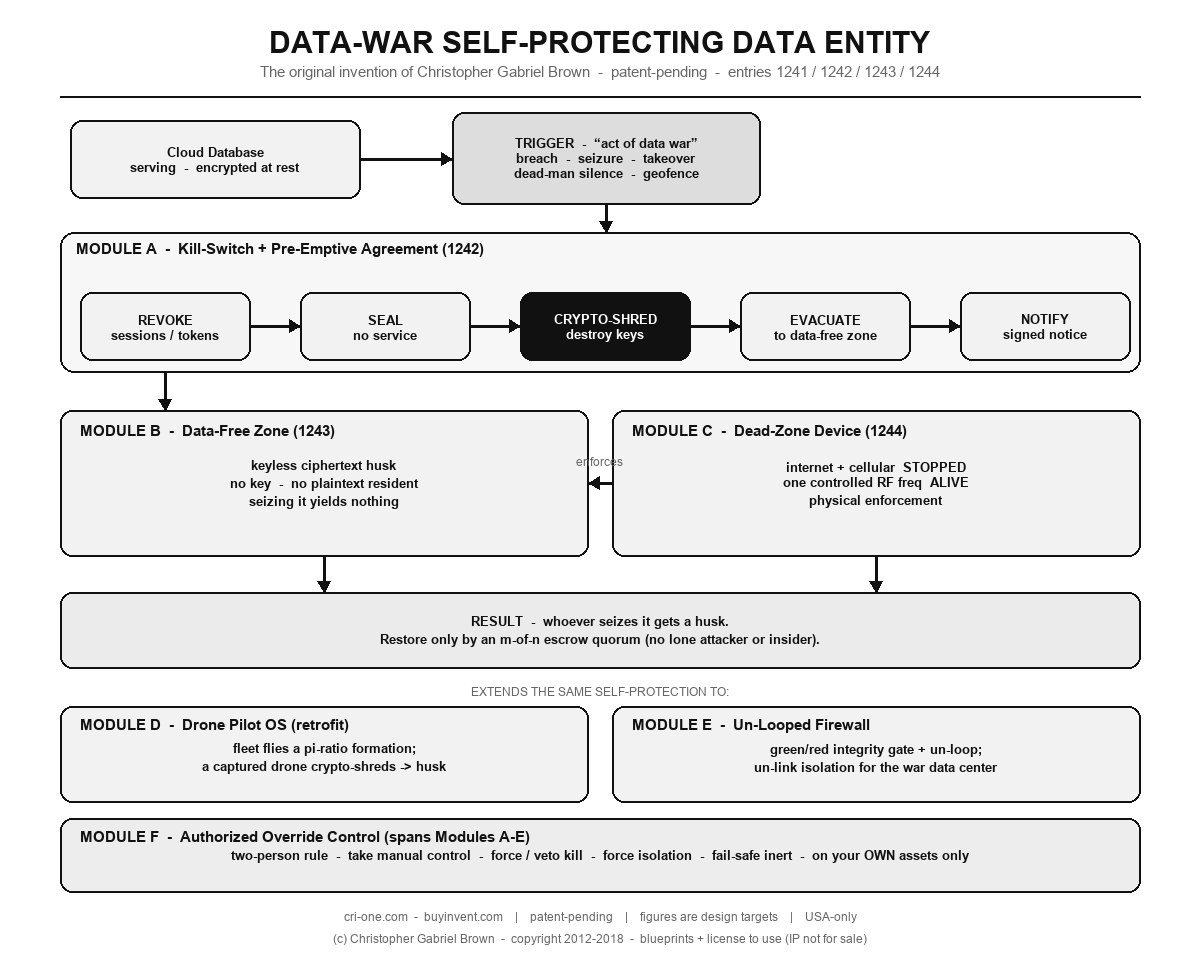
The Data-War Self-Protecting Data Entity is a cloud database that can **render
itself inert under hostile conditions — by binding prior agreement.** Where
ordinary security assumes you keep control of your infrastructure, this system
is built for the case where you might lose it: a breach, a seizure, a
hostile takeover, a rogue operator, physical capture, or the operator simply
going silent.
On a pre-consented trigger, the entity withholds service ("no service"),
destroys its own readability (crypto-shred), retreats to a structurally
data-free safe harbor, and is physically severed from the network — leaving
whoever seized it a worthless husk. Because every stakeholder signs the
response in advance, going dark is lawful, compliant behavior rather than
sabotage.
This is the productization of Christopher Gabriel Brown's own inventions —
his catalog entries 1242, 1243, 1244 (captures 2320/2319/2318), which extend his
foundational entries 1239–1241, all copyright-marked 2012–2018 and published in
his 2017 Invent Depositions (ISBN 9781979767897). He is the originator of this
concept; the work here unifies and builds it out.
The six modules
Full technical specs:
- specs/system-architecture.md — how the modules compose
- specs/1242-killswitch-agreement.md
- specs/1243-data-free-zone.md
- specs/1244-dead-zone-device.md
- specs/drone-pilot-os.md — Module D, the data-war architecture airborne
- specs/network-firewall.md — Module E, the war-data-center perimeter
- specs/override-control.md — Module F, the authorized override layer (two-person rule)
Key capabilities
- "No service" by prior agreement — a multi-party, pre-consented kill that
is contractually compliant, not unilateral sabotage.
- Crypto-shred, not disk-wipe — keys destroyed/escrowed in seconds turns
the entire store into unreadable ciphertext instantly (design target < 5 s).
- Autonomous dead-man trigger — operator silence past the agreed window
fires the agreed response, with no human in the loop required.
- Self-protecting "data code" — attacking or removing the kill-switch
script is itself a trigger ("protects the entity of itself").
- Data-free retreat — the entity collapses into a zone that holds nothing
readable; seizing either the origin or the zone yields a husk.
- Physical enforcement — the Dead-Zone Device severs the data plane in
hardware, leaving only a narrowband controlled-frequency command channel.
- Multi-party restoration — recovery requires an escrow quorum (m-of-n),
so neither a lone attacker nor a lone insider can resurrect the data.
What this defends against
Pricing (recommended anchors — inventor confirms final)
IP-retained license model: the inventor **keeps ownership permanently — the IP
is not for sale. What the buyer gets is the blueprints** (design package +
reference implementation) and a license to use the IP. Consistent with the
portfolio's flagship defense tier.
The $1T family is a bundle discount: licensing all six modules à la carte
totals $1.9T, so the unified family saves $900B. Modules D (Drone Pilot
OS), E (Un-Looped Firewall), and F (Authorized Override) extend the data-war
self-protection out to drone fleets, in to the network perimeter, and up to a
two-person-rule human authority layer — the added capability is what holds the
family at the $1T flagship-defense tier.
> Optional add-on: a buildable-appliance engagement for Module C (BOM, dev
> hardware, bring-up, FCC certification path) — priced separately on inquiry.
Buyer fit
National-security and defense data custodians · critical-infrastructure
operators (energy, finance, health-record holders) · sovereign /
jurisdiction-sensitive cloud operators · any custodian of irreplaceable or
highly-targeted data who must guarantee *"if we lose control, it becomes
worthless to whoever took it."*
Honest status & scope
- Maturity: Design / IP package + a working reference implementation.
Concept originated 2012–2018; this folder is the articulated architecture, the
licensable rights, and a runnable, tested build of Modules A/B (see
impl/ — 16 passing tests, real AES-256-GCM, persistent store, CLI).
Module C is implemented as a software controller; the physical RF appliance is
a separate buildable deliverable. Not a deployed, certified, shipping
product — productization, hardening, and certification remain the licensee's.
- What the buyer licenses: the architecture, the agreement framework, the
three module designs, and the patent-pending rights — IP-retained.
- Productization owned by the licensee: legal enforceability of the
agreement per jurisdiction; key-management / escrow integration; RF/FCC
certification for Module C; validation of the trigger policy against a real
threat model. See the regulatory notes in
specs/1244-dead-zone-device.md.
Authorization to proceed (read before "next steps")
This product is built and scoped as a defensive capability for U.S.
national-security and critical-infrastructure data custodians. What exists today
— the IP, the specs, the draft agreement, and a reference implementation that
runs on synthetic data, single-host, key-in-file — is safe to review, run,
and license-evaluate with no special authorization.
Moving past that, into an operational build or deployment, is gated. The
operator must be coming from inside the authorization perimeter — a sponsored
defense / homeland-security program with the appropriate service account,
an Authority to Operate (ATO) under NIST RMF / FISMA (FedRAMP if cloud), and
FCC authorization for any RF element (Module C). The inventor licenses the
IP and supplies the design; the **operator supplies the authorization,
accreditation, and lawful authority to run it.**
The full boundary — every item deliberately left un-built and the specific gate
to cross it — is in SAFE-SCOPE-AND-NOT-DONE.md.
Project structure
52-defense-data/
├── README.md ← this file (master overview)
├── WEB_DESCRIPTION.html ← store listing copy (guardrail-compliant)
├── PLAYBOOK.md ← internal playbook (not public)
├── LICENSE.md ← IP-retained license terms summary
├── SAFE-SCOPE-AND-NOT-DONE.md ← what was deliberately not built, and the gate to proceed
├── MANIFEST.json ← machine-readable metadata
├── CONTACT_INFO.txt ← contact block
├── specs/
│ ├── system-architecture.md ← the three modules as one system
│ ├── 1242-killswitch-agreement.md
│ ├── 1243-data-free-zone.md
│ ├── 1244-dead-zone-device.md
│ └── 1244-build-package/ ← Module C paper design (BOM, FCC roadmap, diagram)
├── legal/
│ └── PRE-EMPTIVE-AGREEMENT-TEMPLATE.md ← the contract half of Module A
├── impl/ ← the WORKING reference implementation
│ ├── datawar/ ← installable package (Modules A/B + C controller)
│ │ incl. keystore.py (file / HSM-sim key custody)
│ ├── examples/ ← multi-process data-free-zone demo
│ ├── tests/ ← 20 unit tests (stdlib unittest)
│ ├── pyproject.toml ← `datawar` CLI entry point
│ └── README.md ← install / run / test
├── pof/
│ ├── data_war_demo.py ← runnable proof-of-function (stdlib only)
│ └── README.md ← how to run it / what it proves
├── store/
│ ├── description-fragment.html ← Page Builder fragment (go-live ready)
│ └── STAGING.md ← publish runbook (you run the prod push)
├── sales-pitches/
│ └── executive-summary.md ← one-page decision-maker brief
└── source/
├── SOURCE-LISTINGS.txt ← original 1242/1243/1244 text (verbatim)
├── PROVENANCE.md ← dated first-origination record + prior-art note
├── PROVENANCE-LEDGER.txt ← SHA-256 fingerprints of source + artifacts
└── make_ledger.py ← re-runnable ledger generator
Contact (email + postal only — no phone):
Christopher Gabriel Brown
1341 Wellington Cove, Lawrenceville, GA 30043-5255, USA
Email: crioneaka@outlook.com
Store: https://cri-one.com/store/ · https://buyinvent.com/
53 — Data-War Self-Protecting Data Entity
> Internal playbook — not for public eyes.
> Built: 2026-06-23
1. Identity
2. One-liner
> A cloud data entity that, by binding prior agreement, can render itself inert
> under hostile conditions — it withholds service, destroys its own
> readability, retreats to a data-free safe harbor, and is physically severed
> from the network, so losing control of the infrastructure does not mean
> losing the data to whoever took it.
3. What's in the folder
README.md— master product overviewWEB_DESCRIPTION.html— store listing (guardrail-compliant, blue theme)LICENSE.md— IP-retained license terms summaryMANIFEST.json— machine-readable metadataCONTACT_INFO.txtspecs/system-architecture.md— the three modules as one systemspecs/1242-killswitch-agreement.md— Module Aspecs/1243-data-free-zone.md— Module Bspecs/1244-dead-zone-device.md— Module Csales-pitches/executive-summary.md— one-page briefsource/SOURCE-LISTINGS.txt— original 1242/1243/1244 text (provenance)
4. Pricing anchors (confirm before publishing)
Rationale: flagship defense-cyber capability; sits at the War Satellite ($1T)
tier. À-la-carte modules sum exactly to the $1T family. Optional buildable-
appliance engagement for Module C priced separately on inquiry.
5. Hook lines (pick the one that fits the reader)
- (default) If you lose control of the infrastructure — breach, seizure,
takeover, capture — this makes the data worthless to whoever took it.
- (skeptic / 'what is this really?') It's crypto-shredding + a dead-man
switch + control-plane retreat + physical network severance, bound together
by a multi-party agreement so the "kill" is lawful and pre-consented. The
primitives are proven; the patentable part is the four-way composition.
- (buyer's-finance angle) IP-retained license — you're not buying the IP;
you're buying the blueprints + a license to use Chris's IP (he keeps
ownership permanently). No company, no liability transfer. Modules à la carte;
4-step credit-forward licensing path available.
- (competitor question) This is not DLP and not "encryption at rest." Those
protect data while you hold the keys and run the servers. This protects data
for the case where you've lost the servers and the keys with them.
6. Reply patterns
When inbound lands, fall back to the cross-portfolio email patterns in
special\manager\emails\ and adapt. Product-specific bits:
- Objection unique to this project: "Isn't a kill-switch reckless / a
liability?" → Honest answer: that's exactly why it's built on a *pre-emptive
multi-party agreement* with staged response and m-of-n escrow restoration. It
is not a single red button; it is consented, graduated, and reversible only
by quorum. The "no service" state is contractually compliant behavior.
- Objection #2 (Module C): "Isn't jamming illegal?" → Honest answer: yes,
over-the-air denial of licensed third-party services is prohibited (FCC). The
compliant build inhibits the operator's own feeds (conducted/shielded) and
uses a licensed band for the control link. See the regulatory section in
specs/1244-dead-zone-device.md.
- Authorization gate (use to qualify buyers): review/PoF/licensing need no
special authorization; operational build-out is gated on the operator's
U.S. gov / homeland authorization (sponsored program + service account, ATO
under NIST RMF/FISMA, FedRAMP if cloud, FCC for RF). The inventor licenses the
IP; the operator brings the authority. Defensive scope only — never positioned
as a jamming/anti-forensic/offensive tool. Full boundary in
SAFE-SCOPE-AND-NOT-DONE.md. If a prospect can't come from inside that
perimeter, that's a reason to walk (see below).
- Pricing anchor: $1T family / modules à la carte (Section 4).
- Reason to walk away worth saying out loud: if the buyer can't or won't
stand up the multi-party agreement + escrow, the system shouldn't be deployed
— the agreement is the safety mechanism, not paperwork. Don't sell it to
someone who only wants the red button.
7. Status & gaps
- Maturity: Design / IP package + working reference implementation
(concept originated 2012–2018; architecture + legal template + PoF + full
impl/ build done 2026-06-23). Not deployed or certified.
- Implementation: ✅ DONE —
impl/datawar/is an installable package
(Modules A/B + Module C software controller) with a datawar CLI, real
AES-256-GCM (stdlib AEAD fallback), persistent encrypted store, trigger engine
(dead-man/geofence/export-rate/tamper/command), Shamir m-of-n escrow, signed
notices, pluggable key custody (keystore.py: file dev backend +
hsm-sim envelope/KMS model — crypto-shred by destroying the KEK).
20 unit tests pass; persistent CLI lifecycle + HSM-sim lifecycle +
multi-process zone demo (impl/examples/) all verified. Run: `cd impl &&
py -m datawar.cli demo, py -m unittest discover -s tests -t .`,
py examples/multiprocess_zone_demo.py.
- Module C build package: ✅ paper design DONE —
specs/1244-build-package/
(BOM, FCC-certification roadmap, block diagram). Non-emitting; defensive
(conducted inhibit of operator's OWN feeds + lawful OOB control link). Build
gated on FCC authorization (see SAFE-SCOPE).
- Provenance: ✅ DONE —
source/PROVENANCE.md+PROVENANCE-LEDGER.txt
(SHA-256, manifest 40c79ff7…, covers family 1239–1244) + re-runnable
make_ledger.py. Documents dated origination: catalog entries 1239–1244
(root 1241), copyright 2012–2018, his 2017 book Invent Depositions (ISBN
9781979767897, shipped 2017-11-24), Non Provisional Patents (9781987572261),
Buy Invent 2024 v2 (9798324434229), USPTO 19/540,453, web-archive. The one
close third-party patent — **Oracle "cleanroom" US10225259, priority
2016-03-30** — POSTDATES Chris's claimed origination; the unrelated 2006
US9189603 (auth-grid) was removed. Priority key = pre-2016 Wayback of
buyinvent showing 1239–1244 → counsel for priority/FTO. Do NOT frame Chris's
work as derivative; do NOT assert "they copied me" in public copy yet. **Action: buyinvent.com TLS
cert is EXPIRED — renew so the source of record is reachable.**
- PoF readiness: ✅ DONE —
pof/data_war_demo.pyis the single-file narrated
< 1-hour proof to put in front of a prospect; impl/ is the real system behind
it. Both verified.
- Legal template: ✅ DONE (first draft) — `legal/PRE-EMPTIVE-AGREEMENT-
TEMPLATE.md` is the contract half of Module A with Schedules A–E. **Still
needs counsel review before any execution** (clearly flagged in the file).
Next: complete Schedule A (trigger definitions) and Schedule C (escrow) for a
specific deal.
- Catalog presence: STAGED, not live —
store/description-fragment.html+
store/STAGING.md are ready. Decide Option A (new unified product, rec.) vs.
B (upgrade the 3 existing buyinvent listings) vs. C (both), then run the
prepare→push pipeline yourself (agent is prod-blocked). Paste live URL here.
- NDA-gated technical brief: the
specs/files are the brief; decide what
is public vs. NDA-gated before sending the full package.
- Critical missing piece before this can close: nothing structural remains
— the gating items are now (1) counsel sign-off on the agreement and (2) your
go-live decision + push. Optional next build: the Module C buildable-appliance
package (BOM + FCC cert path).
8. Quick links
- Folder:
C:\Users\crione\Chris\special\52-defense-data\ - Store: https://cri-one.com/store/ · https://buyinvent.com/
- Source images:
buyinvent.com/pub/media/catalog/product/F/i/Firefly_1242_*,
Firefly_1243_* (1244 image filename not supplied)
- Related portfolio:
04-war-satellite(defense tier / pricing peer),
29-information-taser (data-denial adjacency), 52-defense-data (stub —
candidate to fold into or cross-link with this)
*Guardrails enforced in all public copy here: patent-PENDING (never
"patented"); numbers are DESIGN TARGETS; email + postal only, no phone;
USA-only / USD; no fabricated customers. See memory store-copy-rules.*
Safe Scope — What Was Deliberately Not Done, and Why
Product: Data-War Self-Protecting Data Entity (Listings 1242 + 1243 + 1244)
Date: 2026-06-23 · Patent-pending design (origination 2012–2018)
> This file records the boundary we stopped at on purpose. Everything built
> so far is the defensive core — protecting a data owner's own data from
> seizure, breach, or hostile control. The items below were withheld because
> responsibly continuing past them requires **authorization, certification, or
> accreditation we do not assume.** This is a feature, not a gap: it keeps the
> product lawful, defensive, and buyer-qualified.
Built (safe, defensive, runnable today)
- The architecture and specs (
specs/). - The legal pre-emptive agreement template (
legal/) — draft, pending counsel. - The runnable proof-of-function (
pof/) and the working reference
implementation (impl/, 16 tests passing) — operating on **synthetic demo
data, on a single host, with the key in a file** so the lifecycle is visible.
- The store/licensing presentation.
All of that is safe to run, review, and license-evaluate now, with no
special authorization, because it touches no real protected data, no real
spectrum, and no third-party systems.
Deliberately NOT done (and the gate to proceed)
Authorization to proceed — the "Homeland service account" gate
Moving beyond IP review + the reference implementation + a licensing
conversation, and into an operational build or deployment, is gated on the
operator holding the appropriate **U.S. government / homeland-security
authorization.** Concretely, the path forward expects one or more of:
- Government sponsorship / contracting standing — e.g. a registered entity
(SAM.gov) engaging under a defense or homeland-security program;
- a vetted homeland/defense service account or sponsorship with the
authority and need-to-know to operate this class of capability;
- an Authority to Operate (ATO) under NIST RMF / FISMA for the target
system, and FedRAMP authorization if it is cloud-hosted;
- FCC authorization for any RF element (Module C);
- counsel sign-off on the pre-emptive agreement for the operating jurisdiction.
In other words: **to continue, you should be coming from inside the
authorization perimeter** (an accredited program with a homeland/defense service
account), not standing up a self-protecting-data-kill capability ad hoc. The
inventor licenses the IP and supplies the design; the operator supplies the
authorization, accreditation, and lawful authority to run it.
This gate is also a buyer qualifier consistent with the product's
USA-only, national-security positioning: the intended licensees (defense /
homeland data custodians, critical-infrastructure operators, sovereign-cloud
operators) already operate inside this perimeter.
What a prospect can do right now, with no special authorization
1. Review the IP, specs, and the (draft) agreement template.
2. Run impl/ and pof/ on synthetic data to validate the mechanism.
3. Have counsel review the pre-emptive agreement.
4. Open a licensing conversation (email + postal only; USA buyers; USD).
Operational build-out begins after authorization is in place.
*Defensive scope only. This system renders a custodian's own data inert under
hostile conditions, by prior multi-party agreement. It is not, and will not be
extended into, a tool for jamming third-party communications, evading detection,
destroying others' evidence, or any offensive use. Contact: Christopher Gabriel
Brown · crioneaka@outlook.com · crioneaka@outlook.com.*
datawar — reference implementation
Working software for the Data-War Self-Protecting Data Entity: Modules A
(kill-switch + agreement) and B (data-free zone) as a real, persistent,
tested system, plus a software controller for Module C (the RF dead-zone device).
This is the build-out of the concept in ../specs/ and the proof
in ../pof/ — promoted from a single narrated demo to an installable
package with on-disk persistence, real authenticated encryption, a trigger
engine, m-of-n key escrow, signed notices, and a CLI.
> Patent-pending design (origination 2012–2018). Reference implementation, not a
> certified product. All performance figures are design targets.
Install
Runs dependency-free (stdlib AEAD fallback). For real AES-256-GCM:
cd impl py -m pip install -e .[aesgcm] # optional; falls back to stdlib if absent
Or run in place without installing: py -m datawar.cli ... from impl/.
Quick start
py -m datawar.cli demo # full scripted run (Modules A/B)
py -m datawar.cli drone-demo # Module D: drone fleet + capture
py -m datawar.cli firewall-demo # Module E: un-looped firewall gate
py -m datawar.cli override-demo # Module F: authorized override (2-person)
py -m datawar.cli init --root ./deploy --name "Entity" --region US --m 3 --n 5
py -m datawar.cli insert --root ./deploy rec-1 "classified value"
py -m datawar.cli serve --root ./deploy rec-1
py -m datawar.cli status --root ./deploy
py -m datawar.cli heartbeat --root ./deploy
# trigger detection (clean -> CLEAR; hostile -> FIRED):
py -m datawar.cli monitor --root ./deploy # CLEAR
py -m datawar.cli monitor --root ./deploy --region RU # geofence -> FIRED
py -m datawar.cli trigger --root ./deploy # immediate manual kill
# after a kill the entity is evacuated; restore needs a quorum of shares:
py -m datawar.cli restore --root ./deploy \
--shares ./deploy/escrow_distribute/Owner.share \
./deploy/escrow_distribute/Host.share \
./deploy/escrow_distribute/Escrow-Agent.share
Run the tests
cd impl py -m unittest discover -s tests -t . # 36 tests, stdlib only # or: py -m pytest tests -q
Package layout
How it maps to the design
- Encryption at rest + crypto-shred →
crypto+entity.shred()(deletes the
live key; records become inert ciphertext).
- "No service" graduated response →
killswitch.fire():
REVOKE → SEAL → SHRED → EVACUATE → NOTIFY, then arms Module C.
- Data-free retreat →
zone.evacuate()writes only keyless ciphertext +
an attestation asserting no key/plaintext is resident.
- Multi-party restoration →
escrow+killswitch.restore(); fewer than the
quorum cannot reconstruct the key (verified against a stored record).
- The agreement →
agreement.jsonis the machine-checkable projection of the
legal template's Schedules; the legal instrument governs.
Honest scope
- The live DEK is kept in
key.liveso the lifecycle is observable across CLI
invocations. Production keeps the DEK in an HSM/KMS, never a file.
escrow_distribute/holds the shares for convenience. **In production,
distribute each share to its holder and delete it from the host** — otherwise
seizing the box seizes a quorum. (init prints this warning.)
- Module C here is a software controller; the physical RF appliance is a
separate buildable deliverable and must be operated within the regulatory
bounds in ../specs/1244-dead-zone-device.md.
DATA-WAR PRE-EMPTIVE AGREEMENT
Multi-Party Consent for Self-Protective "No-Service" of a Protected Data Entity
> ⚠️ TEMPLATE — NOT LEGAL ADVICE. This is a structured starting template for
> the contractual half of Module A (listing 1242). It has not been reviewed
> by counsel. Before any execution, have qualified attorneys (data-privacy,
> contracts, and — for the Dead-Zone Device — communications/FCC counsel) review
> and adapt it to the parties, data, and jurisdictions involved. Bracketed
> [PLACEHOLDERS] must be completed. Patent-pending design; figures referenced
> are design targets.
This Data-War Pre-Emptive Agreement ("Agreement") is entered into as of
[EFFECTIVE DATE] by and among:
- Data Owner:
[LEGAL NAME, ENTITY TYPE, ADDRESS]("Owner"); - Host / Cloud Provider:
[LEGAL NAME, ENTITY TYPE, ADDRESS]("Host"); - Escrow Agent:
[LEGAL NAME, ENTITY TYPE, ADDRESS]("Escrow Agent"); and - (optional) Oversight Party
[COURT / REGULATOR / TRUSTEE]("Oversight Party")
each a "Party" and collectively the "Parties."
Recitals
A. Owner maintains a cloud-resident data store (the "Protected Data Entity")
that, if it fell into hostile control, would cause grave harm.
B. The Parties intend to authorize, in advance and by mutual consent, a
defined self-protective response under which the Protected Data Entity
withholds service and renders itself unreadable upon a defined hostile
condition, so that loss of control of the infrastructure does not mean loss
of the data to whoever takes it.
C. The Parties agree that, because the response below is consented to in advance
by all Parties, entry into the **No-Service State is compliant, authorized
behavior** and is not a breach, sabotage, or unauthorized denial of service.
1. Definitions
1.1 "Act of Data War" / "Trigger Event" — any condition enumerated in
Schedule A, including without limitation: (a) administrative compromise or
credential takeover; (b) unauthorized bulk export or exfiltration above defined
thresholds; (c) seizure, attachment, or compelled transfer of the hosting
environment; (d) unauthorized change of control of Owner or Host; (e) movement
of the Protected Data Entity outside the sanctioned jurisdiction(s) ("Geofence
Violation"); (f) physical compromise of the hosting facility; (g) lapse of the
Heartbeat beyond the Dead-Man Window; or (h) a signed invocation by an
Authorized Invoker.
1.2 "No-Service State" — the consented condition in which the Protected Data
Entity ceases to provide service and becomes unreadable, per Section 6.
1.3 "Crypto-Shred" — destruction and/or escrow-sequestration of the
data-encryption key(s) such that ciphertext is rendered unreadable without
physically destroying media (design target: under five (5) seconds from
trigger).
1.4 "Data-Free Zone" — the control-plane enclave (Module B / listing 1243)
that, by construction, holds no readable data and into which the Protected Data
Entity collapses upon trigger, as described in Schedule D.
1.5 "Dead-Zone Device" — the hardware (Module C / listing 1244) that, when
armed, inhibits internet and cellular data flow within the protected zone and
maintains a single controlled radio frequency as the sole command/heartbeat
channel, configured per Schedule E and operated in compliance with Section 10.
1.6 "Heartbeat" — the periodic signed proof-of-life that an Authorized
Operator must transmit. "Dead-Man Window" — the maximum permitted interval
between Heartbeats, defined in Schedule B; lapse is a Trigger Event.
1.7 "Quorum" — the minimum number m of n key shares (m-of-n) required to
reconstruct the data-encryption key, per Schedule C.
1.8 "Authorized Invoker" / "Authorized Operator" — the natural persons or
roles designated in Schedule B with authority to invoke the response or to
transmit the Heartbeat, respectively.
2. Pre-Emptive Consent (the core)
2.1 Each Party irrevocably consents in advance to the entry of the Protected
Data Entity into the No-Service State, and to the Graduated Response in Section
6, upon any Trigger Event, subject only to the Veto window in Section 4.
2.2 The Parties agree that the No-Service State, when entered in accordance with
this Agreement, does not constitute a breach of any service-level agreement,
hosting agreement, or duty among the Parties, and shall not give rise to
liability for denial of service as among the Parties, subject to Section 9.
2.3 This consent is the consideration that distinguishes the mechanism from
unilateral sabotage; **no response under Section 6 may be invoked except under
this Agreement.**
3. Trigger Events
3.1 The exclusive list of Trigger Events and their detection thresholds is set
out in Schedule A. No condition not listed in Schedule A is a Trigger Event.
3.2 Trigger detection may be automated (by the kill-switch script of Module A)
or by signed manual invocation. Automated triggers and their parameters are
listed in Schedule A and may be amended only by written agreement of all Parties.
4. Invocation, Veto, and False-Trigger Protection
4.1 Upon a candidate Trigger Event, the system shall, where the trigger type and
Schedule B permit, observe a Veto Window of [e.g., 0–N minutes] during
which a designated Party may halt the response by signed veto.
4.2 Certain trigger types (e.g., confirmed seizure, confirmed exfiltration) are
designated "No-Veto" in Schedule A and proceed immediately, because the harm
of waiting exceeds the harm of a false trigger.
4.3 The Parties acknowledge that Crypto-Shred is irreversible without Quorum
restoration (Section 7). The staged response in Section 6 is designed so that
recoverable events do not cause irreversible loss before the Veto Window closes.
5. Dead-Man Heartbeat
5.1 An Authorized Operator shall transmit a Heartbeat at intervals not exceeding
the Dead-Man Window (Schedule B).
5.2 Lapse of the Heartbeat beyond the Dead-Man Window is a No-Veto Trigger Event,
on the rationale that operator silence may itself indicate coercion, compromise,
or loss of the operator.
6. Graduated No-Service Response
Upon a confirmed Trigger Event (and expiry of any applicable Veto Window), the
system shall execute, in order:
1. REVOKE — invalidate all active sessions, tokens, and credentials.
2. SEAL — enter the No-Service State; deny all service requests.
3. CRYPTO-SHRED — destroy and/or escrow-sequester the data-encryption
key(s) per Schedule C, rendering the store unreadable.
4. EVACUATE — collapse the Protected Data Entity into the Data-Free Zone
(Schedule D), leaving only keyless ciphertext, attestation, and the
restoration stub.
5. NOTIFY — transmit a signed, timestamped No-Service notice to every Party
at the notice addresses in Section 13.
6.1 Where the Dead-Zone Device is deployed, EVACUATE and SEAL are physically
enforced per Schedule E and Section 10.
7. Key Escrow and Restoration
7.1 The data-encryption key shall be split into n shares under an m-of-n
threshold scheme and distributed to the holders listed in Schedule C. No
single Party (including Owner) shall hold a Quorum alone.
7.2 The Protected Data Entity may be restored to service only upon
presentation of a Quorum of valid shares by the holders, in accordance with
Schedule C. Restoration re-keys the entity and resumes service.
7.3 Presentation of fewer than m shares shall not reconstruct the key and
shall not restore service.
8. Representations and Warranties
8.1 Each Party represents that it has full authority to enter this Agreement and
to grant the consents herein.
8.2 Owner represents that it is the lawful owner or authorized custodian of the
data within the Protected Data Entity and may lawfully subject it to the
response herein.
8.3 Host represents that the No-Service State and EVACUATE will be honored within
its environment and will not be reversed except by Quorum restoration.
9. Liability, Safe Harbor, and Limitations
9.1 Inter-Party Safe Harbor. No Party shall be liable to another Party for
any No-Service State, Crypto-Shred, or EVACUATE executed in accordance with this
Agreement.
9.2 Third Parties. Nothing herein limits obligations to third parties or
data subjects under applicable law; the Parties shall coordinate any legally
required notices (e.g., breach notification, records-retention, or litigation
holds) arising from a response.
9.3 Limitation. Except for [CARVE-OUTS], no Party's aggregate liability
under this Agreement shall exceed [CAP]. No Party is liable for consequential
or punitive damages.
10. Regulatory Compliance (Dead-Zone Device & Data)
10.1 The Dead-Zone Device shall be operated only in a manner compliant with
applicable communications law. **The Parties acknowledge that intentional
over-the-air interference with licensed third-party radio services is prohibited
(e.g., 47 U.S.C. & FCC rules).** Accordingly, the controlled-frequency and
inhibit functions shall be limited to one or more of: (a) a band the operator is
licensed/authorized to use; (b) conducted (wired) inhibition of the operator's
own internet/cellular feeds; or (c) operation within a shielded facility that
does not radiate into protected public services. Parameters are in Schedule E.
10.2 The Parties shall comply with applicable data-protection, data-residency,
export-control, and records-retention laws in operating the Protected Data
Entity, the Data-Free Zone, and any response.
11. Term; Termination; Survival
11.1 This Agreement is effective on the Effective Date and continues until
terminated by [NOTICE PERIOD] written notice of all Parties, or as in Schedule B.
11.2 Sections 9 (Liability), 12 (Governing Law), and any executed No-Service
State survive termination.
12. Governing Law; Dispute Resolution
12.1 This Agreement is governed by the laws of [U.S. STATE], without regard to
conflicts of law. The Parties are United States persons/entities.
12.2 Disputes shall be resolved by [VENUE / ARBITRATION BODY] in [LOCATION].
13. Notices
All notices shall be by email and postal mail (no telephone) to the
addresses below or as updated in writing:
- Owner:
[EMAIL]·[POSTAL] - Host:
[EMAIL]·[POSTAL] - Escrow Agent:
[EMAIL]·[POSTAL] - Oversight Party:
[EMAIL]·[POSTAL]
14. Signatures
Schedules
Schedule A — Trigger Events & Thresholds. Enumerate each trigger, its
detection method, threshold, and Veto/No-Veto designation.
Schedule B — Operational Parameters. Dead-Man Window; Heartbeat method;
Authorized Operators and Invokers; Veto Window length; termination specifics.
Schedule C — Key Escrow. Scheme m-of-n; identity of each share holder;
share-distribution method; restoration procedure and verification.
Schedule D — Data-Free Zone. Location/jurisdiction; host; attestation
method; the enforced "no readable data" property.
Schedule E — Dead-Zone Device. Controlled frequency/band and license basis;
inhibit method (conducted/shielded/licensed); arm/disarm authority; tamper
response.
*Drafting note for Owner: the single highest-value item to complete first is
Schedule A (what, precisely, counts as an Act of Data War) and Schedule C
(who holds the keys, and how many are needed to bring the data back). Those two
schedules are where this Agreement stops being a concept and becomes operable.*
Proof of Function — Module A (Kill-Switch, listing 1242)
A self-contained, dependency-free demo a prospect can run in minutes on
their own machine. It proves the core mechanism without any cloud, accounts, or
pip install.
Run it
py data_war_demo.py # default: server-seizure scenario py data_war_demo.py --scenario deadman # operator goes silent (dead-man timer) py data_war_demo.py --scenario breach # anomalous bulk export py data_war_demo.py --scenario command # signed operator kill command py data_war_demo.py -m 3 -n 5 # set the escrow quorum (m of n)
(py on Windows; use python3 on macOS/Linux. Requires Python 3.8+.)
What it demonstrates, step by step
1. Encrypted at rest — three records are stored, each encrypted.
2. Escrow setup — the data-encryption key is split m-of-n (default
3-of-5) across Owner, Host, Escrow-Agent, Court, Regulator. **No single party
holds a quorum — not even the Owner.**
3. Normal service — the operator authenticates and reads a record.
4. Trigger — a defined "act of data war" fires (seizure / dead-man /
breach / command).
5. Graduated response — REVOKE → SEAL (no service) → CRYPTO-SHRED (the
key is destroyed) → EVACUATE (only keyless ciphertext is written to the
_data_free_zone/ husk) → NOTIFY. Typically completes in **single-digit
milliseconds** (design target < 5 s).
6. Proof it's inert — the operator can no longer be served, and an
**attacker holding the seized servers and the husk cannot read it** — only
keyless ciphertext was left behind.
7. Lawful restoration — fewer than the quorum fails to recover the key;
a quorum of authorized escrow holders reconstructs it and service
resumes. This shows neither a lone attacker nor a lone insider can resurrect
the data.
Honesty notes
- Demo cipher: stdlib only — a SHA-256 keystream with HMAC-SHA256
(encrypt-then-MAC) — so it runs anywhere. **Production uses AES-256-GCM in an
HSM/KMS.** The mechanism (encrypt at rest → destroy keys → ciphertext inert)
is identical.
- Key sharing: real Shamir secret sharing over the Mersenne prime
2^521 − 1. The m-of-n math is the real thing, not a mock.
- Scope: this is Module A's logic. Module B (data-free zone) is modeled here
as a local folder; Module C (physical dead-zone device) is hardware and is not
simulated. See ../specs/.
- All timings are design targets; this is a patent-pending design package,
not a certified product.
Files
data_war_demo.py— the demo (single file, stdlib only)_data_free_zone/— created at runtime to hold the evacuated husk, then
cleaned up automatically
Executive Summary — Data-War Self-Protecting Data Entity
The original invention of Christopher Gabriel Brown — his catalog entries
1239–1244 (root entry 1241), copyright 2012–2018, published in his book
Invent Depositions (2017, ISBN 9781979767897).
One page for decision-makers. Patent-pending · IP-retained license · figures
are design targets · email/postal inquiries only · USA buyers · USD.
The problem
Every mainstream data-protection control — encryption at rest, access control,
DLP, backups — assumes you keep control of your own infrastructure. None of
them help in the scenario that actually ends organizations and compromises
nations: you lose control of the environment itself — through a breach, a
seizure, a hostile takeover, a rogue insider, physical capture, or simply the
operator going silent. Whoever now runs your servers also holds your keys.
The solution
A cloud data entity that **renders itself inert under hostile conditions, by
binding prior agreement.** On a pre-consented trigger it withholds service,
destroys its own readability (crypto-shred), retreats to a data-free safe
harbor, and is physically severed from the network — leaving whoever seized it
a worthless husk. Because every stakeholder signs the response in advance,
the "kill" is lawful, compliant behavior, not sabotage.
Three modules, one system
Why it's defensible
The primitives are proven (crypto-shredding, dead-man switches, control/data
plane separation, out-of-band management, RF isolation). The **patent-pending
novelty is the four-way composition**: a multi-party agreement that makes the
kill lawful, a self-protecting trigger where attacking the switch fires it, a
structurally data-free retreat, and physical network severance preserving
exactly one controlled-frequency survivor link.
What the buyer gets
An IP-retained license: the inventor keeps ownership **permanently — the IP
is not for sale. The buyer gets the blueprints** (design package + reference
implementation) and a license to use the IP. License individual modules or
the full family. Standard path: Proof-of-Function → Technical Validation →
Evaluation License → Full Use License.
Pricing (recommended anchors)
Module A $400B · Module B $250B · Module C $350B · Full family $1T.
Optional buildable-appliance engagement for Module C priced separately.
Honest status
Design / IP package plus a working reference implementation (runs on
synthetic data, single-host, key-in-file). Not a deployed or certified product.
Productization (agreement enforceability per jurisdiction, key/escrow
integration, FCC certification for Module C) is the licensee's responsibility
and is scoped in the specs.
Authorization to proceed
Reviewing the IP, running the reference implementation on synthetic data, and
evaluating a license require no special authorization. **Operational build-out
and deployment are gated** on the operator's U.S. government / homeland-security
authorization — a sponsored program with the appropriate service account, an
Authority to Operate (ATO) under NIST RMF / FISMA (FedRAMP if cloud), and FCC
authorization for any RF element. The inventor licenses the IP; the operator
supplies the authorization and lawful authority. Defensive scope only — see
SAFE-SCOPE-AND-NOT-DONE.md.
Who should call
National-security and defense data custodians · critical-infrastructure
operators (energy, finance, health-record holders) · sovereign / jurisdiction-
sensitive cloud operators · anyone who must guarantee that *losing control of
the infrastructure does not mean losing the data to whoever took it.*
Christopher Gabriel Brown · crioneaka@outlook.com · crioneaka@outlook.com
1341 Wellington Cove, Lawrenceville, GA 30043-5255, USA
This archive contains 19 documents; 12 more beyond this preview. The complete folder ships as the product.