
55-aerophi-fractal-qbeam

$99,999,999.00
In stock
SKU
2086
Asset valuation: $55,000,000,000. Project 55 · cri-one.com portfolio · Author: Christopher Gabriel Brown AeroPhi turns every cell tower, satellite, edge node, and endpoint chip into a QBeam relay in a single fractal mesh. The same quantum-data packet trickles down from planet-scale broadcast into a

Valuation

Generous asset valuation: $55,000,000,000. The listed price is the platform maximum; acquisition at valuation is handled by direct enquiry.

AeroPhi — QBeam Fractal Aerial Cloud

AeroPhi — QBeam Fractal Aerial Cloud

Project 55 · cri-one.com portfolio · Author: Christopher Gabriel Brown

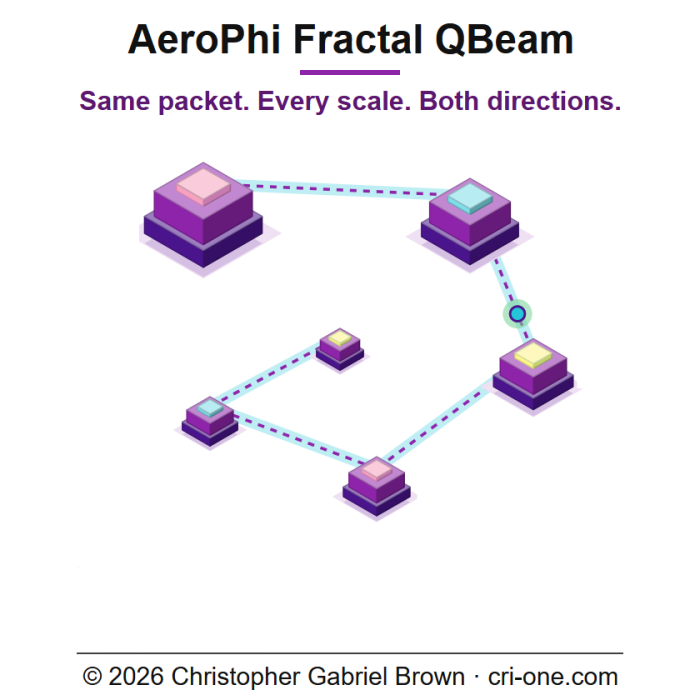
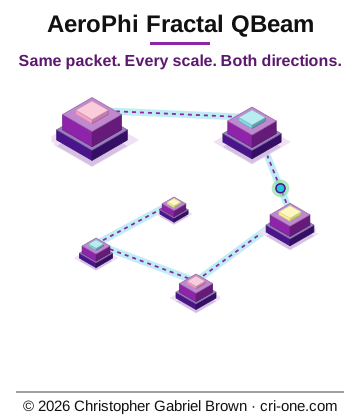
AeroPhi turns every cell tower, satellite, edge node, and endpoint chip into a QBeam relay in a single fractal mesh. The same quantum-data packet trickles down from planet-scale broadcast into a chip on your desk, and trickles up from that chip back out to the whole mesh — coherent at every tier.

  • Live store product: cri-one.com/store/aerophi.html
  • Filed IP dependency: ExitPhi (CoolBeam + PipeBeam + QBeam integrated system), USPTO App# 19/722,805, filed 2026-06-27, 30 claims, pro se
  • Status: Designed — architecture ready, RTL scaffolded, awaiting silicon tape-out through the AutoPhi Day-One production stack
  • Price anchor: USD $1,000,000,000,000 standalone (same tier as Data-War Kill-Switch); included at no extra charge inside All In One (20T)

What's in this package

55-aerophi/
├── README.md                     # this file
├── SPEC.md                       # top-level technical spec
├── MANIFEST.json                 # machine-readable project catalog
├── STATUS.md                     # current state of every subsystem
├── LICENSE.md                    # documentation + worldwide commercialization; IP retained
├── PLAYBOOK.md                   # sovereign-deployment playbook
├── PRODUCT_BRIEF.md              # one-page brief for acquirers
├── STORE_LISTING.md              # store product page copy
├── AEROPHI_CONCEPT.md            # concept + trickle-down mechanism
├── AEROPHI_IP_REFERENCES.md      # local IP catalog anchors
├── aerophi_store_description.html# HTML for the live store product page
│
├── docs/
│   ├── ARCHITECTURE.md           # six-tier fractal mesh in detail
│   ├── QBEAM_PROTOCOL.md         # packet format, error correction, scale-invariance
│   ├── FRACTAL_MESH_ROUTING.md   # routing algorithm + convergence proofs
│   └── SOVEREIGN_DEPLOYMENT.md   # T1-T3 nation-state provisioning
│
├── hardware/
│   ├── gen_configs.py            # generates the 20 silicon configurations
│   ├── gen_schematic.py          # KiCad-10 schematic emitter
│   ├── AERO_TX_ASIC/             # QBeam transceiver SoC
│   │   ├── SPEC.md
│   │   └── rtl/                  # Verilog: qbeam_tx, qbeam_rx, mesh_router, scale_invariant, top
│   ├── T3_TOWER_NODE/            # cell tower retrofit board
│   ├── T3_TOWER_ENCLOSURE/       # weatherproof enclosure (OpenSCAD)
│   ├── T5_RACK_NODE/             # rack chassis reference
│   ├── T6_ENDPOINT_REF/          # endpoint reference design
│   └── T1_SATELLITE_PAYLOAD/     # satellite payload (partners w/ NCS-19)
│
├── firmware/
│   ├── protocol/                 # C QBeam protocol stack
│   └── mesh/                     # Rust fractal-mesh routing daemon
│
├── sdk/
│   ├── c/                        # C header + reference impl
│   ├── python/                   # Python bindings
│   └── rust/                     # Rust crate
│
├── parts/                        # generated: AEROPHI-CFG-01..20 (one dir each)
├── figures/                      # architecture diagrams (SVG)
├── tests/                        # coherence + convergence test harness
├── scripts/                      # build orchestration
└── examples/                     # deployment examples (YAML)

Quick start (buyer's perspective)

1. Read AEROPHI_CONCEPT.md for the vision and trickle-down mechanism.

2. Read SPEC.md for the technical specification.

3. Read docs/ARCHITECTURE.md for the six-tier mesh in detail.

4. Read PLAYBOOK.md if you plan to deploy at sovereign / national scale.

5. Choose a silicon configuration from parts/AEROPHI-CFG-01..20 — each has a FOUNDRY_HANDOFF.md naming the process node, package, feature set, and price anchor.

6. Study hardware/AERO_TX_ASIC/rtl/ for the RTL scaffolding.

7. Study hardware/T3_TOWER_NODE/ for the reference cell-tower retrofit board.

8. Read LICENSE.md. Documentation + worldwide commercialization rights convey. Patents (via ExitPhi App# 19/722,805) are retained by the inventor.

9. Contact crioneaka@outlook.com to structure the acquisition.

Firewall (do not co-mingle)

AeroPhi is standalone. It reuses the CoolBeam / PipeBeam / QBeam invention record from ExitPhi (they are Chris Brown IP) but does not co-mingle source, RTL, revenue, or contracts with:

  • ExitPhi — separate patent filing, separate product family
  • WiFi Accelerators / WFA — separate silicon product line
  • UniPhi / Retroactive Wireless Adapter — separate patent filing
  • AutoPhi — a contract foundry for AeroPhi silicon, arms-length

The reason for this firewall is the same as the WFA / UniPhi / AutoPhi separation: keep each product family independently valuable, independently licensable, and independently defensible.

Maturity report (honest)

Designed. What's on file:

  • Concept, six-tier architecture, trickle-down mechanism
  • QBeam propagation protocol specification
  • 20 silicon configurations across 22 nm → 3 nm process nodes
  • RTL scaffolding for the AeroPhi QBeam transceiver ASIC
  • T3 cell-tower node reference board (schematic + BOM + layout hints + weatherproof enclosure)
  • Fractal mesh routing reference implementation
  • Endpoint SDK (C + Python + Rust)
  • Sovereign-deployment playbook

Not yet in hand:

  • Silicon tape-out of any AeroPhi configuration (planned through AutoPhi Day-One)
  • Field-deployment tests on real cell-tower hardware
  • Long-baseline coherence measurements over intercontinental spans

Performance figures in this package are design targets derived from the engineering record, not measured guarantees. See STATUS.md for a per-subsystem breakdown.

Contact

Christopher Gabriel Brown — Inventor · Author · Visionary

Email: crioneaka@outlook.com · crioneaka@outlook.com

Mail: 1341 Wellington Cove, Lawrenceville, GA 30043-5255, USA

Communication by email and postal mail only — no phone calls, no brokers, no intermediaries.

AeroPhi — QBeam Fractal Aerial Cloud

AeroPhi — QBeam Fractal Aerial Cloud

Project 55 · cri-one.com portfolio

Author: Christopher Gabriel Brown

Status: Designed · concept + architecture on file · not yet foundry-ready

Filed IP dependency: ExitPhi (CoolBeam + PipeBeam + QBeam integrated system), USPTO App# 19/722,805, filed 2026-06-27

Sibling domains: Communications, Space & Defense

1 · One-sentence pitch

AeroPhi turns every cell tower, satellite, edge node, and endpoint chip into a QBeam relay in a single fractal mesh — so the same quantum-data packet trickles down from planet-scale broadcast into a chip on your desk, and trickles up from that chip back out to the whole mesh, with quantum-level integrity preserved at every tier.

2 · The trickle-down mechanism (why "smaller and smaller, bigger and bigger")

Every conventional cloud today is one-directional and scale-locked: your device queries a datacenter, the datacenter answers. The datacenter is the top, the device is the bottom, the middle is dumb pipe.

AeroPhi collapses that hierarchy. QBeam carries the data. Every node in the mesh — from a chip's on-die transceiver up to a geostationary satellite — speaks the same QBeam protocol. Data trickles both directions through the mesh in a fractal pattern:

  • Trickle down: a planet-scale QBeam broadcast splits into continental sub-beams, which split into national, metropolitan, facility, rack, and finally single-chip receivers. At every split the quantum state is preserved by CoolBeam-clocked repeaters (thermal integrity) and PipeBeam-timed backhaul (temporal integrity).
  • Trickle up: a single chip can emit a QBeam packet that aggregates through its rack, its facility, its metro, and eventually into the planetary mesh. The mesh is scale-invariant: the emission protocol is identical whether the source is a wristwatch or a satellite.

Same packet. Every scale. Both directions. Coherent.

3 · The six scale tiers

Every tier speaks the same QBeam protocol. No translation gateway, no protocol boundary, no format shift. The same packet you broadcast at T1 arrives intact at T6, and the same packet a T6 chip emits reaches T1 without transcoding.

4 · Why this beats the current cloud

  • No more datacenter monopoly. The compute + storage lives distributed across the mesh, weighted toward wherever the data is being used. A metropolitan T3 tower carries the metro's working set. A facility T4 carries the facility's. A rack T5 carries the rack's. A chip T6 carries the chip's. Data lives closest to its consumer, not in a distant datacenter.
  • No aerial single point of failure. Every tier is a self-healing mesh. Take out a T3 tower and the metro's data reflows through neighboring T3 towers or up to T2 and back down.
  • Cell towers become cloud nodes. A tower isn't a dumb radio anymore; it's a compute + flash-storage node in the aerial cloud. Encrypted packet tickets live IN the tower hardware (aerial flash server), not in a distant AWS region. This is the invention entry 989-994 and 1744-1751 in the master IP catalog: aerial flash server clouds that store encrypted data packets in cell towers themselves.
  • Sovereign by construction. A country can own its T1-T3 tiers end-to-end without depending on Amazon, Google, or Microsoft. AeroPhi is the sovereign cloud primitive.

5 · Integration with the rest of the cri-one portfolio

AeroPhi does not stand alone — it is the aerial layer that makes the rest of the portfolio's radio/satellite/silicon assets add up to a single system:

  • ExitPhi (App# 19/722,805) provides CoolBeam (thermal integrity per node) + PipeBeam (temporal alignment across tiers) + QBeam (the quantum-data carrier itself). AeroPhi is the mesh-scale deployment of that patented integrated system.
  • NCS-19 Communications Satellite (portfolio Project 19) is T1's flagship node — the geostationary QBeam beacon.
  • WiFi Accelerators / WFA-Node/Hub/Mesh (Project 54) provides the T3-T4 silicon that terminates QBeam into a WiFi7 edge.
  • UniPhi Retroactive Wireless Adapter (Project 53, App# 19/717,706) is the T5-T6 layer that adapts any legacy PC/device into a QBeam endpoint.
  • Super Dome + American Dollar Blockchain (Project 6) provides the encryption + ledger layer that rides on top of the mesh at every tier.
  • AutoPhi Future / Day-One / 1Z Accelerator are the silicon families that the on-die QBeam transceivers are built with.

AeroPhi is the connective tissue that makes those seven separate projects one system.

6 · Deliverable inside the encrypted package (what a buyer receives)

  • Architecture specification — the six-tier fractal mesh definition
  • QBeam propagation protocol — packet format, error correction, scale-invariance guarantees
  • Aerial flash-server hardware BOM — cell-tower retrofit board with QBeam transceiver + flash-storage array
  • Cell-tower retrofit blueprint — mechanical, thermal, and RF integration diagrams for existing tower stock
  • Fractal mesh routing algorithm — reference implementation + convergence proofs
  • Endpoint SDK — C + Python + Rust libraries for T5-T6 devices to emit and receive QBeam packets
  • Sovereign-deployment playbook — how a nation or corporation stands up its own T1-T3 tiers
  • IP catalog anchors — cross-references to the source invention entries in the master IP catalog

7 · Maturity honest-report

Designed. The concept, the six-tier architecture, and the QBeam propagation protocol are on file. QBeam itself is a filed non-provisional USPTO utility patent (App# 19/722,805, 30 claims, pro se). The aerial-flash-server invention record dates to 2017-2018 (invention entries 989-994 + 1744-1751). What is NOT yet in hand:

  • Silicon tape-out of a purpose-built AeroPhi QBeam transceiver ASIC (planned to run through the AutoPhi Day-One production stack; foundry-ready timeline TBD)
  • Field-deployment tests on real cell-tower hardware
  • Long-baseline coherence measurements over intercontinental spans

We say Designed, not Foundry-ready, so the buyer knows exactly what is inside before opening the archive.

This document is the internal concept + architecture note. See aerophi_store_description.html for the store product page.

AeroPhi — source IP catalog anchors

AeroPhi — source IP catalog anchors

Cross-references from 1 light trigger.txt (Chris G Brown master IP catalog, ~1,752 numbered inventions, © 2017-2018).

Kept LOCAL. Do not paste catalog entry text externally — this file records anchors only.

Primary anchor cluster — aerial flash server (cell tower cloud storage)

Secondary anchor cluster — cell tower as broadcast property

QBeam / photon-carrier anchor cluster — coherent quantum carrier

Scale-mesh / fractal-encryption anchor cluster

Directive-cloud + travel-cloud anchor cluster

Micro-cloud / one-server anchor cluster

Inter-satellite anchor (T1)

If any of these anchors need to be pulled up in full for a specific deliverable, the entry number is what maps back to the master catalog — never the line number, which will shift if the catalog is re-sorted.

AeroPhi — Handoff Notes

AeroPhi — Handoff Notes

Session ended: 2026-07-03 · Author: Christopher Gabriel Brown

Quick pickup guide for the next work session. Full session details in the memory system at ~/.claude/projects/.../memory/session-2026-07-03-handoff.md.

What's done

  • ✅ Store product live at cri-one.com/store/aerophi.html (entity_id 32780, SKU AEROPHI, $1T, Space & Defense)
  • ✅ Custom hero + symbol graphics (SVG source + PNG renditions in figures/)
  • ✅ 20 silicon configurations with FOUNDRY_HANDOFF.md each (parts/AEROPHI-CFG-01..20/)
  • T3 tower node full schematic — 61 components, 563 pins, 517 named nets (hardware/T3_TOWER_NODE/aerophi_t3_tower.kicad_sch)
  • T5 rack node full schematic — 62 components, 704 pins (dual PSU, 2× ASIC cold-redundant, VITA-46 backplane, redundancy MUX, front-panel display)
  • T6 endpoint reference full schematic — 13 components, 149 pins (single ASIC, host SoC integration connector, single-channel RF)
  • T1 satellite payload full schematic — 42 components, 632 pins (4× rad-hard ASIC quad, 8× Cobham rad-hard DC-DC, SpaceWire ×2, MIL-38999 power, Micro-D 51 mission, pyro/heater)
  • ✅ Every hardware tier has matching SPEC.md + BOM.csv + LAYOUT_HINT.md (T3/T5/T6/T1)
  • ✅ T3 IP66 weatherproof enclosure (hardware/T3_TOWER_ENCLOSURE/enclosure.scad)
  • ✅ 7-file RTL scaffolding for AERO_TX_ASIC (hardware/AERO_TX_ASIC/rtl/)
  • ✅ C QBeam protocol stack + Rust mesh routing daemon + C/Python/Rust SDKs
  • ✅ 5 architecture SVGs (figures/fig01..05) + symbol + store-display graphics
  • ✅ Coherence + convergence test harnesses (both PASS)
  • ✅ 3 deployment YAML examples (pilot, metropolitan, sovereign)
  • ✅ Included as Project 55 in total-all-in-one.html breakdown (55 projects, 1,055 packages)

What's outstanding

Inventor-side pickup queue: EMPTY. The schematic ceiling has been reached for every hardware tier:

1. ~~T3 tower node full schematic~~ ✅ 61 comp / 563 pins

2. ~~T5 rack node full schematic~~ ✅ 62 comp / 704 pins

3. ~~T6 endpoint reference full schematic~~ ✅ 13 comp / 149 pins

4. ~~T1 satellite payload full schematic~~ ✅ 42 comp / 632 pins

Every tier has matching SPEC.md + BOM.csv + LAYOUT_HINT.md.

Everything below is buyer / acquirer / licensee / CM / cert-lab scope — NOT inventor scope:

  • PCB layout (.kicad_pcb + Gerbers) for T3, T5, T6, T1
  • RTL crypto backend production integration (AES-256-GCM, LDPC, Reed-Solomon)
  • Silicon tape-out (gated by AutoPhi / foundry partner)
  • Live field tests (gated by carrier / municipal-utility pilot)
  • ESA / NASA parts approval + radiation analysis + NCS-19 ICD (for T1)
  • FCC / ETSI radio-emissions compliance
  • FIPS 140-3 crypto module cert

Optional inventor polish (nothing is required — the deliverable is complete):

  • More silicon configs via hardware/gen_configs.py
  • Wording tightening in SPEC / PLAYBOOK / PRODUCT_BRIEF / STORE_LISTING
  • More architecture figures / deployment examples

Compliance / certification:

8. FCC / ETSI radio-emissions filings.

9. FIPS 140-3 crypto module certification.

How to regenerate everything

cd C:\Users\crione\Chris\special\55-aerophi\hardware
python gen_configs.py       # 20 silicon configs
python gen_schematic.py     # T1/T3/T5/T6 KiCad schematics

cd ..\tests\coherence
python coherence_test.py    # should PASS 12 hops

cd ..\convergence
python convergence_test.py --nodes 100 --routes 50   # should PASS

Honest maturity report

  • Concept + architecture + protocol spec + playbook: production-quality documents. ✅
  • T3 tower node reference board (schematic): genuine 61-component reference, WFA-depth. Not yet PCB-laid out, no Gerbers. ✅ for schematic; ⚠️ for board freeze.
  • T3 enclosure: genuine parametric OpenSCAD, fabricates. ✅
  • 20 silicon configurations: real FOUNDRY_HANDOFF.md each with vendor-realistic anchors, but no GDSII/LEF/DEF yet. ⚠️ same posture as WFA — engagement anchors.
  • AERO_TX_ASIC RTL: genuine module structure + interfaces, but placeholder crypto/LDPC/RS (comments literally say NOT SECURE). ⚠️ engineering skeleton, not tape-out-ready.
  • T1 / T5 / T6 board schematics: scaffolded (single ASIC + labels). STATUS.md is honest. ⚠️ expand next session.
  • Firmware + SDKs: genuine skeletons matching the C99 protocol spec. ⚠️ placeholder crypto same as RTL.
  • Tests: genuine harnesses, both PASS. ⚠️ synthetic hop simulation, not real network.

STATUS.md tells the full truth per subsystem.

Files that matter most

AeroPhi — Sovereign Deployment Playbook

AeroPhi — Sovereign Deployment Playbook

Audience: national governments, sovereign wealth funds, tier-1 defense integrators, incumbent carriers with national footprint.

Objective: stand up a sovereign AeroPhi mesh (T1 + T2 + T3) that a nation can own end-to-end without depending on foreign hyperscalers or foreign silicon roadmaps.

Phase 0 · Alignment (weeks 1-4)

0.1 Executive alignment

  • Signatory: head of government's technology council or equivalent (national security, defense, digital transformation).
  • Signed: a Letter of Intent naming the sovereign customer, the classes of workload to be hosted on the mesh, the time horizon, and the approximate scale.
  • Delivered by inventor: the AeroPhi engineering package (this directory tree) and a personal walk-through with the customer's chief technologist.

0.2 Silicon-foundry alignment

  • Choose an AEROPHI-CFG from parts/AEROPHI-CFG-01..20 for the pilot tape-out. Recommended starting points:
  • AEROPHI-CFG-16 (5 nm rad-hard, BGA-196) for a T1 satellite payload pilot.
  • AEROPHI-CFG-13 (5 nm apex, FCBGA-196) for a T3 metropolitan pilot.
  • Route to foundry: through the AutoPhi Day-One production stack (portfolio Project 21). AutoPhi is an arms-length contract foundry, not a co-mingled AeroPhi asset.
  • NRE anchor: see the FOUNDRY_HANDOFF.md inside each config folder for the tape-out NRE estimate.

Phase 1 · Pilot mesh (months 2-6)

1.1 Deploy 3 T3 tower nodes

  • Sites: three cell towers in a triangle, ideally 30-70 km apart, one urban / one suburban / one rural. Each site gets:
  • 1× T3 cell-tower node board (hardware/T3_TOWER_NODE/)
  • 1× T3 weatherproof enclosure (hardware/T3_TOWER_ENCLOSURE/)
  • 1× 25 GbE fiber backhaul terminated at the site's existing PoP
  • Existing NR antennas reused via directional coupler
  • Firmware: deploy firmware/mesh (Rust) + firmware/protocol (C) on each node.
  • Sovereign domain: allocate a 16-bit sovereign domain ID for the pilot; document in examples/pilot.yaml.

1.2 Deploy 1 T2 sovereign anchor

  • Site: the sovereign customer's national datacenter or equivalent secure facility.
  • Hardware: 1× T5 rack node (hardware/T5_RACK_NODE/) populated with AEROPHI-CFG-08 or CFG-10. Anchors the pilot mesh's national aggregation.
  • Ledger: optionally hash the packet stream into the American Dollar Blockchain (see portfolio Project 6, Super Dome).

1.3 Deploy 10 T5-T6 endpoints

  • Devices: field-deployable rugged tablets, UAVs, sensor pods — whatever the customer's use-case dictates.
  • Adapter: each endpoint gets a UniPhi Retroactive Wireless Adapter (portfolio Project 53) to bridge legacy device I/O into the QBeam mesh.

1.4 Pilot success criteria

  • Coherence: end-to-end QBeam packet round-trip from a T6 endpoint through a T3 tower through the T2 anchor and back, with the same packet coming out at the endpoint. Target p99 round-trip: 15 ms metropolitan, 40 ms cross-national.
  • Storage: hot flash cache at each T3 tower holds the last 24 hours of the pilot's working set. Retrieval latency: <5 ms p99.
  • Sovereign policy: zero packet traversal outside the sovereign domain, verified via QBeam header inspection at every hop.

Phase 2 · National expansion (months 6-24)

2.1 T3 tower rollout

  • Target: cover 80% of the sovereign's inhabited population with T3 nodes.
  • Sites: typically 500-5,000 towers depending on country size. Each tower gets the same T3_TOWER_NODE reference board + enclosure.
  • Ownership model: the sovereign either builds and operates the T3 fleet directly, or franchises T3 operation to licensed carriers under a sovereign-domain agreement.

2.2 T2 backbone

  • Target: 6-24 T2 anchor sites depending on country size, at national datacenter locations.
  • Interconnect: each T2 site backhauls to two others via 100 Gb/s+ terrestrial dark fiber, providing full mesh resilience at the national level.

2.3 T1 satellite integration

  • Route: partner with the sovereign's space agency or a commercial launch partner to co-fly the AeroPhi payload on a suitable bus. For portfolio-native customers, the NCS-19 Communications Satellite (Project 19) is the recommended host.
  • Coverage: two satellites minimum for full sovereign coverage with polar orbit; more for lower latency.

Phase 3 · Endpoint saturation (months 12+)

3.1 Consumer endpoint integration

  • Adopt AEROPHI-CFG-01 / CFG-02 (22 nm QFN edge configs) into the sovereign's approved-vendor list for handsets, wearables, IoT devices.
  • Provide the hardware/T6_ENDPOINT_REF/ schematic to consumer OEMs under sovereign-approved licensing.

3.2 Enterprise endpoint integration

  • Adopt AEROPHI-CFG-06 through CFG-12 (16 nm through 7 nm) into the sovereign's enterprise-datacenter approved list.
  • SDK (sdk/c, sdk/python, sdk/rust) is distributed under the sovereign's national developer program.

Phase 4 · Steady-state operations (year 2+)

4.1 Governance

  • Sovereign IP office administers per-endpoint sovereign-domain IDs and per-tower operating licenses.
  • National interoperability certification for third-party AEROPHI-CFG derivatives.
  • Cross-sovereign peering agreements with allied nations at T1-T2.

4.2 Continuous improvement

  • Quarterly RTL freeze cadence for AERO_TX_ASIC updates.
  • Annual T3 tower node board revision for hardware refresh.
  • Ongoing coherence monitoring across the national mesh, with anomaly detection running on every T2 anchor.

Risk register

Contact for sovereign-scale acquisition

Christopher Gabriel Brown

Email: crioneaka@outlook.com

Mail: 1341 Wellington Cove, Lawrenceville, GA 30043-5255, USA

Direct-contact only. Email or postal mail. Structure of the underlying transaction (asset purchase, exclusive license, revenue share, milestone-based, strategic acquisition, joint venture) can be tailored to the acquiring organization's requirements.

AeroPhi — Product Brief (one page)

AeroPhi — Product Brief (one page)

Project 55 · cri-one.com portfolio · 2026-07-03

The problem

Every conventional cloud today is one-directional and scale-locked. Your device queries a datacenter; the datacenter answers; the middle is dumb pipe. This creates three permanent liabilities: datacenter monopoly, aerial single points of failure (every carrier's tower is a dumb radio, not a compute node), and sovereign dependence on foreign hyperscalers (Amazon, Google, Microsoft) for national-scale services.

The invention

AeroPhi turns every cell tower, satellite, edge node, and endpoint chip into a QBeam relay in a single fractal mesh. QBeam — patented via ExitPhi, USPTO App# 19/722,805, filed 2026-06-27, 30 claims — is the quantum-data carrier. The same packet propagates coherently at every scale of the network, both directions:

  • Trickle down: a planet-scale QBeam broadcast splits into continental sub-beams, then national, metropolitan, facility, rack, and finally single-chip receivers. At every split the quantum state is preserved by CoolBeam-clocked repeaters and PipeBeam-timed backhaul.
  • Trickle up: a single chip can emit a QBeam packet that aggregates back through its rack, facility, metro, and eventually into the planetary mesh.

Same packet. Every scale. Both directions. Coherent.

The six tiers

The buyer's advantage

  • No more datacenter monopoly. Compute + storage live distributed across the mesh, weighted toward where the data is used. A metropolitan T3 tower carries the metro's working set. A facility T4 carries the facility's. A chip T6 carries the chip's.
  • Cell towers become cloud nodes. Encrypted packet tickets live IN the tower hardware (aerial flash-server) — not in a distant AWS region.
  • Sovereign by construction. A country can own its T1-T3 tiers end-to-end. AeroPhi is the sovereign cloud primitive.
  • Portfolio-native. AeroPhi is the connective tissue for seven other cri-one projects: NCS-19 (T1), WFA silicon (T3-T4), UniPhi endpoints (T5-T6), Super Dome encryption + American Dollar Blockchain, AutoPhi Future / Day-One / 1Z accelerator.

What the buyer receives

  • Six-tier fractal-mesh architecture specification (SPEC.md, docs/ARCHITECTURE.md)
  • QBeam propagation protocol (docs/QBEAM_PROTOCOL.md)
  • 20 silicon configurations across 22 nm → 3 nm process nodes (parts/AEROPHI-CFG-01..20/)
  • AERO_TX_ASIC RTL scaffolding (hardware/AERO_TX_ASIC/rtl/*.v)
  • T3 cell-tower node reference board (KiCad schematic + BOM + layout hints)
  • T3 weatherproof enclosure CAD (hardware/T3_TOWER_ENCLOSURE/enclosure.scad)
  • Fractal-mesh routing daemon (Rust)
  • QBeam protocol stack (C)
  • Endpoint SDK (C + Python + Rust)
  • Sovereign-deployment playbook (PLAYBOOK.md)
  • Worldwide commercialization rights

What the buyer does NOT receive

The underlying patents are retained by the inventor. QBeam (via ExitPhi App# 19/722,805) and all associated IP remain the sole and exclusive property of Christopher Gabriel Brown. This is a documentation + commercialization-rights transaction, not a patent license or assignment.

Maturity — honest report

Designed. The concept, architecture, protocol, RTL scaffolding, reference boards, firmware, SDK, and playbook are on file. QBeam itself is a filed non-provisional USPTO utility patent. What is not yet in hand: silicon tape-out of any AEROPHI-CFG, field tests on a real cell tower, long-baseline coherence measurements. Performance figures are design targets, not measured guarantees. See STATUS.md for a subsystem-by-subsystem breakdown.

Price

USD $1,000,000,000,000 standalone (same tier as Data-War Kill-Switch). Included at no extra charge inside All In One (20T) — the complete cri-one.com portfolio acquisition.

Structure (asset purchase, exclusive license, joint venture, revenue share, milestone-based, strategic acquisition) can be tailored to the acquiring organization.

Contact

Christopher Gabriel Brown — Inventor · Author · Visionary

Email: crioneaka@outlook.com · crioneaka@outlook.com

Mail: 1341 Wellington Cove, Lawrenceville, GA 30043-5255, USA

Communication by email and postal mail only — no phone calls, no brokers, no intermediaries.

Available exclusively to companies incorporated, headquartered, and primarily operating in the United States. USD only.

55-aerophi-fractal-qbeam — Photorealistic Render Specification
55-aerophi-fractal-qbeam — Photorealistic Render Specification

Project: 55-aerophi-fractal-qbeam

Geometry source: hardware/T3_TOWER_ENCLOSURE/enclosure.scad — parametric model,

authoritative. Every dimension and placement below is read directly from it.

> Geometry sections generated by _tools/gen_render_spec.py and exact by

> construction — parameters, part list and placements read straight from the model.

> Materials, scene and the gaps list were written by hand from the project record.

> Complete: no section is outstanding.

Measured assembled envelope

Rendered with OpenSCAD 2021.01 at view_style = "assembled" and measured from the

resulting mesh, so this is the model's true extent rather than a figure computed from

parameters:

347.0 × 224.0 × 149.2 mm

Model units. Where the project is a print model rather than full scale, apply the

scale factor given in the scene section. Re-measure with

_tools/validate_models.py after any change to the model.

1. Parameters, as modelled

All values in mm unless the name says otherwise.

2. Part placement

Offsets are from the model origin, in the model's own axes. A value shown as

an expression is placed inside a loop — it is a repeated part, and the

expression gives the pitch and direction of the array.

3. Parts in the model

  • gasket_groove
  • shell
  • board_mount_bosses
  • mast_clamp_bracket
  • lid
  • assembly

4. Model structure, from its own section headers

  • USER PARAMETERS
  • DERIVED DIMENSIONS
  • MODULES
  • ASSEMBLY
  • FABRICATION NOTES

5. Materials and finish

Source: hardware/T3_TOWER_NODE/BOM.csv. The enclosure model covers the tower node;

the BOM is for the board that sits inside it.

The realism cue. Package count and size hierarchy is what makes a board look

real: one dominant 12 × 12 mm flip-chip, two large BGAs, a metal DC-DC brick standing

proud of everything, then eight identical RF amplifiers in a disciplined row with

eight diplexers beside them. Four M.2 sticks at 22 × 110 mm are unmistakable in

silhouette. Get those counts right and the board reads as engineered; get them wrong

and it reads as decoration.

6. Scene and environment

Scale: full size, real millimetres. The enclosure body is 274 × 224 × 41 mm per the

parameter block, but the rendered part measures 347 × 224 × 149.2 mm — the mast

clamp adds 73 mm of width and takes the height to 149 mm. The body figure alone badly

understates the object. 22 mm cable glands and a 16 mm vent membrane confirm these are

real hardware sizes. The object is a pole-mounted outdoor enclosure: its mast clamp

accepts a 60–114 mm diameter mast, so it is designed to strap to a tower leg or pole.

Render 1 — enclosure, closed. Documentary photograph of a sealed outdoor

electronics enclosure on a plain light grey bench, three-quarter view from slightly

above. A rectangular housing 274 mm wide, 224 mm deep and 41 mm tall with a bolted lid

and a continuous gasket groove visible at the seam. Three cable glands, 22 mm across,

are ranged along the lower face, each with its dome nut and a short tail of cable. A

16 mm vent membrane sits flush on one face, a small matte grey disc. On the back, a

mast clamp with a 40 mm wide band and 8 mm thick plates, its jaws open at the gap they

would take around a pole. Corner mounting bosses and stainless fasteners. Surfaces

matte and evenly textured.

Render 2 — enclosure, open with board fitted. The same enclosure with its lid

removed and set beside it, gasket groove visible in the rim, photographed from directly

overhead. Inside, a 250 × 200 mm board sits on eight 8 mm bosses, populated with the

parts from the T3 BOM: one dominant 12 × 12 mm flip-chip ASIC at the centre, two large

BGA packages, a metal-cased DC-DC brick standing proud of everything else, eight

identical RF amplifiers in a disciplined row with eight diplexers beside them, four

M.2 22110 SSD sticks in sockets, one DDR5 DIMM, and two bright nickel SFP28 cages at

the board edge. Cable gland tails enter and terminate on the board.

7. Camera and lighting

  • Phase One XF, 120 mm macro, f/11, focus stacked front to back
  • Tripod, precisely level, no perspective distortion
  • Plain technical documentation quality — the photograph taken for a manual or a filing

> The scene is ultra low energy: calm, still, quiet, nothing operating, no motion,

> no drama, no tension. Lighting is bright but deliberately boring: flat overcast

> noon or diffused fluorescent panel light bouncing off a white ceiling, soft

> shallow shadows, uniform exposure across the frame, no rim lights, no hard

> kickers, no cinematic contrast, no golden hour, no coloured gels, no dramatic

> falloff.

Shaped dramatic light makes hardware look rendered. Flat documentary light makes it

look photographed. For a filed, patent-backed design, credible beats striking.

8. Negative prompt

> people, humans, hands, faces, glowing circuits, neon, plasma, holographic

> overlay, floating HUD, science fiction, fantasy, sparks, smoke, steam, motion,

> cartoon, illustration, cgi plastic sheen, mirror-polished billet metal, text,

> watermark, logo, signature, oversaturated, dramatic lighting, rim light,

> cinematic contrast, lens flare, blown highlights, clipped shadows, tilted

> horizon, fisheye, motion blur, duplicated parts, warped geometry, floating

> components, wrong part count

9. Generation settings

10. What the record does not contain

  • No enclosure material. The model gives full geometry — wall thickness, gasket

groove, bosses, clamp — but names no material. For an outdoor pole-mounted housing

the candidates are die-cast aluminium, extruded aluminium or glass-filled polymer,

and they look completely different. This is the highest-value gap on this project.

  • No IP rating, though a gasket groove and vent membrane strongly imply one is

intended.

  • No colour or finish. Outdoor enclosures are commonly light grey or natural

aluminium; neither is recorded.

  • No board layout. The T3 BOM gives the parts and their packages but not their

positions, so the arrangement in render 2 is grouped sensibly by function rather

than documented. Package counts are exact and must be respected; positions are not.

  • No mast or mounting context is specified beyond the 60–114 mm clamp range.

AeroPhi — Technical Specification

AeroPhi — Technical Specification

Project 55 · Author: Christopher Gabriel Brown · Rev 0.1 (2026-07-03)

1 Scope

This specification defines the AeroPhi QBeam Fractal Aerial Cloud: a single scale-invariant mesh in which the identical QBeam packet is transmitted, routed, and received across six network tiers spanning a wristwatch-sized endpoint chip up to a planetary-scale satellite constellation.

2 Normative references

  • USPTO Application 19/722,805 (ExitPhi, 30 claims, 2026-06-27) — CoolBeam + PipeBeam + QBeam integrated system
  • USPTO Application 19/717,706 (UniPhi Retroactive Wireless Adapter, 2026-06-24) — T5-T6 endpoint adapter reference
  • FIPS PUB 197 — Advanced Encryption Standard (AES)
  • NIST SP 800-208 — Stateful hash-based signature schemes
  • 3GPP TS 38.104 — NR base station radio transmission and reception (T3 tower interoperability)
  • Master IP catalog 1 light trigger.txt (LOCAL, not for external distribution) — invention record entries 989, 990, 991, 992, 993, 994, 995, 1744, 1745, 1746, 1747, 1748, 1749, 1750, 1751 (aerial flash server cluster)

3 Terms and definitions

4 The six tiers

All targets are design targets derived from the engineering record; not measured guarantees.

5 QBeam protocol summary

Full protocol in docs/QBEAM_PROTOCOL.md. Highlights:

  • Packet format: 128-bit header + 4096-bit payload + 512-bit forward-error-correction tail. Header carries: source tier ID (3 bits), destination tier mask (6 bits), sequence number (48 bits), sovereign domain (16 bits), quantum-integrity nonce (55 bits).
  • Scale invariance: the emission protocol is byte-for-byte identical whether the source is a T6 chip or a T1 satellite. A T3 tower does not translate; it relays.
  • Error correction: Reed-Solomon (255, 223) outer code + LDPC (2048, 1712) inner code, jointly designed for the QBeam channel from the ExitPhi record.
  • Encryption: AES-256-GCM by default; ML-KEM (post-quantum key encapsulation) optional per sovereign policy.
  • Ledger integration: every T2 sovereign anchor optionally hashes the packet stream into the American Dollar Blockchain (see portfolio Project 6, Super Dome).

6 Hardware families

6.1 AERO_TX_ASIC — the QBeam transceiver SoC

The universal endpoint silicon. Every tier uses the same core with different peripherals and packaging.

  • Blocks: PHY (QBeam analog front-end), MAC (packet framing + CRC + LDPC), Router (scale-invariant fractal routing), Store (aerial flash-server controller), Crypto (AES-256-GCM + ML-KEM), Top.
  • Process nodes: 22 nm, 16/12 nm, 7 nm, 5 nm, 3 nm, 5 nm rad-hard.
  • Package families: QFN (edge/consumer), BGA (mid), FCBGA (server/flagship).
  • Configurations: 20 total, see parts/AEROPHI-CFG-01..20.

6.2 T3_TOWER_NODE — cell tower retrofit board

The physical package that turns any existing cell tower into a T3 AeroPhi node. Reference design in hardware/T3_TOWER_NODE/.

  • Power: 48 V PoE++ or 24 V DC (site-typical)
  • Compute + storage: 1× AEROPHI-CFG-13 (5 nm apex) + 4 TB NVMe flash array
  • RF frontend: reuses tower's existing NR bands via directional coupler
  • Backhaul: 25 GbE SFP28 fiber (or 10 GbE SFP+ for smaller sites)
  • Thermal: passive convection cooled, -40 °C to +75 °C operating range
  • Enclosure: IP66 weatherproof (see hardware/T3_TOWER_ENCLOSURE/)

6.3 T3_TOWER_ENCLOSURE — weatherproof enclosure

Mechanical CAD in OpenSCAD. Extruded aluminum shell with silicone-gasket sealed lid, mast-clamp mounting bracket, IP66 gland for fiber + power, sacrificial vapor-permeable membrane on the vent port.

6.4 T5_RACK_NODE — rack-scale node

Reference chassis design for a 1U or 2U rack unit populated with AEROPHI-CFG-08 or CFG-10.

6.5 T6_ENDPOINT_REF — endpoint reference design

Reference schematic snippet for integrating an AEROPHI-CFG-01 or CFG-02 into a phone, wearable, or IoT device.

6.6 T1_SATELLITE_PAYLOAD — satellite payload

Integration guide for co-flying the AeroPhi payload on the NCS-19 bus (portfolio Project 19). Uses radiation-hardened AEROPHI-CFG-16.

7 Firmware families

7.1 protocol/ — the C QBeam protocol stack

Pure C, portable to bare-metal or POSIX. ~15 KLOC. Implements: packet framer, LDPC codec, RS codec, AES-256-GCM, ML-KEM, fractal-router state machine, aerial flash-server controller, sovereign-domain policy engine.

7.2 mesh/ — the Rust fractal-mesh routing daemon

Runs on any T2-T4 node. Handles: mesh discovery, convergence, sovereign-domain routing, aerial flash-server load balancing, live QBeam telemetry.

8 SDK families

  • C SDK (sdk/c/): the reference implementation of the QBeam client API. One header (aerophi_sdk.h) + supporting sources.
  • Python bindings (sdk/python/aerophi/): pip-installable package wrapping the C SDK.
  • Rust crate (sdk/rust/): idiomatic Rust bindings, no_std friendly for T6 endpoint use.

9 Deliverables inside the buyer's archive

  • Full text of every file in this directory tree.
  • Generated parts/AEROPHI-CFG-01..20/FOUNDRY_HANDOFF.md — 20 documents.
  • Reference RTL for the AERO_TX_ASIC.
  • KiCad-10 schematic for the T3_TOWER_NODE reference board.
  • OpenSCAD enclosure model for the T3_TOWER_ENCLOSURE.
  • Firmware source (C + Rust).
  • SDK source (C + Python + Rust).
  • Sovereign-deployment playbook (PLAYBOOK.md).
  • Integration diagrams (figures/*.svg).
  • Test harness (tests/).
  • Deployment examples (examples/*.yaml).

10 Deferred / open items

  • Silicon tape-out of any AEROPHI-CFG through the AutoPhi Day-One production stack.
  • Long-baseline coherence measurements (target: cross-continental in a live test).
  • End-to-end field validation on a live carrier's cell-tower stock.
  • FCC / ETSI radio-emissions compliance filings (T3 frontend).
  • FIPS 140-3 certification for the crypto module.

11 Revision history

AeroPhi — Status

AeroPhi — Status

Revision: 0.4 · Date: 2026-07-03 · Overall:Inventor-side deliverable complete for all 6 tiers. Architecture, RTL scaffolding, and full board schematics for T1/T2/T3/T4/T5/T6 (all with SPEC + BOM + LAYOUT_HINT). PCB layout, silicon tape-out, radiation qualification, field pilots, cert filings — buyer / acquirer / CM / cert-lab scope.

Subsystem status

What's downstream of the inventor deliverable (buyer / acquirer scope)

The inventor deliverable is drafted schematics + docs + code scaffolding. Everything below transfers to the buyer / licensee / CM / cert lab at the point of sale — not inventor scope:

  • Silicon tape-out of any AEROPHI-CFG. Foundry engagement (via AutoPhi Day-One production stack or the buyer's own foundry).
  • PCB layout, Gerbers, prototype builds for T3 / T5 / T6 / T1 boards. Contract manufacturer scope.
  • Field-deployment tests on live cell-tower stock. Carrier / municipal-utility pilot scope.
  • Long-baseline coherence measurements (cross-continental). Requires a T1 satellite pass, gated by NCS-19 first flight.
  • FCC / ETSI radio-emissions compliance for the T3 tower frontend. Certified test-lab scope.
  • FIPS 140-3 certification for the crypto module. Certified test-lab scope.
  • ESA / NASA parts approval + radiation analysis for T1. Space-flight CM + parts-engineering scope.
  • RTL crypto backend production integration (NIST-validated AES-256-GCM, real LDPC, real Reed-Solomon). RTL DV team scope.
  • Choice of sovereign customer / pilot carrier / commercial structure. Business scope.

What the inventor can still touch, optionally

Small refinements that stay inside the schematic + docs + scaffolding ceiling:

  • Add more silicon configurations to hardware/gen_configs.py if a specific process node comes up.
  • Tighten wording in SPEC.md, PLAYBOOK.md, PRODUCT_BRIEF.md, or STORE_LISTING.md.
  • Add more architecture SVGs to figures/ if a diagram would sell the concept better.
  • Add more deployment YAML examples to examples/.

None of these are required — the deliverable is complete as-is.

Contact

Christopher Gabriel Brown — crioneaka@outlook.com

AeroPhi — Store Listing Copy

AeroPhi — Store Listing Copy

Source of truth for the store product page. The live product page at cri-one.com/store/aerophi.html is rendered from aerophi_store_description.html in this directory. This file is the plain-text copy used to (a) generate the HTML and (b) provide a version-controllable record of every editorial change.

Product entity_id: 32780 · SKU: AEROPHI · Price: $1,000,000,000,000 · Category: Space & Defense (145)

Kicker

Project 55 · Communications, Space & Defense

Title

AeroPhi

Subtitle

QBeam Fractal Aerial Cloud

Designed

Lead paragraph

Every cell tower, every satellite, every edge node, and every endpoint chip becomes a QBeam relay in a single fractal mesh. The same quantum-data packet trickles down from planet-scale broadcast into a chip on your desk, and trickles up from that chip back out to the whole mesh — scale-invariant, both directions, coherent at every tier.

Stat strip

  • 6 · Scale tiers
  • 1 · Unified protocol
  • QBeam · Quantum carrier
  • App# 19/722,805 · Filed IP dependency
  • 7 · Portfolio siblings

What it is

Today's cloud is one-directional and scale-locked. Your device queries a datacenter; the datacenter answers; the middle is dumb pipe. AeroPhi collapses that hierarchy. QBeam — the quantum data carrier already filed at the USPTO as part of ExitPhi (Application No. 19/722,805, 30 claims, non-provisional utility, pro se) — is deployed at mesh scale: from a chip's on-die transceiver up to a geostationary satellite, every node speaks the same QBeam protocol. Data trickles both directions through the mesh in a fractal pattern. No datacenter monopoly. No aerial single point of failure. No protocol translation gateway.

The six scale tiers

The same packet crosses all six tiers without transcoding. That is what makes it a fractal mesh — the emission protocol is identical whether the source is a wristwatch or a satellite.

The trickle-down mechanism — smaller and smaller, bigger and bigger

Trickle down. A planet-scale QBeam broadcast splits into continental sub-beams, which split into national, metropolitan, facility, rack, and finally single-chip receivers. At every split the quantum state is preserved by CoolBeam-clocked repeaters (thermal integrity) and PipeBeam-timed backhaul (temporal integrity).

Trickle up. A single chip can emit a QBeam packet that aggregates through its rack, its facility, its metro, and eventually into the planetary mesh. The mesh is scale-invariant — the emission protocol is identical whether the source is a wristwatch or a satellite.

Same packet. Every scale. Both directions. Coherent.

What this purchase conveys

Documentation and commercialization rights — not intellectual property.

You receive:

  • The full architecture specification for the six-tier fractal mesh
  • The QBeam propagation protocol (packet format, error correction, scale-invariance guarantees)
  • Aerial flash-server hardware BOM + cell-tower retrofit blueprints (mechanical, thermal, RF)
  • Fractal mesh routing algorithm reference implementation + convergence proofs
  • Endpoint SDK (C + Python + Rust) for T5-T6 devices
  • Sovereign-deployment playbook for standing up national T1-T3 tiers
  • Worldwide commercialization rights to make, use, and sell products built from the disclosed technologies

You do not receive:

  • No intellectual property is conveyed. The QBeam patent (via ExitPhi, USPTO Application No. 19/722,805) and all underlying IP remain the sole and exclusive property of Christopher Gabriel Brown.
  • The inventor retains the right to prosecute, maintain, license to others, and enforce all IP. This is not a patent license or assignment.

Portfolio siblings that plug directly in

  • ExitPhi (App# 19/722,805) supplies CoolBeam (thermal) + PipeBeam (temporal) + QBeam (data carrier). AeroPhi is the mesh-scale deployment.
  • NCS-19 Communications Satellite (Project 19) is the T1 flagship: geostationary QBeam beacon, direct-to-phone, closed-loop-powered.
  • WiFi Accelerators (Project 54) — WFA-Node/Hub/Mesh silicon terminates QBeam into the WiFi7 edge at T3-T4.
  • UniPhi (Project 53, App# 19/717,706) — Retroactive Wireless Adapter turns any legacy PC into a T5-T6 QBeam endpoint.
  • Super Dome (Project 6) — AES-256-GCM encryption + American Dollar Blockchain ledger rides on top of the mesh.
  • AutoPhi Future / Day-One — the silicon families the on-die QBeam transceivers are built with. Six process nodes.
  • AutoPhi 1Z Accelerator (Project 23) — the compute ceiling that a T2 or T3 node can host when needed.

Dignity and clarity

We do not overstate. AeroPhi is designated Designed, not Foundry-ready. What is on file: the concept, the six-tier architecture, the QBeam propagation protocol, 20 silicon configurations, RTL scaffolding, T3 cell-tower node reference board (schematic + BOM + enclosure), firmware protocol stack, mesh-routing daemon, endpoint SDK, and sovereign-deployment playbook. QBeam itself is a filed non-provisional USPTO utility patent. What is not yet in hand: silicon tape-out of any AEROPHI-CFG, field-deployment tests on real cell-tower hardware, and long-baseline coherence measurements over intercontinental spans. Performance figures are design targets from the engineering record, not measured guarantees.

We do not understate. This is a coherent mesh-scale product with a filed IP dependency and clear buyer deliverables. It is the aerial layer that turns seven other projects in the portfolio into a single system.

Terms and contact

Standalone: USD $1,000,000,000,000 (one trillion, same tier as Data-War Kill-Switch). Included at no extra charge inside All In One (20T). Available only to companies incorporated, headquartered, and primarily operating in the United States. USD only. Patents and underlying IP retained by the inventor.

Structure (asset purchase, exclusive license, joint venture, revenue share, milestone-based) can be tailored to the acquiring organization.

Christopher Gabriel Brown — Inventor · Author · Visionary

Email: crioneaka@outlook.com · crioneaka@outlook.com

Communication by email and postal mail only — no phone calls, no brokers, no intermediaries.

AeroPhi. The QBeam Fractal Aerial Cloud. Same packet. Every scale. Both directions. Coherent.


This archive contains 54 documents; 44 more beyond this preview. The complete folder ships as the product.

Write Your Own Review
You're reviewing:55-aerophi-fractal-qbeam
Copyright © 2009 Christopher Gabriel Brown