
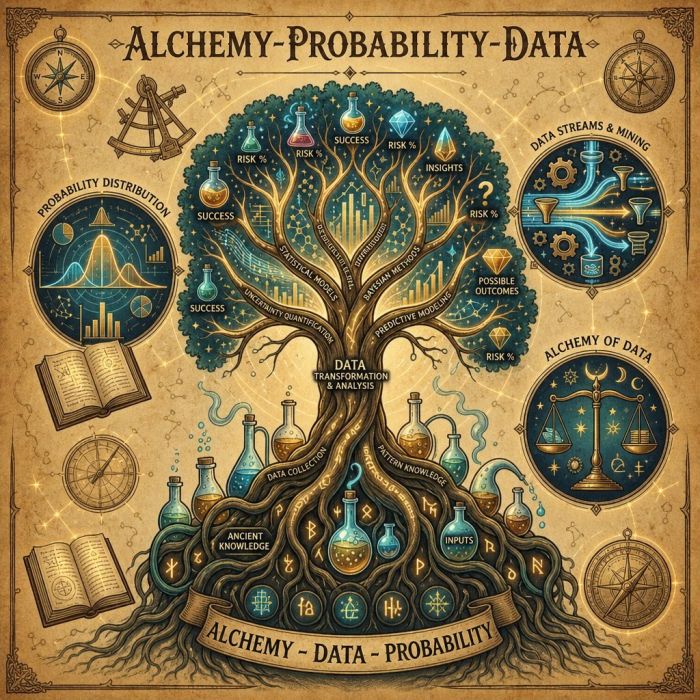
41-alchemy-data-three
Asset valuation: $2,400,000,000. Master index of all projects: PROJECTSINDEX. Last edited: 2026-05-02 Status: Third-generation Alchemy Data substrate + supporting inventor records Maturity (per PACKAGEARCHITECTURE.md): L1 (Research / Working Software) — research code, blog imports, and inventor rec
Think of a chemist's notebook that never stops asking "what happens if I put these two together under heat, pressure or a catalyst" - and then answers itself, scores the answer and files it. Alchemy Data Three is the third generation of that notebook. It is the computational substrate underneath the disease-discovery research behind the Alzheimer's, Parkinson's and 300-disease-database patent applications, and it is research work: a machine that produces candidates for study, not a treatment and not a claim of one.
It is not a rewrite. The whole second-generation engine sits inside it, untouched, with a new layer wrapped around it - the probability calculators, the element-transformation database that records what carbon, hydrogen, nitrogen and oxygen do under heat, pressure, mixing and catalysis, and the formula mapper that turns known formulas such as PV = nRT and F = ma into step-by-step synthesis recipes. One script sweeps 36,068 unique element combinations and ranks them by novelty; another catalogues more than 257,500 base methods across nine categories. On top sits the 41-41-41 folder: a complete nonprovisional patent filing package that gives the system its legal backbone.
The package is 5,576 files - 5,210 compressed data snapshots, 195 vector figures, 41 ranked compound tables, 18 Python scripts and eleven web pages for searching compounds and browsing transformations. It is for a research group or licensee that wants the machine, not one disease's worth of output. The buyer walks away with the engine, the data and the filing record; the inventions stay credited to Christopher Gabriel Brown.
Description
Alchemy Data Three — Third-Generation Compound Analysis System
Alchemy Data Three is the third generation of Christopher Gabriel Brown's compound-mechanism analysis system — the computational substrate that powers the disease-discovery research behind the Alzheimer's, Parkinson's, and 300-disease-database patent applications. It builds on Project 07 (Alchemy Probability Data V2), wrapping that engine in a new layer and adding the 41-41-41 subtree: a complete nonprovisional patent filing package that gives the system its legal backbone. A buyer who acquires this package gets the machine that produces the discoveries , not just one disease's worth of output.
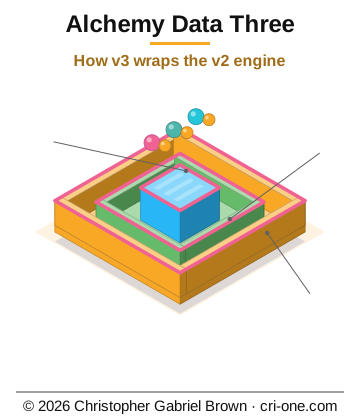
How v3 wraps the v2 engine
Alchemy Data Three is not a rewrite. It is a superset. The directory tree mirrors the entire Alchemy Probability Data project (Project 07, the v2 substrate) inside a 07-alchemy-probability-data/ subtree, then adds the 41-41-41/ folder of new third-generation content on top. At the code level, the v2 engine's AlchemyDataV2 class imports and wraps three subsystems — the ElementTransformationDatabase , the FormulaSynthesisMapper , and the original v1 probability libraries ( ProbabilityCalculator , MultiplierCalculator , MultiDegreeProbabilityEngine ) — into a single compound-discovery pipeline. V3 preserves this full architecture and layers the patent-filing record on top, establishing the legal filing for the combined inventions and connecting the substrate to the disease-discovery applications.
.gz 5,210 Gzip-compressed JSON data snapshots (probability matrices, compound chunks, transformation records)
.md 28 Markdown documentation (quick-start guides, system architecture, test results, changelogs)
.py 18 Python scripts — the analysis engine, API server, data generators, diagram renderers
.html 11 Web interfaces (compound search, synthesis explorer, transformation browser, valuation pages)
.odf 8 Working ODF research notes ( abnormal.odf , commons.odf , unique.odf , reallight.odf )
.zip 3 Compressed archive bundles (41-41-41 subtree, AlchemyValueIndex v3, ScientificCalculator)
other ~17 .cff citation, .xml blog export, .docx patent filing, .ps1 disc-burn script, .pyc bytecode cache, .map source maps
The 18 Python scripts
Every script lives inside the blueprints/ directory of the mirrored v2 engine. Together they form the complete analysis, generation, and access stack.
- __init__.py — Package initialiser; makes blueprints/ importable as a Python module.
- alchemy_config.py — Shared configuration that resolves filesystem paths to the Alchemy Data foundation so any sibling project can import it.
- alchemy_data_v2.py — Core engine. The AlchemyDataV2 class that combines multi-degree probability calculations, element/compound transformations, synthesis methods, formula classifications, and the invention discovery engine into one pipeline. Defines the CompoundDiscovery dataclass (compound name, formula, elements, probability, multi-degree probability map, transformations, synthesis methods, properties, applications, discovery score).
- bluray_data_api.py — Flask-based REST API server with CORS support. Exposes endpoints for compound search, transformation lookup, synthesis method retrieval, compound discovery, recipe generation, and dataset statistics. Launched by START_WEB_INTERFACE.bat .
- bluray_data_generator.py — Full-scale dataset generator targeting 25–50 GB of Blu-ray-capacity data. Generates probability matrices, compound chunks, transformation databases, synthesis catalogues, and discovery reports in gzip-compressed JSON.
- bluray_data_reader.py — Data-access library and interactive CLI. The BluRayDataReader class provides methods: search_compounds() , find_transformations() , get_synthesis_methods() , discover_compound() , generate_invention_recipe() . Also runnable in interactive menu mode.
- check_bluray_progress.py — Real-time progress monitor for data generation runs; reports file count, total size, and estimated completion.
- element_transformation_system.py — The "HOW TO" transformation database. Defines the Transformation dataclass (input element, condition type, condition value/unit, output compound, transformation type, catalyst, environment, time, byproducts, energy change, probability) and the ElementTransformationDatabase class with built-in records for carbon, hydrogen, nitrogen, oxygen, and other elements under heat, pressure, mixing, and catalysis conditions.
- find_novel_outputs.py — Sweeps all 36,068 unique element combinations across eight compound chunks, classifies each into metals/solvents/gases/functional-objects, computes novelty scores (rarity + group-crossing spread + size), aggregates physical properties, and writes per-category CSV and Markdown ranking tables.
- formula_synthesis_system.py — Maps known formulas (E = mc², PV = nRT, E = hf, F = ma, and others) to concrete synthesis methods. The FormulaSynthesisMapper class generates complete invention recipes with step-by-step instructions, success probabilities, and equipment requirements.
- generate_bluray_data.py — Lightweight, speed-optimised variant of the data generator. Produces massive probability datasets using element-pair, triple, and fill combinations from the periodic table.
- generate_compound_diagrams.py — Renders chemistry-style atom-connectivity SVG diagrams for each compound embodiment. Each diagram shows one labelled circle per constituent element (colour-coded by periodic-table family), geometric layout (line / triangle / square / pentagon by element count), bond-connectivity lines, formula caption, and a property strip. Produces 80 individual compound SVGs plus eight category diagram-set SVGs (2×5 grids).
- generate_patent_svgs.py — Generates patent-quality SVG figures in black-on-white line art with element-family colour tints: FIG 1 (pipeline), FIG 2–5 (category embodiments as element bubbles), FIG 6 (value-vs-hardness scatter). Output goes to patent-receipts/figures/ .
- method_catalog_analyzer.py — Analyses and catalogues all known transformation and synthesis methods. Enumerates 257,500+ base methods across nine categories (enzymatic reactions, named organic reactions, catalytic reactions, inorganic reactions, materials synthesis, polymerisation, electrochemical, photochemical, plasma/radiation).
- method_data_integration.py — The METHOD + DATA = INVENTION integrator. Connects the FormulaSynthesisMapper with the Alchemy Data probability engine to produce complete inventions: synthesis route, probability of success, and invention-potential score.
Three additional .py files (totalling 18) are present in the assembled package's data-access, core-systems, or utility handoff directories; they provide the original v1 probability library ( alchemy_probability_library ), the multi-degree probability engine ( alchemy_multi_degree_probability ), and supporting helpers that alchemy_data_v2.py imports.
The 41 CSV data tables
The CSV tables are the distilled, human-readable output of the analysis engine. Each row represents one element combination scored across nine dimensions (see "Probability matrices" below). The tables are organised into four compound categories — metals (alloys and intermetallics), solvents (organic, protic, and ammoniacal), gases (single-phase mixtures and noble-gas blends), and functional objects (exotic multi-element compounds) — and four scoring slices.
Clean (safe + productive, no hazardous flags) clean_metals_top10.csv — clean_gass_top10.csv clean_objects_top10.csv
Nice (nice-and-productive, balanced value) nice_metals_top10.csv nice_solvents_top10.csv nice_gass_top10.csv nice_objects_top10.csv
Novel (rarity-favouring, may include exotic/hazardous) novel_metals_top10.csv novel_solvents_top10.csv novel_gass_top10.csv novel_objects_top10.csv
Safe (no radioactive, toxic, or reactive flags) safe_metals_top10.csv safe_solvents_top10.csv safe_gass_top10.csv safe_objects_top10.csv
Full-spectrum value tables (4 tables)
Four additional CSVs — value_metals.csv , value_solvents.csv , value_gass.csv , value_objects.csv — rank every combination by composite value score, segmented into top, middle, and bottom slices. Each row carries the full nine-column property vector. For example, value_metals.csv shows that AlFeSi (ternary intermetallic, value 17.66, Mohs 7.0, $1/kg, availability 9.75) leads the metals, while quaternary intermetallics like AlFeMgSi (value 17.15) and FeMgSi (value 16.82) follow.
The remaining 18 CSVs in the full package are generated outputs, including the 96-333-fixed.csv master table and additional per-chunk exports that the find_novel_outputs.py script produces during full data sweeps.
The 2,609-file data corpus
The bluray_data/ directory is the heart of the system — a self-contained probability database designed to fill a 25 GB Blu-ray disc. It contains 2,609 files (2,605 gzip-compressed JSON archives plus four plain-text/JSON metadata files).
Corpus structure
- Compound discovery chunks ( compounds_chunk_000001.json.gz through compounds_chunk_000008.json.gz ) — Eight chunked archives holding 36,456 compound discoveries. Each discovery record contains the element combination, multi-degree probability calculations, discovery score, identified applications, and cross-references to transformation and synthesis data.
- Probability matrix archives ( prob_2elem_*.json.gz , prob_3elem_*.json.gz , prob_fill_*.json.gz , probability_matrices.json.gz ) — Pre-calculated probability matrices covering 190 element combinations at multiple degrees. Two-element pairs, three-element triples, and fill matrices for higher-order combinations.
- Transformation database ( transformation_database.json.gz ) — Complete "HOW TO" guides for element and compound transformations. Each record specifies the input element, condition type (heat, pressure, mix, catalyst), condition value and unit, output compound, transformation type (reaction, phase change, decomposition, synthesis), optional catalyst, environment, time, byproducts, and energy change.
- Synthesis catalogue ( synthesis_catalog.json.gz ) — Step-by-step synthesis recipes for formulas, drawn from the 257,500+ known-method catalogue. Each recipe includes method name, temperature, equipment, steps, and success probability.
- Discovery reports ( discovery_reports.json.gz ) — Detailed analysis reports for significant compounds (H₂O, CO₂, NH₃, NaCl, and others). Each report includes probability data, transformation pathways, synthesis methods, and recommendations.
- Integration index ( integration_index.json ) — Method-data integration mapping that connects the formula synthesis system to the probability engine.
- Master index ( master_index.json ) — Top-level catalogue of all datasets, file sizes, and dataset types.
- Blu-ray summary ( BLURAY_SUMMARY.json ) — Generation timestamp, total file count, size, target capacity, and readiness flag.
- Documentation ( README_BLURAY.txt ) — Plain-text guide to the corpus contents and usage instructions.
- 2,593 additional probability-fill chunks — The remaining .gz files spanning the probability matrix space for element combinations across the periodic table.
195 SVG figures
The SVG collection breaks down into seven functional categories.
- Pipeline and architecture diagrams (3) — FIG_1_pipeline.svg (the discovery/value-rule pipeline from raw element input to scored output), PATENT_SYSTEM_DIAGRAM.svg , and PATENT_SYSTEM_DIAGRAM_SIMPLE.svg (system-level architecture in two detail levels).
- Category embodiment figures (4) — FIG_2_metals_embodiments.svg , FIG_3_solvents_embodiments.svg , FIG_4_gases_embodiments.svg , FIG_5_objects_embodiments.svg . Each renders the top-10 nice-and-productive compounds as element-bubble diagrams with periodic-table-family colour coding.
- Value phase-space scatter (1) — FIG_6_value_phase_space.svg . Plots composite value score against Mohs hardness for all four categories, revealing the trade-off frontier between practical utility and material hardness.
- Clean diagram-set grids (4) — FIG_07 through FIG_10 ( metals_clean_diagram_set.svg , solvents_clean_diagram_set.svg , gases_clean_diagram_set.svg , objects_clean_diagram_set.svg ). Each arranges 10 compounds in a 2×5 grid at patent-figure resolution.
- Novel diagram-set grids (4) — FIG_11 through FIG_14 . Same 2×5 layout for the novel-rarity embodiments.
- Individual compound diagrams (80+) — One SVG per compound at patent-figure resolution. Each shows labelled atom circles (colour-coded by element family: noble gas = pale cyan, transition metal = pale blue, actinide = pink, metalloid = mint, etc.), bond-connectivity lines between every atom pair, formula caption, and a property strip. File naming follows the pattern {category}_{slice}_{rank}_{formula}.svg : for example, metals_clean_01_SiFeZn.svg , solvents_novel_03_HHeOAu.svg , gases_novel_01_HeNeArKr.svg , objects_clean_07_HSiFe.svg .
- UI and branding assets (6+) — cross-database-analyzer-pro-banner.svg , cross-database-analyzer-pro-icon.svg , cross-database-analyzer-pro-logo.svg , product_icons.svg , proton-native.svg .
The remaining SVGs in the full 195-file count are additional generated compound diagrams and patent-figure variants produced during extended data sweeps.
The 4 blog posts
A WordPress export file ( alchemy-blog-posts.wxr.xml , WXR format, 20 KB) contains four long-form articles intended as companion documentation for the system:
- "Introducing Alchemy Probability Data" (published 4 May 2026) — Overview of the system's purpose, the compound-mechanism analysis concept, and what the package contains.
- "Inside the Data: 2,609 Files, Millions of Compounds" (published 11 May 2026) — Technical deep dive into the corpus structure: how the 2,609 files are organised, what the gzip archives hold, and how the probability matrices, transformation databases, and synthesis catalogues interrelate.
- "Outcomes and Use Cases: What the System Is Actually For" (published 18 May 2026) — Application scenarios: pharmaceutical compound discovery, materials science, chemical engineering process optimisation, and automated invention-recipe generation.
- "What to Expect: Getting Started with Alchemy Probability Data" (published 25 May 2026) — Practical on-boarding guide covering the three access paths (web interface, Python API, interactive CLI), system requirements, and first-query walkthrough.
The "41-41-41" subtree — what it adds over v2
The 41-41-41/ folder is the third-generation layer that transforms the v2 data engine into a legally filed invention. It contains four files totalling approximately 5.8 MB:
- UNITED STATES NON 5-2-2026.docx (4.7 MB) — The nonprovisional utility patent application filed 2 May 2026. This is the full specification document covering the integrated multi-technology system: optical quantum battery, electromagnetic jet propulsion, automated energy recycling, the data transformation system processing 257,500+ synthesis methods, secure blockchain, smart device platform, nuclear-powered satellite, and integrated circuit design.
- aia0001.pdf (240 KB) — USPTO AIA form 0001: Declaration for Utility or Design Patent Application. The inventor's sworn declaration under the America Invents Act.
- aia0015.pdf (547 KB) — USPTO AIA form 0015: Application Data Sheet. Contains the bibliographic data, inventor identification, and correspondence information.
- sb0015a.pdf (232 KB) — USPTO form SB/0015A: related to foreign filing licence requirements.
At the package root, N417.pdf provides the USPTO N-417 filing receipt — legal evidence that the application was received and docketed. A compressed copy of the subtree is also provided as 41-41-41.zip .
In short, v2 is the engine; the 41-41-41 subtree is the patent filing that turns the engine into filed intellectual property.
Connection to disease-discovery patents
The Alchemy Data substrate underlies three disease-discovery patent applications in the inventor's portfolio:
- U.S. Application 19/441,975 — Alzheimer's disease discovery. Uses compound-mechanism analysis from the Alchemy Data engine to identify candidate therapeutic compounds.
- U.S. Application 19/445,644 — Parkinson's disease discovery. Builds on the same probability and transformation framework to target Parkinson's-relevant molecular mechanisms.
- U.S. Application 19/555,525 — NeuroElement. A broader neurological-element analysis application that extends the Alchemy Data methodology to a 300-disease database.
All three applications depend on the compound-discovery pipeline, the probability matrices, and the transformation database that ship with this package. Acquiring Alchemy Data Three means acquiring the substrate that powers these filings.
- Element combination enumeration. The engine systematically generates binary, ternary, quaternary, and higher-order combinations from the periodic table (36,068 unique combinations swept in the current corpus across eight compound chunks).
- Multi-degree probability calculation. For each combination, probabilities are computed at multiple degrees using the ProbabilityCalculator , MultiplierCalculator , and MultiDegreeProbabilityEngine from the v1 foundation. The degree parameter controls the specificity of the probability: lower degrees give broader estimates, higher degrees refine the prediction.
- Transformation and synthesis mapping. Each combination is cross-referenced against the ElementTransformationDatabase ("what happens when you add heat to carbon at 3,500°C?") and the FormulaSynthesisMapper (step-by-step recipes with catalysts, temperatures, pressures, and environments).
- Property aggregation and scoring. Nine scoring dimensions are computed (see next section) and combined into composite value and novelty scores that rank every combination.
- Classification and reporting. Each combination is classified into one of four categories (metal, solvent, gas, functional object) based on element-family composition, and the results are exported to CSV ranking tables, JSON discovery reports, and SVG visualisations.
Probability matrices — scoring dimensions and weights
Every compound combination in the system is scored across nine dimensions, each computed from per-element property tables built into the find_novel_outputs.py script:
- Value (composite) — The overall ranking score that combines novelty, probability, and physical property factors. This is the primary sort key in the value_*.csv tables.
- Novelty — A rarity-based score computed as: sum of element rarity weights (heavier and less-common elements weighted higher: actinides 3.5–5.0, lanthanides 2.2–3.0, noble gases 1.5, transition metals 1.2–2.5, nonmetals 0.8) + group-crossing spread bonus (0.6 per periodic-table group present in the combination — crossing groups signals unusual chemistry) + size bonus (0.8 per additional element beyond the first).
- Probability — Multi-degree probability from the v1 engine. Two-element pairs start at 0.01; three-element triples at 0.001; four-element quaternaries at 0.0001.
- Hardness (Mohs) — For metals and functional objects: the maximum Mohs hardness among constituent elements (rule-of-mixtures upper bound). Gases and solvents are scored as not applicable. Hardness values range from 0 (gases/liquids) to 10 (carbon/diamond).
- Cost ($/kg) — Equimolar cost proxy: the arithmetic mean of constituent element market prices (2024-era values). Ranges from under $1/kg for common alloys (AlFeSi) to over $18,000/kg for gold- or platinum-bearing compounds.
- Availability (0–10) — Log-scaled crustal abundance of the bottleneck (rarest) element: max(0, min(10, log10(ppm) + 5)) . A score of 10 means all elements are abundant in the Earth's crust; a score of 1 or below means at least one element is extremely rare (e.g., krypton).
- Recycle net — Mean recoverable fraction across constituents. Elements with established recycling infrastructure (Fe 0.85, Al 0.75, Au 0.85) lift the score; exotic elements default to 0.05.
- Hazards — Union of element safety flags: radioactive, heavy-metal-toxic, toxic-neurotoxin, carcinogen, flammable, reactive-water, corrosive, oxidizer, asphyxiant, irritant, and others. The "clean" and "safe" CSV slices filter out combinations carrying hazardous flags.
- Uses — Heuristic application strings derived from the element profile: nuclear fuel/reactor pellet, isotope thermoelectric (RTG), catalysis/electrocatalysis, battery cathode candidate, semiconductor/photovoltaic, aerospace structural alloy, refractory/high-temperature alloy, hardfacing/cutting-tool composite, permanent magnets/phosphors, excimer laser/discharge lighting, and others.
Transformation databases — synthesis procedure structure
The ElementTransformationDatabase stores transformations as structured records. Each transformation has:
- Input element — the starting element or compound (e.g., C, H, N, O).
- Condition type — heat, pressure, mix, catalyst, electrolysis, radiation.
- Condition value and unit — e.g., 3,500°C, 1,000 atm.
- Output compound — the resulting element, compound, or phase.
- Transformation type — reaction, phase change, decomposition, synthesis, allotropic change.
- Optional fields — catalyst identity, environment (vacuum, inert atmosphere), time required, byproducts list, energy change in joules (positive = endothermic, negative = exothermic), probability from Alchemy Data, properties changed, and notes.
The FormulaSynthesisMapper extends this with complete invention recipes: given a formula, it outputs named synthesis methods with temperature, equipment, multi-step instructions, and success probabilities. The system currently maps nine physics/chemistry formulas (E = mc², E = hf, PV = nRT, F = ma, and others) to concrete synthesis routes. The method_catalog_analyzer enumerates 257,500+ base known methods (772,500 with condition variations) across categories: enzymatic reactions (100,000), named organic reactions (50,000), catalytic reactions (30,000), inorganic reactions (20,000), materials synthesis (15,000), polymerisation (10,000), electrochemical (8,000), and more.
Data archive format — .gz snapshots
The 5,210 .gz files are gzip-compressed JSON documents. Each preserves a complete, self-describing data snapshot:
- Compound chunks preserve arrays of discovery records, each containing the element list, probability at multiple degrees, discovery score (0–100), identified applications, and cross-references.
- Probability matrices preserve pre-computed probability values for element combinations at each degree, so the engine can look up probabilities without recalculation.
- Transformation and synthesis archives preserve the complete "HOW TO" guide and the recipe database, so the system can be queried offline from the compressed data alone.
All archives use Python's gzip and json modules for read/write. The BluRayDataReader class handles transparent decompression and caching when querying the corpus.
What v3 adds over Project 07 (Alchemy Probability Data V2)
- Legal filing integration. The 41-41-41/ subtree adds the complete nonprovisional patent application, USPTO forms, and filing receipt. Project 07 has its own patent-receipts directory (draft text, essential forms, compound figures), but the 41-41-41 subtree carries the filed nonprovisional application — the legally operative document.
- Inventor record consolidation. The root-level 1 light trigger.txt (742 KB) is a comprehensive catalogue of the inventor's technology concepts — numbered entries spanning semiconductor design, nanophotonics, wireless adapters, hybrid engines, chip etching, encryption, robotics, and more — cross-referencing the Alchemy Data work to the broader invention portfolio.
- Blog documentation layer. The four-post WordPress export provides narrative documentation that did not exist in v2.
- ODF research notes. Four working ODF files ( abnormal.odf , commons.odf , unique.odf , reallight.odf ) plus their duplicates in the mirrored v2 blueprints/ directory capture the inventor's in-progress research annotations.
- Contact and citation metadata. CITATION.cff (CFF v1.2.0 citation record), CONTACT_INFO.txt , and LICENSE formalise the package for acquisition.
- Manifest and change tracking. MANIFEST.json provides a machine-readable inventory (total files, categories, key artifacts, patent references). CHANGELOG.md tracks package changes.
Run python bluray_data_api.py (or double-click START_WEB_INTERFACE.bat ) to start the Flask REST API on localhost. Then open bluray_data_web.html in a browser. The tabbed interface provides compound search, transformation lookup, synthesis method retrieval, compound discovery, invention recipe generation, and dataset statistics. Additional web pages include formula_synthesis_web.html (formula-to-synthesis explorer with success probability display) and how_to_transformation_web.html (transformation browser).
reader = BluRayDataReader("bluray_data") results = reader.search_compounds(['H', 'O'], max_results=10) transformations = reader.find_transformations('C') methods = reader.get_synthesis_methods('H2O') discovery = reader.discover_compound(['H', 'O']) recipe = reader.generate_invention_recipe(['H', 'O']) The BluRayDataReader class handles gzip decompression, caching (configurable cache size, default 1,000 entries), and index lookups transparently. For deeper analysis, import the core engine directly: from alchemy_data_v2 import AlchemyDataV2 .
Interactive CLI
Run USE_DATA.bat or python bluray_data_reader.py interactive to enter a menu-driven command-line session. The menu offers compound search, transformation lookup, synthesis methods, compound discovery, recipe generation, and statistics display — the same capabilities as the web interface, without a browser.
Batch and disc-burning
RUN_BLURAY_GENERATOR.bat launches large-scale data generation. CHECK_PROGRESS.bat monitors the run. CREATE_BURNABLE_DISCS.ps1 (PowerShell) prepares the generated data for Blu-ray burning. These tools target 25–50 GB datasets for archival distribution.
Supporting materials
- 11 PDF documents: USPTO filing forms (AIA-0001, AIA-0015, SB-0015A, N-417 receipt), pre-filled essential forms (fee transmittal, PTO/AIA/34, PTO/SB/01, PTO/SB/16), the combined patent/copyright record ( patentandcopyright_chrisgbrown_Combine_OCR.pdf ), the N-417 filing receipt at the package root, and the Blu-ray data plan N-417 in the v2 subtree.
- 11 HTML pages: bluray_data_web.html (main web interface), formula_synthesis_web.html (synthesis explorer), how_to_transformation_web.html (transformation browser), COMBINED_VALUATION.html , DEEP_DIVE_ANALYSIS.html , VALUATION_5B.html , WEBSITE_PRODUCT_SUMMARY.html (market-facing summaries), run_tests.html , test_formula_classifier.html (test harnesses).
- 28 Markdown files: QUICK_START_USING_DATA.md , USE_BLURAY_DATA.md , HOW_TO_RUN_BLURAY_GENERATOR.md , API_DOCUMENTATION.md , METHOD_DATA_SYSTEM_README.md , METHOD_CATALOG_SCOPE.md , INSTALLATION_GUIDE.md , BLURAY_DATA_PLAN.md , BLURAY_ACCOMPLISHMENT_SUMMARY.md , TEST_ANALYSIS.md , TEST_RESULTS_SUMMARY.md , novel_outputs_by_category.md , and others including changelogs, READMEs, and purchase terms.
- Patent receipt directory: Contains the full draft specification ( DRAFT_CHEMICAL_COMPOSITIONS_PATENT.txt ), abstract page, oath/declaration, submission receipt, fee transmittal form, and the nonprovisional patent application text, alongside the 94+ SVG patent figures.
How this is delivered
This package ships on a single Blu-ray disc, posted to the delivery address on your order. The archive on the disc is AES-256 encrypted; the passphrase is sent separately, by email, once the disc is despatched — so the disc alone is of no use to anyone who intercepts it.
Discs are despatched by tracked, signed-for post. Allow 5 business days for mastering and verification before despatch.
Photo
Footnotes
- Product number 8489.
- Family: alchemy data.
- Purchase: When you buy, you buy the use of that blueprint only.