22-brain-chemistry
Asset valuation: $8,000,000,000. Master index of all projects: PROJECTSINDEX. Last edited: 2026-05-02 Status: Patent-Pending Product, Pre-Launch Date: March 3, 2026 (priority date) Contact: christopher@cri-one.com NeuroElement is the subject of US patent application 19/555,525 with 24 claims, filed M
Think of the brain as a workshop that runs on fourteen elements, and imagine a formulation drawn up by first asking which of those elements it needs, and in what form. That is NeuroElement. Over about twenty years of research, Christopher Gabriel Brown built databases covering 65 neurotransmitters, 20 brain-critical elements, 54 brain diseases in 18 categories and 40 neurobiochemical mechanisms, then wrote a six-step computational method that scores element combinations for mechanism and disease coverage and maps each chosen element to a compound that can cross the blood-brain barrier. The result is a seven-compound formulation - magnesium L-threonate, zinc carnosine, ebselen, P5P, iron bisglycinate, NAC and citicoline - delivering ten of the fourteen brain-essential elements in three capsules a day, with iron and NAC dosed twelve hours apart so neither reduces the absorption of the other.
What you receive is not a bottle. It is the complete research-and-engineering source tree: the Python analysis platform, the JSON databases, the patent-application documents, the formulation specification, dosing schedule and manufacturing notes, an FDA-compliant Supplement Facts generator, CLI and REST-API tooling, seven research reports and nine patent drawings. This is discovery work, written up so a licensee's own scientists can evaluate, reproduce and build on it; it claims no outcome. The formulation is the subject of US patent application 19/555,525, filed March 3, 2026 with 24 claims, pending examination and not yet granted. The application and the method stay with the inventor; the buyer walks away with everything needed to pick up the work where it stands.
Description
Title of Invention: Multi-Element Neurotherapeutic Composition With Formulation Method and Computational Method for Designing Multi-Target Brain Disease Treatments
Status: Pending examination at the United States Patent and Trademark Office (USPTO). This is not a granted patent.
Priority chain: Prov. 63/552,008 (2024-02-09) → 18/650,137 (2024-04-30) → 19/031,884 (2025-01-18) → 19/177,547 (2025-04-12) → 19/555,525 (2026-03-03)
NeuroElement is a patent-pending, computationally designed seven-compound brain-optimization formulation that delivers 10 of 14 brain-essential chemical elements through bioavailable, blood-brain-barrier-crossing forms. The formulation was designed using a proprietary algorithmic method that systematically analyses 54 diseases, 65 neurotransmitters, and 40 neurobiochemical mechanisms to identify the combination of elements with the highest combined mechanism-coverage and disease-coverage scores.
The deliverable is not a supplement bottle. It is the complete research-and-engineering source tree — Python analysis platform, structured JSON databases, patent-application documents, formulation specification, dosing schedule, manufacturing notes, FDA-compliant Supplement Facts generator, CLI and REST-API tooling, 7 research reports, and 9 patent-drawing SVGs — everything required to evaluate, reproduce, manufacture, and commercialise the formulation.
Computational Method & Coverage Scores
The inventor constructed comprehensive databases covering 65 neurotransmitters, 20 brain-critical elements, 54 brain diseases (in 18 major categories), 40 identified neurobiochemical mechanisms, and 35 clinically approved brain medicines across four evolutionary categories. A six-step computational pipeline selects the element combination with the highest joint mechanism × disease score, then maps each element to a specific bioavailable delivery compound capable of crossing the blood–brain barrier.
# Compound Chemical Formula Daily Dose Element Delivered Elemental Amount Key Mechanism
1 Magnesium L-Threonate C 8 H 14 MgO 10 1,000 mg (500 AM + 500 PM) Mg ∼96 mg NMDA modulation, glutamate regulation, ATP complexation, synaptic density
2 Zinc Carnosine C 9 H 12 N 4 O 3 Zn 75 mg (AM) Zn ∼16 mg BDNF signalling, NMDA modulation, amyloid regulation, >300 enzyme cofactor
3 Ebselen C 13 H 9 NOSe 300 mg (PM) Se ∼22 mg Glutathione peroxidase mimetic, IMPase inhibition (lithium mimetic), thyroid support
4 Pyridoxal-5′-Phosphate (P5P) C 8 H 10 NO 6 P 25 mg (AM) P ∼3.1 mg GAD cofactor (glutamate → GABA), serotonin & dopamine synthesis
5 Iron Bisglycinate C 4 H 8 FeN 2 O 4 25 mg (AM) Fe ∼5 mg Tyrosine hydroxylase cofactor (rate-limiting step of dopamine synthesis)
6 N-Acetyl-L-Cysteine (NAC) C 5 H 9 NO 3 S 600 mg (PM) S ∼60 mg Glutathione precursor, oxidative-stress defence, transition-metal chelation
7 Citicoline (CDP-Choline) C 14 H 26 N 4 O 11 P 2 500 mg (250 AM + 250 PM) P ∼108 mg Phospholipid membrane synthesis, acetylcholine precursor, neuroprotection
Daily total fill weight: 2,665 mg across 3 capsules (1 AM + 2 PM), Size 00 HPMC vegetarian shells
Elements not covered: Cu, I, Mn, Cl — addressed in patent claims as optional additions.
Morning (AM) Capsule A (1 × Size 00) Magnesium L-Threonate 500 mg, Zinc Carnosine 75 mg, P5P 25 mg, Iron Bisglycinate 25 mg, Citicoline 250 mg, Excipients 85 mg 960 mg
Evening (PM) Capsule B1 (1 × Size 00) Magnesium L-Threonate 500 mg, Ebselen 300 mg, Excipients 30 mg 830 mg
Capsule B2 (1 × Size 00) NAC 600 mg, Citicoline 250 mg, Excipients 30 mg 880 mg
Key dosing rationale:
- Iron / NAC separation: Iron Bisglycinate (AM) and NAC (PM) are dosed 12 hours apart to prevent thiol chelation of Fe 2+ , which would reduce absorption of both compounds.
- Morning actives: P5P supports active-phase neurotransmitter synthesis (serotonin, dopamine). Iron supports dopaminergic tone during waking hours.
- Evening actives: Ebselen and NAC support glutathione regeneration during sleep-phase neurochemistry. Magnesium L-Threonate’s calming effect suits evening dosing (split AM/PM for steady-state).
Mechanism Coverage (34 / 40)
Not covered (6): osmotic regulation, chloride channels, potassium channels, calcium signalling, cobalt / B12 pathway, manganese SOD — these rely on dietary elements (Na, Cl, K, Ca, Co, Mn) outside the formulation scope.
Disease Coverage Matrix (16 / 18)
Disease Mg-Thr Zn-Car Ebselen P5P Fe-Bis NAC Citicoline
•• = primary mechanism | • = supporting mechanism | — = not directly addressed. Diseases not covered (2/18): Stroke (primarily vascular) and Brain Tumours (oncological).
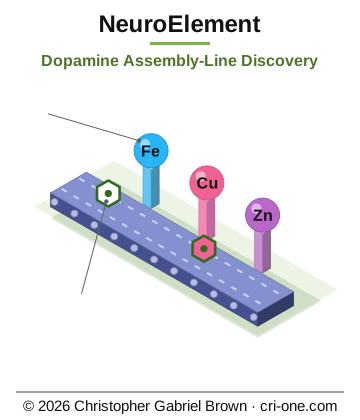
Dopamine Assembly-Line Discovery
A key finding of the research is the Dopamine Assembly Line — a sequential metallic-cofactor pathway required for dopamine synthesis, conversion, and transport:
No existing Parkinson’s disease therapy supplies the metallic cofactors the dopamine assembly line requires. The NeuroElement formulation addresses steps 1 and 3 directly via Iron Bisglycinate and Zinc Carnosine; step 2 is supported by dietary copper.
Evolutionary Medicine Timeline (“Chicken or Egg” Discovery)
The database reveals that three independent timelines — evolutionary age , historical drug-discovery order , and pharmacokinetic onset speed — all converge on an identical ordering across four brain-medicine categories:
3 Delusional (psychosis/mood) ∼200–300 million years 20 min acute / 4–8 wk full (Haloperidol IM) Chlorpromazine, 1952
4 Memory Most recent 3–6 wk (Donepezil) / 6+ mo (Lecanemab) Tacrine, 1993
Principle: oldest brain system = fastest drug response = discovered first.
Brain Diseases 54 (neurological 151–175, psychiatric 251–275, infections 17–20) brain_diseases.json
Symptom Observation Guides 54 (25 neurological + 25 psychiatric + 4 infection) symptom_observation_guide.json
Pharmaceutical Drug Entries 39 brain_elements.json (drug_book_entries)
Medicine Timeline (pharmacokinetics) 35 medicines across 4 categories medicine_timeline.json
The package ships a production-quality Python research platform (v1.0.0) requiring no dependencies beyond the standard library for CLI usage. An optional REST API layer uses FastAPI + Uvicorn.
BrainChemistryDB brain_chemistry_db.py Master database — unified access to all neurotransmitter, disease, element, and observation data
BrainCompoundAnalyzer brain_compound_analyzer.py Core analysis engine — compound comparison, elemental mechanism mapping, disease-coverage scoring
NeurotransmitterDB neurotransmitter_db.py 65-neurotransmitter query engine with search, filtering, and cross-referencing
TimelineDB timeline_db.py Medicine pharmacokinetics and the “Chicken or Egg” evolutionary timeline analysis
SupplementFacts supplement_facts.py FDA-compliant Supplement Facts panel generator per 21 CFR 101.36
DiseaseExtractor disease_extractor.py Cross-project disease data extraction and unification
ReportGenerator report_generator.py Generates all 7 Markdown research reports from live data
REST API api.py FastAPI application — /api/stats, search, compare, disease, timeline endpoints
CLI Tool brain_research_tool.py Full command-line interface — 14 sub-commands
NONPROVISIONAL_UTILITY_PATENT_APPLICATION.md Full utility patent — 68 paragraphs, 24 claims, formulation recipe, oath/declaration
PATENT_APPLICATION_PROVISIONAL.md Original provisional draft — 43-page specification, 7 drawing sheets
FIG. 1 FIG_1_composition_block_diagram.svg Seven-component composition block diagram — elements delivered
FIG. 6 FIG_6_evolutionary_medicine_timeline.svg Convergence of evolutionary, historical, and pharmacokinetic timelines
FIG. 7 FIG_7_GABA_synthesis_bottleneck.svg P5P as GAD cofactor — glutamate → GABA conversion
FIG. 8 FIG_8_formulation_mixing_method.svg Geometric dilution and blending method for manufacturing
FIG. 9 FIG_9_divided_dosing_schedule.svg AM/PM divided dosing schedule with interaction rationale
Independent — Composition Claim 1 The 7-compound multi-element neurotherapeutic composition for oral administration, delivering ≥10 brain-essential elements
Dependent — Composition Claims 2–11 Dose ranges, divided-dosing regimen (AM/PM), capsule fill weights, excipients, mechanism coverage (≥30/40), disease coverage (≥10 diseases), ebselen as lithium mimetic, NAC as intra-composition safety, dopamine-pathway support, copper-exclusion rationale
Independent — Formulation Method Claim 12 Geometric-dilution pre-blend under reduced lighting (P5P photodegradation), two-stage blending, encapsulation
Dependent — Formulation Method Claims 13–15 Blending periods (5–10 min / 2 min), evening capsule preparation, QC testing (weight ±5 %, disintegration ≤30 min, moisture
Independent — Treatment Method Claim 16 Method of treating neurological or psychiatric disorders by administering the composition
Dependent — Treatment Method Claims 17–19 Disease list (16 diseases), divided-dose daily regimen (≥4 weeks), simultaneous coverage (≥30 mechanisms × ≥10 diseases)
Independent — Computational Method Claim 20 Eight-step algorithm: database construction → element mapping → mechanism scoring → disease scoring → combined scoring → BBB-compound selection
Dependent — Computational Method Claims 21–24 Sequential enzymatic dependencies (assembly-line identification), neurological/psychiatric molecular-weight classifier, minimum database sizes (≥40 diseases, ≥50 neurotransmitters, ≥30 mechanisms), specific BBB delivery-compound mappings
Brain Chemistry Master Report BRAIN_CHEMISTRY_MASTER_REPORT.md Full brain-chemistry overview, element roles, 10 drug categories, key principles
Neurotransmitter Reference NEUROTRANSMITTER_REFERENCE.md Complete reference of 65 brain neurotransmitters across 9 categories
Disease Cross-Reference BRAIN_DISEASE_MECHANISM_CROSS_REFERENCE.md Compound–disease mechanism overlap matrix
Compound Analysis COMPOUND_ANALYSIS_REPORT.md Chemical comparison of key research compounds (MW, electronegativity, mechanism counts)
Observation Diagnosis Guide OBSERVATION_DIAGNOSIS_GUIDE.md Observable symptoms for 54 diseases — identification by observation only
External Database Connections EXTERNAL_DATABASE_CONNECTIONS.md Links to PubChem, NIMH PDSP, HMDB, CSF Metabolome, StatPearls
Evolutionary Medicine Timeline EVOLUTIONARY_MEDICINE_TIMELINE.md The “Chicken or Egg” convergence analysis across 4 categories
Pre-blend method Geometric dilution — smallest component (P5P 25 mg) mixed 1:1 with MCC, then doubled progressively; reduced-lighting conditions to prevent P5P photodegradation
Blending periods First blend: 5–10 minutes; lubricant blend: 2 minutes (to avoid over-lubrication)
QC testing Identity, potency, heavy metals (USP / ), microbial limits (USP / ), capsule weight ±5 %, disintegration ≤30 min at 37 °C, moisture
Serving size 3 capsules/day (1 morning + 2 evening), 30 servings per container
Iron + tea / coffee Tannins reduce iron absorption — take AM capsule 30 min before or 2 hr after
NAC + nitroglycerin NAC potentiates nitrate vasodilation — contraindicated with nitrate drugs
Ebselen + lithium Ebselen mimics lithium at IMPase — caution if patient is on lithium therapy
P5P + levodopa P5P can accelerate peripheral decarboxylation of L-DOPA — take separately from Parkinson’s medication (or use with carbidopa)
Zinc + copper Long-term Zn supplementation (>40 mg elemental) can deplete Cu — at 16 mg elemental, risk is low; monitor if taking >3 months
A formal pre-proposal letter was submitted on March 3, 2026 to The Michael J. Fox Foundation for Parkinson’s Research and to Dr. Mitesh Bhakta, PharmD (compounding pharmacist), outlining the Dopamine Assembly-Line discovery and requesting scientific evaluation and pharmaceutical compounding partnership.
Structured data 10 files JSON databases — neurotransmitters, elements, diseases, observations, timeline
- Formulation specification — product/formulation.md — complete 7-compound recipe with doses, rationale, excipients, capsule fill weights, and manufacturing notes.
- Patent application — 24-claim nonprovisional utility application ready for USPTO filing in DOCX format.
- 5 structured JSON databases — neurotransmitters (65), brain elements (20), brain diseases (54), symptom observation guides (54), medicine timeline (35).
- Python research platform — 5,998 lines, 13 modules, 14 CLI sub-commands, REST API, test suite.
- 9 patent-drawing SVGs — composition diagrams, mechanism/disease matrices, computational flowchart, dopamine assembly line, evolutionary timeline, GABA bottleneck, manufacturing method, dosing schedule.
- 7 research reports — generated from live data, covering master overview, neurotransmitter reference, disease cross-reference, compound analysis, observation guide, external databases, and evolutionary timeline.
- FDA Supplement Facts generator — Python module generating a panel compliant with 21 CFR 101.36.
- Product valuation report — market analysis, competitive landscape, pricing strategy, IP valuation ($7.5M–$25M base; $6.3M risk-adjusted), revenue projections, acquisition scenarios.
- Data validation script — structural integrity checks and cross-reference validation for all JSON data.
How this is delivered
This package ships on a single Blu-ray disc, posted to the delivery address on your order. The archive on the disc is AES-256 encrypted; the passphrase is sent separately, by email, once the disc is despatched — so the disc alone is of no use to anyone who intercepts it.
Discs are despatched by tracked, signed-for post. Allow 5 business days for mastering and verification before despatch.
© 2026 Christopher Gabriel Brown. All rights reserved.
NeuroElement™ is a product designation of the inventor. U.S. Patent Application 19/555,525 — patent pending.
No intellectual property is conveyed with purchase. The underlying copyrighted material, the method-claim patent strategy, and the “Cri-One” and “NeuroElement” marks remain the property of Christopher Gabriel Brown.
Photo
Footnotes
- Product number 8470.
- Family: health research.
- Purchase: When you buy, you buy the use of that blueprint only.