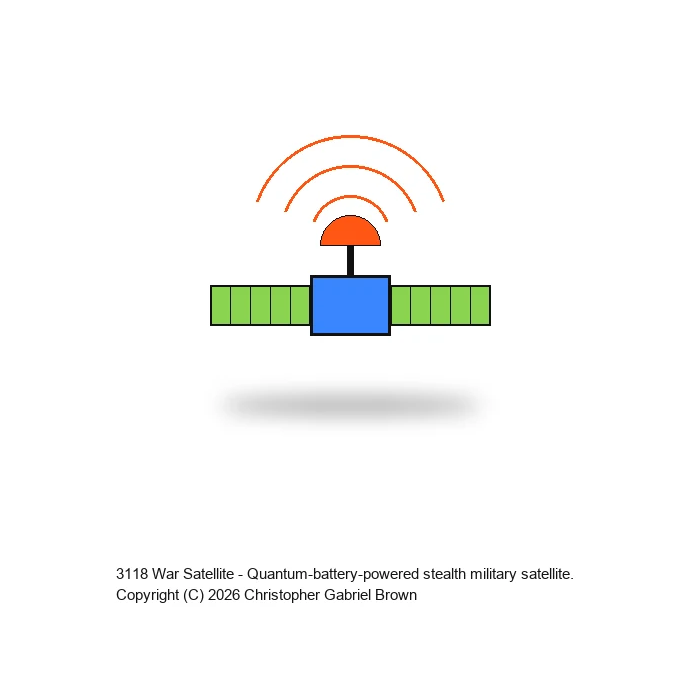
War Satellite
Publicly online since 2010 · U.S. patent applications since 2012 · inventions offered since 2014. The work of Christopher Gabriel Brown, independently documented.
War Satellite System
Quantum-Battery-Powered, Stealth-Capable, Autonomous Military Satellite Platform
One platform on orbit, powered by an optical quantum battery rather than a fading solar array. Stealth against radar. Autonomous AI under human oversight. Multi-mission โ ISR, communications, strike, defense โ from one bus. Re-entry capable, with global reach.
Built on 1,752+ previously filed patents (2017). Complete design documentation across 62 files. A 60-month roadmap from contract award to operational deployment. The price reflects what an integrated, patent-fenced, autonomous defense platform actually costs to acquire as a complete design package.
One satellite. One quantum battery. Multi-mission. 60 months from contract to orbit.
The War Satellite System is a complete design package for a quantum-battery-powered, stealth-capable, autonomous military satellite platform. Primary power is provided by an optical quantum battery (LED nano-charging; reference Project 05-quantum-battery), enabling long-duration on-orbit operations with clean, high-efficiency power. The system combines high-efficiency quantum battery power, advanced stealth, autonomous AI operations under human oversight, and a multi-mission platform architecture (ISR, communication, strike, defense) into one integrated bus with global reach and re-entry capability. The acquisition is the complete design documentation โ 62 files โ not a deployed satellite.
Six Core Capabilities
Advanced Technologies
- Vertical Chip Stacking & Optical Processing โ advanced computing architecture for the on-board processing stack.
- Oxygen Orbit Engine Propulsion โ with Calvin Generator for extended on-orbit operations.
- High-Speed Encrypted Communication โ secure global communications backbone.
- Fractional Encryption Security โ advanced cryptographic protection for sensitive payloads.
- Timeline Encryption โ temporal security measures for time-sensitive command links.
- Multi-Drone Weapon Systems โ integrated weapon platforms dispatchable from the bus.
- War Data Center โ on-board data processing with end-to-end encryption.
- GPS Pi Navigation โ advanced navigation system from the inventor's GPS-3D triplet-pi work.
Package Contents โ 62 Files of Complete Design Documentation
War_Satellite_Executive_Summary.mdโ one-page overview for decision makers.War_Satellite_Complete_Design_Package.mdโ full technical specifications.War_Satellite_System_Architecture.mdโ detailed architecture documentation.War_Satellite_Implementation_Roadmap.mdโ 60-month development roadmap.US_Government_Proposal.mdโ government proposal document.- Operational Scenarios โ mission planning and operations.
- Risk Assessment โ comprehensive risk analysis.
- Competitive Analysis โ market positioning.
- All technical specifications and operational procedures across the remaining package files.
Implementation Timeline โ 60 Months in Four Phases
From contract award to operational deployment, the package documents a 60-month (5-year) phased timeline:
| Phase | Activity | Duration |
|---|---|---|
| Phase 1 | Design & Development | 18 months |
| Phase 2 | Prototype & Testing | 18 months |
| Phase 3 | Production & Integration | 18 months |
| Phase 4 | Deployment & Operations | 6 months |
Use Cases โ Five Mission Areas
| Mission Area | What the Bus Does |
|---|---|
| Defense Applications | Military satellite operations, integrated defense systems, strategic defense platforms. |
| ISR Missions | Intelligence gathering, surveillance operations, reconnaissance missions. |
| Communication Hub | Secure global communications, encrypted data transmission, command and control systems. |
| Strike Capabilities | Precision strike operations, multi-drone weapon systems, tactical response capabilities. |
| Defense Systems | Missile defense, threat protection, defensive countermeasures. |
Patent Portfolio โ 1,752+ Previously Filed (2017)
The War Satellite System is grounded in a patent portfolio of 1,752+ previously filed patents (2017), distributed across the system's functional areas:
| Area | Patent Count |
|---|---|
| Core War Satellite | 20+ |
| Computing & Data | 50+ |
| Communication | 25+ |
| Weapons & Drones | 30+ |
| Supporting Technology | 1,700+ |
| Total | 1,752+ |
Cross-references in the canonical PATENT_PORTFOLIO.md and PATENT_LINKAGE_REPORT.md show War Satellite (Project 04) as a named project under the USPTO 19/540,453 umbrella application ("Integrated Technology Portfolio comprising Electronic Automotive Platform, Unified Processor, Electric Jet Propulsion, War Satellite System"), filed 2026-02-13.
How it's made
The War Satellite System is the productised assembly of a quantum-battery-powered satellite bus whose every functional area is anchored to the inventor's existing patent portfolio. The optical quantum battery primary power source is referenced from Project 05-quantum-battery; stealth and digital-camouflage technology, autonomous AI operations, multi-mission payload integration, re-entry-and-redeploy capability, and the supporting computing/communication/weapons stacks are all present in the patent record as 2017+ inventions and surface in the umbrella application 19/540,453 (filed 2026-02-13). The 62 design documentation files in the package โ from the executive summary through the complete design package, the system architecture, the implementation roadmap, the US government proposal, operational scenarios, risk assessment, and competitive analysis โ are the assembly of those underlying inventions into a single defense-grade platform specification.
Why I made it
The conventional military-satellite acquisition cycle in the United States is dominated by single-mission platforms with single-failure-mode power architectures, narrow defensive postures, limited stealth, and life cycles dictated by the degradation of solar-cell arrays. The War Satellite System was designed because the underlying inventions in the inventor's portfolio โ the optical quantum battery, the stealth-and-digital-camouflage stack, the autonomous AI operations layer, the GPS-Pi navigation work, the fractional and timeline encryption schemes โ collectively make a different kind of satellite plausible: one platform, multiple missions, quantum-battery primary power, autonomous under human oversight, re-entry-capable, and bound by a single patent fence rather than five separate ones across five separate vendors.
The acquisition is the complete design package because that is what a defense procurement program office actually needs to begin: the executive summary, the architecture, the roadmap, the government proposal, the operational scenarios, the risk register, and the competitive positioning. Manufacturing, launch, and operations are downstream of that.
What it can do
Within the 60-month timeline, the system delivers a single bus capable of operating across five mission areas (ISR, communication, strike, defense, and integrated defense systems) under autonomous AI control with human oversight, powered by an optical quantum battery rather than degrading solar panels, with stealth against radar and digital camouflage, and with re-entry capability that allows the bus to disperse and return to orbit rather than being a single-event asset. Global reach is enabled by the inter-satellite communication links and the high-speed encrypted communication architecture documented in the design package.
What the design package does not deliver: it does not include manufactured hardware, a launch-ready airframe, or a deployed satellite. It does not constitute a contract with any manufacturer or government program office. It is the complete design documentation a buyer takes forward into Phase 1 (Design & Development) of the 60-month timeline. Manufacturing, integration, launch, and operations are the buyer's downstream responsibility under whatever procurement vehicle they elect to use.
Why it's a fact
Every claim above can be checked against the source record:
- The 62 design documentation files exist on disk under
D:\special\04-war-satellite\, including the named executive summary, complete design package, system architecture, implementation roadmap, US government proposal, operational scenarios, risk assessment, and competitive analysis. Each is inspectable end-to-end before acquisition. - The "1,752+ previously filed patents (2017)" figure is the inventor's own accounting in the canonical web description, distributed across the named functional categories (20+ core, 50+ computing/data, 25+ communication, 30+ weapons/drones, 1,700+ supporting). The breakdown is verifiable by inspecting the inventor's filing record.
- USPTO 19/540,453 ("Integrated Technology Portfolio comprising Electronic Automotive Platform, Unified Processor, Electric Jet Propulsion, War Satellite System"), filed 2026-02-13, is the umbrella application explicitly naming War Satellite. Status verifiable at
patentcenter.uspto.gov. - The optical-quantum-battery primary power source is referenced from Project 05-quantum-battery, which is independently listed at
cri-one.com/store/quantum-battery.htmland is the same architecture also covered by USPTO 18/370,908 (AutoPhi Quantum battery integration & electromagnetic propulsion IC). - The 60-month four-phase timeline is documented in
War_Satellite_Implementation_Roadmap.mdand is repeated in the canonical web description; the 18-month phase boundaries are not invented for this listing. - The five mission areas (Defense, ISR, Communication Hub, Strike, Defense Systems) and the eight advanced technologies are itemised in the package's web description as written by the inventor.
License Terms โ What's Granted, What Isn't
The acquisition grants the buyer permission to make, build, and copy the deliverable. It does not transfer the underlying intellectual property:
- Granted with the acquisition: permission to take the 62-file design documentation package forward into Phase 1 (Design & Development) of the 60-month timeline; permission to manufacture (or have manufactured) the satellite bus and its subsystems; permission to build deployments under defense procurement vehicles; permission to make copies of the design package for the buyer's program-office, prime-contractor, and integration use.
- Not transferred with the acquisition: USPTO 19/540,453 (Integrated Technology Portfolio umbrella, filed 2026-02-13, explicitly names War Satellite), the broader 1,752+-patent portfolio (20+ core, 50+ computing, 25+ communication, 30+ weapons, 1,700+ supporting), the optical-quantum-battery primary power source IP (Project 05), trademarks, copyrights, or any rights to license or assign the IP onward. The intellectual property remains held by Christopher Gabriel Brown.
- The buyer's permission is to use the design package, not to own the rights behind the design package.
This framing applies uniformly across the inventor's portfolio. Buyers seeking IP assignment rather than make/build/copy permission should contact the inventor directly โ that is a separate negotiation outside the standard storefront acquisition.
One bus. Multi-mission. Quantum-battery primary power. 60 months from contract to deployment. Patent-fenced by 1,752+ previously filed inventions.
A buyer who acquires the War Satellite System takes possession of the complete 62-file design documentation package โ executive summary through US government proposal โ ready for Phase 1 of the 60-month timeline. The patent foundation is the inventor's existing 1,752+-patent portfolio, with the umbrella USPTO application 19/540,453 explicitly naming War Satellite among its listed projects.
A complete defense-platform design package, ready for Phase 1.
One acquisition delivers the War Satellite System design package: the optical-quantum-battery primary power architecture (referenced from Project 05), the six core capabilities (Quantum-Battery-Powered, Stealth-Capable, Autonomous, Multi-Mission, Re-Entry Capable, Global Reach), the eight advanced-technology stack (Vertical Chip Stacking, Oxygen Orbit Engine, High-Speed Encrypted Comms, Fractional Encryption, Timeline Encryption, Multi-Drone Weapons, War Data Center, GPS Pi Navigation), the 62 files of design documentation, the 60-month four-phase implementation roadmap, the five mission areas (ISR / Communication / Strike / Defense / Defense Systems), the US government proposal, and the patent portfolio of 1,752+ previously filed inventions.
Patent foundation: USPTO 19/540,453 (Integrated Technology Portfolio umbrella, filed 2026-02-13, explicitly names War Satellite) plus the inventor's 1,752+-patent portfolio across core satellite, computing & data, communication, weapons & drones, and supporting technology.
$1,000,000,000,000 ($1T)
Complete design package โ ready for development. 60 months to deployment. Christopher Gabriel Brown ยท 1341 Wellington Cove, Lawrenceville, GA 30043 ยท ยท crioneaka@outlook.com.