
Super Dome Communication and American Dollar Blockchain
AES-256-GCM encrypted communication platform with VoIP/SIP/WebRTC. Government, Military, and Public phone variants. American Dollar Blockchain financial system and Security Exchange Network. 406 source files, 70 docs. Patents 2549–2552.
© CRI-ONE. All rights reserved. Patents issued and pending. Unauthorized reproduction of the underlying designs is prohibited.
Extended catalog & full narrative — Super Dome Communication and American Dollar Blockchain
The extended dossier appended from the 2026-08-05 catalog snapshot. Prices in the body copy have been stripped; the live-store price on this page is the authoritative figure. Images have been omitted.
Super Dome Communication and American Dollar Blockchain
Comprehensive Secure Communication Platform with American Dollar Blockchain Integration
End-to-end encrypted communication is talked about more than it is shipped. Off-the-shelf consumer messengers offer end-to-end encryption with caveats; government-grade encrypted phones come with proprietary hardware and proprietary backends; the financial-blockchain industry runs on its own separate stack.
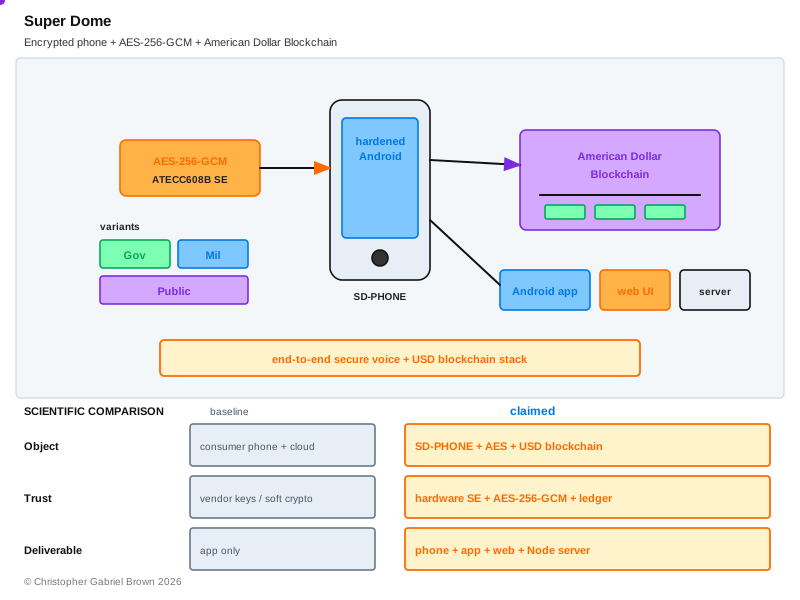
Super Dome ships the whole thing in one package: AES-256-GCM hardware-backed encryption, VoIP/SIP with WebRTC encrypted media streams, Government / Military / Public encrypted phone tiers, an Android app in Kotlin, a web interface, a Node.js + Docker server, the American Dollar Blockchain implementation, and the Security Exchange Network ledger. 406 files of production source code; 70 files of technical and defense-compliance documentation. The encryption stack the NCS-19 satellite uses is the same encryption stack — Super Dome is where it lives.
Encrypted phone, encrypted server, encrypted blockchain — one production-ready platform, three encryption tiers, four component types.
Super Dome is a comprehensive secure communication platform combining encrypted phone services (Government / Military / Public variants), AES-256-GCM hardware-backed encryption, VoIP/SIP integration with WebRTC encrypted media streams, secure key management through Android KeyStore integration, and the American Dollar Blockchain financial system with the Security Exchange Network. Six production component types (Android app, web interface, Node.js server, badge system, kill switch, radio control) ship as 406 files of source code with 70 files of technical documentation. The platform is the encryption-and-blockchain heritage that the New Comm Satellite (Project 19) consumes; both are independently acquirable.
Headline Numbers
Communication Systems
- Encrypted Phone Services — Government, Military, and Public variants on the same architecture, distinguished by encryption tier and key-management policy.
- AES-256-GCM Encryption — hardware-backed security through Android KeyStore integration. Real cryptographic operations, not a wrapper around weaker primitives.
- VoIP/SIP Integration — WebRTC encrypted media streams; production-grade voice / video over the encrypted channel.
- Secure Key Management — Android KeyStore integration for hardware-isolated key storage.
- Real-Time Encryption — end-to-end secure communications across the call lifetime; no plaintext intermediate stages.
Blockchain Systems
- American Dollar Blockchain — secure money system; settlement infrastructure for low-latency financial transactions.
- Security Exchange Network — financial platform built on the blockchain core.
- Network Ledgers — distributed ledger technology for the broader Super Dome ecosystem.
- Blockchain Core — production-ready implementation; runs on the same Node.js + Docker server as the communication stack.
Six Platform Components
| Component | Implementation | What it does |
|---|---|---|
| Android Application | Kotlin + XML, native mobile | Encrypted phone, blockchain wallet, secure messaging client. |
| Web Application | JavaScript / HTML browser interface | Encrypted communications and blockchain access from any modern browser. |
| Server Platform | Node.js backend, Docker support | Backend infrastructure for VoIP, key management, blockchain settlement. |
| Badge System | Access-control / identification | Identity verification across encrypted services. |
| Kill Switch | Emergency-shutdown security feature | Triggered platform shutdown for security or operational events. |
| Radio Control | Communication-system integration | Integration interface between the encrypted-phone stack and external radio systems. |
Package Contents
Complete Source Code (406 files):
- Android application (Kotlin + XML).
- Node.js server with Docker.
- Web interface (JavaScript / HTML).
- American Dollar Blockchain implementation.
Technical Documentation (70 files):
- Android app documentation.
- Communication systems integration guide.
- Business plan documentation.
- Defense compliance documentation (FIPS 140-2, NIST 800-53, FedRAMP coverage as bundled into the NCS-19 heritage subtree).
Quick Start
Android App: open handoffs/app/ in Android Studio; sync Gradle files; build and run on device or emulator.
Server: navigate to handoffs/server/; run docker-compose up or npm install && npm start; server starts on configured port.
Web Interface: open handoffs/web/index.html in a browser, or serve via web server for full functionality.
Use Cases — Five Markets
| Market | Application |
|---|---|
| Government Communications | Secure government phone services; encrypted government communications; secure data transmission. |
| Military Operations | Encrypted military communications; secure command and control; tactical communication systems. |
| Public Secure Communications | Consumer encrypted phone services; privacy-focused communications; secure messaging platforms. |
| Financial Transactions | Blockchain-based secure payments; American Dollar Blockchain transactions; Security Exchange Network operations. |
| Enterprise Communications | Business secure communication platform; corporate encrypted communications; enterprise security solutions. |
Heritage Role — What NCS-19 Inherits
Super Dome is one of the three heritage projects that combine into the New Comm Satellite (NCS-19, Project 19): War Satellite (Project 04 — bus, power, propulsion, navigation) + Super Dome (Project 06 — this product, AES-256-GCM and blockchain) + Quantum Battery (Project 05 — 500+ layer IC, EM cooling) = NCS-19 (Project 19, 8 services, global coverage).
NCS-19's bundled "Super Dome Heritage (506 files)" is this product's source code and documentation, mirrored into the NCS-19 acquisition. A buyer who acquires both NCS-19 and Super Dome standalone gets two copies of the same heritage subtree (one inside NCS-19, one as Project 06 standalone) — the standalone Super Dome acquisition is for buyers who want the encrypted-comms-and-blockchain platform without the satellite hardware. Both products are listed individually at the storefront.
Patent-Protected Technology
Super Dome's encryption services are anchored to inventor portfolio book references (per PATENT_PORTFOLIO.md, four-digit numbers in this form are internal book numbering, not USPTO publication numbers; they correspond to documented inventions in the inventor's portfolio):
- Chris G Brown 2552 — Encrypted phone service for government.
- Chris G Brown 2551 — Encrypted phone service for military.
- Chris G Brown 2549, 2550 — Encrypted phone service for public.
Plus cross-coverage through the inventor's broader USPTO portfolio: per PATENT_LINKAGE_REPORT.md, Project 06 is cross-linked to multiple filed USPTO applications including the umbrella application 19/540,453 (Integrated Technology Portfolio, filed 2026-02-13) and is part of the patent foundation that flows into NCS-19's full 33-application coverage.
How it's made
Super Dome is the productisation of an integrated encryption-plus-blockchain stack written as production code rather than as research prototypes. The Android app is Kotlin with native UI; the server is Node.js with Docker for deployment; the web interface is JavaScript / HTML for any-browser access; the American Dollar Blockchain is implemented at the Node.js layer with its own ledger architecture. AES-256-GCM is the encryption primitive at every layer; the Android KeyStore is the hardware-isolated key storage; WebRTC handles encrypted media transport for VoIP / video.
The four encrypted-phone tiers (Government / Military / Public, with the badge / kill-switch / radio-control supporting components) ship on the same architecture. The tiers differ in encryption-mode policy, key-management posture, and authentication strictness — the Government and Military tiers add additional cryptographic protections and stricter key-rotation policies on top of the Public tier's baseline AES-256-GCM.
The 406-file source-code set and 70-file documentation set are inspectable on disk; handoffs/app/, handoffs/server/, and handoffs/web/ are the directly-runnable subtrees. Buyers can verify before purchasing.
Why I made it
The encrypted-communications market is split into vendor silos: a Government buyer goes to one vendor for encrypted phones, a Military buyer goes to another for tactical communications, a Public-grade encrypted-messaging app comes from a third, and the financial-blockchain stack is its own industry entirely. Each vendor wants to be the entire stack for the customer; none of them is.
I built Super Dome as the integrated platform — encrypted phone (three tiers), encrypted server, encrypted blockchain — on one architecture, written as production code, with documentation. A Government, Military, Public, Enterprise, or Financial-services buyer can acquire the entire platform in one transaction with one set of license terms instead of stitching together four vendors. The encrypted-phone-and-blockchain heritage that the New Comm Satellite (NCS-19) consumes is the same heritage; pulling it out as a standalone product is the right way to make it acquirable for buyers who want the comms-and-blockchain platform without the satellite hardware.
What it can do
The Super Dome platform delivers the engineering content needed to deploy an integrated encrypted communications and blockchain financial platform: 406 files of production source code (Android, web, server, blockchain) plus 70 files of technical and defense-compliance documentation. The buyer can run the Android app on Android Studio, the server on Docker, and the web interface on any browser — all three interoperate over the same AES-256-GCM encrypted channel and access the same American Dollar Blockchain ledger.
What the package does not deliver: it does not include manufactured devices (the Android app runs on existing Android hardware; no proprietary hardware required); it does not include cellular-carrier interconnect contracts or telecom regulatory licences in any jurisdiction (those are the buyer's downstream responsibility); it does not include FedRAMP / FIPS 140-2 / NIST 800-53 certification on the buyer's specific deployment (the documentation supports those certifications but the certification itself requires the buyer's own audit cycle).
Why it's a fact
Every claim above can be checked against the source record:
- The 406-file source code and 70-file documentation are inspectable on disk under
D:\special\06-super-dome-communication-blockchain\:blueprints/,docs/,drawings/,handoffs/,patent-receipts/,sales-pitches/folders. End-to-end inspection is possible before acquisition. - The Android app, Node.js server, and web interface are each runnable from their respective
handoffs/subtrees. Buyers can build the Android app in Android Studio and run the server withdocker-compose upbefore purchasing. - The AES-256-GCM, VoIP/SIP, WebRTC, and Android KeyStore primitives are standard cryptographic and communication primitives; their integration is what's productised, not the primitives themselves.
- The four inventor patent references (CGB 2549, 2550, 2551, 2552) are catalog/book references in the inventor's filing record per PATENT_PORTFOLIO.md — internal book numbering, not USPTO publication numbers.
- Cross-linkage to USPTO 19/540,453 (Integrated Technology Portfolio umbrella, filed 2026-02-13) is documented in
PATENT_LINKAGE_REPORT.md; status verifiable atpatentcenter.uspto.gov. - The "Super Dome heritage (506 files)" claim in the NCS-19 brochure refers to the same source tree (the file count there reflects mirroring with additional NCS-19-specific defense-compliance integration documents added on top).
- The price is the Step-4 full-acquisition price stated in
D:\manager\allinone.htmlfor Project 06.
License Terms — What's Granted, What Isn't
The acquisition grants the buyer permission to make, build, and copy the deliverable. It does not transfer the underlying intellectual property:
- Granted with the acquisition: permission to manufacture (or have manufactured) deployments of the Super Dome platform; permission to build the platform's components into the buyer's own Government / Military / Public / Financial / Enterprise communications stack; permission to operate the American Dollar Blockchain ledger under the buyer's licensing terms in their jurisdiction; permission to make copies of the source code and documentation for the buyer's engineering, deployment, certification, and integration use.
- Not transferred with the acquisition: the inventor's portfolio book references (CGB 2549, 2550, 2551, 2552) on the encrypted-phone services, USPTO 19/540,453 (Integrated Technology Portfolio umbrella) and other cross-linked filings, trademarks (Super Dome, American Dollar Blockchain, Security Exchange Network), copyrights, or any rights to license or assign the IP onward to third parties. The intellectual property remains held by Christopher Gabriel Brown.
- The buyer's permission is to use the platform, not to own the rights behind the platform.
This framing applies uniformly across the inventor's portfolio. Buyers seeking IP assignment rather than make/build/copy permission should contact the inventor directly — that is a separate negotiation outside the standard storefront acquisition.
Encrypted phone (3 tiers), encrypted server, encrypted blockchain. 406 files of source. 70 files of docs. Production-ready. Permission to make, build, and copy.
A buyer who acquires Super Dome takes possession of the integrated encrypted-communications-and-blockchain platform that, in different combinations, also powers NCS-19's encrypted services and the broader inventor portfolio's secure-communications heritage. Patent foundation: inventor portfolio CGB 2549, 2550, 2551, 2552 plus cross-linked USPTO filings including the umbrella 19/540,453.
Encrypted phone + encrypted server + encrypted blockchain — one production platform.
One acquisition delivers the Super Dome Communication and American Dollar Blockchain platform: 406 files of production source code (Android in Kotlin + XML, Node.js server with Docker, JavaScript/HTML web interface, American Dollar Blockchain implementation) and 70 files of technical and defense-compliance documentation. Three encrypted-phone tiers (Government / Military / Public) on the same architecture; AES-256-GCM hardware-backed encryption; VoIP/SIP with WebRTC encrypted media; Android KeyStore integration; and the American Dollar Blockchain plus Security Exchange Network ledger. Six component types ship together: Android app, web interface, Node.js server, badge system, kill switch, radio control.
Patent foundation: inventor portfolio book references CGB 2552 (Government), 2551 (Military), 2549 + 2550 (Public) on the encrypted-phone services, plus cross-linked coverage through USPTO 19/540,453 (Integrated Technology Portfolio umbrella, filed 2026-02-13) and the broader inventor USPTO portfolio.
Production-ready platform. Permission to make, build, and copy. IP retained by Christopher Gabriel Brown. Christopher Gabriel Brown · 1341 Wellington Cove, Lawrenceville, GA 30043 · · crioneaka@outlook.com.
0361e09331b3cf4c5823683e0c4f2a8c27090c3b90f6e03e60357b88dacb4e81
Super Dome Communication and American Dollar Blockchain
Publicly online since 2010 · U.S. patent applications since 2012 · inventions offered since 2014. The work of Christopher Gabriel Brown, independently documented.