Open Research: 300-Disease Mechanism Analysis Database
Publicly online since 2010 · U.S. patent applications since 2012 · inventions offered since 2014. The work of Christopher Gabriel Brown, independently documented.
Open Research: 300-Disease Mechanism Analysis Database
FREE - 300 diseases, 16 categories, 36,456+ compounds, 450,000+ lines. Includes theoretical formulations, Python scripts, alchemy data. Computational research - NOT medical advice.
© CRI-ONE. All rights reserved. Patents issued and pending. Unauthorized reproduction of the underlying designs is prohibited.
Extended catalog & full narrative — Open Research: 300-Disease Mechanism Analysis Database
The extended dossier appended from the 2026-08-05 catalog snapshot. Prices in the body copy have been stripped; the live-store price on this page is the authoritative figure. Images have been omitted.
This item is delivered by Christopher Gabriel Brown by email within 24 hours of your order. You'll receive the deliverable at the email on your order. USA delivery only. Founder Access Pass credit (code FAP99CREDIT) applies at checkout automatically.
Research: 300-Disease Mechanism Analysis Database
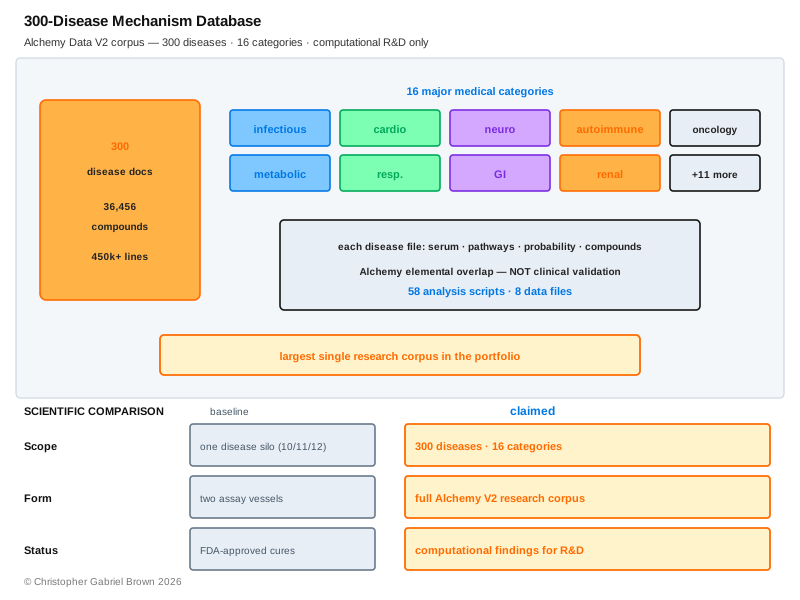
Computational mechanism-overlap research across 300 diseases in 16 medical categories — 36,456 analyzed compounds, 300 individual research documents, 58 Python analysis scripts, theoretical formulations, transformation pathways, and probability matrices
This product is research, not medicine. It is a computational database covering 300 diseases — spanning infectious, cardiovascular, respiratory, gastrointestinal, endocrine, neurological, musculoskeletal, dermatological, hematologic, psychiatric, renal, hepatic, autoimmune, genetic, oncological, and metabolic conditions — built on the Alchemy Data V2 elemental-overlap system. It surfaces overlap; it does not prove cure.
The product is the productised acquisition of Project 13 — one of the largest single research efforts in the repository, with 300+ research documents, 58 analysis scripts, and computational findings on 36,456 analyzed compounds.
SAFETY_DISCLAIMER.md for full warnings.300 diseases. 16 categories. 36,456 compounds. 450,000+ lines of documentation. One acquisition.
Research: 300-Disease Mechanism Analysis Database is the productised acquisition of Project 13 — a computational research database covering 300 diseases organized into 16 medical categories. Each disease has a dedicated research document containing theoretical serum formulations, transformation pathways, probability analysis, compound data, and treatment categorization. The work is built on the Alchemy Data V2 system, which uses correlation-based elemental analysis to identify elemental overlaps between compound profiles and disease mechanisms.
Data statistics
| Metric | Value |
|---|---|
| Total diseases covered | 300 |
| Disease categories | 16 |
| Research documents | 300+ individual files |
| Python analysis scripts | 58 |
| Compounds analyzed | 36,456 |
| Lines of documentation | 450,000+ |
| Root documentation files | 28 |
| Data files (JSON/CSV) | 8 |
Disease categories
The 300 diseases are organized into 16 major categories:
| # | Category | Disease numbers | Count |
|---|---|---|---|
| 1 | Infectious Diseases | 1 – 50 | 50 |
| 2 | Cardiovascular Diseases | 51 – 75 | 25 |
| 3 | Respiratory Diseases | 76 – 100 | 25 |
| 4 | Gastrointestinal Diseases | 101 – 125 | 25 |
| 5 | Endocrine Disorders | 126 – 150 | 25 |
| 6 | Neurological Disorders | 151 – 175 | 25 |
| 7 | Musculoskeletal Disorders | 176 – 200 | 25 |
| 8 | Dermatological Conditions | 201 – 225 | 25 |
| 9 | Hematologic Disorders | 226 – 250 | 25 |
| 10 | Psychiatric Disorders | 251 – 275 | 25 |
| 11 | Renal Disorders | 276 – 290 | 15 |
| 12 | Hepatic Disorders | 291 – 300 | 10 |
| 13–16 | Autoimmune, Genetic, Oncological, Metabolic | Additional | — |
The complete numbered disease list is in DISEASES-LIST.md.
What each disease document contains
Theoretical serum formulations — primary compound identification and molecular weight, target concentration and final volume specifications, reagent lists with quantities and purity grades, step-by-step (theoretical) preparation procedures, and quality control checkpoints. These are computational outputs, not validated pharmaceutical preparations.
Transformation pathways — compound-to-treatment conversion processes, synthesis methods and reaction conditions, intermediate compound identification, and pathway efficiency / yield estimates.
Probability analysis — mechanism overlap scores, compound match confidence levels, and multi-degree probability calculations from the Alchemy Data V2 system. These are mathematical calculations, not clinical success rates.
Treatment categorization — the disease's mapping into the 16-category taxonomy and links to related diseases that share elemental overlap.
Methodology — what this is and isn't
The Alchemy Data V2 system is a correlation-finding tool. For each disease the system maps the disease to relevant elements, searches the database for compounds matching those element profiles, generates transformation pathways and probability matrices, then cross-references results against pharmaceutical databases where available (approximately 19% coverage). It is not a clinical drug discovery pipeline. Discovery scores and probability values reflect database coverage and mathematical overlap, not clinical efficacy or therapeutic success rates.
The compounds and formulations have not been synthesized, have not been tested in humans, and have not been approved for medical use by any regulator. The package is for computational-research use, IP licensing, and follow-on lab work by qualified investigators.
Relationship to the dedicated discovery products
This 300-disease database is a breadth product. The dedicated discovery products (Diabetes Project 10, Alzheimer's Project 11, Parkinson's Project 12) are the depth products: each adds a filed USPTO patent application, top-ranked candidate compounds with full literature cross-reference, and patent drawings. The bundled COMPARISON_WITH_DEDICATED_DISCOVERIES.md spells out the differences in detail. A buyer interested in one specific disease at depth should pair this database with the relevant dedicated discovery product.
What ships in the package
- README.md with the full overview, data statistics, and category structure.
- 300+ individual disease research documents covering all 300 diseases.
- 58 Python analysis scripts in the
_internal/directory used to generate the findings. - findings/ and cures/ directories with computational outputs.
- METHODOLOGY.md — the Alchemy Data V2 methodology explanation.
- SAFETY_DISCLAIMER.md — safety warnings and known toxicity considerations.
- DISEASES-LIST.md — the complete numbered list of 300 diseases.
- COMPARISON_WITH_DEDICATED_DISCOVERIES.md — how this database relates to the dedicated discovery products.
- IMPROVEMENTS.md, STATUS.md, WORK_QUALITY_ASSESSMENT.md — operational documentation.
- 300-diseases-overview.html, WEB_DESCRIPTION.html, START_HERE.html.
- Disease research reference chart (11×17 SVG).
- CITATION.cff, LICENSE, IP_NOTICE.md, CHANGELOG.md, MANIFEST.json.
- The full 13-disease-cure-research.zip archive.
How it's made
The work was conducted by mapping each of 300 diseases into a category set and an element profile, running the Alchemy Data V2 elemental-overlap search across 36,456 candidate compounds, generating per-disease transformation pathways and probability matrices, and writing the results into 300+ individual research documents totaling over 450,000 lines of documentation. Where pharmaceutical-database cross-references were available (around 19% of cases), they were attached as scientific context. The output is a single coherent database in which the same Alchemy methodology is applied uniformly across the disease taxonomy.
What it can do
The acquired package delivers the full 300-disease database, all 58 analysis scripts, the methodology documentation, the safety disclaimers, and the open-research license. A buyer can use the database as input to wet-lab investigation, as a screening tool for follow-on drug-discovery pipelines, as a citable computational-research reference, or as a starting point for additional patent filings on individual disease targets. The buyer also acquires the right to make, build, and copy the package contents.
What this acquisition does not deliver: clinical-trial data on the candidate compounds (none exists), regulatory approval (none granted), synthesised compound samples (none included), or assignment of any patent rights. The dedicated discovery products (Project 10 Diabetes, Project 11 Alzheimer's, Project 12 Parkinson's) carry their own filed USPTO applications and remain separate acquisitions.
License Terms — What's Granted, What Isn't
The acquisition grants the buyer permission to make, build, and copy the deliverable. It does not transfer the underlying intellectual property:
- Granted: permission to use the database as research input; permission to copy the documentation; permission to build follow-on research and synthesis work against the candidate compositions.
- Not transferred: the Alchemy Data V2 system itself, the dedicated discovery USPTO applications (19/441,975 Alzheimer's, 19/445,644 Parkinson's, the filed Diabetes application), trademarks, copyrights. IP remains held by Christopher Gabriel Brown.
Buyers seeking IP assignment rather than make/build/copy permission should contact the inventor directly.
Open computational research. 300 diseases, 36,456 compounds, 450,000+ lines. Permission to make, build, and copy.
300 diseases, 16 categories, one database.
One acquisition delivers Project 13 in full: the Alchemy Data V2 mechanism-overlap analysis across 300 diseases in 16 medical categories, 300+ individual research documents, 58 Python analysis scripts, computational findings on 36,456 analyzed compounds, theoretical serum formulations, transformation pathways, probability matrices, and the open-research license.
— Fifteen Million USD
Computational research. Not medical advice. Not a clinically validated treatment. Theoretical formulations only. Permission to make, build, and copy. IP retained by Christopher Gabriel Brown. Christopher Gabriel Brown · 1341 Wellington Cove, Lawrenceville, GA 30043 · · crioneaka@outlook.com.