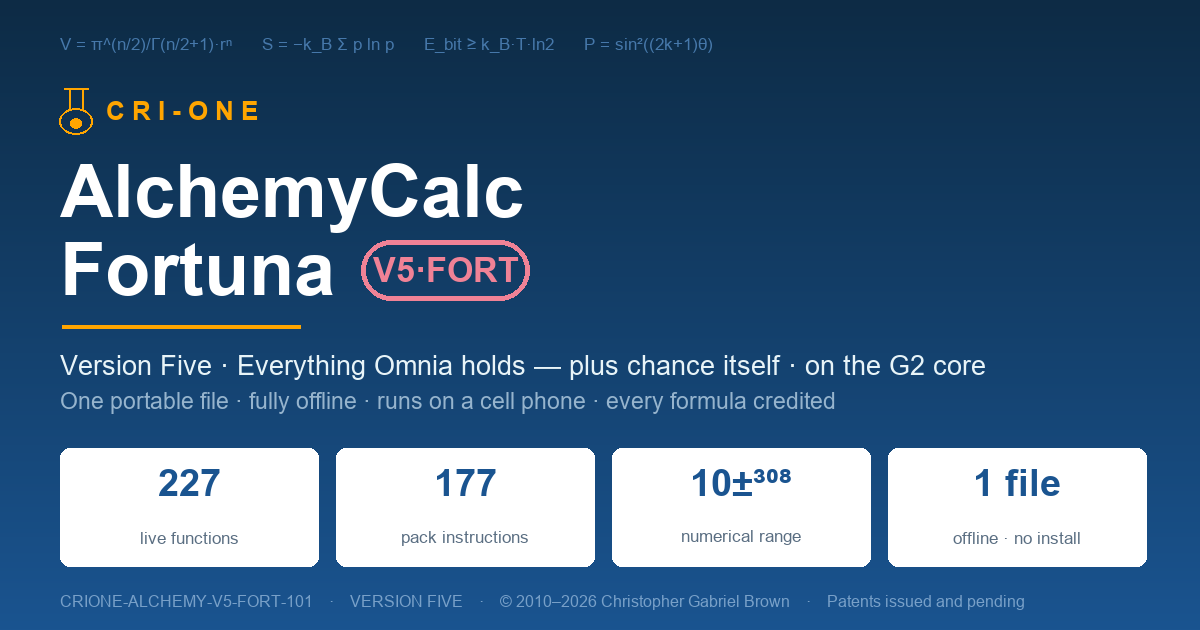
227 live, computable functions in one portable, fully offline file. The complete AlchemyCalc G2 base (CGB depositions, attributed open-science corpus, instruction editor, AutoPhi math accelerator, Fractal Lab, database loader) plus a 177-instruction Fortuna pack: Medicine (48) · Energy (46) · Carbon (45) · Omnia (18) · Probability & Chance + Games, Wagers & Fortune (20).
What the Fortuna pack computes
everything the Omnia edition carries — the full clinical, power, carbon and Earth/information/finance libraries and the library search — plus the probability pack: Bernoulli's binomial, Poisson, the birthday problem, coupon collector, gambler's ruin, the Kelly criterion, Turing & Good's deciban evidence engine, Pearson's random walk, exact dice sums, lottery odds, Monty Hall, streaks, Benford's law, surprisal and the Drake equation. And the capability no deterministic calculator has: the Monte Carlo Lab — give any input of any instruction a distribution instead of a number, run ten thousand seeded trials, and read the outcome as it actually is: mean, spread, bad-luck 5th percentile, good-luck 95th, drawn as a histogram. Same seed, same fortune — even the randomness is reproducible, so even the randomness can be audited. A distribution sampler completes the tab.
Learn it right — a suggestion. These are professional-grade instructions, and most people need instructional help the first time through. Our suggestion: pair this edition with an AI tutor, such as Claude by Anthropic (claude.ai) — paste an instruction's 📜 origin line, its formula, and your numbers, and ask Claude to walk you through what it means, the units, and how to read the result before you rely on it. The calculator computes; a tutor explains.
Provenance — who and what
Formulas and laws of nature are unpatentable — no one owns them. Every calculation names its origin, in-app and in the shipped ledgers (PROVENANCE.md + PROVENANCE-FORTUNA.md). The ten CGB Mathematical Depositions are © Christopher Gabriel Brown; every borrowed formula credits its originator and year.
In the box
- The AlchemyCalc Fortuna app — one file (271 KB), no install, no internet, phone-ready
- The Proof button — the calculator verifies itself against known values, live on your device
- The Professor button — composes a full lesson prompt for an AI tutor such as Claude (claude.ai)
- Plain-English guide (laymen notes), quick-start, license & IP notice
- Both provenance ledgers and a fictional demo dataset
Medicine content: educational mathematics only — not medical advice. Energy content: engineering estimates — verify against codes. Carbon content: emission factors are averages — use official factors for reporting. Fortuna content: randomized results are seeded simulations — reproducible, and still simulations. Probability is not prophecy; never wager what you cannot lose.
Christopher Gabriel Brown — Inventor · Author · Visionary
christopher@cri-one.com · crioneaka@outlook.com · 1341 Wellington Cove, Lawrenceville, GA 30043-5255, USA
© 2010–2026 Christopher Gabriel Brown, CRI-ONE. All rights reserved. Patents issued and pending.
Complete instruction list — all 227 functions
Every instruction in this edition, with its formula and its origin. Mathematical formulas and laws of nature are unpatentable; each borrowed formula credits its originator and year, and the ten CGB Mathematical Depositions are © Christopher Gabriel Brown.
CGB depositions (10)
| Instruction | Formula | Origin — who and what |
|---|---|---|
| 1 · Dimensional Fold | V(n-sphere) = π^(n/2) / Γ(n/2+1) · rⁿ ⟹ peaks at n* = 5, → 0 as n → ∞ | CGB Deposition 1 © Christopher Gabriel Brown — builds on the classical n-sphere volume via Leonhard Euler's Gamma function (18th c.) |
| 2 · Entropic Bridge | S = −k_B Σ pᵢ ln pᵢ ≥ ∮dQ/T (Shannon = Clausius = Helmholtz) | CGB Deposition 2 © Christopher Gabriel Brown — builds on Claude Shannon (1948), Ludwig Boltzmann & Rudolf Clausius (19th c.), Rolf Landauer (1961) |
| 3 · Golden Spiral Convergence | lim F(n+1)/F(n) = φ = (1+√5)/2 ⟹ r_opt = φ⁻² ≈ 0.382 wire/gate area | CGB Deposition 3 © Christopher Gabriel Brown — builds on Leonardo of Pisa “Fibonacci” (1202) and Euclid's extreme-and-mean ratio (~300 BC) |
| 4 · Harmonic Decay | Σ 1/n² = π²/6 ⊗ ∫₀^∞ e^(−λt)cos(ωt)dt = λ/(λ²+ω²) | CGB Deposition 4 © Christopher Gabriel Brown — builds on Leonhard Euler's Basel solution (1734) and Pierre-Simon Laplace's transform (c. 1785) |
| 5 · Photon Chromosome Encoding | C = ⌊log₂(Δλ/δλ)⌋ + ⌊log₂(2π/δθ)⌋ + ⌊log₂(I_max/I_min)⌋ bits/photon | CGB Deposition 5 © Christopher Gabriel Brown — builds on Claude Shannon's information theory (1948) and Max Planck's quantum (1900) |
| 6 · Quantum Counting Paradox | 2ⁿ states ≠ 2ⁿ computations ⟹ P = sin²((2k+1)θ), k* = ⌊(π/4)√N⌋ | CGB Deposition 6 © Christopher Gabriel Brown — builds on Lov Grover's quantum search algorithm (1996) |
| 7 · Recursive Growth Bound | T(n) = a·T(n/b) + n^c ⟹ compare c against log_b(a) | CGB Deposition 7 © Christopher Gabriel Brown — builds on the Master Theorem of Jon Bentley, Dorothea Haken & James B. Saxe (1980) |
| 8 · Thermal Noise Floor | E_bit ≥ k_B·T·ln2 ⟹ FLOPS_max = P_budget / (k_B·T·ln2) | CGB Deposition 8 © Christopher Gabriel Brown — builds on Rolf Landauer's limit (1961) |
| 9 · Voxel Resonance | Ψ(v) = Π[αₖ sin(2πfₖ/Nₖ) + βₖ e^(−γₖd²)] · det(M_seed) | CGB Deposition 9 © Christopher Gabriel Brown — original composite formulation |
| 10 · Zero-Point Fabrication | Σ ½ħω → ∞ ⟹ ζ(−1) = −1/12 ⟹ E_reg = −ħcπ²/(720d³) | CGB Deposition 10 © Christopher Gabriel Brown — builds on Hendrik Casimir (1948) and Euler–Riemann zeta regularization ζ(−1) = −1/12 |
Mathematics (8)
| Instruction | Formula | Origin — who and what |
|---|---|---|
| Quadratic roots | ax² + bx + c = 0 ⟹ x = (−b ± √(b²−4ac)) / 2a | Classical mathematics — Babylonian tablets (~1800 BC); general solution tradition of al-Khwarizmi (c. 820). Unpatentable, public domain |
| Combinations & permutations | C(n,k) = n! / k!(n−k)! · P(n,k) = n!/(n−k)! (log-gamma — no overflow) | Classical combinatorics — Pingala (~200 BC), Blaise Pascal (1654); computed via Cornelius Lanczos's log-gamma approximation (1964). Public domain |
| Bayes' theorem | P(A|B) = P(B|A)·P(A) / [P(B|A)·P(A) + P(B|¬A)·P(¬A)] | Rev. Thomas Bayes (published 1763), generalized by Pierre-Simon Laplace (1774). Public domain |
| Normal distribution | φ(x) = e^(−(x−μ)²/2σ²) / σ√2π · Φ(x) via erf | Abraham de Moivre (1733), Carl Friedrich Gauss (1809); erf approximation from Abramowitz & Stegun's Handbook 7.1.26 (Hastings, 1964, US-Gov public domain) |
| Logistic growth | P(t) = K / (1 + ((K−P₀)/P₀)·e^(−rt)) | Pierre François Verhulst (1838). Public domain |
| Compound & continuous growth | A = P(1 + r/n)^(nt) · A = P·e^(rt) | Classical finance mathematics; continuous compounding via Jacob Bernoulli (1683) and Euler's e. Public domain |
| Shannon channel capacity | C = B · log₂(1 + S/N) | Claude Shannon (1948), with Ralph Hartley (1928) — the Shannon–Hartley theorem. Public domain |
| Prime counting estimate | π(n) ≈ n/ln n · sharper: n/(ln n − 1) | Carl Friedrich Gauss & Adrien-Marie Legendre (1790s); Prime Number Theorem proved by Hadamard & de la Vallée Poussin (1896). Public domain |
Physics & Energy (12)
| Instruction | Formula | Origin — who and what |
|---|---|---|
| Mass–energy E = mc² | E = m·c² | Albert Einstein (1905). A law of nature — unpatentable, public domain |
| Kinetic energy & momentum | KE = ½mv² · p = mv | Classical mechanics — Isaac Newton (1687), Gottfried Leibniz's vis viva; modern ½mv² formalized 19th c. Public domain |
| Ohm's law solver | V = I·R · P = V·I (leave exactly one of V/I/R blank) | Georg Simon Ohm (1827); electrical power after James Prescott Joule. Public domain |
| Coulomb's law | F = k·q₁·q₂ / r² | Charles-Augustin de Coulomb (1785). Public domain |
| Ideal gas PV = nRT | P·V = n·R·T (leave exactly one blank) | Émile Clapeyron (1834), combining Robert Boyle (1662), Jacques Charles, Joseph Gay-Lussac and Amedeo Avogadro. Public domain |
| Carnot efficiency | η = 1 − T_cold / T_hot | Sadi Carnot (1824). Public domain |
| Battery C-rate & runtime | E = Ah·V · I = C·Ah · runtime = 1/C | Standard electrical-engineering C-rate convention (20th c. industry practice). No single originator; unpatentable arithmetic |
| Solar PV yield | E = A · η · H_sun · PR | Standard photovoltaic yield estimation (industry practice, late 20th c.). Unpatentable arithmetic |
| Wind turbine power | P = ½·ρ·A·v³·Cp (Betz limit Cp ≤ 16/27 ≈ 0.593) | Kinetic flux ½ρAv³ (classical); Betz limit — Albert Betz (1919), independently Frederick Lanchester (1915). Public domain |
| Radioactive decay | N(t) = N₀·e^(−λt), λ = ln2 / t½ | Ernest Rutherford & Frederick Soddy (1902). A law of nature — public domain |
| Photon energy E = hc/λ | E = h·c / λ | Max Planck (1900) and Albert Einstein (1905). Public domain |
| Faraday electrolysis | m = Q·M / (z·F), Q = I·t | Michael Faraday's laws of electrolysis (1834). Public domain |
Chemistry & Carbon (10)
| Instruction | Formula | Origin — who and what |
|---|---|---|
| Dilution C₁V₁ = C₂V₂ | C₁·V₁ = C₂·V₂ (leave exactly one blank) | Standard laboratory chemistry (C₁V₁ = C₂V₂ conservation). No single originator; unpatentable arithmetic |
| pH / pOH | pH = −log₁₀[H⁺] · pH + pOH = 14 | Søren Peder Lauritz Sørensen (1909). Public domain |
| Henderson–Hasselbalch | pH = pKa + log₁₀([A⁻]/[HA]) | Lawrence Joseph Henderson (1908) and Karl Albert Hasselbalch (1917). Public domain |
| Arrhenius rate | k = A·e^(−Ea/RT) | Svante Arrhenius (1889). Public domain |
| Gibbs free energy | ΔG = ΔH − T·ΔS · K = e^(−ΔG/RT) | Josiah Willard Gibbs (1873–1878); equilibrium link after Jacobus van 't Hoff. Public domain |
| Nernst equation | E = E° − (RT/zF)·ln Q | Walther Nernst (1889). Public domain |
| Beer–Lambert | A = ε·l·c | Pierre Bouguer (1729), Johann Heinrich Lambert (1760), August Beer (1852). Public domain |
| Hydrocarbon combustion — CO₂ ledger | CₓHᵧ + (x+y/4)O₂ → xCO₂ + (y/2)H₂O | Stoichiometry on Antoine Lavoisier's conservation of mass (1770s–80s). Public domain |
| Carbon-14 dating | t = (t½/ln2)·ln(N₀/N), t½ = 5,730 yr | Willard Libby (1946–49, Nobel 1960); 5,730-yr “Cambridge half-life” (1962). Public domain |
| Percent yield & atom economy | yield% = actual/theoretical · 100 · AE% = M(product)/ΣM(reactants) · 100 | Standard chemistry; atom economy after Barry Trost (1991, concept — the arithmetic is unpatentable). Public domain |
Medicine (10)
| Instruction | Formula | Origin — who and what |
|---|---|---|
| Body mass index | BMI = kg / m² | Adolphe Quetelet (1832); the name “body mass index” after Ancel Keys (1972); WHO bands. Public domain |
| Body surface area (Mosteller) | BSA = √(cm·kg / 3600) | R. D. Mosteller (1987, NEJM). A published clinical formula — unpatentable |
| Creatinine clearance (Cockcroft–Gault) | CrCl = (140−age)·kg·(0.85 if female) / (72·SCr) | Donald Cockcroft & Matthew Gault (1976, Nephron). Public domain |
| Half-life & steady state | t½ = 0.693/k · steady state ≈ 5·t½ | Standard pharmacokinetics, foundational work of Torsten Teorell (1937). Public domain |
| Loading dose | LD = C_target · Vd · kg / F | Standard clinical pharmacokinetics (Rowland & Tozer convention). Unpatentable arithmetic |
| Maintenance dosing | rate = Cl · C_ss / F | Standard clinical pharmacokinetics (Rowland & Tozer convention). Unpatentable arithmetic |
| Clearance ↔ Vd ↔ t½ | Cl = k·Vd · t½ = 0.693·Vd/Cl | Standard pharmacokinetics — clearance/volume/half-life identities. Public domain |
| Mass dose → molar dose | n = dose / M(formula) — molar mass from the built-in engine | Standard chemistry applied to dosing; molar masses from IUPAC values. Unpatentable arithmetic |
| IV drip rate | gtt/min = volume·dropFactor / minutes | Standard clinical/nursing formula. No single originator; unpatentable arithmetic |
| Cardiac output (Fick) | CO = VO₂ / [(CaO₂ − CvO₂) · 10] | Adolf Eugen Fick's principle (1870). Public domain |
Pharmacokinetics (10)
| Instruction | Formula | Origin — who and what |
|---|---|---|
| Michaelis–Menten kinetics | v = V_max·C / (K_m + C) | Leonor Michaelis & Maud Menten (1913). Public domain |
| Hill dose–response | θ = Cⁿ / (EC50ⁿ + Cⁿ) | Archibald Vivian Hill (1910). Public domain |
| Accumulation & fluctuation | R = 1 / (1 − e^(−k·τ)), k = 0.693/t½ | Standard pharmacokinetics (superposition principle). Unpatentable arithmetic |
| Steady-state infusion level | C_ss = R₀ / Cl · time to 90% ≈ 3.32·t½ | Standard pharmacokinetics (Rowland & Tozer convention). Unpatentable arithmetic |
| Infusion rise curve | C(t) = (R₀/Cl)·(1 − e^(−k·t)) | Standard pharmacokinetics — first-order rise to steady state. Public domain |
| AUC from dose & clearance | AUC = Dose·F / Cl | Standard pharmacokinetics — dose/clearance identity. Public domain |
| Volume of distribution | V_d = Dose / C₀ | Standard pharmacokinetics — volume of distribution definition. Public domain |
| Protein-binding level correction (Sheiner–Tozer form) | C_corr = C_measured / (0.2·albumin + 0.1) | Sheiner & Tozer form (1979) — generic protein-binding correction. Public domain |
| Renal dose adjustment | Dose_adj = Dose × CrCl / 120 | Standard renal dosing convention. Unpatentable arithmetic |
| Absolute bioavailability | F = (AUC_oral·Dose_IV) / (AUC_IV·Dose_oral) | Standard pharmacokinetics — AUC ratio definition. Public domain |
M_RB (12)
| Instruction | Formula | Origin — who and what |
|---|---|---|
| eGFR — CKD-EPI 2021 (race-free) | eGFR = 142·min(SCr/κ,1)^α·max(SCr/κ,1)^−1.200·0.9938^age·(1.012 if female) | Inker et al., CKD-EPI 2021 race-free equation (NEJM 2021). Published clinical formula — unpatentable |
| eGFR — MDRD (re-expressed) | eGFR = 175·SCr^−1.154·age^−0.203·(0.742 if female) | Levey et al., MDRD Study equation (1999; re-expressed 2006). Public domain |
| Measured creatinine clearance | CrCl = (U_Cr·V) / (P_Cr·t) | Standard renal physiology — clearance definition. Public domain |
| Fractional excretion of sodium | FENa = (U_Na·P_Cr) / (P_Na·U_Cr) × 100 | C. H. Espinel (1976, JAMA). Public domain |
| Ideal & adjusted body weight (Devine) | IBW = 50 (♂) / 45.5 (♀) + 2.3·(inches over 60) · AdjBW = IBW + 0.4·(TBW − IBW) | Ben J. Devine (1974); adjusted-weight convention standard practice. Public domain |
| Body surface area (Du Bois) | BSA = 0.007184·H^0.725·W^0.425 | Delafield Du Bois & Eugene F. Du Bois (1916). Public domain |
| Lean body weight (Janmahasatian) | ♂ 9270·W/(6680+216·BMI) · ♀ 9270·W/(8780+244·BMI) | Janmahasatian et al. (2005, Clin Pharmacokinet). Published clinical formula — unpatentable |
| Free-water deficit | deficit = TBW_fraction·kg·(Na/140 − 1) | Standard clinical water-balance arithmetic. Unpatentable |
| Sodium corrected for glucose | Na_corr = Na + 1.6·(glucose − 100)/100 | Katz correction (1973, NEJM). Public domain |
| Anion gap (albumin-corrected) | AG = Na − Cl − HCO₃ · corrected +2.5·(4 − albumin) | Standard acid–base chemistry; albumin correction after Figge et al. (1998). Public domain |
| Calcium corrected for albumin | Ca_corr = Ca + 0.8·(4 − albumin) | Payne et al. (1973, BMJ). Public domain |
| Serum osmolality & gap | calc = 2·Na + glucose/18 + BUN/2.8 | Standard formula (Smithline & Gardner 1976 review of conventions). Public domain |
M_CR (10)
| Instruction | Formula | Origin — who and what |
|---|---|---|
| Mean arterial pressure | MAP = DBP + (SBP − DBP)/3 | Standard hemodynamics. Public domain |
| Corrected QT (Bazett & Fridericia) | QTc_B = QT/√RR · QTc_F = QT/RR^(1/3), RR = 60/HR | Henry Cuthbert Bazett (1920) and Louis Sigurd Fridericia (1920). Public domain |
| Shock index | SI = HR / SBP | Allgöwer & Burri (1967). Public domain |
| Alveolar gas & A–a gradient | PAO₂ = FiO₂·(P_atm − 47) − PaCO₂/0.8 · A–a = PAO₂ − PaO₂ | Standard alveolar gas equation (Fenn, Rahn & Otis lineage, 1946). Public domain |
| PaO₂ / FiO₂ ratio | P/F = PaO₂ / FiO₂ | Standard ratio; severity bands per the Berlin definition (2012). Public domain |
| Oxygen content & delivery | CaO₂ = 1.34·Hb·SaO₂ + 0.003·PaO₂ · DO₂ = CO·CaO₂·10 | Standard respiratory physiology — oxygen-content equation. Public domain |
| Systemic vascular resistance & stroke volume | SVR = 80·(MAP − CVP)/CO · SV = CO/HR | Standard hemodynamics (Ohm's-law analogy after Georg Ohm 1827). Public domain |
| Winters' formula | expected PaCO₂ = 1.5·HCO₃ + 8 (± 2) | R. W. Winters and colleagues (1967). Public domain |
| Minute & alveolar ventilation | V_E = RR·V_T · V_A = RR·(V_T − V_D) | Standard respiratory physiology. Public domain |
| Rapid shallow breathing index | RSBI = RR / V_T(L) | Karl Yang & Martin Tobin (1991, NEJM). Published clinical index — unpatentable |
M_FD (8)
| Instruction | Formula | Origin — who and what |
|---|---|---|
| Parkland burn resuscitation | 24-h volume = 4 mL × kg × %TBSA · half in first 8 h | Charles R. Baxter, Parkland Memorial Hospital (1968). Public domain |
| Maintenance fluids (Holliday–Segar) | 100/50/20 mL·kg⁻¹·day⁻¹ by 10-kg band · 4-2-1 hourly | Malcolm Holliday & William Segar (1957, Pediatrics). Public domain |
| Weight-based dose splitter | per-dose = (mg/kg/day × kg) / doses per day | Standard weight-based dosing arithmetic. Unpatentable |
| BSA-based dose | dose = mg/m² × BSA (Mosteller) | Standard oncology-style BSA dosing; BSA per R. D. Mosteller (1987). Public domain |
| Weight-based drip rate | mL/h = dose(µg/kg/min) × kg × 60 / conc(µg/mL) | Standard critical-care infusion arithmetic. Unpatentable |
| Milligrams ↔ milliequivalents | mEq = mg × valence / molecular weight | Standard chemistry — equivalent-weight arithmetic. Public domain |
| Infusion time & rate | hours = volume / rate | Standard clinical arithmetic. Unpatentable |
| Nutrition calories (TPN arithmetic) | kcal = 3.4·g_dextrose + 4·g_protein + 9·g_fat | Standard nutrition constants (Atwater-system lineage, 1890s). Public domain |
M_LN (8)
| Instruction | Formula | Origin — who and what |
|---|---|---|
| LDL — Friedewald | LDL = TC − HDL − TG/5 (mg/dL; invalid when TG > 400) | William Friedewald, Robert Levy & Donald Fredrickson (1972). Public domain |
| A1c → estimated average glucose | eAG = 28.7 × A1c − 46.7 | Nathan et al., ADAG study (2008, Diabetes Care). Published formula — unpatentable |
| Number needed to treat | NNT = 1 / (CER − EER) | Laupacis, Sackett & Roberts (1988, NEJM). Public domain |
| Odds ratio & relative risk (2×2) | OR = ad/bc · RR = [a/(a+b)] / [c/(c+d)] | Standard epidemiology; odds ratio after Jerome Cornfield (1951). Public domain |
| Predictive values from prevalence | PPV = sens·p / [sens·p + (1−spec)(1−p)] | Bayes' theorem applied to diagnosis (Thomas Bayes 1763). Public domain |
| Resting energy (Mifflin–St Jeor) | 10·kg + 6.25·cm − 5·age + 5 (♂) / − 161 (♀) · TDEE = BMR × activity | Mifflin & St Jeor (1990, Am J Clin Nutr). Published formula — unpatentable |
| Resting energy (Harris–Benedict) | ♂ 66.5+13.75·kg+5.003·cm−6.755·age · ♀ 655.1+9.563·kg+1.850·cm−4.676·age | James Arthur Harris & Francis Gano Benedict (1919). Public domain |
| Body-fat estimate (Deurenberg) | BF% = 1.2·BMI + 0.23·age − 10.8·(1 if ♂) − 5.4 | Paul Deurenberg et al. (1991, Br J Nutr). Published formula — unpatentable |
Electrical (11)
| Instruction | Formula | Origin — who and what |
|---|---|---|
| Resistors in series & parallel | R_series = ΣR · 1/R_parallel = Σ(1/R) | Circuit laws of Gustav Kirchhoff (1845) on Georg Ohm's law (1827). Public domain |
| Voltage divider | V_out = V_in · R₂/(R₁+R₂) | Standard circuit analysis (Ohm/Kirchhoff lineage). Public domain |
| Capacitor energy & charge | E = ½CV² · Q = CV | Classical electrostatics (Leyden-jar lineage, 18th c.; field energy after Maxwell). Public domain |
| Inductor energy | E = ½LI² | Classical electromagnetism (Faraday/Maxwell lineage, 19th c.). Public domain |
| RC charging curve | V(t) = V₀·(1 − e^(−t/RC)) | Standard first-order transient analysis (19th-c. telegraphy lineage). Public domain |
| LC resonant frequency | f = 1 / (2π·√(LC)) | William Thomson, Lord Kelvin (1853). Public domain |
| Transformer ratios | V_s/V_p = N_s/N_p · I_s/I_p = N_p/N_s | Michael Faraday's induction (1831); practical transformer 1880s. Public domain |
| Three-phase power | P = √3·V_L·I_L·pf | Standard AC power engineering (three-phase after Dolivo-Dobrovolsky & Tesla era, 1880s–90s). Public domain |
| Wire resistance & voltage drop | R = ρL/A · round-trip drop = 2·I·R | Pouillet's law form of Ohm's law (Claude Pouillet, 1837). Public domain |
| Power-factor correction | Q_c = P·(tanφ₁ − tanφ₂) | Standard AC power engineering. Unpatentable arithmetic |
| Ohmic (I²R) heating | P = I²R | Joule's first law — James Prescott Joule (1841). Public domain |
E_GS (11)
| Instruction | Formula | Origin — who and what |
|---|---|---|
| Hydroelectric power | P = ρ·g·Q·H·η | Classical hydraulics (Bernoulli lineage, 18th c.). Public domain |
| Pumped-storage energy | E = ρ·V·g·h·η | Classical mechanics — gravitational potential energy. Public domain |
| Flywheel energy | E = ½·I·ω² | Classical rotational mechanics (Euler lineage). Public domain |
| Capacity factor | CF = actual MWh / (rated MW × 8760) | Standard utility-industry metric. Unpatentable arithmetic |
| Solar array sizing | array kW = daily kWh / (sun-hours × PR) | Standard photovoltaic sizing practice. Unpatentable arithmetic |
| Battery bank sizing | Ah = kWh/day × autonomy days × 1000 / (V × DoD × η) | Standard off-grid sizing practice. Unpatentable arithmetic |
| Peukert battery runtime | t = H·(C/(I·H))^k | Wilhelm Peukert (1897). Public domain |
| Battery pack mass from density | mass = kWh × 1000 / (Wh/kg) | Arithmetic on published energy densities. Unpatentable |
| Generator EMF (Faraday) | EMF_peak = N·B·A·ω | Michael Faraday's law of induction (1831). Public domain |
| Heat-pump COP (Carnot bound) | COP_heat ≤ T_h/(T_h−T_c) · COP_cool ≤ T_c/(T_h−T_c) | Carnot bound — Sadi Carnot (1824). Public domain |
| Fuel mass → electricity | kWh = kg × MJ/kg / 3.6 × η | Standard calorimetry and plant-efficiency arithmetic. Public domain |
E_TH (9)
| Instruction | Formula | Origin — who and what |
|---|---|---|
| Sensible heat Q = mcΔT | Q = m·c·ΔT | Joseph Black's specific heat (18th c.). Public domain |
| Latent heat Q = mL | Q = m·L (water: fusion 334, vaporization 2257 kJ/kg) | Joseph Black's latent heat (1761). Public domain |
| Heat conduction (Fourier) | Q̇ = k·A·ΔT / d | Jean-Baptiste Joseph Fourier (1822). Public domain |
| Radiation (Stefan–Boltzmann) | P = ε·σ·A·T⁴ | Josef Stefan (1879) and Ludwig Boltzmann (1884). Public domain |
| Newton's cooling | T(t) = T_a + (T₀−T_a)·e^(−kt) | Isaac Newton (1701). Public domain |
| Building U-value loss | Q̇ = U·A·ΔT · R = 1/U | Standard building physics (Fourier lineage). Public domain |
| Heating degree-day energy | E = UA·HDD·24 / 1000 | Standard HVAC degree-day method (20th c. practice). Unpatentable arithmetic |
| Thermal expansion | ΔL = α·L·ΔT | Classical thermophysics. Public domain |
| Water-heating time | t = m·c·ΔT / P | Q = mcΔT applied (Joseph Black lineage). Public domain |
E_FM (10)
| Instruction | Formula | Origin — who and what |
|---|---|---|
| Vehicle road-load power | P = C_rr·m·g·v + ½·ρ·C_dA·v³ | Standard vehicle dynamics (rolling + aerodynamic drag, Rayleigh drag lineage). Public domain |
| EV range & charge time | range = kWh×1000 / (Wh/km) | Standard EV engineering arithmetic. Unpatentable |
| Fuel economy conversion & cost | L/100km = 235.215 / mpg(US) | Unit conversion + arithmetic. Unpatentable |
| Stop-and-go energy & regen | E = ½mv² per stop · recovered = E×regen | Classical kinetic energy (Leibniz/Coriolis lineage). Public domain |
| Rocket equation (Tsiolkovsky) | Δv = v_e·ln(m₀/m_f) | Konstantin Tsiolkovsky (1903). Public domain |
| Escape velocity | v_e = √(2GM/r) | Newtonian gravitation (Isaac Newton, 1687). Public domain |
| Orbital period (Kepler) | T = 2π·√(a³/GM) | Johannes Kepler's third law (1619), form via Newton. Public domain |
| Power ↔ torque ↔ rpm | P = τ·ω, ω = rpm·2π/60 | Classical mechanics; horsepower after James Watt (1780s). Public domain |
| Gravity storage E = mgh | E = m·g·h | Classical mechanics — potential energy. Public domain |
| Appliance running cost | cost = W × h/day × 365 × rate / 1000 | Billing arithmetic. Unpatentable |
E_NO (5)
| Instruction | Formula | Origin — who and what |
|---|---|---|
| Binding energy from mass defect | E = Δm·c² · 1 u = 931.494 MeV | Albert Einstein (1905); mass-spectrograph defect work of Francis Aston (1919). Public domain |
| Fission energy per kilogram | E = N_atoms × ~200 MeV | Fission discovered by Hahn & Strassmann, explained by Meitner & Frisch (1938); ~200 MeV/fission standard nuclear engineering. Public domain |
| Radioactivity from mass | A = λN, λ = ln2/t½ | Rutherford & Soddy decay law (1902). Public domain |
| Inverse-square intensity | I = I₀·(r₀/r)² | Classical geometry of radiation (Kepler/Newton lineage). Public domain |
| Photon flux from power | n = P·λ / (h·c) | Max Planck (1900) and Albert Einstein (1905). Public domain |
Combustion & Fuels (11)
| Instruction | Formula | Origin — who and what |
|---|---|---|
| Oxygenated-fuel combustion CₓHᵧO₂ | CₓHᵧO_z + (x + y/4 − z/2)·O₂ → x·CO₂ + (y/2)·H₂O | Stoichiometry on Antoine Lavoisier's conservation of mass (1770s–80s). Public domain |
| Stoichiometric air–fuel ratio | AFR = (x + y/4 − z/2) × 137.9 / M_fuel (mass air per mass fuel) | Standard combustion engineering (stoichiometric air requirement). Public domain |
| Excess air & lambda | λ = AFR_actual / AFR_stoich · %EA = (λ−1)×100 | Standard combustion engineering (lambda convention). Unpatentable arithmetic |
| Higher heating value (Dulong) | HHV ≈ 0.338·C% + 1.428·(H% − O%/8) + 0.095·S% MJ/kg | Pierre Louis Dulong's heating-value formula (19th c.). Public domain |
| LHV from HHV | LHV = HHV − 2.442 × 9·H%/100 (water-of-combustion penalty) | Standard calorimetry — latent-heat correction. Public domain |
| Combustion air volume | V_air = mol_fuel × (x+y/4−z/2) × 4.76 × 22.414 L (STP) | Standard combustion stoichiometry. Public domain |
| Biogas energy content | E = CH₄% × 35.8 MJ/m³ | Standard fuel-gas calorimetry. Unpatentable arithmetic |
| Grid emission factor from fuel | kgCO₂/kWh = CO₂-per-kg ÷ (MJ/kg ÷ 3.6 × η) | Standard power-plant emission arithmetic. Unpatentable |
| Wood fuel vs moisture | LHV_as-received = LHV_dry·(1−M) − 2.442·M | Standard biomass-fuel calorimetry. Public domain |
| Volumetric energy density | MJ/L = MJ/kg × density | Arithmetic on published fuel properties. Unpatentable |
| Fuel cost per useful kWh | $/kWh = price ÷ (kWh-per-unit × η) | Billing arithmetic. Unpatentable |
C_CC (12)
| Instruction | Formula | Origin — who and what |
|---|---|---|
| Carbon ↔ CO₂ mass | CO₂ = C × 44.009/12.011 = C × 3.664 | Molecular mass ratio 44.009/12.011 — a fact of chemistry. Public domain |
| Tree biomass → CO₂ stored | CO₂ = green mass × (1−moisture) × C-fraction × 3.664 | Standard forestry carbon accounting (IPCC-style default fractions). Public domain |
| Forest sequestration rate | annual = area × rate | Standard forestry accounting arithmetic. Unpatentable |
| ppm ↔ gigatonnes | 1 ppm CO₂ = 2.13 GtC = 7.81 GtCO₂ | Standard carbon-cycle conversion (2.13 GtC per ppm). Public domain |
| Emissions → atmospheric rise | Δppm = GtCO₂ × AF / 7.81 | Standard carbon-cycle bookkeeping (airborne fraction after Keeling-era studies). Public domain |
| CO₂ radiative forcing | ΔF = 5.35 × ln(C/C₀) W/m² | Myhre, Highwood, Shine & Stordal (1998, GRL) simplified forcing expression. Published formula — unpatentable |
| Doubling forcing & warming | ΔF₂ₓ = 5.35·ln2 ≈ 3.71 W/m² · ΔT = λ·ΔF | Svante Arrhenius (1896) lineage; modern coefficient after Myhre et al. (1998). Public domain |
| CO₂ concentration projection | C(t) = C₀ + rate × years (linear trend) | Linear projection on the record begun by Charles David Keeling (1958). Public domain |
| Dissolved CO₂ (Henry's law) | [CO₂(aq)] = k_H × pCO₂ | William Henry (1803). Public domain |
| Carbonate speciation vs pH | pK₁ = 6.35, pK₂ = 10.33 — fractions of H₂CO₃*/HCO₃⁻/CO₃²⁻ | Standard aquatic chemistry (Bjerrum speciation, after Niels Bjerrum). Public domain |
| Greenhouse gases → CO₂e | CO₂e = mass × GWP₁₀₀ (CH₄ 27.9 · N₂O 273) | GWP₁₀₀ factors per IPCC Sixth Assessment Report (2021) — public scientific record |
| Per-capita emissions | t/person = national MtCO₂ × 10⁶ / population | Arithmetic. Unpatentable |
C_CM (13)
| Instruction | Formula | Origin — who and what |
|---|---|---|
| Fullerene C₆₀ arithmetic | M(C₆₀) = 60 × 12.011 = 720.66 g/mol | Buckminsterfullerene discovered by Kroto, Curl & Smalley (1985, Nobel 1996); arithmetic on molar mass. Public domain |
| Graphene sheet mass | mass = area × 0.77 mg/m² (single layer) | Graphene isolated by Geim & Novoselov (2004, Nobel 2010); areal density from graphite lattice — a material fact |
| Carbon allotrope volume | V = m/ρ (graphite 2.266, diamond 3.514 g/cm³) | Arithmetic on published densities. Unpatentable |
| CO₂ gas density | ρ = P·M / (R·T) | Ideal-gas density (Clapeyron 1834 applied). Public domain |
| Dry-ice cooling | Q = m × 571 kJ/kg (sublimation) | Standard thermophysical constants. Public domain |
| Limestone calcination CO₂ | CaCO₃ → CaO + CO₂ (44.01/100.09 by mass) | Standard industrial chemistry (lime burning, ancient practice; stoichiometry after Lavoisier). Public domain |
| Bicarbonate buffer pH | pH = 6.35 + log₁₀([HCO₃⁻]/[H₂CO₃*]) | Henderson–Hasselbalch (1908/1917) applied to carbonic acid. Public domain |
| Adsorption — Freundlich | q = K·C^(1/n) | Herbert Freundlich (1907). Public domain |
| Adsorption — Langmuir | q = q_m·K·C / (1 + K·C) | Irving Langmuir (1918, Nobel 1932). Public domain |
| CO₂ compression work (isothermal) | W = n·R·T·ln(P₂/P₁) | Classical thermodynamics — isothermal ideal-gas work (Boyle/Clapeyron lineage). Public domain |
| δ¹³C isotope signature | δ¹³C = (R_sample/R_VPDB − 1) × 1000 ‰ · R_VPDB = 0.011180 | Standard isotope geochemistry on the VPDB scale (program of Harold Urey's school, 1950s). Public domain |
| Photosynthesis energy ledger | 6CO₂ + 6H₂O → C₆H₁₂O₆ + 6O₂ · ΔG ≈ +2,870 kJ/mol | Standard biochemistry; carbon-fixation pathway after Melvin Calvin (1950s, Nobel 1961). Public domain |
| Carbon-fiber composite modulus | E = V_f·E_f + V_m·E_m (rule of mixtures) | Rule of mixtures after Woldemar Voigt (1889). Public domain |
C_CA (9)
| Instruction | Formula | Origin — who and what |
|---|---|---|
| Driving CO₂ from fuel economy | kg = L/100km × km/100 × 2.31 (petrol) / 2.68 (diesel) | Stoichiometric fuel factors (2.31/2.68 kg per liter) — standard emission arithmetic. Public domain |
| Flight CO₂ estimate | kg ≈ km × factor × class multiplier | Standard aviation emission-factor averages. Unpatentable arithmetic |
| Electricity CO₂ | kg = kWh × grid factor / 1000 | Standard grid-factor arithmetic. Unpatentable |
| Fuel volume → CO₂ (stoichiometric) | petrol 2.31 · diesel 2.68 kg CO₂ per liter | Stoichiometric fuel factors — standard. Public domain |
| Natural gas → CO₂ (computed) | CH₄: 16.04 g/mol at 22.414 L/mol → ×44.009/16.043 CO₂ | Computed from molecular ratios (CH₄ → CO₂). Public domain |
| Carbon price cost | cost = tCO₂ × price | Arithmetic. Unpatentable |
| Tree-planting offset estimate | trees = annual tCO₂ ÷ ~0.021 t/tree/yr (rough average) | Common forestry average — arithmetic on published estimates. Unpatentable |
| Linear net-zero pathway | annual cut = current ÷ (target year − now) | Arithmetic. Unpatentable |
| Carbon-capture energy penalty | extra fuel = p / (1 − p) | Standard carbon-capture engineering arithmetic. Public domain |
Earth & Sky (8)
| Instruction | Formula | Origin — who and what |
|---|---|---|
| Great-circle distance (haversine) | d = 2R·asin(√(sin²(Δφ/2) + cosφ₁·cosφ₂·sin²(Δλ/2))) | Classical spherical trigonometry; haversine tables of James Andrew (1805), computing use popularized by Roger W. Sinnott (1984). Public domain |
| Pressure vs altitude (barometric) | P = P₀·e^(−M·g·h / (R·T)) (isothermal approximation) | Barometric formula — classical atmospheric physics (Laplace lineage, 19th c.). Public domain |
| Earthquake energy (Gutenberg–Richter) | log₁₀E(J) = 1.5·M + 4.8 | Beno Gutenberg & Charles Richter energy–magnitude relation (1956). Public domain |
| Wind chill (NWS 2001) | WC = 13.12 + 0.6215T − 11.37v⁰·¹⁶ + 0.3965T·v⁰·¹⁶ (°C, km/h) | JAG/TI wind-chill formula — US National Weather Service & Environment Canada (2001). Government work, public |
| Heat index (Rothfusz) | NWS regression on Steadman's apparent temperature (°F, RH %) | Lans P. Rothfusz (1990, NWS), regression on Robert Steadman's model (1979). Government work, public |
| Dew point (Magnus) | T_d = b·γ/(a−γ), γ = ln(RH/100) + aT/(b+T) (a 17.62, b 243.12) | Magnus–Tetens approximation — Gustav Magnus (1844), Otto Tetens (1930). Public domain |
| Doppler shift (sound) | f' = f·v/(v − v_source) (approaching) | Christian Doppler (1842). Public domain |
| Decibels — combine & compare | dB = 10·log₁₀(I/I₀) · combined = 10·log₁₀(10^(a/10)+10^(b/10)) | The decibel, after Alexander Graham Bell (Bell System convention, 1920s); standard acoustics. Public domain |
O_IC (6)
| Instruction | Formula | Origin — who and what |
|---|---|---|
| Nyquist sampling & signalling | f_s ≥ 2·f_max · C = 2B·log₂(M) | Harry Nyquist (1928); sampling theorem after Claude Shannon (1949) and Vladimir Kotelnikov (1933). Public domain |
| Amdahl's law | S = 1 / ((1−p) + p/N) | Gene Amdahl (1967). Public domain |
| Little's law | L = λ·W (in-system = arrival rate × time in system) | John D. C. Little (1961, proof of L = λW). Public domain |
| Moore's-law projection | N = N₀ · 2^(years/2) (the 1975 two-year cadence) | Gordon Moore's observation (1965; two-year cadence 1975). A published observation — unpatentable |
| Password entropy | bits = length · log₂(charset) | Information theory of Claude Shannon (1948) applied to passphrases. Public domain |
| Data-transfer time | t = size × 8 / rate | Arithmetic. Unpatentable |
O_FE (4)
| Instruction | Formula | Origin — who and what |
|---|---|---|
| Loan payment (amortization) | M = P·r·(1+r)ⁿ / ((1+r)ⁿ − 1) | Classical annuity/amortization mathematics (17th–18th c. actuarial lineage). Public domain |
| Compound annual growth rate | CAGR = (end/start)^(1/years) − 1 | Standard compound-growth arithmetic (Bernoulli/Euler lineage). Public domain |
| Break-even point | units = fixed / (price − variable) | Standard cost–volume–profit accounting (20th c. practice). Unpatentable arithmetic |
| Inflation — future cost & real value | future = A·(1+i)ʸ · real = A/(1+i)ʸ | Compound-interest arithmetic applied to price levels. Public domain |
Probability & Chance (12)
| Instruction | Formula | Origin — who and what |
|---|---|---|
| Binomial distribution | P(X=k) = C(n,k)·pᵏ·(1−p)ⁿ⁻ᵏ | Jacob Bernoulli, Ars Conjectandi (1713). Public domain |
| Poisson distribution | P(k) = λᵏ·e^(−λ) / k! | Siméon Denis Poisson (1837). Public domain |
| Geometric wait for first success | P(first at n) = p·(1−p)ⁿ⁻¹ · E = 1/p | Classical probability (Bernoulli-trial lineage). Public domain |
| Exponential waiting time | P(T > t) = e^(−t/τ) | Classical probability — the memoryless law. Public domain |
| Birthday problem | P(shared) = 1 − ∏(1 − i/365) | Classic problem; formal treatment popularized by Richard von Mises (1939). Public domain |
| Coupon collector | E(draws to collect all n) = n·(1 + ½ + ⅓ + … + 1/n) | Classical problem (De Moivre/Euler lineage; harmonic numbers). Public domain |
| Random walk (drunkard's walk) | RMS distance after n steps = √n · E|d| = √(2n/π) | Karl Pearson posed 'the problem of the random walk' (1905); recurrence after George Pólya (1921). Public domain |
| Normal probability of a range | P(a < X < b) = Φ(b) − Φ(a) | De Moivre (1733) and Laplace — the normal law of errors. Public domain |
| Surprisal — bits of surprise | I = −log₂(p) · independent surprises add | Claude Shannon's information theory (1948). Public domain |
| Benford's law | P(first digit d) = log₁₀(1 + 1/d) | Simon Newcomb (1881), rediscovered by Frank Benford (1938). Public domain |
| Evidence engine (odds & decibans) | posterior odds = prior odds × LRⁿ · decibans = 10·log₁₀(LR) | Bayes in odds form; decibans and weight-of-evidence after Alan Turing & I. J. Good (Banburismus, 1940s; Good 1950). Public domain |
| Streak probability | P(a run of k heads somewhere in n fair flips) — exact recursion | Runs in coin tossing — classical, after Abraham de Moivre (18th c.). Public domain |
F_GW (8)
| Instruction | Formula | Origin — who and what |
|---|---|---|
| Dice sum probability | P(sum = s) for n six-sided dice — exact convolution | Exact dice distributions via convolution — Abraham de Moivre (1718). Public domain |
| Lottery odds (hypergeometric) | P(match m) = C(k,m)·C(n−k, k−m) / C(n,k) | Hypergeometric distribution — classical combinatorics. Public domain |
| Gambler's ruin | fair game: P(ruin) = 1 − s/t · biased: ((q/p)ˢ−1)/((q/p)ᵗ−1) | Pascal–Fermat correspondence (1654); solved form by Christiaan Huygens (1657). Public domain |
| Expected value of a wager | EV = Σ value·probability · Var = Σ p·(v−EV)² | Expected value — Christiaan Huygens (1657). Public domain |
| Kelly criterion | f* = (b·p − q) / b (b = net odds, q = 1−p) | John L. Kelly Jr. (1956, Bell System Technical Journal). Published formula — unpatentable |
| Monty Hall | stay = 1/N · switch = (N−1)/(N·(N−k−1)) after k doors opened | Steve Selvin (1975); made famous by Marilyn vos Savant (1990). Public domain |
| Drake equation | N = R★ · f_p · n_e · f_l · f_i · f_c · L | Frank Drake (1961). A framework of probabilities — public domain |
| Fair-walk expected duration | E(bets until ruin or target) = s·(t − s) (fair game) | Classical fair-walk duration result (Markov-chain lineage). Public domain |
a9694d65bc936cee9609371ac2568031d35c6b3bc01443e02b9c8db8f8b15547
AlchemyCalc Fortuna V5
Publicly online since 2010 · U.S. patent applications since 2012 · inventions offered since 2014. The work of Christopher Gabriel Brown, independently documented.