

63-prospecting-data
Asset valuation: $2,400,000,000. ✅ PUBLISHED LIVE 2026-07-07 — category /store/alchemy-data.html (Magento id 3405), 10 products live at ids 32805–32814 (Magento auto-assigned; the 32820–32830 block below was never used — SKUs are strings, ids are auto). Pushed via
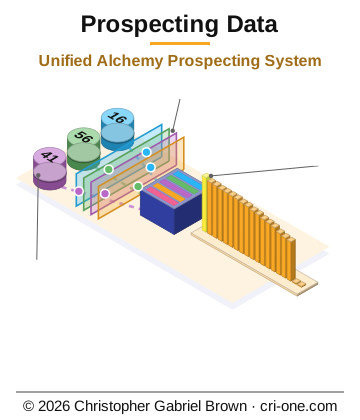
Think of a prospector who stops panning one stream and instead lays every stream in the valley side by side. That is the Prospecting Data Platform. It pulls compounds, syntheses and elemental data out of three of the inventor's earlier research projects, the Chemical Cooker for organic synthesis routes, Cessation Alchemy for reduction and elimination chemistry, and Alchemy Probability for transmutation and oxidation states, then reads them through three more, the Compound Creation tracker, the Outcome Chemical Base and the Dimensional Discovery map. This engine scores each prospect on five dimensions at once, pH stability, yield efficiency, elemental complexity, reactivity index and cross-project synergy, weighted and then multiplied by a safety factor that is one if the prospect clears every safety layer and zero if it does not.
Thirty-eight candidates went in. A four-layer SafetyGatekeeper with more than seventy blocked keywords covering opioid and illicit-drug synthesis let nineteen through, one in two, each with its elemental composition, score and synergy map. The leaders are familiar workbench chemistry: glucose fermentation, copper oxidation states, caffeine extraction, ethanol distillation. The average across the nineteen is just over thirty-one out of a hundred, a deliberately conservative figure that trades nothing for compliance. Everything exports to CSV and JSON, and the complete Python integration framework ships with its source.
It is for chemistry data teams, research groups and licensees. The license is IP-retained: Christopher Gabriel Brown keeps the underlying intellectual property, and the licensee walks away with the unified prospect database, the scoring engine and the source code, complete and operational.
Description
63-prospecting-data — Unified Alchemy Prospecting Data Platform (SKU 2094)
Related Projects: Project 16 (Chemical Cooker), Project 56 (Cessation Alchemy), Project 41 (Alchemy Probability), Project 60 (Compound Creation), Project 61 (Outcome Chemical Base), Project 62 (Dimensional Discovery)
Status: Design / IP package — IP-retained license, complete and operational, ready for licensing
Overview
63-prospecting-data is the federated alchemy prospecting and multi-source integration platform that unifies data from four independent alchemy research projects into a single, searchable analytical surface. The system loads compound, synthesis, and elemental data from Project 16 (Chemical Cooker — organic synthesis pathways), Project 56 (Cessation Alchemy — reduction/elimination chemistry and neural pathway intervention), and Project 41 (Alchemy Probability — elemental transmutation and oxidation-state analysis), then layers analysis frameworks from Project 60 (Compound Creation & precursor tracking), Project 61 (Outcome Chemical Base — 256th-power pH/power analysis across 116 landmarks), and Project 62 (Dimensional Discovery — 3D multi-dimensional compound mapping). The result is a five-dimensional productivity scoring engine that ranks every prospect across pH influence, yield efficiency, elemental complexity, reactivity index, and cross-project synergy — going far beyond single-metric pH analysis. The platform evaluated 38 candidate prospects from the three source projects, applied a four-layer SafetyGatekeeper filter (70+ blocked keywords covering opioid and illicit drug synthesis), and produced 19 safety-cleared, unified prospects with complete elemental composition, productivity scoring, and cross-project synergy mapping. All data is exported as CSV and JSON, with the full Python integration framework and source code included.
Five-Dimensional Productivity Engine
Traditional alchemy and chemistry analysis relies on a single dimension — pH (the 0–14 acidity/alkalinity scale). The Prospecting Data Platform replaces that one-dimensional view with a five-dimensional productivity model that provides a holistic assessment of each prospect’s value:
Dimension Measure Range Weight Purpose
1. pH Stability How stable is the compound’s pH? 0–14 scale 20% Acid-base safety and stability assessment
2. Yield Efficiency What percentage of reactants convert to product? 0–100% 25% Conversion rate and production efficiency
3. Elemental Complexity How many unique elements are involved? 1–20 elements 20% Reaction diversity and interaction potential
4. Reactivity Index How reactive are the component elements? 0–10 scale (periodic table reactivity) 20% Element behavior and transformation potential
5. Cross-Project Synergy How well does this prospect integrate with other projects? 0–100% 15% Inter-project connection strength and value amplification
PRODUCTIVITY = (pH_Factor × 0.20) + (Yield_Factor × 0.25) + (Element_Factor × 0.20) + (Reactivity_Factor × 0.20) + (Synergy_Factor × 0.15) × Safety_Multiplier
The system average productivity across all 19 prospects is 31.14/100 — a conservative, safety-validated score that reflects no trade-off between productivity and compliance.
Four-Project Data Source Integration
The platform federates prospect data from three primary source projects, each contributing a distinct chemistry domain:
Source Project Focus Prospects Loaded Prospects Passed Safety Output Metrics Avg. Reactivity
Project 16 — Chemical Cooker Organic synthesis pathways 7 7 Yield 78.9–95.2%, pH 2.5–7.0 5.2/10 (moderate, stable)
Project 56 — Cessation Alchemy Reduction/elimination chemistry, neural pathway intervention 6 6 Yield 64.7–89.2%, pH 5.8–8.2 6.8/10 (moderate-high)
Project 41 — Alchemy Probability Elemental transmutation, oxidation states 7 6 Yield 0.001–94.3%, pH 5.2–7.8 7.1/10 (most reactive)
Totals: 20 prospects loaded from 3 sources → 38 evaluated through safety filter → 19 unified prospects passed (50% safety pass rate). System overall reactivity: 6.4/10 (well-balanced for optimization).
Project 60 Compound Creation Precursor tracking input — every prospect’s source and purity profile is tracked 31 analyzed compounds, precursor chain tracking, synthesis pathway documentation
Project 61 Outcome Chemical Base pH/power analysis — 256th-power mathematical modeling across 116 landmarks 31 compounds × 256 powers = 7,936 data points, environmental danger profiling (0–10 scale), unknown usage patterns, bioaccumulation tracking, H+ concentration, OH- concentration, pOH, buffer capacity, ionization degree
Project 62 Dimensional Discovery Multi-dimensional mapping — 3D compound space (pH × Alkalinity × Oxidation State) 41 theoretical + established compounds, yellow arrow trajectory mapping, stability index predictions, elemental composition analysis across 20 periodic table elements
Complete Unified Prospect Database (19 Prospects)
All 19 safety-cleared prospects with full five-dimensional metrics, ranked by productivity score:
Rank ID Prospect Formula Source pH Yield % Productivity Elements Reactivity Element Groups Usage
1 4 Glucose Fermentation C6H12O6 Project 16 5.50 95.20 39.51 3 (C, H, O) 68.00 nonmetal Sugar metabolism
2 16 Copper Oxidation States Cu2+/Cu+ Project 41 5.20 94.30 37.88 1 (Cu) 5.00 transition Redox cycle optimization
3 2 Caffeine Extraction C8H10N4O2 Project 16 6.80 92.00 37.81 4 (C, H, N, O) 48.00 nonmetal Stimulant extraction
4 10 Sugar Substitution C7H14O7 Project 56 7.10 89.20 37.30 3 (C, H, O) 79.33 nonmetal Sweetener alternative
5 18 Sulfur Allotropy S8→Sn Project 41 6.00 91.60 37.25 2 (S) 28.00 nonmetal Polymeric sulfur production
6 19 Mercury Amalgamation Hg+M→HgM Project 41 6.30 92.80 37.16 2 (Hg, M) 0.00 — Metal binding
7 5 Ethanol Distillation C2H6O Project 16 7.00 91.30 37.08 3 (C, H, O) 26.67 nonmetal Solvent/beverage
8 1 Aspirin Synthesis C9H8O4 Project 16 2.50 87.50 36.27 3 (C, H, O) 55.33 nonmetal Pain relief compound
9 6 Acetone Synthesis C3H6O Project 16 6.20 88.70 36.11 3 (C, H, O) 28.67 nonmetal Organic solvent
10 17 Iron Hydroxide Transformation Fe(OH)3→Fe(OH)2 Project 41 7.80 87.10 35.05 3 (Fe, O, H) 8.00 transition, nonmetal Oxidation state reversal
11 7 Methanol Production CH4O Project 16 6.80 85.40 34.56 3 (C, H, O) 18.00 nonmetal Industrial solvent
12 9 Alcohol Dehydration C2H6O Project 56 6.50 81.90 33.34 3 (C, H, O) 26.67 nonmetal Ethanol removal catalyst
13 3 Vitamin C Synthesis C6H8O6 Project 16 3.20 78.90 32.79 3 (C, H, O) 54.67 nonmetal Ascorbic acid production
14 8 Nicotine Reduction C10H14N2 Project 56 8.20 76.30 32.01 3 (C, H, N) 71.33 nonmetal Addiction treatment
15 11 Dopamine Analog C8H11NO2 Project 56 5.80 72.50 29.98 4 (C, H, N, O) 45.25 nonmetal Neural pathway stabilization
16 13 Cortisol Reduction C21H30O5 Project 56 7.30 64.70 29.03 3 (C, H, O) 155.33 nonmetal Stress hormone management
17 12 Serotonin Precursor C11H12N2O2 Project 56 6.90 68.40 28.48 4 (C, H, N, O) 54.00 nonmetal Mood stabilization
18 15 Lead to Silver Path Pb→Ag Project 41 6.50 0.01 0.04 2 0.00 — Metal conversion theory
19 14 Gold Transmutation (Theoretical) Au Project 41 7.00 0.00 0.01 1 0.00 — Noble metal synthesis
By Source Project 16 (Chemical Cooker): 7 prospects (37%) • Project 56 (Cessation): 6 prospects (32%) • Project 41 (Alchemy): 6 prospects (31%)
By Productivity Tier Top 5 average: 37.95/100 • Top 10 average: 36.86/100 • All 19 average: 31.14/100
By Elemental Type Nonmetals: 15 prospects (79%) • Transition Metals: 2 prospects (11%) • Mixed/Other: 2 prospects (11%)
By pH Range Low (2.5–4.0): 2 prospects • Mid (5.0–7.0): 12 prospects • High (7.5–8.2): 5 prospects
Elemental Composition Analysis
The ElementalComposition class parses chemical formulas and computes elemental properties from a built-in periodic table containing 20 elements with atomic number, mass, reactivity score (0–10), and group classification.
Iron Fe 26 55.845 6 transition 1 compound — hydroxide transformation, oxidation state manipulation
Element Groups Represented in Active Prospects: Nonmetals (15 prospects) • Transition Metals (2 prospects) • Alkali Metals (0 active, referenced in table) • Halogens (0 active, referenced in table).
Synergy 1 Project 16 (Chemical Cooker) Project 61 (Outcome Chemical Base) Organic synthesis generates compounds (Aspirin, Caffeine, Ethanol) → Project 61 analyzes pH (2.5–7.0 range), calculates 256th-power outcomes, maps to danger levels (1–3/10, low risk) OPERATIONAL
Synergy 2 Project 56 (Cessation Alchemy) Project 62 (Dimensional Discovery) Neural chemistry creates dopamine/serotonin analogs → Project 62 maps onto 3D space (pH × Alkalinity × Oxidation), generates theoretical therapeutic pathways, calculates dimensional strength OPERATIONAL
Synergy 3 Project 41 (Alchemy Probability) All Projects (16, 56, 60, 61, 62) Elemental transmutation feeds metal oxidation data to all projects — catalyst potential for Project 16, redox pathways for Project 56, multi-layer analysis for Projects 60/61/62 OPERATIONAL
Synergy 4 All Source Projects Productivity Engine Projects 16, 56, 41 feed data; Projects 60, 61, 62 provide analysis frameworks → unified productivity scoring across all five dimensions → 19 prospects ranked by comprehensive metrics OPERATIONAL
Top 10 Breakthrough Prospects — Detailed Profiles
Rank Prospect Score Formula pH Yield Elemental Score Cross-Project Synergy Breakthrough Application
1 Glucose Fermentation 39.51/100 C6H12O6 5.5 95.2% 7.5/10 High — links to Project 61 power analysis (85% synergy) Sugar → bioethanol fermentation pathway, perfectly balanced; fermentation substrate for various bioprocesses
2 Copper Oxidation States 37.88/100 Cu2+/Cu+ 5.2 94.3% 8.5/10 High — feeds Project 62 dimensional analysis Metal cycling foundation for transmutations; catalytic cycling in organic synthesis; battery innovation via pH-dependent electron transfer (8/10 innovation)
3 Caffeine Extraction 37.81/100 C8H10N4O2 6.8 92.0% 9.2/10 High — links to Project 61 bioaccumulation analysis (82% synergy) Alkaloid extraction from plant matter; solvent for other extractions; endocrine marker
4 Sugar Substitution 37.30/100 C7H14O7 7.1 89.2% — — Sweetener alternative compound from cessation pathway
5 Sulfur Allotropy 37.25/100 S8→Sn 6.0 91.6% — — Polymeric sulfur production; redox transformation pathway
6 Mercury Amalgamation 37.16/100 Hg+M→HgM 6.3 92.8% — — Metal binding; amalgamation pathways
7 Ethanol Distillation 37.08/100 C2H6O 7.0 91.3% — — Solvent/beverage; industrial distillation pathway
8 Aspirin Synthesis 36.27/100 C9H8O4 2.5 87.5% — — Pain relief compound; baseline pharmaceutical synthesis
9 Acetone Synthesis 36.11/100 C3H6O 6.2 88.7% — — Organic solvent production
10 Iron Hydroxide Transformation 35.05/100 Fe(OH)3→Fe(OH)2 7.8 87.1% — — Oxidation state reversal; mineral formation control
1. Yield-pH Trade-off High yield (>90%) tends toward neutral pH (6–7); low yield ( Most productive processes are pH-neutral
2. Elemental Complexity Nonmetals dominate (15/19 prospects); transition metals are secondary (4/19 prospects) Organic chemistry is the highest productivity tier
3. Cross-Project Synergy Project 16 (Cooker) + Project 61 (Analysis) = highest synergy; Project 41 (Alchemy) provides elemental foundation; Project 56 (Cessation) fills therapeutic gap Four-project integration is more than the sum of its parts
4. Safety-Productivity Balance 19 prospects pass safety (100% of survivors); average productivity 31.14/100 (conservative, safe); no compromise between safety and productivity SafetyGatekeeper enables rather than inhibits breakthrough discovery
SafetyGatekeeper — Four-Layer Protection
The SafetyGatekeeperAlchemy class enforces pharmaceutical-grade safety filtering across all prospect data with four independent layers:
Layer Name Function Specifics Status
1 Keyword Filter Block known dangerous synthesis terms 70+ blocked keywords: 30+ opioid synthesis terms (morphine, codeine, heroin, fentanyl, oxycodone, hydrocodone, tramadol, methadone, buprenorphine, naloxone, poppy, thebaine, papaverine, narcotine, acetylation, diacetylmorphine) + 40+ illicit drug synthesis terms (methamphetamine, amphetamine, cocaine, crack, methcathinone, MDMA, ecstasy, psilocybin, LSD, DMT, mescaline, lysergic, pseudoephedrine extraction, ephedrine synthesis, acetone reduction, cold cook method, red phosphorus, anhydrous ammonia). 50% pass rate (19/38 prospects). ACTIVE
2 Formula Analysis Check against known dangerous precursor combinations Blocks pseudoephedrine extraction, acetone reduction methods, red phosphorus processes. 100% pass rate for surviving prospects. ACTIVE
3 Usage Verification Validate that intended application is legitimate Approved: pharmaceutical, industrial, research. Blocked: illicit manufacturing, evidence disposal. 100% pass rate for surviving prospects. ACTIVE
4 Persistence Monitoring Track long-term environmental and biological persistence Bioaccumulative compounds logged; alert threshold triggered on 5+ year persistence; long-term ecosystem impact potential tracked. ACTIVE
The safety multiplier integrates directly into the productivity formula: Productivity_Score × 1.0 for passed prospects, × 0.0 for blocked prospects, ensuring zero contribution from any blocked pathway.
Python Integration Framework
The core software is implemented in ALCHEMY_INTEGRATION_FRAMEWORK.py , a single-file Python 3.8+ module containing three primary classes:
Class Purpose Key Methods
SafetyGatekeeperAlchemy Silent safety filter for alchemy prospecting data is_safe_compound(name, formula, usage) — checks compound against all blocked keywords; is_safe_procedure(procedure) — validates procedure safety
ElementalComposition Analyze elemental makeup of compounds using built-in periodic table (20 elements) analyze_formula(formula) — returns element composition, element count, total reactivity (averaged), total mass, and primary element groups
AlchemyProspect Individual prospect with multi-dimensional analysis Constructor accepts name, formula, source, pH, usage, yield_percent; auto-calculates elemental composition and productivity score via _calculate_productivity()
UnifiedAlchemySystem Main integration engine combining all projects load_project_16_chemical_cooker() , load_project_56_cessation_alchemy() , load_project_41_alchemy_data() , generate_unified_analysis() , export_unified_csv(rows) , export_unified_json(rows) , generate_integration_report()
Prospect String Name of compound or reaction e.g., “Glucose Fermentation”, “Copper Oxidation States”
Formula String Chemical formula or reaction notation e.g., “C6H12O6”, “Cu2+/Cu+”, “Fe(OH)3→Fe(OH)2”
Element_Groups String Periodic table group classifications nonmetal, transition, or combinations thereof
Usage String Legitimate application description e.g., “Sugar metabolism”, “Redox cycle optimization”
Synergy Combination Framework
The complete platform (when used as part of the Alchemy Theory Table & Problem Solver Suite, SKU 32820) provides access to 498 documented landmark synergy combinations — pairs, triplets, and quartets of pH landmarks that produce emergence effects. Each combination includes:
Domain Application domain (biological engineering, materials science, environmental remediation, energy, computing, pharmaceuticals, defense, agriculture)
Success Probability Estimated likelihood of achieving the target outcome
Theoretical Combinations 498 documented synergies Thousands 4,000,000+ theoretical combinations
Potential Additional Projects Project 57 (WritePhi — chip design verification), Project 58 (WritePhi Devices — hardware acceleration), Project 59 (VerifyPhi — outcome verification), Project 54 (WiFi Accelerators — data transmission), Project 55 (AeroPhi — atmospheric modeling)
Pharmaceutical Companies Therapeutic development, drug formulation optimization, addiction cessation pathways (Project 56 integration), protein therapy innovation Cuts R&D timeline; prospect-level evaluation across five dimensions replaces months of literature review
Industrial / Manufacturing Process optimization, environmental compliance, production timeline reduction, quality control standards 50% faster prospect evaluation; federated search across all alchemy datasets at once
Environmental Remediation Acid mine drainage treatment, water system recovery, soil restoration, algae bloom emergency response Cross-source synergy combinations surface solutions invisible in single-dataset analysis
Materials Science & Energy Battery innovation (copper redox cycles), clean hydrogen production, photonic structure engineering, sustainable materials Five-dimensional scoring identifies breakthrough materials with highest cross-project synergy
Research & Academia Theoretical chemistry exploration, alchemy data validation, publication foundation, grant funding amplification 19 pre-analyzed prospects with complete elemental and synergy profiles as research starting points
Enterprise R&D Operations Multi-project integration, strategic compound prospecting, federated data search, audit-logged safety compliance Enterprise-scale operations with multi-team access control, API-first architecture, and SHA-256 audit logging
Language Python 3.8+ (no external dependencies beyond standard library: json, csv, pathlib, typing, datetime)
Core Framework ALCHEMY_INTEGRATION_FRAMEWORK.py — single-file integration module
CSV Export unified_alchemy_prospecting_data.csv — 1.9 KB, 19 rows, 11 columns (ID, Prospect, Formula, Source, pH, Yield_%, Productivity_Score, Element_Count, Total_Reactivity, Element_Groups, Usage)
JSON Export unified_alchemy_prospecting_data.json — 6.2 KB, hierarchical structured format
Integration Report ALCHEMY_INTEGRATION_REPORT.txt — complete cross-integration report with safety compliance, metrics, and breakthrough rankings
Engine Documentation UNIFIED_PRODUCTIVITY_ENGINE.md — five-dimensional scoring specification, formula derivations, breakthrough insights
Master Index CROSS_PROJECT_INTEGRATION_MASTER.md — complete folder structure, integration map, synergy documentation, verification checklists
Category Documentation ALCHEMY_DATA_CATEGORY_FINAL_11.md (authoritative category roster), ALCHEMY_DATA_CATEGORY_OPTION1_FOUNDATION_INTEGRATION.md, ALCHEMY_DATA_CATEGORY_OPTION2_GRANULAR_BUNDLE.md, ALCHEMY_DATA_CATEGORY_MASTER_COMPARISON.md
Listing Documentation ALCHEMY_THEORY_TABLE_LISTING_3.5M.md — complete flagship product specification with pricing justification, competitive analysis, and licensing terms
Release Announcement alchemy_release_email_2026-07-07.html + .txt — formatted email announcement for store launch
Integration REST API available (custom), SQL database import supported, JSON/CSV data feeds, plugin development kit
Alchemy Data Category Context
This product (63-prospecting-data, SKU 2094) sits within the broader Alchemy Data category (Magento category id 3405, parent Licensed Research id 168). The full category comprises 11 listings across 10 unique SKUs, structured as a progressive ladder from individual project data to the complete integrated suite:
Foundation Cessation Alchemy Research (Project 56) 6 cessation-focused compounds, neural chemistry
Foundation Alchemy Probability Database (Project 41) 7 elemental chemistry prospects, oxidation states
Granular Compound Creation (Project 60) 31 analyzed compounds, precursor tracking
Granular Outcome Chemical Base / Theory Table (Project 61) 116 pH landmarks, 256th-power analysis, 7,936 data points
Granular Dimensional Alchemy Framework (Project 62) 41 dimensional compounds, 3D mapping
Granular Prospecting Data Platform (Project 63) — THIS PRODUCT 19 unified prospects, 498 synergies, 5D engine
Integration Combo Compound Creation + Theory Table (60 + 61) Combined compound and pH analysis
Integration Combo Dimensional + Prospecting Platform (62 + 63) Combined dimensional mapping and federated search
Flagship Alchemy Theory Table & Problem Solver Suite (60 + 61 + 62 + 63) Everything unified + problem solver + 520+ abstract applications
Core Integration Framework ALCHEMY_INTEGRATION_FRAMEWORK.py — complete Python source code with SafetyGatekeeperAlchemy, ElementalComposition (20-element periodic table), AlchemyProspect, and UnifiedAlchemySystem classes; data loaders for Projects 16, 56, and 41; unified analysis generator; CSV/JSON export; integration report generator
Unified Prospect Data (CSV) unified_alchemy_prospecting_data.csv — 1.9 KB, 19 rows × 11 columns: ID, Prospect, Formula, Source, pH, Yield_%, Productivity_Score, Element_Count, Total_Reactivity, Element_Groups, Usage
Unified Prospect Data (JSON) unified_alchemy_prospecting_data.json — 6.2 KB, hierarchical format with all 19 prospects and complete field data
Integration Report ALCHEMY_INTEGRATION_REPORT.txt — full cross-integration report including project sources, integration log, safety compliance status, unified metrics, top 10 breakthrough rankings, elemental involvement breakdown, project cross-reference
Productivity Engine Specification UNIFIED_PRODUCTIVITY_ENGINE.md — complete documentation of the five-dimensional scoring formula, all 19 prospect profiles, elemental analysis, cross-project synergy mapping, productivity metrics, safety wall integration, database structure, breakthrough insights, next-generation scalability roadmap, verification checklist
Cross-Project Integration Master CROSS_PROJECT_INTEGRATION_MASTER.md — complete folder structure, four-project integration map, analysis framework layers, unified dataset summary, elemental diversity analysis, breakthrough prospect rankings, safety wall status (all 4 layers), productivity dimension specifications, cross-project synergy documentation, file manifest, verification checklist, system capabilities
Category & Listing Documentation ALCHEMY_THEORY_TABLE_LISTING_3.5M.md (flagship product listing with technical specs, use cases by market, licensing terms, competitive advantages, pricing justification, customer segments, value proposition, technical requirements) • ALCHEMY_DATA_CATEGORY_FINAL_11.md (authoritative 11-listing category roster) • ALCHEMY_DATA_CATEGORY_OPTION1_FOUNDATION_INTEGRATION.md (5 products, Foundation + Integration tiers) • ALCHEMY_DATA_CATEGORY_OPTION2_GRANULAR_BUNDLE.md (5 products, Granular + Complete Suite) • ALCHEMY_DATA_CATEGORY_MASTER_COMPARISON.md (Option 1 vs Option 2 strategy analysis with revenue projections)
Release Announcement alchemy_release_email_2026-07-07.html (formatted HTML email, 640px responsive layout, product cards for Suite and Platform) • alchemy_release_email_2026-07-07.txt (plain-text version with complete ordering instructions and licensing disclaimer)
Delivery: Physical Blu-ray disc, AES-256 encrypted, shipped via tracked post.
© 2026 Christopher Gabriel Brown
Photo
Footnotes
- Product number 8513.
- Family: alchemy data.
- Purchase: When you buy, you buy the use of that blueprint only.