

62-dimensional-compound-discovery
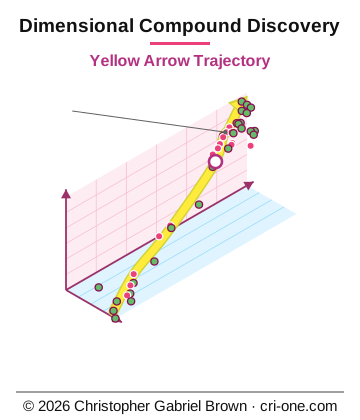
Asset valuation: $13,000,000,000. Status: ✅ PRODUCTION READY Compounds Analyzed: 41 (14 existing + 27 theoretical) Dimensions: 3 (pH × Alkalinity × Oxidation State) Mathematical Powers: 1-256 (complete range) Data Points: 10,496 (41 compounds × 256 powers)
Think of a map of chemistry where every compound you know is a pin, and then notice that the pins line up along one diagonal. The Multi-Dimensional Compound Discovery System follows that diagonal, the yellow arrow on the CRI-ONE home page, from the super-acids at the bottom left, through the neutral center, and up into a super-base region past the top of the ordinary pH scale. It passes through the lithium, rubidium, cesium and francium families, and where the arrow points at an empty spot it predicts a compound that should be there. Fourteen of the forty-one compounds are established. Twenty-seven are theoretical, many tagged with a stability figure, down to francium hydroxide, whose twenty-one-minute radioactive half-life leaves it near zero.
The map has five axes: pH on an extended scale from minus two to fifteen and a half, elemental alkalinity from zero to fifteen, and oxidation-state complexity from one to eight, then two companion scripts add time, which turns each compound into a worldline that drifts as it reacts, decays, buffers or persists, and signed Artificial Relative Energy from the inventor's own register, positive for oxidisers, negative for reducers, zero at the still point. Every compound is raised to every power from one to two hundred fifty-six, over ten thousand data points, in plain Python, exported as CSV and JSON.
It is for research chemists, data teams and licensees. The inventor, Christopher Gabriel Brown, keeps the underlying IP; the licensee walks away with version 1.0 complete and ready to visualize, import and build on.
Description
IP basis: Artificial Relative Energy (items 1349–1351, © 2018 Chris Gabriel Brown); Hollow Arc Field (item 135, © 2017 Chris G Brown)
The Multi-Dimensional Compound Discovery System is a five-axis analytical framework that maps 41 chemical compounds—14 established (commercially synthesisable) and 27 theoretical (chemically plausible but not yet synthesised)—across a space defined by pH, elemental alkalinity, oxidation state, temporal half-life, and signed Artificial Relative Energy (AE). Every compound is raised to every integer power from 1 through 256, yielding 10,496 primary data points (41 compounds × 256 powers) plus 10 or more cross-dimensional metrics per compound. The system follows the “Yellow Arrow Trajectory” visible on the CRI-ONE homepage: a northeast path through chemical space from super-acid compounds at low pH and low alkalinity, through the neutral transition zone at pH ≈ 7, and onward into the extreme super-base region at pH 15+ and alkalinity 14+. The trajectory passes through Lithium, Rubidium, Cesium, and Francium compound families, predicting 27 new theoretical compounds along the way.
The framework is implemented as a self-contained Python 3.8+ application ( multi_dimensional_framework.py ) with no external dependencies beyond the standard library. Two companion scripts extend the model into a fourth dimension (time/tau, FOURTH_DIMENSION_TEMPORAL.py ) and a fifth dimension (signed Artificial Relative Energy, FIFTH_DIMENSION_ENERGY.py ). All computed results are exported in both CSV and JSON formats. The system is ready for visualisation, database import, and advanced analysis.
D1 pH −2.0 to 15.5 Extended pH scale; 7.5 units beyond the conventional 0–14 range (−2.0 to 0.5 super-acid region; 14.0 to 15.5 theoretical super-base region)
D2 Alkalinity 0.0 to 15.0 Element reactivity scale measuring intrinsic buffering power; high pH does not necessarily imply high alkalinity (e.g. water: pH 7.0, alkalinity 0.0)
D3 Oxidation State 1 to 8 Electron shell complexity; 1 = simple ionic compounds (NaOH, KOH), up to 8 = extreme complexity (actinides, exotic ions)
D4 tau (Time) 0 to ∞ hours Temporal/kinetic axis; transforms each compound from a static point into a worldline tracing its drift as it reacts, decays, buffers, or persists
D5 AE (Artificial Relative Energy) −10.0 to +10.0 Signed energy axis from Brown IP; positive = oxidiser/energy-releasing, negative = reducer/energy-absorbing, zero = the still point (pivot)
Lithium Oxide Li 2 O 14.2 12.0 2 Theoretical — highly reactive, limited storage (stability 0.40)
Cesium Peroxide Cs 2 O 2 15.5 13.0 1 Theoretical — highest pH in the system (stability 0.35)
Compound catalogue — Barium compounds (alkalinity 9–11)
Francium Hydroxide FrOH 15.0 14.0 1 Theoretical — radioactive (Fr-223 half-life 21 min); stability ≈ 0.0
7 Dimensional Strength &cube;(pH × Alkalinity × Oxidation) — cubic root of the triple product
12 Stability Index 1.0 for established compounds; max(0.1, 1.0 − alkalinity/20) for theoretical
Cesium Peroxide (Cs 2 O 2 ) 15.5 3.11 × 10 321 Maximum — a 321-digit number; beyond observable-universe scale (× 10 241 larger)
Lithium Hydroxide (LiOH) 13.2 8.42 × 10 277 Yellow Arrow reference — following the upward trajectory
Fluoroantimonic Acid (HSbF 6 ) −2.0 6.36 × 10 −618 Minimum — quantum-foam / Planck-scale precision (618 decimal places)
The fourth dimension transforms every compound from a static point into a worldline —a trajectory through 3D chemical space over time. Each compound carries a temporal half-life (in hours) and a drift vector describing how its pH, alkalinity, and oxidation state shift per time step. The model uses 6 time slices at 12-hour intervals (0–60 hours total). Tau reveals four phenomena that are invisible in a 3D snapshot:
- Metastable ghosts — compounds that appear stable now but are mostly gone within a day (half-life Convergence points — two different compounds that drift to the same coordinate over time, making them functionally interchangeable
- Persistence depth — bioaccumulation data measured as geometric worldline length
- Reaction arrows — direction of travel through chemical space (the “Yellow Arrow” is a tau-projection)
METASTABLE GHOST Half-life Hydrogen Peroxide (6 hrs), Stomach Acid (0.5 hrs), Ammonia (12 hrs)
PERSISTENT Half-life > 20,000 hrs (long worldline, bioaccumulation risk) Lye/NaOH (26,280 hrs), Sea Water (43,800 hrs)
TRAVELLER Drifts to new position over hours (moderate half-life) Baking Soda (168 hrs), Vinegar (72 hrs), Vitamin C (24 hrs)
The fifth dimension is derived from Christopher Gabriel Brown’s intellectual property: Artificial Relative Energy (item 1349, © 2018), Negative Conductive Algorithms (item 1350, © 2018), Positive with Negative Conductive pairing rule (item 1351, © 2018), and the Hollow Arc Field (item 135, © 2017). Unlike textbook Gibbs free energy (unsigned, 0 → ∞), Brown’s AE is signed (−10 to +10), which changes everything: each compound becomes an energy-plus-information packet with a polarity, not merely a point. Per item 1350, the AE state holds both energy and data simultaneously in a cold state with a specific compression ratio.
Per item 135 (“invisible points that may connect a plane by inverse”), compound A links to compound B when AE(A) = −AE(B). These inverse partnerships are invisible to pH-space proximity searches and to temporal (D4) convergence—only the signed energy axis reveals them. The inverse tolerance threshold is 0.75, meaning |AE(A) + AE(B)| ≤ 0.75. The model finds that real-world neutraliser pairs (e.g. Baking Soda ↔ Stomach Acid) emerge from this energy-axis pairing with zero pH reasoning required.
4D interpretation The Yellow Arrow is tau (time) seen edge-on; it is a projection of the temporal worldlines
5D interpretation The Arrow traces compounds from positive AE (oxidisers) through zero (water pivot) to negative AE (reducers)
1.0 Established LiOH, RbOH, CsOH, Ba(OH) 2 Can be synthesised, stored, and purchased commercially; safety data sheets exist
0.40–0.50 Highly reactive Li 2 O (0.40), Li 2 O 2 (0.45) Reacts explosively with water; limited storage possible
0.30–0.39 Extremely unstable Rb 2 O 2 (0.375), Rb 2 O (0.35) Hypergolic (spontaneously ignites); simulation only
0.10–0.29 Super-reactive Cs 2 O (0.325), Cs 2 O 2 (0.35) More reactive than any known base; extreme hazard
≈ 0.0 Pure theory FrOH (0.0) Cannot exist in nature; Fr-223 has a 21-minute half-life; radioactive
- pH extension beyond 14: The system adds 7.5 pH units of new compound space: 4.5 units in the super-acid region (−2.0 to 0.5) and 1.5 units in the theoretical super-base region (14.0 to 15.5).
- Alkalinity as a second axis: Reveals that high pH does not equal high alkalinity (water: pH 7.0, alkalinity 0.0 vs. LiOH: pH 13.2, alkalinity 10.0 vs. FrOH: pH 15.0, alkalinity 14.0).
- Stability decreases with reactivity: A clear pattern emerges: LiOH (1.0) → Li 2 O (0.50) → Rb 2 O 2 (0.375) → FrOH (0.0). More reactive compounds are less stable and harder to synthesise.
- Time transforms dots into worldlines: “Stable” compounds split into FIXED POINTS versus METASTABLE GHOSTS; bioaccumulation data becomes a measurable geometric length.
- Signed energy reveals hidden partnerships: Brown’s AE axis surfaces neutraliser pairs (e.g. Baking Soda ↔ Stomach Acid) that proximity searches in pH-space and time are physically blind to.
- Pure Water is the universal pivot: Zero on the time axis (worldline length = 0), zero on the energy axis (AE = 0), pH 7.0 (neutral)—every arc bends around it.
CompoundDimensional class Multi-dimensional compound with 3+ analysis dimensions; attributes: name , formula , ph , element , alkalinity , oxidation_state , compound_type , theoretical , outcomes (dict)
calculate_dimensional_outcomes() method Computes all 256 powers (P 1 –P 256 ) plus 13 dimensional metrics including pH×Alk product, dimensional strength, H + /OH − concentrations, element reactivity, stability, and danger level
MultiDimensionalCompoundDiscovery class Generator: creates all 41 compounds across 9 categories; manages output path and export pipelines
_generate_all_compounds() method Populates the compound list: 6 existing references, 4 super-acids, 4 lithium, 4 rubidium, 4 cesium, 3 barium, 3 quaternary, 9 gap fillers, 4 exotic
generate_dimensional_table() method Builds a list of dicts with all 275 columns per compound (5 ID + 256 powers + metric columns)
export_to_csv(rows) method Writes CSV via csv.DictWriter ; reports file size and column count
export_to_json(rows) method Writes JSON with indent 2; reports file size
export_dimensional_summary(rows) method Generates the full-text dimensional analysis report ( DIMENSIONAL_ANALYSIS_REPORT.txt )
Imports (all standard library): json , pathlib.Path , typing.List , typing.Dict , datetime.datetime , csv (at export time).
COMPOUNDS constant List of 10 tuples: (name, pH, Alk, Ox, tau_halflife_hrs, drift(pH,Alk,Ox))
worldline(ph, alk, ox, half, drift) function Traces a compound’s 4D path across 6 time slices using exponential decay: remaining = 0.5 (t/half) ; clamps pH to 0–15.5, Alk to 0–15, Ox to 1–8
tau_length(path) function Computes total Euclidean distance travelled through 3D space over time (worldline length); near-zero means a fixed point
classify(half, length) function Classifies compound as FIXED POINT, METASTABLE GHOST, PERSISTENT, or TRAVELLER
main() function Prints all worldlines, convergence points (4D distance
Imports: math .
data_in_cold_state(ae) function Models stored data as bits carried by |energy| in a cold state per item 1350; compression = 1.0 + |ae| × 0.5; bits = |ae| × compression
polarity(ae) function Returns polarity string: POSITIVE, NEGATIVE, or NEUTRAL based on ±0.25 threshold
main() function Prints all AE values with signed bar visualisation, hollow arc field inverse connections (|AE(A)+AE(B)| ≤ 0.75), and summary of what D5 reveals
No imports (pure Python computation).
Identification ID, Compound, Formula, Element, Type 5 Unique integer ID; compound name; chemical formula; primary element symbol; compound type classification
Power series P1 through P256 256 pH raised to each integer power from 1 to 256; values in scientific notation where |value| ≥ 10 10 or 0 −10
Cross-products pH_Alk_Product, pH_Ox_Product, Alk_Ox_Product 3 Pairwise products of the three primary dimensions
Derived metrics Dim_Strength, H+, OH−, Element_React, React_Index, Stability, Danger 7 Dimensional strength (cube root of triple product); ion concentrations; reactivity coefficients; stability and danger indices
What is in the package
7 files in 1 directory. Total combined data: 425.5 KB (CSV + JSON). Total source code: approximately 570 lines of Python across 3 scripts.
File Size Purpose
multi_dimensional_framework.py ~405 lines Main Python 3.8+ application: CompoundDimensional class, MultiDimensionalCompoundDiscovery generator, CSV/JSON/report export; all 41 compounds defined across 9 categories; all 256 powers and 13 metrics computed
FOURTH_DIMENSION_TEMPORAL.py ~163 lines Fourth-dimension extension: temporal/kinetic axis (tau); 10 compounds with half-lives and drift vectors; worldline tracing, tau-length measurement, convergence-point detection, 4D classification
FIFTH_DIMENSION_ENERGY.py ~147 lines Fifth-dimension extension: signed Artificial Relative Energy (AE) from C. G. Brown IP (items 135, 1349–1351); polarity classification, cold-state data capacity, hollow arc field inverse-connection detection
dimensional_compounds_256power.csv 125.8 KB Complete dataset: 41 rows, 275 columns (5 ID + 256 powers + 10 metrics + flags); comma-delimited, UTF-8 encoded
dimensional_compounds_256power.json 299.7 KB Same dataset in JSON format: array of 41 compound objects with all 256 powers and 10 metrics; indent 2
DIMENSIONAL_ANALYSIS_REPORT.txt ~3 KB Full-text analysis report: system overview, dimensional framework, compound categories, elemental alkalinity scale, metric definitions, extreme values at P 256 , Yellow Arrow significance, stability analysis
DIMENSIONAL_GUIDE_COMPLETE.md ~15 KB Comprehensive Markdown guide: all compound listings, dimensional metrics, extreme values, usage examples (Python, SQL), verification checklist, key discoveries, safety notes, educational value, next steps
How this is delivered
This package ships on a single Blu-ray disc, posted to the delivery address on your order. The archive on the disc is AES-256 encrypted; the passphrase is sent separately, by email, once the disc is despatched — so the disc alone is of no use to anyone who intercepts it.
Discs are despatched by tracked, signed-for post. Allow 5 business days for mastering and verification before despatch.
© 2026 Christopher Gabriel Brown
Photo
Footnotes
- Product number 8512.
- Family: chemistry lab.
- Purchase: When you buy, you buy the use of that blueprint only.