

29-information-taser
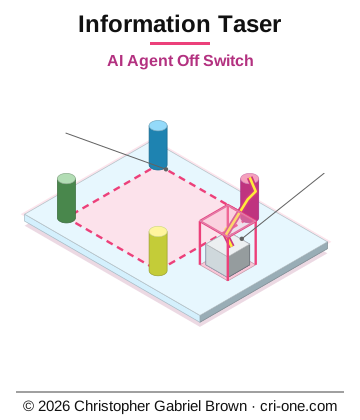
Asset valuation: $600,000,000. Master index of all projects: PROJECTSINDEX. Last edited: 2026-05-02 Status: Concept + outreach materials on file Maturity (per PACKAGEARCHITECTURE.md): L1 (Research / Outreach in Progress) Inventor: Christopher Gabriel Brown
Think of a circuit breaker on the wall of a house. It does nothing all day, then the moment a wire runs hot it cuts the power before the wall catches. The Information Taser is that breaker for automated systems. It is a defensive information-security framework built to halt, contain or disable an AI agent, a bot network, a data pipeline or an algorithmic process the moment it steps outside its authorized scope. It productizes eight inventions the inventor filed between 2012 and 2018, arranged in four layers: detection, containment, redirection and remediation.
The argument underneath it is written out in a full-length essay, "Respect the Tool." A person who picks up a tool and loses respect for it earns the cut; a person the tool comes for uninvited did nothing wrong. For that second kind of harm there must be insurance. That is the doctrine, and it is why the centrepiece is a working 30-question AI Resilience Assessment, five questions in each of six domains, from liability awareness and insurance coverage through foresight, incident response, public protection and security readiness, with automated scoring.
The status is concept plus outreach materials on file. What ships is the essay in text and HTML, the assessment, a working Node.js RAG pipeline with Python build and query scripts, a Document Intelligence tool for government-spending analysis, a DOGE case study, drafted outreach letters and defensive admin tooling. It is for security teams, boards and insurers who need a standard to measure against; the eight inventions stay with the inventor.
Description
Information Taser — AI Agent Off Switch
The Information Taser is a defensive information-security framework designed to halt, contain, or disable an automated system — AI agent, bot network, data pipeline, or algorithmic process — the moment it begins operating outside its authorized scope. It is the productization of eight prior inventions filed by Christopher Gabriel Brown between 2012 and 2018, years before the current AI crisis. The package includes a working Node.js RAG (Retrieval-Augmented Generation) pipeline, a 30-question AI Resilience Assessment with automated scoring, a companion Document Intelligence tool for government-spending analysis, a full-length essay titled “Respect the Tool,” a DOGE case study, Python RAG build and query scripts, outreach correspondence drafted for the FBI, the White House, and the Scammer Payback (Pierogi) programme, and defensive admin tooling.
Core Concept — The “Respect the Tool” Doctrine
The framework is built around a central philosophical argument, set out in a full-length essay by Christopher G. Brown (copyright 2026). The argument distinguishes two types of harm:
- Earned cuts — harm that results from a user who picks up a tool, loses respect for it, and gets cut. That is accountability; the scar teaches the lesson.
- Unearned cuts — harm that arrives uninvited, when the tool comes for someone who never picked it up. A city bus runs a red light; an AI hiring system rejects a qualified candidate; a self-driving vehicle strikes a pedestrian. The victim did nothing wrong. There must be insurance.
The essay traces this argument through eight numbered sections — I. The Cut, II. The Catalog of Sharp Things, III. The Bus, IV. The Robot in the Intersection, V. The Foresight Portfolio, VI. The Case for AI Insurance, VII. The Inventor’s Obligation, VIII. The Final Cut — and concludes: “The framework is called AI Insurance. And the bus is already on the road.”
The essay is delivered in both plain-text ( essay_respect_the_tool_ai_insurance.txt ) and formatted HTML ( essay_respect_the_tool_ai_insurance.html ) versions.
The 8 Underlying Inventions (Filed 2012–2018)
The Information Taser unifies eight specific inventions into a four-layer defensive doctrine:
Invention # Patent Ref Description Doctrine Layer
#83 3479 “The ability to toggle and make paths in order to compute the existing switches that need to be used and made off and on. Electricity gone computational. Simple but very early need in tech space.” The earliest computational toggle concept. Containment
#162 3400 “Turning off the virus” — transforming virus intentions to turn and transform the effort of mainline to a “true police operating system.” To hack a hack is to make a bucket full of drinking water instead of used oil. Virus redirection. Redirection
#510 3052 Cloud data security software — “a method of protecting the future with technology by foreseeing the attention of progress and code modifications… cloud processing software that sees and fixes security problems.” The proactive defensive layer. Detection
#1244 2318 A device that stops internet and cellular data packets and controls a radio-frequency zone, coordinated via a cloud database environment. The original “data code kill switch script” with cooperation and compliance of no service. Patent pending 2012–2018. Containment
#1245 2317 “To switch off a zone incorporated with data and on a war or war data pre-emptive agreement” — the canonical off-switch concept for data zones under attack. Cloud database environment with kill-switch script cooperation. Patent pending 2012–2018. Containment
#1290 2272 “A permit to operate and sanction any such privilege of scanning police bot to help find and trace topics of negative nature and danger for mankind.” Automated threat-scanning. Detection
#1291 2271 “Populated bot database — the recovery validation for sale of recovered bot data and found information as confirmed data or false data as a trade in economic value or true data.” Bot-database for threat validation. Detection
#1435 2127 “AI car insurance is the most positive way for resolution for bad AI outcome and should be held responsible for its unnatural nature.” AI insurance framework for when autonomous systems cause harm. Copyright 2018. Remediation
- Detection (Inventions #510, #1290, #1291) — Cloud security software that sees and fixes problems proactively; automated police-bot scanning for threats; bot database for validation of recovered data as confirmed or false.
- Containment (Inventions #83, #1244, #1245) — Computational toggle switches for off/on path control; data-packet kill switch that stops internet and cellular communications in a controlled zone; zone-level off-switch for data under attack, coordinated via cloud database.
- Redirection (Invention #162) — Virus-intent transformation: converting malicious code effort into a constructive “true police operating system,” turning hostile payloads into defensive tools.
- Remediation (Invention #1435) — AI insurance framework providing financial resolution when autonomous systems cause harm to people who never interacted with the tool.
AI Resilience Assessment — 30-Question Standardised Examination
The centrepiece deliverable is a fully functional HTML/JavaScript assessment ( ai-insurance.html , also served at /index.html by the Node server) that evaluates any organisation across six domains , five questions per domain, for a total of 30 questions :
Domain Focus Questions Weight
1. AI Liability Awareness Who is legally liable when AI causes harm? Operator vs. developer vs. owner liability; bystander harm; annual liability audits; board-level awareness. 5 (Q1.1–Q1.5) 16.7%
2. AI Insurance Coverage Dedicated AI liability policies; explicit coverage of AI-made decisions; gap analysis between traditional and AI-specific insurance; bystander/third-party coverage; regulatory fine coverage. 5 (Q2.1–Q2.5) 16.7%
3. AI Foresight & Risk Assessment Pre-deployment risk assessment; negative-outcome analysis; post-deployment monitoring; bias and discrimination testing; documented kill-switch procedure. 5 (Q3.1–Q3.5) 16.7%
4. Incident Response & Accountability AI-specific incident response plan; algorithm-to-executive accountability chain; evidence documentation and preservation; compensation framework for harmed individuals; annual incident-response drills. 5 (Q4.1–Q4.5) 16.7%
5. Consumer & Public Protection Notification of AI-driven decisions; dispute/appeal process with human review; prohibition on sale of AI-collected data; opt-out to human-only processing; public transparency reports. 5 (Q5.1–Q5.5) 16.7%
6. Security & Encryption Readiness End-to-end encryption at rest and in transit; role-based access with separated environments; AI-specific emergency protocols; annual penetration testing; anti-weaponisation safeguards. 5 (Q6.1–Q6.5) 16.7%
Scoring System
Each question offers four responses scored 0–3 points (No / In progress or minimal / Partially / Yes — fully implemented). Maximum score per question is 3; maximum per domain is 15 (5 × 3); total maximum is 90 points (30 × 3). A progress bar at the top of the page tracks completion. All 30 questions must be answered before submission.
90–100% A Certified AI Resilient Full operating clearance. Annual reassessment required.
80–89% B Conditional Pass 90-day remediation window to address deficiencies. Failure to remediate results in suspension.
70–79% C Probationary Restricted AI operations (supervised mode only). Mandatory reassessment in 60 days.
60–69% D Suspended All AI operations halted immediately. Operating during suspension is grounds for licence revocation.
Below 60% F Revoked Business licence revoked. No remediation period. No appeal. Full reassessment from zero required.
Results are displayed with a colour-coded grade letter, domain-by-domain bar chart breakdown, and a consequence box. Enforcement notice in the preamble: “A score below 60% results in immediate revocation of business license and all AI operating authority. This is not a recommendation. This is a gate.”
DOGE Case Study — Scored 0/90, Grade F
The package includes a full case study ( doge-case-study.md ) applying the Information Taser assessment to the Department of Government Efficiency (DOGE). The study evaluates DOGE across all six domains and concludes with a score of 0 out of 90 (0%), Grade F — REVOKED . Key findings per domain:
- Domain 1 (AI Liability Awareness) — 0/15: No formal identification of liability. No distinction between operator (Musk/DOGE staff), developer (engineers given access), and owner (federal government). Bystander harm to federal employees, veterans, and citizens was never considered.
- Domain 2 (AI Insurance Coverage) — 0/15: No AI-specific insurance. No coverage for individuals harmed by automated service cuts. No gap analysis.
- Domain 3 (AI Foresight & Risk Assessment) — 0/15: No pre-deployment risk assessment. No study of negative outcomes. No monitoring of downstream effects. No bias testing. No kill switch.
- Domain 4 (Incident Response & Accountability) — 0/15: No incident response plan. No accountability chain. Musk operated with no elected authority and unclear reporting structure. No evidence preservation. No compensation framework.
- Domain 5 (Consumer & Public Protection) — 0/15: No notification of AI-driven decisions affecting benefits. No dispute process. No data protection policy for accessed federal data. No opt-out mechanism. No transparency reports.
- Domain 6 (Security & Encryption Readiness) — 0/15: Unvetted personnel given access to sensitive federal systems. No documented access-level separation. No AI-specific emergency protocols. No security audit. No anti-misuse safeguards.
The study frames the Information Taser as a “reverse SOS signal” that fires before a disaster, and doubles as a fraud detection instrument : when an entity claims AI readiness but cannot pass a basic 30-question assessment, the tool asks “Where did the authority come from? Where did the money go? What was actually built?”
Node.js RAG Pipeline — Technical Architecture
The package includes a fully working Retrieval-Augmented Generation pipeline built on Node.js. The server entry point is server.js ; it initialises an Express HTTP server on port 3000 (configurable via PORT environment variable) and serves two frontends:
- /index.html — the AI Resilience Assessment
- /rag.html — the Document Intelligence tool (government-spending analysis)
@xenova/transformers ^2.17.2 Local transformer-based embedding (Xenova/all-MiniLM-L6-v2 model, ~23 MB download on first run)
server.js Express application entry point. Initialises embedder and vector store on startup, mounts static file serving and API routes.
src/config.js Central configuration: port (3000), upload directory ( data/uploads ), Vectra index directory ( data/vectra_index ), documents manifest ( data/documents.json ), embedding model ( Xenova/all-MiniLM-L6-v2 ), chunk size (500 chars), chunk overlap (50 chars), top-K results (5), optional LLM endpoint and API key.
src/rag/parser.js File parser supporting PDF (via pdf-parse , extracts text and page count), CSV (via csv-parse/sync , column-aware row-by-row rendering), TXT, and MD formats.
src/rag/chunker.js Text chunker with paragraph-aware splitting (splits on double newlines), 500-character target chunk size, 50-character overlap, sentence-level fallback for oversized paragraphs. Exports chunkText() and chunkCSVRows() (groups of 20 rows per chunk).
src/rag/embedder.js Embedding module using @xenova/transformers pipeline for feature extraction. Model: Xenova/all-MiniLM-L6-v2 . Mean pooling with L2 normalisation. Exports initEmbedder() , embed() , embedBatch() .
src/rag/vectorStore.js Vector store wrapper around Vectra LocalIndex . Stores vectors to data/vectra_index/index.json . Exports initVectorStore() , addItem() , search() , deleteByDocumentId() , getIndex() .
src/routes/documents.js REST API for document management. POST /api/documents/upload (multipart file upload, parse, chunk, embed, store, update manifest). GET /api/documents (list all indexed documents). DELETE /api/documents/:id (remove document, its vectors, and uploaded file).
src/routes/query.js REST API for semantic search. POST /api/query (accepts { question, topK } , embeds the question, searches the vector store, returns ranked results with scores and source metadata). Optional LLM synthesis: auto-detects Anthropic Claude API (x-api-key header, anthropic-version 2023-06-01) or Ollama-compatible endpoint for answer generation from retrieved context.
API Endpoints
- POST /api/documents/upload — Upload a document (PDF, CSV, TXT, or MD, up to 50 MB). Returns { documentId, filename, chunkCount, status: "indexed" } .
- GET /api/documents — List all indexed documents with metadata (original name, upload date, chunk count, file size, type).
- DELETE /api/documents/:id — Delete a document and its associated vectors.
- POST /api/query — Semantic search. Accepts { question: string, topK?: number } . Returns ranked results with text, cosine similarity score, source filename, chunk index, and document ID. If LLM_ENDPOINT environment variable is set, appends an AI-synthesised answer.
RAG Frontend (public/rag.html + public/rag.js + public/rag.css)
A browser-based Document Intelligence interface for government-funding and spending analysis. Features drag-and-drop file upload, document management panel, semantic query input, and pre-built query chips organised into four categories:
- Spending Accountability: largest spending with least documented outcomes; agencies with budget increases without service improvements; duplicate programmes across departments.
- Grant & Funding Tracking: entities receiving the most grant funding; grants awarded without competitive bidding; overhead vs. direct services ratios.
- Efficiency & Waste Detection: headcount-to-output ratios; contracts renewed without performance review; vendor payments without matching purchase orders.
- State/County/City Comparisons: per-capita spending comparison; AI spending relative to budget; infrastructure fund allocation vs. failure locations.
_build_rag.py Builds a self-contained SQLite FTS5 full-text-search database ( rag.db ) from the project’s text files. Indexes six source files: 1 light trigger.txt , Contact Information.txt , CONTACT_INFO.txt , essay_respect_the_tool_ai_insurance.txt , google_patents_search_list.txt , Yesterday.txt . Paragraph-aware chunking (~1000 chars per chunk, 200-char overlap, 100-char minimum). FTS5 virtual table with Porter stemming and Unicode61 tokeniser. Schema columns: source, chunk_idx (unindexed), byte_start (unindexed), content (indexed). Companion sources table tracks file size, chunk count, and index timestamp.
rag_query.py Command-line query tool for the SQLite RAG database. Usage: python rag_query.py "off switch" . Flags: --full (print complete chunk text instead of snippet), --source STR (filter by source filename), -n N (number of results, default 5). Uses FTS5 MATCH with rank ordering and snippet() for highlighted results.
_find_coincidences.py Pattern and co-occurrence analysis across all indexed chunks. Probes five terms: “off,” “information,” “data,” “virus,” “expose.” Ranks chunks by number of distinct co-occurring terms (primary) and total match count (secondary). Outputs distribution summary, top 15 most-coincident chunks, and threshold breakdowns for 5-, 4-, and 3-term co-occurrences.
Outreach Correspondence
Three outreach drafts, prepared for transmission to government and law-enforcement entities:
File Recipient Format Constraint Purpose
EMAIL_FBI_OUTREACH.md FBI / IC3 (Internet Crime Complaint Center) 2,000-character limit (IC3 tip submission) Offers the Information Taser as a documented, patent-backed framework to help the Bureau evaluate AI threats before they become crimes. Highlights Invention #1079 as predictive foresight. Emphasises the 30-question assessment as a tool for identifying bad actors deploying AI without safeguards. Not seeking funding — offering the framework.
EMAIL_WHITE_HOUSE_OUTREACH.md The President of the United States 4,000-character limit Proposes the Information Taser as an American-made AI protection framework. Outlines the problem (no standardised testing for AI safety), the solution (six-domain assessment), and why it matters (protecting workers, holding tech accountable, positioning America as the global AI safety standard-setter). Proposes a “DOGE for every state” rollout: all 50 states scored and graded before deploying AI into DMV systems, tax processing, benefits distribution, law enforcement, child services, and unemployment claims. No foreign investors, no Silicon Valley middlemen.
EMAIL_SCAMMER_PAYBACK_OUTREACH.md Scammer Payback (Pierogi) — YouTube scam-investigation channel No hard limit Proposes collaboration to fight AI-powered fraud. Suggests using the Information Taser to score scam operations and publish results; referencing the “Respect the Tool” essay; raising awareness of AI fraud through Pierogi’s audience (millions of viewers). Offers the full assessment, essay, DOGE case study, and patent documentation at no cost. Addressed to scammerpaybacktipline@gmail.com.
anti-hacker-ban.sh Defensive Bash script for shared hosting (cPanel). Bans confirmed malicious IPs via .htaccess deny rules. Protects the owner’s IP from self-blocking. Creates timestamped backups before modification. Includes rollback instructions.
Yesterday.txt Inventor cross-cutting design note. Contains the AutoPhi Quantum-Classical Hybrid Supercomputer portfolio overview, electromagnetic cooling system specifications (Patent 1096–1098), LED recycle-powered system specifications (Patents 3561, 1026), and full technology portfolio summary linking to the broader invention catalog.
1 light trigger.txt Complete invention catalog — over 1,500 entries listing every invention by number, description, patent reference, and image URL from buyinvent.com. This is the cross-cutting reference linking all inventions cited in the Information Taser doctrine.
google_patents_search_list.txt Compiled list of USPTO patent application numbers with context snippets for Google Patents search. Includes applications 17/687,656, 63/552,008, 29/839,062, 29/892,202, 17/454,808, 18/650,137, 19/031,884, 19/177,547, and others.
data/vectra_index/index.json Vectra vector store index file containing embedded document vectors.
public/rag.html Document Intelligence frontend (government-spending analysis interface).
public/rag.js Frontend JavaScript for file upload, document listing, semantic query execution, and result rendering.
public/rag.css Stylesheet for the Document Intelligence interface.
rag.db Pre-built SQLite FTS5 database containing chunked and indexed text from the project’s source documents.
MANIFEST.json Package manifest: 34 total files (12 source code, 10 documentation, 5 web, 4 other, 3 data). Maturity level 1 (Research).
CITATION.cff Citation metadata in CFF 1.2.0 format. Author: Christopher Gabriel Brown. Date released: 2026-05-02. Licence: LicenseRef-Proprietary-CGB.
LICENSE Proprietary licence file.
CHANGELOG.md Change log following Keep a Changelog convention.
CONTACT_INFO.txt Seller contact: Christopher G. Brown, Lawrenceville, Georgia.
Contact Information.txt Duplicate contact file (same address details).
hide-availability-status.ocmod.xml/.zip OpenCart modification file for the store front-end.
sales-pitches/ Contains product card ( information-taser26_PRODUCT_CARD.md ), store product description ( information-taser26_STORE_PRODUCT_DESCRIPTION.html ), and vault delivery instructions ( information-taser26_VAULT_DELIVERY_INSTRUCTIONS.html ).
Patent Portfolio Cross-References
The companion project 43-redaction-pen-protect-and-defend/ is thematically related (both touch on truth, public discourse, and authorship) and covers the following USPTO applications:
- 17/687,656 — filed 03/06/2022
- 18/650,137
- 19/031,884 — filed 01/18/2025
- 19/177,547 — filed 04/12/2025
- 63/552,008 — filed 02/09/2024 (provisional)
Additional patent applications referenced in the essay and outreach materials: 17/454,808 (filed 11/13/2021), 18/370,908, 18/460,559, 18/219,732, 29/839,062 (design patent, filed 07/13/2022), 29/892,202 (filed 05/15/2023). The full portfolio spans from application 62/393,084 (filed September 11, 2016) through 19/177,547 (filed April 12, 2025).
Key Inventions Referenced Throughout the Package
- Invention #1079 (Patent ref 2483) — “To prove that artificial intelligence is unsecured and dangerous, we can look at the responsibility of consequences first and foremost — in pre-examination routines of: what if my car gets hit by a robot? Or what if my kid gets run over by a robot? What happens to the operator and owner of either — or, in any circumstance — and to know that there are and will be rules and lawsuits.” Filed 2017, eight years before the current AI crisis. This is the foundational text cited in the assessment preamble, the essay, and all three outreach drafts.
- Invention #1094 — Web-bot network of data applications searching for the meaning of artificial intelligence, pro and con. Automated systems studying themselves, evaluating their own risks before deployment.
- Invention #1095 — Negative conclusion foresight of AI research — the effects on everyday life for humans and the difference between “state of the art” marketing language and actual consequences.
- Invention #1045 (Patent ref 2517) — “Government do-not-share consumer information list — a list that prohibits the sale of user information and logs.”
- Inventions #1010–1012 (Patent refs 2552, 2551, 2549/2550) — Three separated encrypted phone services: government, military, and public. The need for separated encrypted systems referenced in the DOGE case study, Domain 6.
- Inventions #1087–1089 (Patent refs 2475, 2474, 2473) — Phone distress chip that sends SOS to a qualified number; application for emergency information for people without internet; domestic abuse counselling application. Emergency and distress protocols referenced in the DOGE case study constitutional sources.
The Information Taser as a Fraud Detection Instrument
Beyond resilience assessment, the tool operates as a fraud-detection mechanism. The “Resilience Means Survivability” preamble states: the Information Taser operates as a reverse SOS signal — it fires before the disaster, not after. If an AI system cannot survive a network disruption, a WiFi failure, a connectivity crash, or an infrastructure outage, the deploying entity has no business putting it into the lives of people who depend on it. The assessment also serves as a fraud detection instrument: if a company claims AI readiness but cannot pass a basic resilience examination, where did the money go?
Pricing
- For Sale (copy ownership): $25,000,000 — single licensed copy of the complete methodology. Includes off-switch architecture, virus redirection framework, cloud defensive layer reference, detection and bot-scanning module, full “Respect the Tool” essay, reference implementation code, and outreach templates. Single named owner; no redistribution, no resale, no sharing. No intellectual property rights transfer.
- For Hire (bespoke deployment): Contact for engagement terms. Hire the inventor directly to design, build, and deploy a custom Information Taser off-switch. Typical engagement includes threat-zone mapping and kill-switch placement, custom script authoring (per Invention #1244), deployment integration, team training and handoff, and post-deployment monitoring.
Copy ownership does not transfer any patents, derivative rights, redistribution rights, translation rights, or commercial exploitation rights. All underlying IP — including invention numbers 83, 162, 510, 1244, 1245, 1290, 1291, 1435, and patent reference 2318 — remains the exclusive property of Christopher Gabriel Brown.
How this is delivered
This package ships on a single Blu-ray disc, posted to the delivery address on your order. The archive on the disc is AES-256 encrypted; the passphrase is sent separately, by email, once the disc is despatched — so the disc alone is of no use to anyone who intercepts it.
Discs are despatched by tracked, signed-for post. Allow 5 business days for mastering and verification before despatch.
Photo

Footnotes
- Product number 8477.
- Family: information taser.
- Purchase: When you buy, you buy the use of that blueprint only.