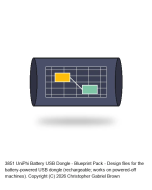
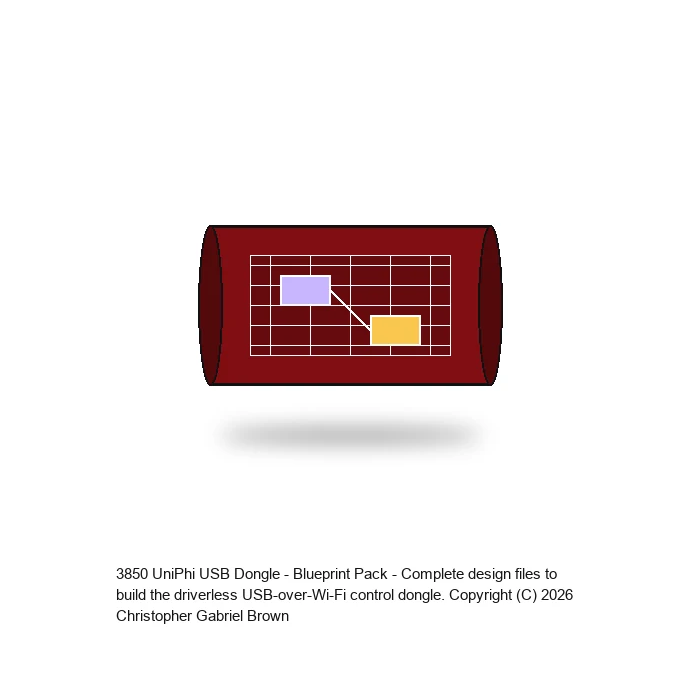
UniPhi USB Dongle - Blueprint Pack
Make a PC’s keyboard and mouse wireless. Complete design files for a USB adapter the PC trusts as a native keyboard — no driver, no install — driven over Wi-Fi. Wired in, wireless out. Patent pending — U.S. Patent Application No. 19/717,706 (utility; filed June 24, 2026, 6:58:31 a.m. ET).
© CRI-ONE. All rights reserved. Patents issued and pending. Unauthorized reproduction of the underlying designs is prohibited.
Extended catalog & full narrative — UniPhi USB Dongle - Blueprint Pack
The extended dossier appended from the 2026-08-05 catalog snapshot. Prices in the body copy have been stripped; the live-store price on this page is the authoritative figure. Images have been omitted.
UniPhi makes wired things wireless. Bolt a thumb-sized adapter onto anything that has a cord — a keyboard, a monitor, a bench instrument, a CNC mill, a whole PC — and it joins your Wi-Fi. The device itself never changes and needs no drivers; the wire stays, the cord goes. Once a device is wireless, one console can drive a roomful from a single pointer — but that’s the bonus. Turning the wired thing wireless is the product.
The little stick that turns any PC into a machine you can drive from across the room — with nothing to install on the machine itself.
In plain English
This is the essential UniPhi adapter. Build the dongle from the blueprint, plug it into any computer’s USB port, and that computer immediately believes it has a normal keyboard and mouse attached. There is no driver to install. There is no service to allow. There is no firewall to open. The PC just sees a USB keyboard.
The dongle, however, is listening to the UniPhi Software running on your PC. So when you type at your keyboard while your cursor is over that machine, the dongle hands those keystrokes to the target as if you were standing right in front of it.
One dongle per machine you want to drive. That is the recipe.
In technical terms
A USB-C, ESP32-S3-based bridge that enumerates to the target as a composite USB Human-Interface Device (boot-protocol keyboard plus mouse) and an optional Communications Device Class serial endpoint — requiring no driver or supplementary software on the target operating system. The wireless radio subscribes to the UniPhi grid fabric and translates inbound HID command packets into native HID reports presented to the target through the same USB port that powers the dongle.
- ESP32-S3-MINI-1 (native USB device controller + Wi-Fi 802.11 b/g/n 2.4 GHz).
- USBLC6-2 in-line ESD protection on D+/D- pair, antenna keep-out per Espressif reference design.
- USB-C UFP role declared via 5.1 kΩ CC pull-downs.
- 24AA02E48 EEPROM with factory-burned EUI-48 for grid-side unique identification.
- AP2112K LDO 5 V to 3.3 V regulation, single-layer power tree.
What is included (deliverables)
- KiCad 10 schematic with manufacturer footprints assigned (push “Update PCB from Schematic” and the ratsnest is correct).
- PCB layout specification: 18 mm × 45 mm outline, 2-layer 1.6 mm FR-4 stackup, 90 Ω USB differential-pair geometry, ESP32-S3 antenna keep-out, DRC settings.
- ESP32-S3 firmware source (USB composite HID + CDC + Wi-Fi client).
- Bill of materials with part numbers.
Ease of use, end to end
- Fabricate & assemble the board (any 2-layer prototype house).
- Flash the firmware once over USB.
- Plug it into the target’s USB port.
- Open UniPhi on your control PC and roll your cursor to that machine.
Design target
Under 50 ms input latency on a local Wi-Fi network. Performance values are design targets, not guarantees.
How to order
Email- and postal-order only — no phone, no brokers. USA-based buyers, USD only. Delivery is by encrypted email link upon payment confirmation.
- Email: crioneaka@outlook.com · crioneaka@outlook.com
- Postal: Christopher Gabriel Brown · 1341 Wellington Cove · Lawrenceville, GA 30043-5255 · United States
UniPhi is patent pending (U.S. Utility Application No. 19/717,706, filed 06/24/2026, 6:58:31 a.m. ET, inventor: Christopher Gabriel Brown). Purchase grants use of the software and design files included in this listing for the buyer’s own build — it does not transfer, assign, or license the underlying patent-pending invention. The patent and all derived rights are retained by the inventor.
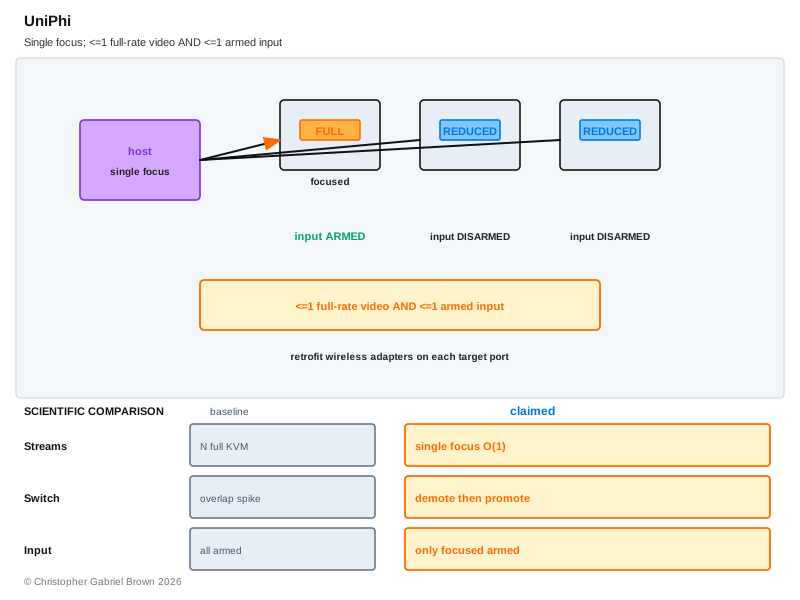
f308b96e991439e42d319928de02ab9bd44f0b5b5712150b5851bb52c68f10cd
UniPhi USB Dongle - Blueprint Pack
Publicly online since 2010 · U.S. patent applications since 2012 · inventions offered since 2014. The work of Christopher Gabriel Brown, independently documented.