UniPhi Software
The brain that runs your wired-turned-wireless devices. Once your adapters put each machine on Wi-Fi, this drives them all from one pointer — a live video wall with the bandwidth discipline of a hardware KVM, over the air. Patent pending — U.S. Patent Application No. 19/717,706 (utility; filed June 24, 2026, 6:58:31 a.m. ET).
© CRI-ONE. All rights reserved. Patents issued and pending. Unauthorized reproduction of the underlying designs is prohibited.
Extended catalog & full narrative — UniPhi Software
The extended dossier appended from the 2026-08-05 catalog snapshot. Prices in the body copy have been stripped; the live-store price on this page is the authoritative figure. Images have been omitted.
UniPhi makes wired things wireless. Bolt a thumb-sized adapter onto anything that has a cord — a keyboard, a monitor, a bench instrument, a CNC mill, a whole PC — and it joins your Wi-Fi. The device itself never changes and needs no drivers; the wire stays, the cord goes. Once a device is wireless, one console can drive a roomful from a single pointer — but that’s the bonus. Turning the wired thing wireless is the product.
One pointer. Many computers. One operator in charge of the room.
In plain English
UniPhi Software is the program that sits on your PC and lets you drive every other PC in your office, lab, or shop from your one keyboard and mouse. You see them all on screen at once. You point your cursor at the one you want, and that machine becomes the one you are typing into. Move the cursor to a different one, and now it is the one you are typing into. The other machines do not need any software installed on them, and there are no cables to run.
It is the difference between standing up and walking to each machine to do one small thing, and just rolling your cursor over to it from where you are sitting now. For a person with eight machines to manage, it is the difference between a day of small interruptions and a day of work.
In technical terms
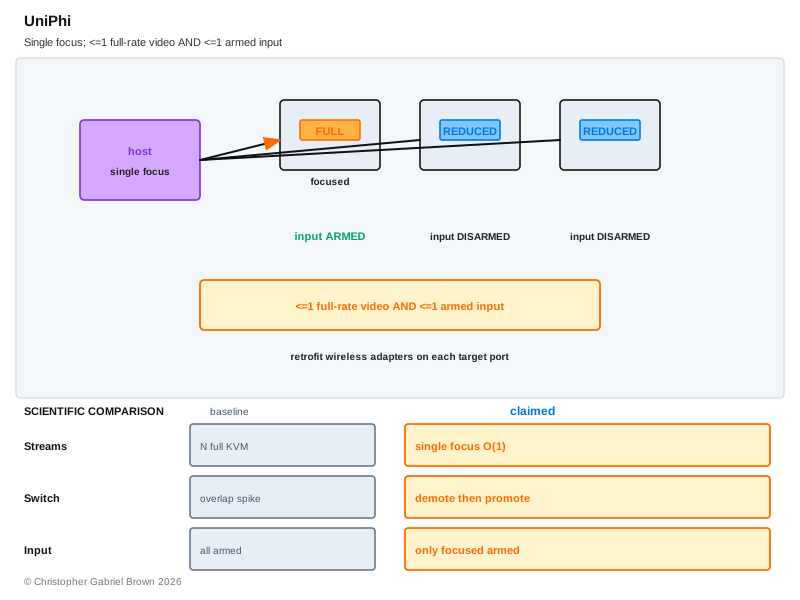
UniPhi is a Python-based control fabric for federating many discovery hubs — each representing one target computer reached through a retrofit Wi-Fi adapter (USB-HID, DisplayPort capture, serial, GPIO, etc.) — under a single global pointer token. The fabric enforces a strict grid-wide invariant: at any instant, at most one target receives full-rate video and at most one target has its keyboard/mouse injection armed. Pointer transitions atomically demote the prior target’s video to a thumbnail tier and disarm its input before promoting the new target. Aggregate full-rate video bandwidth is therefore bounded by one stream regardless of grid size.
- Windows host; PySide6 grid console with live MJPEG/H.264 stage and a tile wall of all targets.
- Adapter-agnostic command bus: capability-flagged dispatch routes a
single
Command(action, params)to whichever adapter type is appropriate (video, input, serial, audio, gcode, network/WoL). - Auto-discovery of dongles on the local Wi-Fi grid; idempotent re-pair on reconnect.
- Drives every UniPhi dongle and adapter built from the blueprint packs in this catalog.
What is included
- The full UniPhi grid console software for Windows.
- The federation runtime (fabric), simulator, configuration format, CLI, and the release-grade test harness.
- Six built-in adapter drivers: USB-HID input, video, audio, serial data, CNC g-code, and wake-on-LAN.
Design targets
- Input latency under 50 ms on a local Wi-Fi network.
- Focused video 1080p at ~30–80 ms glass-to-glass (DisplayPort dongle).
- Eight active machines on a typical Wi-Fi 6 link; larger grids work because the single-focus rule bounds bandwidth.
Performance values are design targets, not guarantees.
How to order
Email- and postal-order only — no phone, no brokers. USA-based buyers, USD only. Delivery is by encrypted email link upon payment confirmation.
- Email: crioneaka@outlook.com · crioneaka@outlook.com
- Postal: Christopher Gabriel Brown · 1341 Wellington Cove · Lawrenceville, GA 30043-5255 · United States
UniPhi is patent pending (U.S. Utility Application No. 19/717,706, filed 06/24/2026, 6:58:31 a.m. ET, inventor: Christopher Gabriel Brown). Purchase grants use of the software and design files included in this listing for the buyer’s own build — it does not transfer, assign, or license the underlying patent-pending invention. The patent and all derived rights are retained by the inventor.
d07eff68659cd869a845de480822fb85591084d7e98da8ec7ff5cb1aa26bdc51
UniPhi Software
Publicly online since 2010 · U.S. patent applications since 2012 · inventions offered since 2014. The work of Christopher Gabriel Brown, independently documented.