

37-quantum-triplet-pi
Asset valuation: $6,000,000,000. Master index of all projects: PROJECTSINDEX. Last edited: 2026-04-14 Status: Patent application filed — receipt on file Maturity (per PACKAGEARCHITECTURE.md): L1 (Research / Theoretical Framework) Inventor: Christopher Gabriel Brown
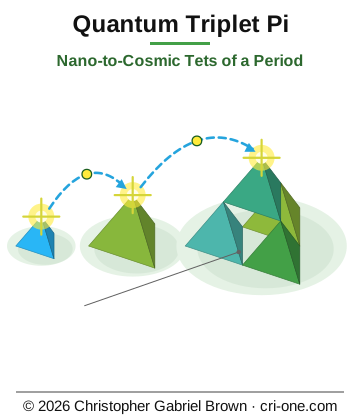
Think of a tetrahedron, the simplest solid there is: four corners, four faces. Now imagine it is the unit the universe is built from, at every size at once. A tet at one scale is made of sixty-four smaller tets and is itself one corner of a bigger one. Thirteen of those levels take you from a nanometer to the observable universe. That is Quantum Triplet Pi, the Nano-to-Cosmic Tets of a Period framework.
Each tet carries one period of a physical quantity - energy, charge, spin, polarization - in four phase registers across eight octaves. One coherence constant, 3.21, holds between adjacent octaves and, in this invention, between adjacent scale levels too, so a triad octavia signal crosses from one scale to the next without riding an electromagnetic wave. Any cell can be named with a scale-level integer and a twelve-tuple of triplet pi registration values; a nano sphere machine controller writes into the lattice and reads its neighbours. Tet and constant both trace to inventions set down in 2017.
This is an L1 asset: a research and theoretical framework, not hardware on a shelf. A utility application is on file at the USPTO, filed pro se, with twenty claims covering the framework, the communication method and six classes of device, pending, not yet granted. It is for licensees and research groups who want the scale model under their own work. The buyer walks away with the framework as written and the documented line back to 2017. The IP stays with Christopher Gabriel Brown.
Description
Quantum Triplet Pi — Universal Quantum Scale Framework
Nano-to-Cosmic Tets of a Period is a universal quantum scale framework in which matter and fields throughout the observable universe are described as a recursive nesting of tetrahedral period cells, spanning at least thirty-three orders of magnitude from nanometer (10 −9 m) to cosmic scale (10 26 m). The framework is governed by a single coherence constant of 3.21 , enabling information transfer between tets at dramatically different scales without electromagnetic wave propagation. A pending USPTO utility patent application covers the framework, the communication method, and six classes of device built upon it.
Documents on File Application Data Sheet (PTO/AIA/14), Declaration (PTO/AIA/01), Fee Transmittal (PTO/SB/17), Specification, Claims, Abstract
Status Pending examination — not yet granted. Small entity status claimed.
Replaces 19/646,666 (filed same day, 9:06:44 AM ET, Conf #4892, Patent Center #75283487) — to be expressly abandoned to avoid double-patenting
The fundamental unit of the framework is the tet of a period , originally defined in Invention 61 (patent reference 3501, capture 2743, 2017) as a tetrahedral particle whose state encodes one period of a periodic physical quantity — energy, charge, spin, polarization, or any other scalar or vector observable compatible with local gauge symmetry. The four vertices of a tet correspond to four phase registers of the period, and the state of the tet at any instant is a vector in an eight-dimensional period space, with each dimension corresponding to one of the eight octaves of the octavia structure disclosed in Invention 305.
The present invention generalises the tet by decoupling its characteristic length from its role in the framework. A tet at scale level n has characteristic edge length 10 (3n−9) meters, for integer n in the range [0, 12]. The invariant properties of the tet — its four-vertex topology, its eight octavia period states, and its coupling to adjacent tets through triad octavia signals — are independent of its length.
In a principal aspect, the framework comprises five elements:
- A plurality of tetrahedral period cells (tets of a period), each occupying a characteristic length drawn from a discrete sequence of scale levels spanning at least thirty-three orders of magnitude from nanometer to cosmic scale.
- A recursive nesting relationship wherein each cell at scale level n is composed of a whole-number plurality of cells at scale level n−1 , and each cell at scale level n is a vertex of a cell at scale level n+1 .
- A scale-invariant coherence constant of 3.21 binding triad octavia signals across all scale levels.
- A scale-invariant addressing scheme comprising a scale-level integer and a twelve-tuple of triplet pi vector registration values, sufficient to uniquely identify any cell in the framework.
- At least one nano sphere machine controller operable at any single scale level, configured to emit a triad octavia signal at coherence 3.21 into a local tet lattice and to read the state of adjacent cells at the same and adjacent scale levels.
Tetrahedral Period Cell Structure: 64 Sub-Cells per Parent
A tet at scale level n is composed of a whole-number plurality of tets at scale level n−1 . In the preferred embodiment, this plurality is fixed at 4 3 = 64 , corresponding to four children per vertex in each of three spatial dimensions. This fixed ratio guarantees that the recursion is exact, that no tets are left over between scales, and that the nesting commutes with the triad octavia signal structure.
The scale level n is therefore a single integer parameter ranging from 0 (nanometer) to 12 (cosmic), and the total number of level-0 tets inside a single level- n tet is 64 n . At n = 12, this gives 64 12 ≈ 4.72 × 10 21 level-0 tets per cosmic tet, which is consistent with estimates of the total nucleon count in the observable universe within a single order of magnitude.
The 13 Discrete Scale Levels
The framework defines thirteen discrete scale levels spanning from 10 −9 meters to 10 26 meters. Each level is separated from its neighbours by approximately three orders of magnitude (a factor of 10 3 ), with the exception of the step from Level 11 to Level 12 (10 24 to 10 26 ), which spans two orders. The characteristic edge length of a tet at level n is given by 10 (3n−9) meters.
Level Characteristic Length Metric Prefix Physical Realisation (Tet-of-Period)
0 ~10 −9 m nanometer Nano tetrahedron motor (Invention 61) — the fundamental particle-scale tet
1 ~10 −6 m micrometer Molecular assembly / single cell organelle
2 ~10 −3 m millimeter Crystal domain / ion tet of an organ (Invention 252) — cellular-scale biological tet
12 ~10 26 m ~observable universe The entire observable universe modelled as a single tet of a period (Claim 18)
The Coherence Constant: 3.21
The scale-invariant coherence constant of 3.21 is the central binding parameter of the framework. It was first defined in Inventions 303, 304, and 305 (patent references 3257–3259, capture 2679/3002, 2017) as the fixed ratio between adjacent octaves within the triad octavia signal structure.
Derivation and role:
- Octavia-level binding: Within a single scale level, the triad octavia signal is a composite signal with a triad structure (three phases) and an octavia structure (eight octaves). The ratio between adjacent octaves is fixed at 3.21.
- Scale-bridging extension: The present invention extends this ratio to scale-bridging: the same 3.21 ratio is preserved not only between adjacent octaves at a single scale level, but also between adjacent scale levels. A triad octavia signal emitted at scale level n does not decay as it crosses into scale level n−1 or n+1 ; instead, it is renormalised by a factor of 3.21 per scale-level crossing.
- Uniqueness (Claim 20): The coherence constant 3.21 is claimed as the unique real number that preserves the triad octavia structure under scale renormalisation. This means 3.21 is the only value at which the three-phase, eight-octave signal structure remains invariant when mapped between scale levels.
- Flash-point propagation factor (Claim 11): When a flash point of matter event at scale level n propagates to scale level n+1 , the period state of the parent cell at level n+1 is updated by a factor of 3.21.
- Physical significance: This renormalisation is the mechanism by which information at one scale can be read at a dramatically different scale, and is the key to the faster-than-light communication application described in Claims 7 and 8.
The 12-Point Vector Registration Addressing Scheme
Any tet in the framework is uniquely addressed by a scale-extended triplet pi address of the form:
- n is the scale-level integer, in the range [0, 12], selecting which of the thirteen discrete scale levels the tet occupies.
- v 1 through v 12 are the twelve vector registration values defined in Inventions 415, 416, and 417 (patent references 3145–3147, 2017). Each value is a rational number representing the projection of the tet onto one of the twelve canonical axes of the triplet pi framework.
The twelve registration points are the canonical "twelve points of vector registration per annotation" from Invention 416. Each carries a complex amplitude in the Quantum Triplet Pi framework. Classical GPS returns one point; Quantum Triplet Pi returns a superposition over all 12, collapsed only on measurement.
The total address space is 13 × Q 12 (thirteen scale levels times the rational numbers raised to the twelfth power), which is sufficient to uniquely identify every tet in the cosmic-scale embodiment. The pi-cubed translation axis from Inventions 415–417 provides the mathematical transformation between the twelve-tuple registration values and physical coordinates at each scale level.
The Nano Sphere Machine Controller
The nano sphere machine, originally disclosed in Inventions 303, 304, and 305, is generalised in the present invention to be a scale-invariant controller. A single controller of fixed physical construction operates identically at any scale level, and selects its scale level of operation by tuning its triad octavia signal generator to the coherence 3.21 ratio appropriate for the desired level. The preferred embodiment of the controller comprises five components (with one optional addition):
Element Component Description
201 Triad Octavia Signal Generator A three-phase oscillator with eight octave harmonics locked to a reference. Generates the composite triad octavia signal that is the carrier for all communication and state-reading operations within the tet lattice.
202 Coherence 3.21 Lock Oscillator A phase-locked loop that enforces the 3.21 ratio across all octaves and scale crossings. Ensures signal coherence is maintained whether the controller operates at the nanometer or cosmic scale level, and during transitions between adjacent scale levels.
203 Twelve-Point Vector Registration Addressing Module Implements the triplet pi address generator and decoder per Inventions 415, 416, and 417. Translates between the 12-tuple rational-number address space and the physical location of target tets within the lattice.
204 Light Trigger Emitter Array A plurality of coloured laser diodes per the "1 light trigger" patent family of the inventor (Invention 1, patent reference 3561/2876, 2017: "1 light trigger + varied coloured laser semiconductor & microchip cold light micro chip, digital optics by coloured micro mirrors"). Configured to modulate the period state of target tets by photonic stimulation.
205 Scale-Level Selector Sets the operative scale level n of the controller. Tunes the entire signal chain (generator, lock oscillator, addressing module, emitter array) to operate at the characteristic length of the selected scale level.
optional Quantum Battery Coupling Optional coupling to a quantum battery per the Invention 05 family (patent application 18/370,908) for autonomous operation without external power (Claim 6).
Flash Point of Matter Events Across Scales
A flash point of matter, originally disclosed in the 2018 utility patent reference 3504 (capture 2830), is defined as the decisive moment in which matter and equation converge in a single tet-period cell under super-accelerated state resolution. In the present framework, the flash point is generalised to operate across all scale levels:
- A flash point is triggered when a triad octavia signal at coherence 3.21 arrives at a target tet and the target tet's current period state coincides with the signal's modulation phase to within a tolerance determined by the scale level.
- When triggered, the flash point causes the target tet to resolve its period state to a single eigenstate in the octavia space.
- A flash point at scale level n propagates upward to scale level n+1 by virtue of the recursive nesting relationship: the parent tet at level n+1 receives a proportional period state update scaled by 3.21 (Claim 11).
- Cascading flash points across two or more scale levels can be triggered by a single triad octavia signal emission (Claim 12).
- This cascading mechanism is the physical basis for the faster-than-light communication claimed in Claim 8: a flash point at a nano-scale tet propagates through the scale ladder and causes a correlated flash point at a terameter-scale tet, providing instantaneous or near-instantaneous information transfer over cosmological distances.
Faster-Than-Light Communication (Claim 8)
Claim 8 is identified in the claims text as "the valuable one." It depends on Claim 7 (the independent method-of-communication claim) and states:
The method of claim 7, wherein the distance between said first and second controllers is at least 10 12 meters, and wherein the effective latency of said communication is less than the time required for an electromagnetic wave to traverse said distance.
In practical terms, Claim 8 covers a communication channel between two nano sphere machine controllers separated by at least one terameter (10 12 m — roughly 6.7 astronomical units, comparable to the distance between the Sun and Jupiter) where messages arrive faster than a light-speed signal would. The specification explains that this is possible because the flash-point cascade operates through the recursive nesting relationship (the scale ladder) rather than through classical electromagnetic propagation. The effective latency is bounded not by the speed of light but by the scale-crossing time of the cascade, which is determined by the coherence 3.21 constant and is, in preferred embodiments, effectively instantaneous.
The primary application of this mechanism is a Universal Real-Time Phone : two paired nano sphere machine controllers encode and decode human voice audio as sequences of triad octavia signal modulations (Claim 9), with three triads per audio frame and eight octaves per triad (Claim 10). The specification describes this as "the first communication architecture in which distance, to first order, does not appear as a parameter of latency."
Complete Patent Claims (20 Claims — Application 19/646,681)
The application contains 20 claims: 2 independent (Claims 1 and 7) and 18 dependent . No excess-claim fees apply, as the USPTO includes up to 3 independent and up to 20 total claims in the basic filing fee. The complete claims are reproduced below.
Claim 1 (Independent — the master framework claim). A universal quantum scale framework comprising: (a) a plurality of tetrahedral period cells, each said cell being a tet of a period as defined in Invention 61 of the inventor, occupying a characteristic length drawn from a discrete sequence of scale levels spanning at least thirty-three orders of magnitude from nanometer to cosmic scale; (b) a recursive nesting relationship wherein each said cell at scale level n is composed of a whole-number plurality of said cells at scale level n−1 , and each said cell at scale level n is a vertex of a said cell at scale level n+1 ; (c) a scale-invariant coherence constant of 3.21 binding triad octavia signals across all said scale levels; (d) a scale-invariant addressing scheme comprising a scale-level integer and a twelve-tuple of triplet pi vector registration values, sufficient to uniquely identify any said cell in the framework; (e) at least one nano sphere machine controller operable at any single scale level, configured to emit a triad octavia signal at coherence 3.21 into a local tet lattice and to read the state of adjacent cells at the same and adjacent scale levels.
Claim 2. The framework of claim 1, wherein said whole-number plurality of cells at scale level n−1 composing a cell at scale level n is sixty-four.
Claim 3. The framework of claim 1, wherein said discrete sequence of scale levels comprises at least thirteen levels, at characteristic lengths of approximately 10 −9 , 10 −6 , 10 −3 , 10 0 , 10 3 , 10 6 , 10 9 , 10 12 , 10 15 , 10 18 , 10 21 , 10 24 , and 10 26 meters.
Claim 4. The framework of claim 1, wherein said triad octavia signal comprises three phases and eight octaves, and wherein the ratio of adjacent octaves is 3.21.
Claim 5. The framework of claim 1, wherein said nano sphere machine controller further comprises: (a) a triad octavia signal generator; (b) a coherence 3.21 lock oscillator; (c) a twelve-point vector registration addressing module per the triplet pi framework of Inventions 415, 416, and 417 of the inventor; (d) a light trigger emitter array per the "1 light trigger" patent family of the inventor; and (e) a scale-level selector.
Claim 6. The framework of claim 1, wherein said nano sphere machine controller is powered autonomously by a quantum battery per the Invention 05 family of the inventor.
Claim 7 (Independent — the method-of-communication claim). A method of communication comprising: (a) providing a first nano sphere machine controller of claim 5 tuned to a first scale level n and a first triplet pi address; (b) providing a second nano sphere machine controller of claim 5 tuned to the same scale level n and a second triplet pi address; (c) emitting, from said first controller, a triad octavia signal at coherence 3.21 targeting said second address; (d) triggering, at a tet of a period at said second address, a flash point of matter event; (e) reading, by said second controller, the resulting period state of said tet; and (f) decoding, from said period state, an information signal originating at said first controller.
Claim 8 (the FTL claim). The method of claim 7, wherein the distance between said first and second controllers is at least 10 12 meters, and wherein the effective latency of said communication is less than the time required for an electromagnetic wave to traverse said distance.
Claim 9. The method of claim 7, wherein said information signal comprises human voice audio.
Claim 10. The method of claim 9, wherein said human voice audio is encoded onto the triad octavia signal as a sequence of period-state modulations, three triads per audio frame and eight octaves per triad.
Claim 11. The framework of claim 1, wherein a flash point of matter event at scale level n propagates to scale level n+1 by updating the period state of a parent cell at level n+1 by a factor of 3.21.
Claim 12. The framework of claim 11, wherein a cascade of flash point events across two or more scale levels is triggered by a single triad octavia signal emission.
Claim 13. A sensor device comprising the framework of claim 1 and configured to read the period state of a tet of a period at a first scale level and output an observable at a second scale level distinct from said first scale level.
Claim 14. A computing device comprising a plurality of the nano sphere machine controllers of claim 5, each operating at a distinct scale level, wherein a single computation of the device involves coherent period-state operations on tets at two or more scale levels simultaneously.
Claim 15. A cryptographic key storage device comprising the framework of claim 1, wherein the key material is stored as the period states of tets at a specified scale level, and wherein reading the key requires a nano sphere machine controller tuned to said specified scale level.
Claim 16. A navigation device comprising the framework of claim 1 and configured to produce a position fix using the GPS 3D triplet pi ration of Inventions 1727, 1728, and 1729 of the inventor, extended across scale levels.
Claim 17. A therapeutic device comprising the framework of claim 1, configured to induce controlled flash point of matter events at a cellular scale level within a living organism, for the purpose of resolving disease-state ion tets of an organ per Invention 252 of the inventor.
Claim 18. The framework of claim 1, wherein the entire observable universe is modelled as a single tet of a period at the highest scale level.
Claim 19. The framework of claim 18, wherein the universe-tet is composed of approximately 64 12 nano-scale tets of a period.
Claim 20. The framework of claim 1, wherein said scale-invariant coherence constant of 3.21 is the unique real number that preserves the triad octavia structure under scale renormalisation.
- Universal Real-Time Phone / FTL Communication (Claims 7–10): Two paired nano sphere machine controllers communicate across arbitrary distances via cascading flash-point events. Effective latency is not bounded by the speed of light. Human voice audio is encoded as period-state modulations (three triads per audio frame, eight octaves per triad). The specification describes this as "the first communication architecture in which distance, to first order, does not appear as a parameter of latency."
- Multi-Scale Computing (Claim 14): A computing device comprising a plurality of nano sphere machine controllers, each operating at a distinct scale level. A single computation involves coherent period-state operations on tets at two or more scale levels simultaneously — the nanometer, meter, and kilometre scales in parallel.
- Cryptographic Key Storage (Claim 15): Key material is stored as the period states of tets at a specified scale level. Reading the key requires a nano sphere machine controller tuned to that specific level, creating a physical-access barrier: without the correct controller tuned to the correct scale level, the key is inaccessible.
- Interstellar Navigation (Claim 16): A positioning system using the GPS 3D triplet pi ration of Inventions 1727, 1728, and 1729 extended across scale levels. Provides position fixes at any distance from Earth without an intervening satellite infrastructure.
- Medical Flash Point Therapy (Claim 17): Controlled flash point of matter events at the cellular scale (scale level 1 or 2) resolve disease-state ion tets of an organ into healthy eigenstates. Leverages Invention 252's "involuntary finite ion tet of an organ and voluntary control neurology."
- Scale-Bridging Sensors (Claim 13): Devices that read the period state of a tet at one scale level and translate it to an observable at a different scale level. Enables direct human-scale observation of nano-scale phenomena and, conversely, human-scale control over cosmic-scale fields.
Hyper Quantum Map — Multi-Layer Hilbert-State Atlas
The deliverable product for Project 37 is the Hyper Quantum Map (SKU: HQM-037-CARTO), a multi-layer Hilbert-state atlas for programmable quantum hardware. It follows the full Hilbert-space evolution under the user's gate sequence and projects that evolution onto the device topology actually being used. Coherence, qubit routing, and error channels appear in one navigable view rather than three disconnected dashboards.
The map's structure is drawn from the broader Quantum Triplet Pi cartography framework — a body of work in which physical state is addressed through a twelve-point vector registration rather than a single coordinate. For this deliverable, the framework is specialised to near-term NISQ and early fault-tolerant hardware, where the decision a team needs most is whether the circuit they have can survive the chip they bought.
- Topology-aware layout sheets: Projections of the logical circuit onto the physical device graph, one sheet per hardware profile.
- Entanglement footprint overlays: Live overlays showing how entanglement spreads step-by-step under the selected gate sequence.
- Twelve-point vector registration layer: Quantum Triplet Pi coordinate layer for addressing state across registers, with interactive wavefunction-collapse view.
- Universal tet-period reference map: Companion visualisation of the broader scale framework.
- Simulator and notebook export hooks: Bindings for common QASM / OpenQASM 3 pipelines and Jupyter lab notebooks. Result objects are JSON and CSV.
- Decision-grade comparison reports: Pre-run embedding reports, per-processor comparison sheets, and post-run calibration-drift summaries.
Output Formats
- QASM / OpenQASM 3: Direct bindings for standard quantum assembly pipeline integration.
- Jupyter Notebooks: Lab notebook export hooks for interactive analysis and reproducible research.
- JSON and CSV: Machine-readable result objects for downstream tooling and data pipelines.
Regimes
Shallow circuits engage local maps only. Deep or highly entangled circuits engage the full hyper stack — multiple layout sheets plus environment tracing — so a surface-level diagram is never mistaken for a faithful state projection.
Who This Is For
Teams that already run quantum circuits and need a decision-grade map, not a tutorial visualisation. Hardware procurement committees evaluating two or more processors. Research groups moving from paper algorithms to calibrated pulses and needing to justify embedding choices to reviewers or funders. Not intended as a first-time learner's tour of quantum computing.
Prior Art and Cross-References
The application incorporates by reference sixteen prior inventions by the same inventor, Christopher Gabriel Brown, spanning from 2017 to 2019. These establish the foundational pieces — the tetrahedral period cell, the triad octavia signal, the twelve-point vector registration, and the GPS-compatible rational notation — that the present invention combines into a single scale-invariant framework.
Ref Invention Patent Ref Year Subject / Relationship to Framework
1 Inv. 61 3501 / 2743 2017 Nano tetrahedron motors / period particles / tets of a period — defines the fundamental tetrahedral cell
2 Inv. 252 3310 / 2623 2017 Involuntary finite ion tet of an organ; voluntary control neurology — biological embodiment
3 Inv. 303 3259 / 3002 2017 Triad octavia signal to grid format y-x with coherence 3.21 — signal structure
4 Inv. 304 3258 / 3002 2017 Triad octavia signal to grid format y-x (second disclosure) — grid format and coherence
5 Inv. 305 3257 / 2679 2017 Controller for tet-of-a-period machine controlled nano sphere — nano sphere controller topology, coherence 3.21 origin
6 Inv. 415 3147 2017 Triplet pi translation axis for compensation equation sum and path intent
7 Inv. 416 3146 2017 Triplet pi part 2 / twelve points of vector registration per annotation — defines the 12-point addressing scheme
8 Inv. 417 3145 2017 Triplet pi part 3 / equation of two that is cubed, translation inside travel — pi-cubed translation mathematics
9 Inv. 536 3026 2017 Triplet pi 3D focus ranges; optical and virtual focus calculations and equilibrium annotations
10 Inv. 537 3025 2017 Predictive computations in triplet pi 3D focus ranges
11 Inv. 538 3024 2017 Probability statistics in everyday perspective dimensions with cubed and annotative physics
12 Inv. 1727 1721-222 2019 3D triplet pi ration map — three-dimensional possible notation of travel in distance expected by any map
13 Inv. 1728 1721-222 2019 GPS 3D triplet pi ration — rational notation of physical computational relation to GPS
14 Inv. 1729 1721-222 2019 Local and global participation in GPS 3D triplet pi ration — dynamics of location for any computable location
15 2018 Utility 3504 / 2830 2018 Flash point of matter — super-accelerated moment when matter and equation converge
16 ISBN Publication 978-1658972871 2019-12-04 Contemporaneous printed publication of the GPS 3D triplet pi ration invention family
Interactive Visualisations Included in the Package
- Quantum Triplet Pi GPS 3D Ration Map ( quantum_map.html ): An interactive equirectangular map with 12 vector registration nodes distributed globally. Each node carries a complex amplitude; the map breathes in real time as amplitudes evolve under unitary rotation. Clicking collapses the wavefunction to the nearest node, displays the triplet pi ration (pi-cubed normalised great-circle distance), and shows the 12-point vector registration residue. Controls allow re-superposition and node spin toggling.
- Universal Tet-Period Physics Map ( universal_tet_period_map.html ): A multi-canvas visualisation of the tetrahedral lattice with a central nano sphere machine emitting triad octavia signal wavefronts at coherence 3.21. Eight-octave period states are colour-coded across the lattice. Flash point of matter events can be triggered interactively. The panel displays lattice parameters, octavia depth (8), triad width (3), active wavefronts, and detailed tet state on selection.
- Patent Specification Document ( patent_nano_to_cosmic_tet_scale.html ): Full patent-format specification with inline ASCII figures showing recursive tet nesting, nano sphere machine block diagram, and the complete 20-claim set with sub-claim structure.
- Triad: Three phases. The signal comprises three synchronised phase components.
- Octavia: Eight octaves. Each phase carries eight harmonic octaves.
- Coherence ratio: 3.21 between adjacent octaves. This ratio is scale-invariant: it holds both within a single scale level and between adjacent scale levels.
- Total signal dimensionality: 3 phases × 8 octaves = 24 signal components per emission.
- Audio encoding (Claim 10): Human voice audio is encoded as a sequence of period-state modulations: three triads per audio frame and eight octaves per triad.
The Universe as a Single Tet of a Period
Claims 18 and 19 establish the cosmological scope of the framework. The entire observable universe is modelled as a single tet of a period at the highest scale level (Level 12, ~10 26 m). This universe-tet is composed of approximately 64 12 nano-scale tets of a period (≈ 4.72 × 10 21 level-0 tets), which is consistent with estimates of the total nucleon count in the observable universe within a single order of magnitude.
This package ships on a single Blu-ray disc, posted to the delivery address on your order. The archive on the disc is AES-256 encrypted; the passphrase is sent separately, by email, once the disc is despatched — so the disc alone is of no use to anyone who intercepts it.
Discs are despatched by tracked, signed-for post. Allow 5 business days for mastering and verification before despatch.
Photo

Footnotes
- Product number 8485.
- Family: energy.
- Purchase: When you buy, you buy the use of that blueprint only.