
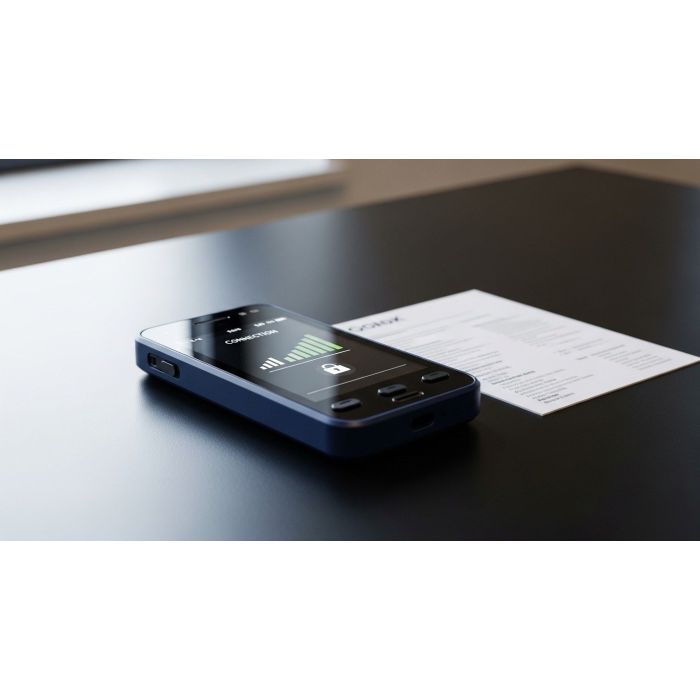
20-newstar-cell
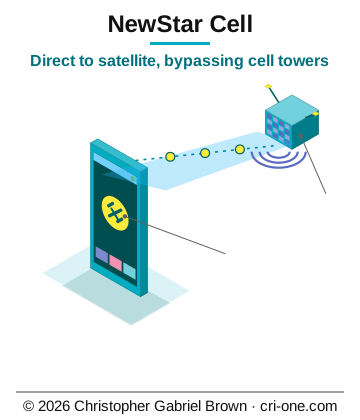
Asset valuation: $1,600,000,000. Master index of all projects: PROJECTSINDEX. Last edited: 2026-05-02 Status: Project package with firmware, prototype, and product-page content Maturity (per PACKAGEARCHITECTURE.md): L1 (Research / In Development)
Imagine one phone that is three phones. In the morning it is a school phone: a curriculum launcher, a focus timer, a homework tracker, a browser filtered to educational sites, and a parent or teacher who can lock it there. At work it is a business phone: encrypted calls, fingerprint-authenticated messaging, remote wipe. In the evening it is a play phone: games, streaming, satellite TV, smart-home control. A fingerprint and a swipe move you between the three, each with its own home screen, app permissions and network policy. Underneath, the NewStar Cell talks straight to the NCS-19 satellite, bypassing cell towers, with one-touch connectivity in under six seconds and traffic encrypted with AES-256-GCM or quantum key distribution. No ads, no tracking, no telemetry, no user data sold. Privacy is the product, not the user.
What exists today is pre-production: a complete hardware specification around an eight-core ARM64 processor, a working UI prototype, and five firmware modules in Python, written to port to C on ARM and tested against a CAN-bus-level satellite simulator, all 114 tests passing. No handset has been manufactured yet; this is development work, and it says so.
It is for a handset maker, a school district, an enterprise buyer or a licensee who wants privacy built in rather than bolted on. The inventor, Christopher Gabriel Brown, keeps the IP - thirty-four USPTO applications and 1,755 copyrighted inventions - and the buyer walks away with the firmware, the hardware specification, the prototype and the satellite protocol, ready to carry into hardware.
Description
Copyright: © 2017–2026 Christopher Gabriel Brown. All rights reserved.
Patents: 34 USPTO patent applications filed (2012–2025). Key filings: 19/177,547 (04/12/2025), 19/031,884 (01/18/2025), 18/650,137 (04/30/2024), 17/687,656 (03/06/2022), 15/825,059 (11/28/2017). Invention catalog: 1,755 copyrighted inventions; 80+ directly phone-relevant.
Status: Pre-production — firmware complete (114/114 tests pass), hardware specification complete, interactive UI prototype working, satellite interface protocol defined and tested against simulator. No physical phone hardware manufactured yet.
Overview
NewStar Cell is a tri-mode cellular phone running Windows (full desktop-class OS with responsive design) that connects directly to the NCS-19 Communications Satellite, bypassing cell towers entirely. It operates in three distinct modes — School, Business, and Play — switchable via fingerprint plus PIN or swipe gesture. The phone achieves one-touch satellite connectivity in under six seconds, encrypts all traffic with AES-256-GCM or quantum key distribution (QKD + AES-256), and runs a zero-data-sharing architecture by design: no ads, no tracking, no telemetry, no user data sold to third parties. Privacy is the product, not the user.
The phone’s firmware stack is implemented in Python (ready to port to C/ARM), fully tested against a CAN-bus-level NCS-19 satellite simulator, and encompasses five modules totalling approximately 2,900 lines of code across the firmware and support files. All 114 tests pass with zero failures, exchanging 148 CAN frames in 0.01 seconds.
Tri-Mode System
Users switch between modes via a mode selector (fingerprint + swipe gesture or PIN). Each mode has its own home screen layout, app permissions (whitelist/blacklist), network policies, notification rules, and visual theme. A persistent colour bar at the top of the screen indicates the active mode: Blue for School, Red for Business, Green for Play. Quick switch uses a swipe from the top-right corner plus fingerprint; admin or parent can lock the phone to a single mode; scheduled auto-switch configures mode changes based on time of day.
Aspect School Mode Business Mode Play Mode
Purpose Locked-down educational environment Enterprise-grade encrypted communications Full entertainment and social media access
NCS-19 Service Type PUBLIC_ENCRYPTED (0x03) GOVERNMENT_ENCRYPTED (0x01) BROADBAND_INTERNET (0x04)
Key Inventions #1053 (curriculum launcher), #108 (video conferencing), #1059 (cloud backup) #1010, #1012 (encrypted service), #1093 (fingerprint-proof messaging), #1046 (browser encryption), #1045 (do-not-share) #101, #102 (satellite TV), #1082, #1083 (smart home), #1081 (plug-and-play WiFi)
Target Market K–12 schools, parents, school districts Government, military, enterprise, legal, medical General consumer
School Mode Features (Invention #1053)
- Curriculum-based app launcher — subject-organised app grid (Math, Science, English, etc.)
- Focus timer — Pomodoro-style study timer with break alerts
- Note-taking with handwriting, typing, voice notes, and OCR (Invention #1070)
- Scientific and graphing calculator
- Research browser — filtered to educational sites only
- Homework tracker with due dates and submission
- Video conferencing for remote classes (Invention #108)
- Cloud sync — auto-backup schoolwork (Invention #1059)
- Offline dictionary and thesaurus
- E-book reader with highlighting and annotations
- Teacher/admin remote management: remote lock, app whitelist, optional screen monitoring, assignment push, usage reports, content filter
- Blocked in School Mode: social media, games (except educational), entertainment streaming, app store (unless admin-approved), camera (configurable by admin)
Business Mode Features (Inventions #1010, #1012)
- End-to-end encrypted voice calls (Inventions #1010, #1012)
- Fingerprint-authenticated encrypted messaging (Invention #1093)
- Multi-party video/voice conferencing (Inventions #108, #109)
- Multi-channel communications — voice, data, screen, camera simultaneously (Invention #112)
- Satellite fallback when cell towers unavailable (Inventions #101, #102)
- Business analytics: cost tracking, expense reports, asset values (Invention #1055)
- Bar code scanner for inventory management (Invention #1114)
- Cloud routing for optimised data paths (Invention #1051)
- Virtual data centre design and forecast software (Invention #1052)
- Manufacturing cost and turnaround planner (Invention #1054)
- User-controlled secure browser sessions (Invention #1046)
- Do-not-share consumer information toggle (Invention #1045)
- Built-in always-on VPN option
- Remote wipe capability
- AI assistants: trend analyser (#1047), product formulator (#1048), account manager bot (#1049), feedback collector (#1050)
Play Mode Features
- Full gaming with GPU acceleration
- Video and music streaming apps unlocked
- Direct satellite TV reception (Inventions #101, #102)
- Camera suite with photo/video, filters, and editing
- Basic music creation tools
- All social media platforms unlocked
- Smart home control: lights, sound, TV, internet (Invention #1082); room-by-room config (Invention #1083); plug-and-play WiFi (Invention #1081)
Cross-Mode Features (Always Available)
- Phone calls and SMS/text in all modes
- Emergency SOS — one-button alert, hardware distress chip (Invention #1087)
- Emergency connection without internet (Invention #1088)
- Domestic abuse / mental health counselor chat app (Invention #1089)
- GPS/maps navigation
- System settings, battery monitor, mode switcher
Processor ARM64 (Snapdragon 8cx Gen 3+ class or custom), 8-core (4 performance + 4 efficiency), up to 3.0 GHz, 4 nm or 3 nm process node, integrated Adreno 740+ class GPU, NPU AI accelerator #1034 (multi-layered chip), #1033 (nano layer pressing), #1032 (vertical chip stilts), #1107/#1108 (software-driven CPU), #1060 (programmable chip), #1 (light trigger laser semiconductor), #1021 (rhodium bedding etching)
RAM 8 GB / 16 GB LPDDR5X, 8533 Mbps, soldered on motherboard using solid-state synthetic metal solder technique #1090 (solid-state synthetic metal soldered RAM)
Storage 256 GB / 512 GB / 1 TB UFS 4.0 / NVMe, above-board solid-state threading interface #1042 (solid-state threading), #1085 (phone backup chip for numbers/codes), #1086 (computer backup chip for auth codes)
Display 6.7-inch (phone) or 7.5-inch (phablet option) AMOLED with digital optics, 2K resolution (2560 × 1440) or higher, 120 Hz adaptive refresh, 10-point multi-touch capacitive, coloured micro mirror display technology, colour math algorithms for rendering, active stylus support, Gorilla Glass Victus 2 or equivalent #1 (digital optics by coloured micro mirrors, colour mathematics)
Battery Solid-state lithium silicon, 6000–7000 mAh, 3.85 V nominal, built-in generator with recycle design, self-charging capability #1026 (battery with at-will performance + built-in generator)
Charging USB-C PD 65 W fast charge, Qi2 15 W wireless, optional solar panel back, reverse charge #1000 (solar powered operations)
Thermal Liquid contact cooling, self-adjusting climate control, grounded transistors and capacitors, shock-resistant grounding #1000 (outdoor chassis), #1001 (climate control)
5G Modem Sub-6 GHz + mmWave, 4G LTE fallback bands —
Satellite Direct-to-satellite connectivity, 98% uptime target, cell tower franchise re-seller capability #101, #102 (satellite phone), #1041 (cell tower franchise)
Radio Comms Alpha channel specified focused radio communications (hardware + software + encrypted software) #1173, #1174, #1175, #1176
Cameras Rear main: 50 MP, f/1.8, OIS. Rear ultra-wide: 12 MP, f/2.2, 120-degree. Rear depth: 2 MP, f/2.4. Front: 16 MP, f/2.0. Video: 4K@60fps, 8K@30fps. Built-in OCR (#1070), bar code scanning (#1114), scribble/image search (#1065) #1070, #1114, #1065
Biometrics Under-display ultrasonic fingerprint sensor, IR-based 3D face mapping —
Speakers Stereo top + bottom firing, Hi-Res Audio certified DAC, 3× noise-cancelling microphone array —
- Top Board (Display + Touch): display driver IC, touch controller, ambient light sensor
- Main Board (SoC + Connectivity): processor/SoC, RAM (soldered), 5G/LTE modem, WiFi/BT module, satellite module, encryption module, SOS distress chip, backup chips
- Bottom Board (Power + I/O): USB-C controller, battery management IC, 65 W PD charging IC, audio codec + DAC, speaker amplifiers, camera ISP
PCB: 10–12 layer HDI, FR-4 high-Tg material, above-board solid-state threading (Invention #1042), intermittent end-state paths for input/throughput (Invention #1043).
Recommended Dock USB-C hub with HDMI 2.0, 2× USB-A 3.0, USB-C PD 65 W passthrough, Ethernet, SD reader ($40–$80)
SOS Distress Chip (Invention #1087)
- Dedicated hardware chip — not software-dependent
- Has its own small battery backup
- Can send GPS coordinates via satellite even if phone is powered off
- Activated by holding the recessed hardware SOS button for 3 seconds
- Sends to pre-programmed emergency numbers
- Works without cellular signal — uses NCS-19 satellite (Inventions #101, #102)
- Emergency connection app works without internet (Invention #1088)
- NCS-19 Emergency Services channel (ServiceType 0x07) with Global beam type for maximum coverage
- SOS channel: 1544 MHz, 200 kHz bandwidth, AES-128-GCM encryption
- Domestic abuse / mental health counselor chat app available (Invention #1089)
- Does NOT require prior satellite connection — SOS bypasses all normal connection flow
NCS-19 Satellite Phone Interface
The user presses a single button and the phone connects to NCS-19. No menus, no settings, no configuration.
- PRESS — User taps satellite icon (one touch)
- GPS LOCK — Phone gets GPS coordinates ( ACQUISITION — Phone transmits on L-band uplink to NCS-19
- BEAM STEER — NCS-19 phased array steers spot beam to phone location
- LINK LOCK — CommLinkStatus state = LOCKED (0x02)
- ENCRYPT — ENCR-001 establishes encrypted session (AES-256-GCM default)
- CONNECTED — DirectToDeviceStatus shows phone connected
- READY — All phone services route through satellite
Total time: button press to connected Connection State Machine (11 States)
The crypto pipeline supports all six NCS-19 encryption modes with real cryptographic operations. On real hardware, AES operations are offloaded to the ENCR-001 ASIC. Wire frame format: byte 0 = encryption mode (0x00–0x05), byte 1 = key ID, bytes 2–3 = ciphertext length (uint16 LE), bytes 4–15 = nonce (12 bytes, GCM standard), bytes 16–31 = authentication tag (16 bytes), byte 32+ = ciphertext (variable length). Wire overhead: +32 bytes per packet.
0x02 AES-256-GCM 256-bit Play Mode (default for all modes) Strong authenticated encryption, tamper detection
0x03 QKD + AES-256 256-bit (quantum-derived) Business Mode (maximum security) Quantum key distribution feeds AES-256-GCM; key rate 1,000 bps via QKD-001 module
0x04 FRACTIONAL 256-bit Heritage mode (Invention #244) Odd/even byte fraction division — partial encryption of interleaved data
0x05 TIMELINE 256-bit Heritage mode Time-synchronised keys with epoch-based rotation (key rotates every minute)
Tamper detection: flipping a single bit in ciphertext is caught and rejected. Tested across data sizes from 1 byte to 65,536 bytes. QKD key buffer management included: keys are consumed from the buffer and used to derive AES-256 session keys.
NCS-19 Satellite CAN Bus — All 24 CAN IDs
The NCS-19 data bus runs CAN 2.0 B at 250/500 kbit/s. The phone firmware defines all 24 CAN IDs; of these, 9 are phone-relevant (marked with asterisk) and have full encode/decode implementations with byte-exact roundtrip testing.
0x200 CommLinkStatus * Communication Payload Phone link state (IDLE → ACQUIRING → LOCKED), signal dBm, BER, active channels
0x201 BeamSteeringCommand * Communication Payload Steer beam to phone GPS location (azimuth, elevation, beam type, power)
0x202 ChannelConfig * Communication Payload Set frequency, bandwidth, encryption mode, service type for phone channel
0x203 EncryptionStatus * Communication Payload Verify encryption active, throughput (Mbps), key status, QKD availability
0x204 QKDStatus * Communication Payload Quantum key availability, key rate (bps), keys in buffer, photon error rate
0x213 DirectToDeviceStatus * Communication Payload Phone connection count, signal quality %, coverage cell ID, handoff pending flag — THE key message for NewStar
0x214 BlockchainTransaction * Communication Payload American Dollar Blockchain payment confirmation via satellite
0x300 PhasedArrayStatus * Antenna Subsystem Array element count, beam count, temperature, fault flags
0x301 BeamHopSchedule * Antenna Subsystem Time-slot allocation for phone data (slot ID, beam ID, cell ID, duration)
Phased array (satellite side) 4,096 T/R elements, up to 63 simultaneous beams, +38 dBi gain per spot beam
Services 8 types: Government, Military, Public, Broadband, Broadcast, IoT, Emergency, Blockchain
All firmware runs with zero external dependencies (Python 3.10+ standard library only). The cryptography library is optional — if installed, real AES-GCM hardware acceleration is used; without it, an HMAC-based stream cipher fallback is used (functional but not FIPS-certified). Total: approximately 2,900 lines of code, 114 tests, 0 failures.
File Lines Tests Purpose
firmware/ncs19_codec.py ~589 12 / 12 pass CAN message encoder/decoder for all 9 phone-relevant NCS-19 CAN messages. Defines all 24 CAN IDs, enumerations (LinkState, EncryptionMode, ServiceType, BeamType), dataclass message types (CommLinkStatus, BeamSteeringCommand, ChannelConfig, EncryptionStatus, QKDStatus, DirectToDeviceStatus, BlockchainTransaction, PhasedArrayStatus, BeamHopSchedule), and unified codec with byte-exact encode/decode roundtrip.
firmware/connection_fsm.py ~556 11 / 11 pass Full one-touch connection state machine: DISCONNECTED → GPS_LOCKING → GPS_LOCKED → BEAM_SEARCH → BEAM_ACQUIRED → ENCRYPTING → CONNECTED. Handles beam handoff, degraded mode, fault recovery, SOS emergency override, live mode switching while connected, timeout checks, connection metrics tracking, TX frame queue.
firmware/crypto_pipeline.py ~511 21 / 21 pass Real AES-128/256-GCM encryption pipeline. Supports all 6 NCS-19 encryption modes. Implements EncryptedPacket wire serialization, KeyMaterial management, QKD key buffer, tamper detection, fractional encryption (odd/even byte division, Invention #244), and timeline encryption (epoch-based key rotation). Tested across data sizes from 1 B to 65,536 B.
firmware/ncs19_simulator.py ~482 7 / 7 pass Simulates the NCS-19 satellite: generates realistic CAN bus responses. Handles beam acquisition, channel configuration, QKD activation, encryption engine startup, periodic status updates (100 ms cycle), beam handoff simulation, signal degradation/recovery, link fault simulation, multi-device tracking (1,200+).
firmware/test_full_stack.py ~391 63 / 63 pass End-to-end integration tests connecting phone firmware (codec + FSM + crypto) to the satellite simulator. Tests: one-touch connect for all 3 modes, real encrypted data transfer (5 messages per mode including 4 KB binary), beam handoff, signal degradation and recovery, SOS emergency override, live mode switch (School → Business → Play), clean disconnect. 148 CAN frames exchanged in 0.01 seconds.
CAN frames exchanged: 148. Execution time: 0.01 seconds. Platform: Python 3.14.2 / Windows 11.
1 Light trigger + laser semiconductor and microchip, digital optics by coloured micro mirrors, colour mathematics Core processor technology, display technology, colour rendering
100 Wireless machine adapters with personal cloud Wireless connectivity
101 Phone connect to satellite instead of cell towers — 98% uptime Core satellite phone connectivity
102 Phone communication gone satellite — cell tower alternatives Satellite network architecture
108 Conference call computer Multi-party calling, video conferencing
109 Computer phone — large smart phone book-like design, multi-channel Phone form factor + comms
1000 Outdoor chassis with solar powered operations, liquid cooling, shock resistant grounding Solar phone power, thermal management, durability
1026 Battery with at-will performance + built-in generator Self-charging solid-state battery
1034 Multi-layered processing chip — nano myriad layers Custom ARM SoC design (advanced CPU)
1044 Board stacking brackets, board-to-board ports Modular board architecture (3-board stack)
1045 Government do-not-share consumer information list Privacy protection, zero data sharing
1048 Job bot — makes assumptions from trends, formulates products AI product design assistant
1160 Re-writable chip — written to and rewritten in any language Programmable chip, firmware updates
1171 Bluetooth security with encrypted encoding Secure Bluetooth
1173–1176 Radio specified alpha channel communications (hardware, software, encrypted) Focused radio communications
Total phone-relevant inventions: 80+ (from 1,755 copyrighted inventory). Categories: Communications and Connectivity (20), Hardware / Chips / Processors (33), Battery and Power (4), Security and Encryption (8), Software and Apps (20), Display and UI (4).
USPTO Patent Applications (34 Unique Filings, 2012–2025)
- OS: Windows 11 on ARM (full desktop-class OS, responsive design), full Win32 app compatibility, Microsoft Store + sideloading
- Launcher: Tri-mode launcher as Windows shell replacement; responsive UI adapts from phone screen to desktop monitor; touch-first interface with mouse/keyboard support when docked
- Mode switching: fingerprint + PIN; per-mode app permissions and restrictions
- Always-on mode: OS “do not shut down” mode for specific programs (Invention #1068)
- Built-in apps: conference call computer (#108), emergency counselor chat (#1089), automated business cost tracker (#1055), bar code data scanner (#1114), image search by scribble (#1065), cloud backup shipping (#1059)
- AI assistants: job bot for trend analysis (#1047), product formulation (#1048), account management (#1049), feedback collection (#1050)
- Security hardware: TPM 2.0 for Windows security and BitLocker, secure enclave for encryption key storage (#1010, #1012), UEFI Secure Boot, Windows Hello (fingerprint + face)
02 docs/02_FEATURE_REQUIREMENTS.md Detailed feature tables per mode, cross-mode features, minimum specs
03 docs/03_BUSINESS_PLAN.md Market opportunity, revenue model, go-to-market, financial projections
04 docs/04_PHONE_INVENTIONS_EXTRACTED.md 80+ phone-relevant inventions extracted from 1,755 catalog entries
05 docs/05_HARDWARE_SPECIFICATION.md Board layout, SoC, memory, connectivity, battery, BOM estimate ($300–$450/unit)
06 docs/06_NCS19_PHONE_INTERFACE.md Satellite interface protocol, connection flow, frequency plan, link budget
07 docs/07_PROJECT_STATUS.md Current status and next steps
08 docs/08_FIRMWARE_TEST_REPORT.md Full test results (114 tests, 0 failures, 148 CAN frames)
- docs/ROADMAP.md — Complete 8-phase production roadmap from prototype to market launch (~36 months, $22M–$66M total investment)
- prototype/index.html — Interactive browser-based UI prototype demonstrating one-touch NCS-19 connection, tri-mode system, lock screen, satellite status display, SOS button, Windows-style taskbar, responsive design
- tools/patent_tracker.html — Interactive patent portfolio tracker: 34 USPTO applications, sortable, searchable, exportable, editable
- product-page/newstar-product.html — Product sales page
- google_patents_search_list.txt — 34 USPTO patent application numbers with context (for Google Patents search)
- 1 light trigger.txt — Master invention catalog (1,755 entries)
- 20-newstar-cell-hero.svg — Product hero image
- product-images/NewStar-Cell.png — Product image
- MANIFEST.json — Project manifest (maturity level 1: Research)
- CITATION.cff — Citation metadata
- CHANGELOG.md — Change log
- LICENSE — Commercial source licence
- PLAYBOOK.md — Project playbook
What Is in the Package
- Complete 20-newstar-cell/ source tree — every file in the directory and its sub-directories
- 5 Python firmware modules (~2,900 lines of code) with 114 passing tests
- 10 specification documents covering every aspect of the product
- Interactive UI prototype (browser-based, open in any browser)
- Patent portfolio tracker (34 USPTO applications, browser-based)
- Product sales page and hero image
- Complete production roadmap (8 phases, ~36 months)
- Master invention catalog reference (1,755 entries)
- NCS-19 satellite interface protocol with CAN bus byte-exact codec
- All six encryption modes implemented and tested (AES-128-GCM, AES-256-GCM, QKD+AES-256, Fractional, Timeline, Plaintext)
- Full satellite simulator for development and testing
- Bill of materials estimate ($300–$450 per unit at 10K volume)
- Business plan with Year 1–3 revenue projections ($3M–$5M, $15M–$30M, $65M–$115M)
- 4 payment structure options (lump sum, staged, hybrid, revenue share)
- Competitive comparison table (NewStar vs iPhone vs Samsung vs satellite phones)
- Worldwide commercialisation rights under commercial source licence
What Does NOT Exist Yet
- No physical phone hardware has been manufactured
- No ARM SoC board has been fabricated
- No satellite radio module has been integrated
- No phased array antenna chip is installed
- No encryption ASIC (ENCR-001 interface) is built
- Firmware is tested against simulator only — does not transmit RF
- No real QKD photon exchange occurs (key buffer is software-filled)
- No NCS-19 satellite is in orbit
- No manufacturing partner has been contracted
How this is delivered
This package ships on a single Blu-ray disc, posted to the delivery address on your order. The archive on the disc is AES-256 encrypted; the passphrase is sent separately, by email, once the disc is despatched — so the disc alone is of no use to anyone who intercepts it.
Discs are despatched by tracked, signed-for post. Allow 5 business days for mastering and verification before despatch.
Photo
Footnotes
- Product number 8468.
- Family: personal comms.
- Purchase: When you buy, you buy the use of that blueprint only.