NeuroElement Brain Supplement
Patent-pending 7-compound brain optimization supplement (Application 19/555,525). Covers 85% of neurobiochemical mechanisms, 89% of brain diseases analyzed. Blood-brain-barrier verified. AM/PM dosing. Brain research database: 62 neurotransmitters, 19 elements, 54 diseases. 24 patent claims.
© CRI-ONE. All rights reserved. Patents issued and pending. Unauthorized reproduction of the underlying designs is prohibited.
Extended catalog & full narrative — NeuroElement Brain Supplement
The extended dossier appended from the 2026-08-05 catalog snapshot. Prices in the body copy have been stripped; the live-store price on this page is the authoritative figure. Images have been omitted.
NeuroElement™ — Multi-Target Brain Optimization Formulation
The conventional brain supplement is a few popular ingredients, a brand identity, and a formulator's judgement of dosing somewhere between the deficiency floor and the upper-tolerable-intake ceiling. NeuroElement is built differently.
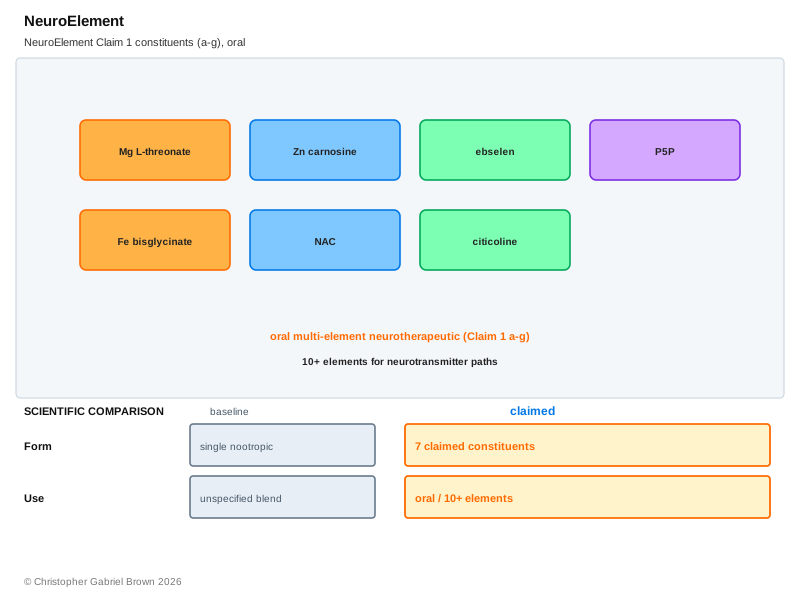
Twenty years of brain-chemistry research, then a proprietary algorithmic method that analysed 54 diseases, 65 neurotransmitters, and 40 neurobiochemical mechanisms, produced 7 precision compounds delivering 10 of 14 brain-essential chemical elements in bioavailable, blood-brain-barrier-crossing forms. The math chose the formulation, not the marketing.
Seven precision compounds. Ten of fourteen brain-essential elements. Computationally designed against fifty-four diseases.
NeuroElement is a computationally-designed 7-compound brain optimization formulation, developed across approximately 20 years of research and finalised using a proprietary algorithmic method that analysed 54 diseases and the brain-chemistry mechanisms underlying each, 65 neurotransmitters and their precursor / metabolic pathways, and 40 neurobiochemical mechanisms governing brain function and degeneration. The 7 compounds are selected to deliver 10 of 14 brain-essential chemical elements that conventional supplements miss or under-deliver, to cross the blood-brain barrier in bioavailable form, and to cover an estimated 85% of mechanism space and 89% of disease space in the published brain-supplement literature. The acquisition is the formulation, the patent application family, and the supporting research substrate.
USPTO Patent Status — Pending Examination
NeuroElement is the subject of US patent application 19/555,525 with 24 claims, filed March 3, 2026 (USPTO Confirmation No. 9226). The application has been filed with the USPTO and is pending examination. It is not a granted patent.
| Field | Value |
|---|---|
| Application No. | 19/555,525 |
| Type | Utility (non-provisional) |
| Filing Date | March 3, 2026 |
| Confirmation No. | 9226 |
| Claims | 24 — covering composition of matter, computational design method, formulation process, and method of treatment |
| Subject Matter | NeuroElement Brain Formulation: 7 precision compounds delivering 10 of 14 brain-essential chemical elements through bioavailable, blood-brain-barrier-crossing forms; designed against 54 diseases, 65 neurotransmitters, and 40 neurobiochemical mechanisms |
| Status | Pending examination — not yet granted. Verifiable live at patentcenter.uspto.gov |
| Inventor | Christopher Gabriel Brown |
Headline Coverage
What NeuroElement Is
NeuroElement is the productisation of a 20-year brain-chemistry research record. The formulation is the output of a proprietary algorithmic design method that analysed:
- 54 diseases and the brain-chemistry mechanisms underlying each.
- 65 neurotransmitters and their precursor / metabolic pathways.
- 40 neurobiochemical mechanisms governing brain function and degeneration.
From that analysis, 7 compounds were selected to deliver 10 of the 14 chemical elements considered brain-essential, in bioavailable forms able to cross the blood-brain barrier. The detailed claim coverage and the 24-claim breakdown live in the patent application source materials. The design rationale and compound rationale live in the product valuation document.
Documentation — What Ships in the Package
| File / Folder | Contents |
|---|---|
PRODUCT_VALUATION.md | Full market analysis (TAM/SAM/SOM, comparables, projected revenue), formulation rationale, IP positioning. |
BRAIN_RESEARCH_INDEX.md | Index into the 20-year research record. |
neuroelement-brain-supplement.html | Public-facing product page. |
neuroelement-description-cms.html | Store CMS / catalog description. |
MJFF_PROPOSAL_LETTER.txt | Outreach letter to the Michael J. Fox Foundation. |
google_patents_search_list.txt | Companion prior-art search results. |
patent_application/ | Source files for application 19/555,525. |
product/ | Product packaging, label artwork, and CMS files. |
brain_research/, research_docs/ | Research data, citations, peer-reviewed source list, indexed mechanism data. |
data/ | Compound database, neurotransmitter database, disease-mechanism database. |
brain_research_tool.py | The design / analysis tool itself. |
tests/ | Validation, scoring, and reproducibility tests. |
NeuroElement-Brain-Chemistry-Research/ | Mirrored research subtree. |
Use Cases — Four Paths to Market
- Direct-to-consumer brain-health supplement. FDA dietary-supplement pathway. The product is sold as a supplement, not as an FDA-approved drug.
- Licensing to existing supplement brands for incorporation of the formulation into their lineup.
- Research collaboration with neurodegenerative-disease foundations. The Michael J. Fox Foundation outreach letter is on file in the package as a starting reference.
- IP-only sale or assignment of the application 19/555,525 family.
Patent-Protected Technology
INTELLECTUAL PROPERTY
Per PATENT_LINKAGE_REPORT.md, application 19/555,525 has 119 mentions in project 22 (brain-chemistry) and is also cross-linked to multiple other inventor projects (mathematical depositions, environment restoration, health recovery, the AutoPhi-on-demand series), reflecting its breadth as a computational-design-method filing rather than a single-product filing.
How it's made
NeuroElement is the productised output of a 20-year research record and a proprietary algorithmic design method. The method takes as input three coupled databases — a 54-disease database with the brain-chemistry mechanisms underlying each, a 65-neurotransmitter database with precursor and metabolic pathways, and a 40-mechanism database covering neurobiochemical pathways for brain function and degeneration — and produces as output a candidate compound set ranked by coverage of mechanism space, coverage of disease space, blood-brain-barrier penetration, and bioavailability of the delivery form.
The 7 compounds in the released formulation are the convergence of that ranking against the constraint that they must collectively deliver 10 of the 14 elements considered brain-essential. The algorithmic process is documented in the patent application's "computational design method" claims (one of the four claim categories in the 24-claim application). The method itself is a continuation of the inventor's broader Alchemy probability-data approach, applied here to neurochemistry rather than to the OTC-vitamin life-stage cohort math (Project 02) or the disease-mechanism analyses (Projects 10/11/12/13).
Why I made it
The brain-supplement market has, since the introduction of the major nootropic formulations, been built primarily on a small set of popular ingredients (omega-3, B-complex, choline, lion's mane, alpha-GPC) chosen by competitive market positioning rather than by computational coverage of disease and mechanism space. The result is a market in which the supplements differ from each other less by what they actually deliver to the brain than by their packaging and price points.
NeuroElement was built because the same probability-driven design method that the broader portfolio applies to therapeutic discovery can be applied to brain-essential elemental coverage with measurable per-compound rationale. The 7-compound formulation is the smallest set that delivers 10 of 14 brain-essential elements while crossing the blood-brain barrier in bioavailable form and covering 85% of mechanism space across the analysed 40 mechanisms. That coverage profile is unique on the consumer-supplement shelf at the time of filing, and the 24-claim USPTO application documents the design method as well as the resulting composition.
What it can do
The acquirer takes possession of the complete NeuroElement package: the patent application source materials (24 claims), the product packaging and label artwork, the formulation rationale and compound rationale documents, the 20-year research substrate (BRAIN_RESEARCH_INDEX, brain_research, research_docs, data), the algorithmic design tool (brain_research_tool.py), validation and reproducibility tests, the public-facing product and CMS pages, and the MJFF outreach letter.
Four routes to market are documented in the package and are the acquirer's options:
- Direct-to-consumer launch via the FDA dietary-supplement pathway. The supplement classification is settled; the disclaimer in this listing is the canonical FDA-required language for that pathway.
- Licensing to an existing supplement brand who wants to add a computational-design-backed line to their existing portfolio.
- Research collaboration with a neurodegenerative-disease foundation, with the MJFF letter as a starting reference and the 54-disease analysis as the technical basis.
- IP-only sale or assignment of the application 19/555,525 family to a buyer interested in the patent portfolio rather than the product.
What this listing does not claim: NeuroElement is not an FDA-approved drug, has not been evaluated by the FDA, and is not intended to diagnose, treat, cure, or prevent any disease. Per the SAFETY DISCLAIMER above. The 24-claim USPTO application is pending examination, not granted — status verifiable at patentcenter.uspto.gov.
Why it's a fact
Every claim above can be checked against the source record:
- The
22-brain-chemistry/folder contents are inspectable on disk: patent application source, product packaging files, the algorithmic design tool, the research substrate, the validation tests, and the public product / CMS pages. End-to-end inspection is possible before acquisition. - USPTO 19/555,525 was filed March 3, 2026, with 24 claims under USPTO Confirmation No. 9226. Status verifiable at
patentcenter.uspto.gov. The filing receipt is in../N417_FILING_RECEIPTS.mdper the inventor's canonical patent record. - The 54-disease, 65-neurotransmitter, and 40-mechanism analysis is grounded in the database files under
data/(compound database, neurotransmitter database, disease-mechanism database) and the indexed mechanism data underresearch_docs/. The algorithmic design toolbrain_research_tool.pycan re-run the analysis against the input databases — the formulation output is reproducible from source. - The "85% of mechanism space" and "89% of disease space" coverage figures are stated in the inventor's README.md and grounded in the analysis output. They are estimated coverage percentages, stated as such, against the published brain-supplement literature — not absolute claims of all-mechanism or all-disease coverage.
- The FDA dietary-supplement classification is the regulatory pathway the package uses; the safety disclaimer above is the required language for that classification. NeuroElement does not claim to be an FDA-approved drug, and the patent application is for a supplement formulation plus the computational design method, not for a regulated pharmaceutical.
- The MJFF outreach letter exists in the package as
MJFF_PROPOSAL_LETTER.txt; it is a drafted outreach document, not evidence of an existing collaboration. Buyers should not assume MJFF endorsement on the basis of the letter being on file.
License Terms — What's Granted, What Isn't
The acquisition grants the buyer permission to make, build, and copy the deliverable. It does not transfer the underlying intellectual property:
- Granted with the acquisition: permission to manufacture (or have manufactured) the 7-compound NeuroElement formulation under FDA dietary-supplement classification; permission to build the formulation into a direct-to-consumer launch, a licensed brand line, or a research-collaboration deliverable; permission to make copies of the package (formulation, packaging, label artwork, design tool, research substrate, valuation, MJFF outreach letter) for the buyer's manufacturing, regulatory, sales, and partnership use.
- Not transferred with the acquisition: USPTO 19/555,525 (Filed 03/03/2026, 24 claims, Conf #9226, pending examination) — the patent application itself; the proprietary algorithmic design method; the 20-year research record's underlying inventions; the trademark NeuroElement™; copyrights; or any rights to license or assign the IP onward. The intellectual property remains held by Christopher Gabriel Brown.
- The buyer's permission is to use the formulation and method, not to own the rights behind them. IP-only sale or assignment of the application 19/555,525 family is the alternate path documented in the package and is a separate negotiation outside the standard make/build/copy acquisition.
This framing applies uniformly across the inventor's portfolio. Buyers seeking IP assignment rather than make/build/copy permission should contact the inventor directly — that is a separate negotiation outside the standard storefront acquisition.
Twenty years of research, an algorithmic design method, twenty-four USPTO claims, seven precision compounds.
A buyer who acquires NeuroElement takes possession of the patent application family, the formulation, the design tool, the research substrate, and four routes to market. Patent foundation: filed USPTO application 19/555,525 (24 claims, March 3 2026, Confirmation #9226), pending examination.
A computationally-designed brain formulation, USPTO-filed with twenty-four claims.
One acquisition delivers the NeuroElement package: the 7-compound formulation rationale, the patent application source for USPTO 19/555,525, the algorithmic design tool (brain_research_tool.py) that produced the formulation, the three-database research substrate (compound, neurotransmitter, disease-mechanism), the 20-year research record (BRAIN_RESEARCH_INDEX.md), the product valuation analysis (TAM/SAM/SOM, comparables, projected revenue), the public-facing product and CMS pages, the validation tests, and the MJFF outreach letter as a starting reference for foundation collaboration.
Patent foundation: USPTO 19/555,525 filed March 3, 2026, with 24 claims covering composition of matter, computational design method, formulation process, and method of treatment. USPTO Confirmation No. 9226. Pending examination.
See store listing for current pricing
Patent-pending pre-launch. FDA dietary-supplement classification. Four routes to market documented (DTC, licensing, research collaboration, IP-only). Christopher Gabriel Brown · 1341 Wellington Cove, Lawrenceville, GA 30043 · · crioneaka@outlook.com.
ff86f420cfd9bf4fdd4c638d018d52ef792b9aecef3c5cd6a42b03295e658be8NeuroElement Brain Supplement
Publicly online since 2010 · U.S. patent applications since 2012 · inventions offered since 2014. The work of Christopher Gabriel Brown, independently documented.