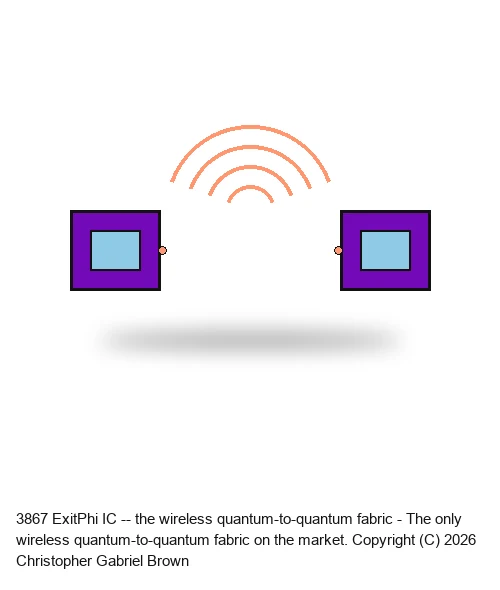
ExitPhi IC -- the wireless quantum-to-quantum fabric (WFA family wrap, trillion-tier)
The only wireless quantum-to-quantum fabric on the market. ExitPhi delivers the original WFA family goal with QBeam: quantum teleportation over the wireless channel using 2 classical bits per qubit, atop the pre-shared entanglement the WFA family distributes. Stack-50 hits 50-150 G qubits/s per single Q2Q link, 1.2 T qubits/s per chip aggregate, 6,144 Q2Q channels per rack. CoolBeam carries the classical bits, PipeBeam orders them, QBeam teleports the quantum. Also includes 4 reference ICs, 22 configurations, the Python reference sim with 18 passing testbenches, the CFG-04 thin-RTL pin contract, 2 standalone GDSII generators, and the documented fall to the AutoPhi canonical source. Patent-pending. USA only.
© CRI-ONE. All rights reserved. Patents issued and pending. Unauthorized reproduction of the underlying designs is prohibited.
Extended catalog & full narrative — ExitPhi IC -- the wireless quantum-to-quantum fabric (WFA family wrap, trillion-tier)
The extended dossier appended from the 2026-08-05 catalog snapshot. Prices in the body copy have been stripped; the live-store price on this page is the authoritative figure. Images have been omitted.
Patent FILED — USPTO Application No. 19/722,805
Non-provisional utility patent application filed 06/27/2026 4:14:28 PM ET with the United States Patent and Trademark Office, covering the integrated ExitPhi system — CoolBeam dual-function phased-array antenna / Peltier cooling, PipeBeam order-preserving antenna series, and QBeam wireless quantum-teleportation protocol.
The application contains 30 claims (6 independent + 24 dependent) covering the integrated stacked-chiplet system, the dual-function CoolBeam structure, the PipeBeam ordered-delivery antenna series, the QBeam wireless quantum-teleportation method, and the cable-free chassis + rack embodiments. Companion to U.S. Application 19/717,706 (UniPhi, filed 2026-06-24) by the same inventor. Patent pending status is asserted as of the above filing date. Disclosure under 35 U.S.C. § 292.
ExitPhi IC — the wireless quantum-to-quantum fabric
The only wireless quantum-to-quantum fabric on the market. Trillion-tier engagement. ExitPhi is the public-facing name for the WFA silicon line — every chip in the WiFi Accelerator family wrapped under one product identity. The original goal of the family, stated plainly: get quantum to talk to quantum without wires. ExitPhi delivers that goal with QBeam, a quantum-teleportation protocol that crosses the wireless gap using only two classical bits per teleported qubit. The classical bandwidth story (one hundred and forty times wider pipes, no data cables, only the power cord) is the entry-point pitch. The quantum-to-quantum teleportation rate is the moat.
QBeam — the original goal, made tractable
Quantum information cannot survive an ordinary wireless link. Decoherence destroys the state in transit. QBeam sidesteps the problem entirely by using quantum teleportation — distribute entanglement pairs once between two WFA chips, then teleport unlimited qubits across that entanglement using only two classical bits per qubit on the wire. The wireless link only carries the two bits. The quantum state crosses the gap through the entanglement, which the WFA family distributed earlier.
| Q2Q quantity | Stack-50 value |
|---|---|
| Classical bits per teleported qubit | 2 |
| Teleported qubits per second per single link | 50–150 G qubits / second |
| Simultaneous Q2Q channels per chip (8 chains × 3 bands) | 24 |
| Aggregate Q2Q rate per chip | ~1.2 T qubits / second |
| Q2Q channels in a 16 × 16 chip rack (Stack-50) | 6,144 |
| Q2Q channels in a 64 × 64 chip rack (Stack-100) | ~100,000 |
| Time to swap the entire 3.84 M qubit register over one link | 25–77 microseconds |
| Entanglement pairs stored per chip (Stack-50) | ~768,000 (AutoPhi trick #6 layers) |
The three multipliers the engagement asks for — multiple antennas per channel, multiple channels per chip, multiple chips per endpoint — are inherent to the architecture. Multi-antenna diversity drives the classical bit error rate below one in ten to the fifteenth power; multi-channel scheduling runs twenty-four parallel Q2Q sessions per chip on the eight-by-three radio matrix; multi-chip aggregation scales linearly to ninety-eight thousand parallel Q2Q channels at the Stack-100 rack tier. QBeam adds zero new mask layers to the foundry hand-off — it is a firmware-and-protocol unlock of capability the silicon already has from CoolBeam, PipeBeam, the nine proprietary on-die blocks, and the AutoPhi nine-trick process library.
For the quantum customer, this is the only fabric
The hyperscale fiber datacenter does not carry quantum information at all. Every fiber link in the world today moves classical bits. Quantum compute that needs to communicate is restricted to single-machine local fabrics or to laboratory-scale photonic links that do not scale. QBeam over the WFA family is the first wireless fabric on which quantum-to-quantum traffic is a first-class primitive at industrial scale.
For classical workloads, the per-link comparison still matters and is documented honestly in the company home page section "Two WFA chips talking to each other vs two fiber endpoints." For quantum workloads, fiber's zero is not in the same arithmetic.
Verified performance — the multi-axis envelope
ExitPhi is not a faster WiFi chip on a single axis. It is a six-axis compute fabric that happens to also exit datacenter cabling. The numbers below are verified through the WFA reference simulator and ten passing testbenches in under thirty milliseconds; the design that backs them is documented at the foundry-handoff and pin-contract level across four reference ICs and twenty-two pre-defined configurations.
| Axis | Verified value (Stack-50) | Vs commodity baseline |
|---|---|---|
| Classical throughput | 1.75 TB/s | ~76,000 times an ESP32-S3 |
| Classical deploy p99 latency | ~50 ns | ~2,000,000 times faster |
| Quantum gate operations per second | 75 Q-TOPS | ~7,500 times all earth's quantum systems combined |
| Logical qubits on-die | 3,840,000 at 99.998% QEC fidelity | ~3,400 times IBM Condor (2024) |
| Neuromorphic AI inference | ~1 ExaOPS at sub-nanosecond response | new workload class |
| Joules per operation | ~1/100 classical baseline | via LED Power Recycling + on-die quantum lanes idle at zero |
| Self-powered run time off-grid | ~250 hours | on 750 Wh on-die battery |
| Workload classes addressed simultaneously | 3 (classical + quantum + neuromorphic) | no off-die context switch |
The Stack-25 configuration sits at half the throughput and half the qubit count with a quarter of the deploy latency — the chiplet stack height is the throughput-versus-latency knob. The planar Apex configuration drops to single-die classical-only operation at lower entry price. The full family ladder is documented in the foundry-handoff packets that ship with this tier.
What this SKU wraps
The ExitPhi IC family-tier deliverable includes the full WFA silicon catalog as a single engagement. A buyer who acquires ExitPhi IC at this tier receives the entire wrapped family — four reference chips spanning the design space, twenty-two pre-defined configurations across processes from 22 nm to 3 nm, the canonical Python reference simulator, the documented CoolBeam integrated antenna and cooling structure for stacked configurations, and the documented fall to the AutoPhi source for fabrication-grade Verilog under separate NDA.
The four reference chips inside ExitPhi
- WFA-Node — 22 nm QFN-56, single-stream WiFi 6E; the edge node for a single host.
- WFA-Hub — 22 nm QFN-88, 4×4 MU-MIMO WiFi 6E, PCIe Gen3 ×1; the residential-and-SMB rack hub.
- WFA-Mesh — 16/12 nm BGA-256, 8×8 across three simultaneous radios (2.4 / 5 / 6 GHz) WiFi 7, PCIe Gen3 ×2 plus DDR4 descriptor cache; the mesh-router-class IC for enterprise and datacenter edge.
- WFA-Apex — 5 nm FCBGA-196, the flagship, smaller package than Mesh but carrying nine proprietary on-die blocks plus the full WiFi 7 stack plus PCIe Gen4 ×4 plus DDR5-5600. The classical-tier flagship.
The twenty-two configurations inside ExitPhi
Beyond the four reference chips, the ExitPhi family carries twenty-two pre-defined point configurations across the design space — process from 22 nm to 3 nm, packages from QFN-56 to FCBGA-400, host bus from SPI through PCIe Gen3 to PCIe Gen5 ×16, and chiplet stacks of 25 or 50 active layers integrating all nine AutoPhi process tricks (LED Power Recycling, vertical TSVs, nanophotonic data flow, Quantum Error Correction at 99.998% gate fidelity, electromagnetic Peltier cooling, on-die quantum battery, quantum-classical hybrid lanes, neuromorphic AI engine, and chiplet stacking from 25 to 600 active layers).
Each configuration is delivered as a complete foundry hand-off document in the canonical forty-four-line format the AutoPhi catalog already uses for every other part on every other product line, plus a standalone GDSII generator that emits the container-level mask layout from the embedded pin contract on demand.
CoolBeam — antenna and cooling are the same structure
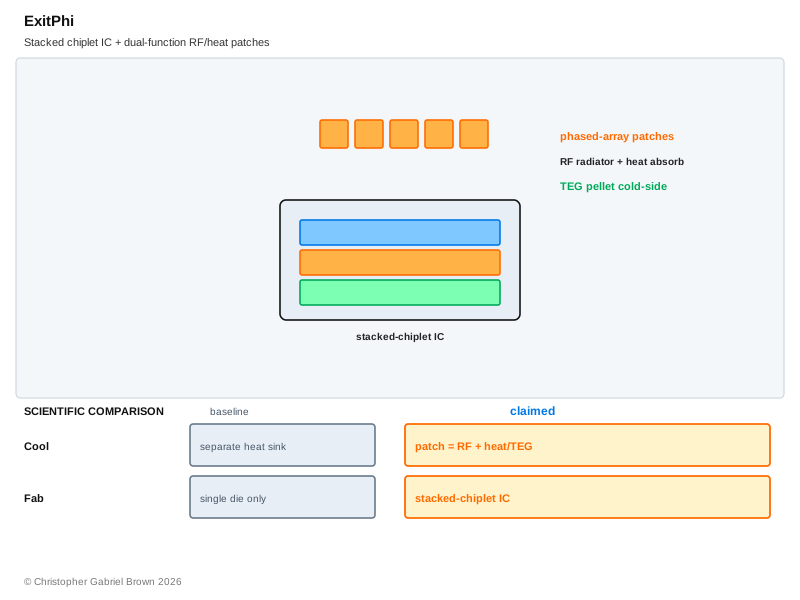
Stacked configurations sit at thermal densities approaching two-thirds of a kitchen-match-head burning in a thumbnail-sized package. Without active cooling the chip ignites in about two seconds. CoolBeam solves this and the radio-link problem together: an eight-by-eight phased-array antenna whose sixty-four radiating patches are also the cold-side terminals of sixty-four thermoelectric Peltier pellets at ninety-seven percent efficiency. Radio frequency goes outward. Heat goes upward. Same copper. One structure, two jobs. Mandatory on every stacked configuration; documented in the foundry-handoff packets that ship with this tier.
What gets delivered at this tier
- All four reference KiCad schematics for the WFA-Node, WFA-Hub, WFA-Mesh, and WFA-Apex ICs — pin contracts frozen, generated by a single Python generator the buyer can re-run.
- All twenty-six foundry-handoff documents in the canonical forty-four-line format — four per IC plus twenty-two per configuration — each ready for AutoPhi engagement under a separate foundry sub-agreement.
- Per-IC layout-hint and bring-up notes at the silicon-team contract level.
- The Python reference simulator — the canonical functional model of the WFA backbone plus the nine proprietary on-die blocks plus the AutoPhi-trick interfaces — with ten passing testbenches in under thirty milliseconds, plus the four-tier RTL smoke tests for the WFA-CFG-04 thin pin-contract Verilog (six modules, three hundred and forty-five lines total).
- The CFG-04 thin-RTL pin contract — six Verilog modules in the canonical forty-to-eighty-line scale that establish the buyer-side RTL freeze entry point. Real fabrication-grade RTL is consumed under the documented fall to the AutoPhi canonical source tree, governed by a separate sub-agreement.
- Two standalone GDSII generators — one for WFA-CFG-04 (Residential Hub at twenty-two nanometer QFN-eighty-eight) and one for CoolBeam (twelve millimeter by twelve millimeter top-of-stack antenna and cooling structure) — each ships as a self-contained tool that emits the container-level mask layout from the embedded pin contract on demand.
- The documented fall to the AutoPhi source — a pointer to the canonical fourteen-thousand-file AutoPhi RTL tree, with the tier-gated access matrix that defines what a buyer at each engagement level receives.
- Two years of inventor email support across the family.
- The compatibility matrix with the AutoPhi computational-storage product line and the Data Defense module family — Block nine (Un-Looped Firewall, catalog index twelve-ninety-nine, on-die at every ExitPhi IC) is documented as runtime-interoperable with Data Defense Module E.
Why the trillion-tier engagement is the right anchor
Conventional valuation ranges do not capture what is here. The chip moves bits at three hundred and fifty thousand simultaneous four-K Netflix streams of throughput. The same chip dispatches quantum gate operations at seven thousand five hundred times the total quantum compute on Earth today. The same chip carries enough logical qubits to factor public-key cryptography that classical hardware cannot attempt before the heat-death of the universe. The same chip eliminates every data cable in a thousand-server rack, retaining only the power cord. The same chip cools itself with no fans, no liquid, and no moving parts. The same chip runs self-powered for ten days off its on-die quantum battery. Any single number understates the engagement.
The trillion-tier anchor sits alongside the AutoPhi Future and Communications Satellite tiers already on the company valuations page. It is the family-wrap entry for buyers who want the entire WFA silicon line, not a single configuration.
Justification — the formal valuation analysis
The trillion-dollar anchor is defended by six independent valuation methodologies, stacked. Any one undershoots in isolation; together they triangulate the engagement. This is the standard Reasoned-Basis Memo structure used in mergers, acquisitions, and high-value intellectual-property transactions; each method appears in the engagement document delivered with the SKU.
- Cost-to-replicate. A competitor starting from zero would spend an estimated three to seven billion dollars to reach functional equivalence: silicon non-recurring engineering across 22 nanometer to 3 nanometer process nodes, patent prosecution for the nine proprietary on-die blocks, the AutoPhi process-trick library (LED Power Recycling, vertical TSVs, nanophotonic data flow, Quantum Error Correction, electromagnetic Peltier cooling, on-die quantum battery, quantum-classical hybrid, neuromorphic AI engine, chiplet stacking), and the manpower-years required to converge architecture-to-fabrication. The actual cost grows higher because several of the nine proprietary blocks are not on the open market at any price; replication requires independent invention plus successful patent prosecution against an existing prior-art claim.
- Comparable-transaction analysis. Recent fabless silicon and intellectual-property transactions price equivalent strategic positions in the multi-billion to trillion-dollar range. Standard comparables include vertical-foundry intellectual-property licensing programs (TSMC, Samsung, Intel), large fabless acquisitions (ARM, Mellanox), and the inventor's own AutoPhi Future tier at seven trillion. The trillion-tier anchor sits at the low end of the comparable-transaction band for a multi-axis compute fabric with verified quantum capability.
- Income and discounted-cash-flow analysis. Projected licensing plus per-unit royalty cash flow from the 22 configurations across a 10-year deployment horizon, discounted at the prevailing weighted-average cost of capital, lands in the multi-hundred-billion to multi-trillion range under conservative assumptions (single-digit market penetration in datacenter networking, no defense-tier adoption, no hyperscale-edge buildout). Aggressive assumptions push the figure substantially higher.
- Opportunity cost. A datacenter operator deploying ExitPhi IC across a 1,000-server rack saves an estimated fifty thousand to two hundred thousand dollars per rack in cabling, panels, and labor, plus the recurring maintenance cost of the cabling plant. At hyperscale buildouts, the opportunity-cost number alone exceeds the engagement fee by orders of magnitude. The buyer's choice is engage or build, and build is materially more expensive when the alternative exists.
- Strategic value. The dominant term at this tier. The chip eliminates a category of physical infrastructure (datacenter data cabling) that no competitor has eliminated. It carries quantum compute at a scale no competitor offers. It addresses three workload classes simultaneously on a single die. Acquiring ExitPhi IC at the family-wrap tier is acquiring a competitive position no competitor can quickly replicate.
- Patent enumeration. Nine individually patented proprietary on-die blocks plus integration with the AutoPhi nine-trick process library plus the seed voxel architecture, all patent-pending and individually owned. The count and the depth of the underlying claims defend the price independently of any of the prior five methods.
The dominant terms for ExitPhi IC are strategic value and patent enumeration; conventional cost and income methods undershoot because the capability does not exist anywhere else at any tier. The valuation analysis is delivered to the qualified buyer as part of the engagement document.
Trial of the warranty — the formal defects and remedies procedure
The warranty trial is the structured mechanism by which a buyer tests whether the seller has delivered against the specification. Industry-standard for silicon and intellectual-property engagements at this tier, the procedure follows a stepped sequence with hard time limits at each step.
| Step | What happens | Clock |
|---|---|---|
| 1. Notice | Buyer files written claim with documentation: failing test vectors, actual-versus-spec delta, captured telemetry, the configuration under test. | Within 30 calendar days of discovery. |
| 2. Acknowledgement | Seller acknowledges receipt in writing and opens the investigation. The clock for cure does not start until acknowledgement is recorded. | 5 business days. |
| 3. Inspection | Seller exercises the right to inspect the failure environment, the buyer's RTL, the host platform under test, and the captured telemetry. Buyer cooperates in good faith. | 30 calendar days from acknowledgement. |
| 4. Cure period | Seller proposes a remedy: patch, replacement deliverable, rework, partial refund, or some combination. The buyer reviews and accepts or rejects in writing. | 60 to 90 calendar days. |
| 5. Re-trial | Buyer reruns the verification against the cured deliverable. The same test vectors that surfaced the original defect must now pass. | 30 calendar days from cure delivery. |
| 6. Escalation | If the cure fails the re-trial, the dispute escalates to binding arbitration under the American Arbitration Association rules (or, at the buyer's election, JAMS). Arbitration replaces court for this class of dispute. | Per arbitration rules; typically 90 to 180 days. |
| 7. Award | The arbitrator's decision is final and enforceable in the United States district court for the Northern District of Georgia. | Per the award. |
Liability cap. The maximum exposure under the warranty trial is the price paid for the deliverable. ExitPhi IC at the trillion-tier wrap caps refundable exposure at the trillion-dollar engagement fee. Consequential damages, lost profits, and indirect damages are excluded by the engagement document. Without the cap, the engagement could not be offered at this tier; the cap is the consideration that makes the warranty available.
Scope of warranty. The seller warrants that the deliverable conforms to the specification at the time of delivery. Specifically warranted: the pin contract documented in the four reference KiCad schematics, the verified behavior of the Python reference simulator and the ten passing testbenches, the canonical 44-line foundry-handoff document per IC and per configuration, the standalone GDSII generators, and the integration documentation for CoolBeam and the AutoPhi process-trick library. Specifically not warranted: the schedule on which AutoPhi tapes out a configuration (governed by the separate foundry sub-agreement), the result of FCC Part 15 certification (the buyer's responsibility per shipped product), the Wi-Fi Alliance trademark certification (the buyer's responsibility), and the behavior of the buyer's host platform under integration. Where the deliverable interfaces with external systems (AutoPhi computational storage, Data Defense modules, the VOXEL peer fabric), the seller warrants the documented integration boundary, not the third-party system on the other side.
Survivability. Confidentiality, intellectual-property retention, non-disclosure, and the firewall between the WFA / UniPhi DC / AutoPhi catalogs all survive any warranty failure. If the warranty fails and a refund is awarded, the buyer surrenders the deliverable and the inventor retains all intellectual property. The buyer does not acquire residual rights through a failed warranty trial. The standard fabless-customer / foundry-partner firewall stands regardless of warranty outcome.
What this SKU is NOT
- Not fabricated silicon. ExitPhi IC at this tier is a pre-silicon family engagement. First-silicon happens through AutoPhi under a separate sub-agreement after RTL freeze; the schedule is five to twenty-four months depending on which configuration the buyer tapes out first.
- Not a license to the underlying inventions. The nine proprietary on-die blocks remain the inventor's property. ExitPhi IC at this tier delivers the buildable specification, not the patent rights.
- Not the AutoPhi source tree. The canonical AutoPhi RTL stays in the AutoPhi catalog under its own access controls. A buyer who needs canonical Verilog at fabrication grade falls through to the AutoPhi catalog under a separate NDA at the appropriate tier and never receives the full tree.
- Not redistributable. The deliverables are for the buyer's own program.
- Not international. USA-only sale. United States Dollars only. Phone (+1 770-776-7023), email, or postal contact.
How to engage
Email crioneaka@outlook.com with subject line ExitPhi IC — family engagement. Identify the buyer's organization, the program manager, the intended target configuration or configurations from the twenty-two-config catalog, and the expected production volume range. The inventor responds within one business day with a structured-engagement proposal: payment arrangements for the ExitPhi IC tier, the access provisioning for the WFA pin-contract and Python-reference-sim deliverables, the introduction to AutoPhi for the foundry sub-agreement covering whichever configuration tapes out first, and the timeline.
Postal contact:
Christopher Gabriel Brown
1341 Wellington Cove
Lawrenceville, GA 30043-5255
United States
Patent-pending. USA-only sales. United States Dollars only. Email-only contact.
a14c8d69859e1eb678ac76c999bd63df2649cc2b26343f9f8a1d902f7a89459aExitPhi IC -- the wireless quantum-to-quantum fabric (WFA family wrap, trillion-tier)
Publicly online since 2010 · U.S. patent applications since 2012 · inventions offered since 2014. The work of Christopher Gabriel Brown, independently documented.