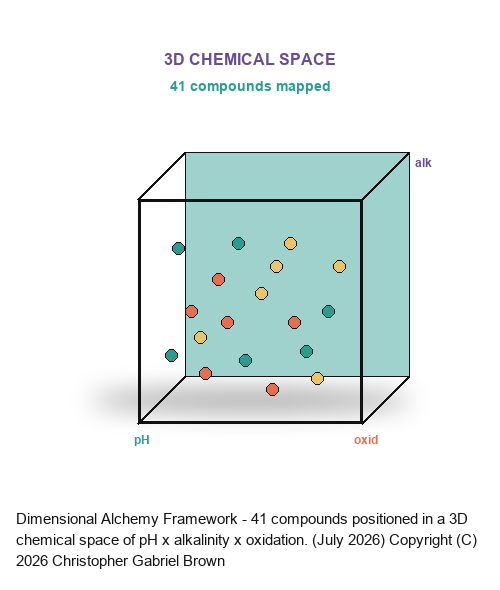
Dimensional Alchemy Framework
Compound discovery in 3D chemical space with predicted stability for 27 clearly-labeled theoretical compounds. A predictive/generative framework. Design-target asking price.
© CRI-ONE. All rights reserved. Patents issued and pending. Unauthorized reproduction of the underlying designs is prohibited.
Extended catalog & full narrative — Dimensional Alchemy Framework
The extended dossier appended from the 2026-08-05 catalog snapshot. Prices in the body copy have been stripped; the live-store price on this page is the authoritative figure. Images have been omitted.
Chemical space you can actually navigate — positioned in three dimensions, with a framework that even sketches where brand-new theoretical compounds might sit.
Why this exists — the intent
The intent is to stop treating compounds as a flat list and start treating them as points in a navigable 3D space (pH × alkalinity × oxidation state) — then use that structure to predict where theoretical new candidates might fall and how stable they might be, as fuel for further study.
What you actually receive
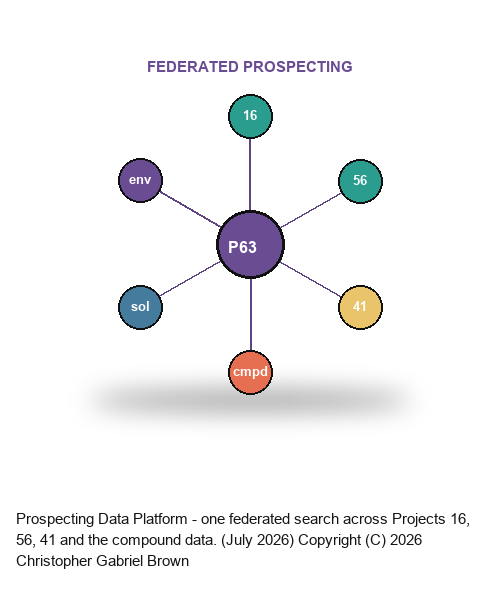
- 41 compounds positioned in 3D space — 14 established + 27 theoretical
- Stability-index and synthesis-feasibility predictions
- An elemental-composition analyzer (20 elements)
- The Python framework (source) + 125 KB CSV (275 columns) + 299 KB JSON
The outcome — what you can do with it
- Explore chemical space visually/structurally instead of as a flat table
- Generate theoretical candidate compounds as starting points for real investigation
- Prioritize which candidates look most stable/feasible before deeper work
⚖️ Faithful scope — what this data actually is (so nothing is overstated):
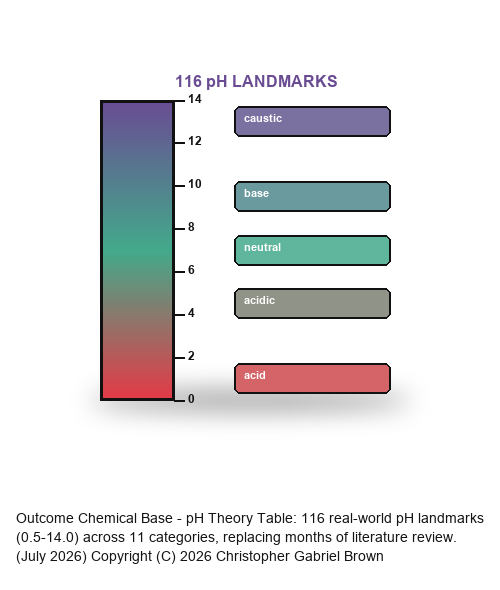
| Reference data | The pH values are real, publicly-known reference ranges for common substances, organized and cross-referenced. |
| Computed values | The large 'data point' counts come from mathematics applied to the reference values (e.g. raising a pH across many powers, plus standard derived acid-base metrics). They are arithmetic expansions for exploration, not individual laboratory measurements. |
| Estimated scores | Danger, safety, success-probability and productivity scores are the author's heuristic model estimates on a defined scale — useful for ranking and ideation, not lab-certified results. |
| Theoretical compounds | 27 of the 41 compounds are theoretical / predicted — they have not been synthesized or lab-verified. The stability and feasibility numbers are model predictions to guide investigation, not evidence that these compounds exist or will behave as predicted. |
Why the price is
The design-target asking price reflects the added predictive and generative modeling plus the software framework — more than a static dataset. Priced as an exclusive deliverable, not appraised.
Exactly what you receive: a digital data + software deliverable — the dataset files (CSV and JSON), any Python source noted above, and written documentation, delivered by digital download/email. Your purchase includes a license to use these deliverables. It does not transfer or license any patent or intellectual-property rights, and it is not a stake in any company.
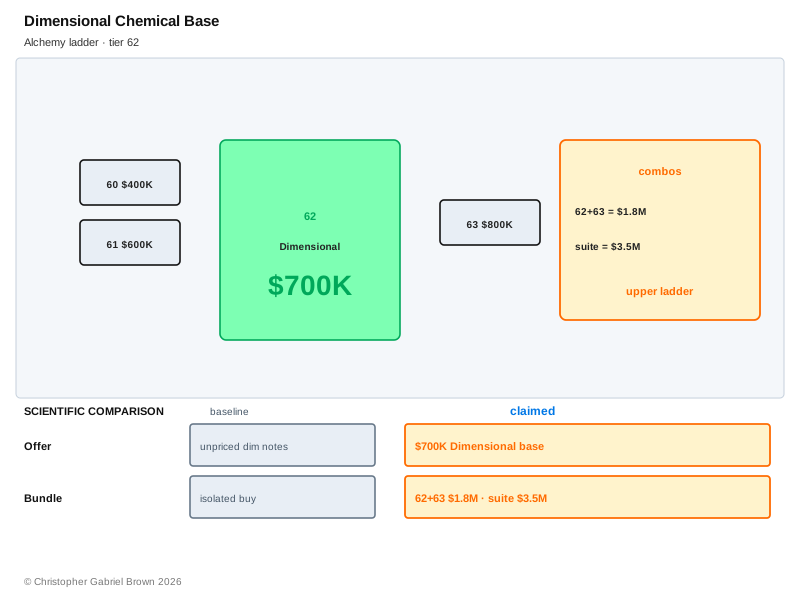
How the price was set (in plain terms): the figure below is the inventor's design-target asking price for an exclusive, premium research deliverable. It reflects the scope and originality of the work described above and the inventor's chosen positioning. It is not a third-party appraisal, an audited valuation, or a claim of realized or guaranteed resale value. It is an asking price — offers and licensing discussions are welcome by email.
📅 Description authored & last edited: 2026-07-07 at 19:45 (inventor's local time). Sales & support by email. Availability: USA only. © 2026 Christopher Gabriel Brown. All rights reserved.
c3e24e80d29dcd3388ae11ad2d8eb5af9951ae2ec9e14b807d1450e97fb7cff1Dimensional Alchemy Framework
Publicly online since 2010 · U.S. patent applications since 2012 · inventions offered since 2014. The work of Christopher Gabriel Brown, independently documented.