Quantum Triplet Pi — 3D Computational Framework (Copy Ownership)
Publicly online since 2010 · U.S. patent applications since 2012 · inventions offered since 2014. The work of Christopher Gabriel Brown, independently documented.
— Quantum Triplet Pi ? 3D Computational Framework (Copy Ownership)The quantum extension of the Triplet Pi 3D computational framework ? a pi-cubed coordinate system with 12-point vector registration, productized for quantum computing applications.
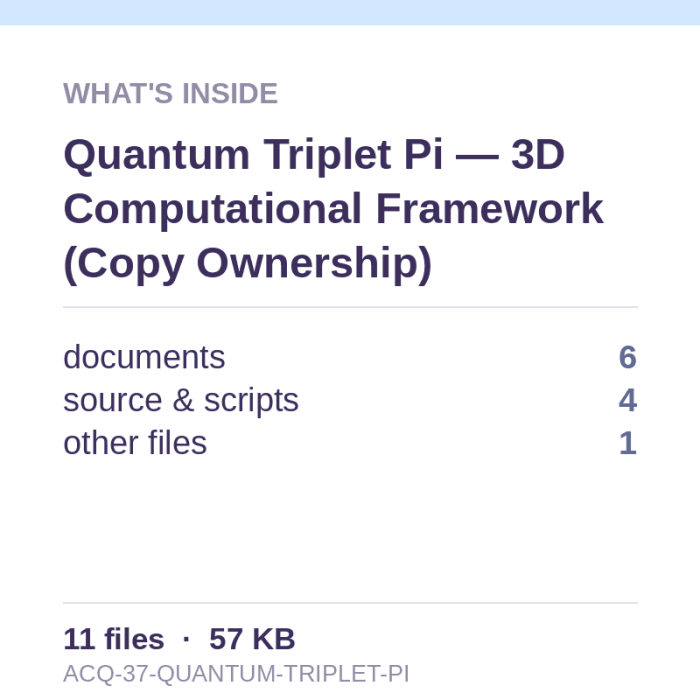
- What you receive: a blueprint package — design documents as an instant digital download.
- License: evaluation use; all intellectual property retained by CRI-ONE.
- Want everything? The complete engineering write-up is under Full details.
Quantum Triplet Pi — 3D Computational Framework (Copy Ownership)
The quantum extension of the Triplet Pi 3D computational framework — a pi-cubed coordinate system with 12-point vector registration, productized for quantum computing applications. Superposition over vector registration points, entangled annotation across endpoints, quantum GPS ration, and coherent path compensation. Anchored in inventions 415-417, 536-538, and 1727-1729 (filed 2017-2019). Ownership of a single licensed copy. No , no redistribution, no sharing.
© CRI-ONE. All rights reserved. Patents issued and pending. Unauthorized reproduction of the underlying designs is prohibited.
Extended catalog & full narrative — Quantum Triplet Pi — 3D Computational Framework (Copy Ownership)
The extended dossier appended from the 2026-08-05 catalog snapshot. Prices in the body copy have been stripped; the live-store price on this page is the authoritative figure. Images have been omitted.
Downloads immediately on checkout — your product files as a direct download. Open with 7-Zip, WinRAR, or macOS Archive Utility.
Hyper Quantum Map
Multi-Layer Hilbert-State Atlas for Programmable Quantum Hardware
acq-37-quantum-triplet-pi-3d-framework and the SKU
is ACQ-37-QUANTUM-TRIPLET-PI. The product as canonically branded under the active
USPTO filing (19/646,681) is Hyper Quantum Map — the productisation of
the broader Quantum Triplet ? cartography framework. Both names appear in the inventor's
project tree; this listing uses the canonical Hyper Quantum Map branding from the
current product brochure.
A classical floorplan shows wires and cells. A quantum floorplan must show state overlap, SWAP depth, and readout collision.
The Hyper Quantum Map unifies three things that today live in three separate tools — logical circuit depth, device connectivity and directionality, and noise and crosstalk priors — into a single navigable representation a working team can reason against. Less a diagram than a weather map for a quantum computer.
One quantum atlas. Twelve-point vector registration. Decision-grade for NISQ and early fault-tolerant hardware.
The Hyper Quantum Map is a structured atlas of a quantum program's state and physical layout. It follows the full Hilbert-space evolution under the buyer's gate sequence and projects that evolution onto the device topology actually being run. Coherence, qubit routing, and error channels appear in one navigable view rather than three disconnected dashboards. The map's structure is drawn from the broader Quantum Triplet ? cartography framework — a body of work in which physical state is addressed through twelve-point vector registration rather than a single coordinate. Specialised here for near-term NISQ and early fault-tolerant hardware. Filed under USPTO 19/646,681 with 20 claims.
1 — Core Specification
dim(M) = 2n × klayout — n qubits, k topology sheets
2 — Simplified Interpretation
The Hyper Quantum Map is a structured atlas of a quantum program's state and physical layout. It follows the full Hilbert-space evolution under the gate sequence and projects that evolution onto the device topology the team actually runs on. Coherence, qubit routing, and error channels appear in one navigable view rather than three disconnected dashboards.
3 — Plain Language
Think of it as a weather map for a quantum computer. Instead of guessing whether a circuit "fits" the machine, the team gets a layered picture: which qubits carry the real work, where entanglement spreads, and where the hardware is likely to hurt them first. They plan routes before they burn calibration time.
4 — Analysis & Significance
Classical floorplans show wires and cells. A quantum floorplan must show state overlap, SWAP depth, and readout collision. The Hyper Quantum Map unifies three things that today live in three separate tools: logical circuit depth, device connectivity and directionality, and noise and crosstalk priors — rendered as a single navigable representation that a working team can reason against.
Typical applications: picking the best embedding for a fixed algorithm, comparing two processors head-to-head before purchase, explaining why a benchmark wins or loses on a given chip, and shortening the iteration loop from abstract QASM to calibrated pulses on the bench.
The map's structure is drawn from the broader Quantum Triplet ? cartography framework — a body of work in which physical state is addressed through a twelve-point vector registration rather than a single coordinate. Classical diagrams return one point; Quantum Triplet ? returns a calibrated superposition that collapses only on measurement. For this deliverable, that framework is specialised to near-term NISQ and early fault-tolerant hardware, where the decision a team needs most is whether the circuit they have can survive the chip they bought.
Regimes: shallow circuits engage local maps only. Deep or highly entangled circuits engage the full hyper stack — multiple layout sheets plus environment tracing — so a pretty diagram is never mistaken for a faithful state projection. The acquirer receives the underlying cartography primitives; the deeper scale framework that makes them work is referenced but not disclosed in full at this tier.
5 — What Ships
| Component | What it is |
|---|---|
| Layout sheets | Topology-aware projections of the logical circuit onto the physical device graph — one sheet per hardware profile. |
| Entanglement footprint overlays | Live overlays that show how entanglement spreads step-by-step under the selected gate sequence. |
| Twelve-point vector registration | Quantum Triplet ? coordinate layer for addressing state across registers, with interactive wavefunction-collapse view. |
| Universal tet-period reference map | Companion visualisation of the broader scale framework, redacted for acquirer consumption at this tier. |
| Simulator + notebook export hooks | Bindings for common QASM / OpenQASM 3 pipelines and Jupyter Lab notebooks. Result objects are JSON and CSV. |
| Decision-grade reports | Pre-run embedding reports, per-processor comparison sheets, and post-run calibration-drift summaries. |
6 — Who This Is For
Teams that already run quantum circuits and need a decision-grade map, not a tutorial visualisation. Hardware procurement committees evaluating two or more processors. Research groups moving from paper algorithms to calibrated pulses and needing to justify embedding choices to reviewers or funders. Not intended as a first-time learner's tour of quantum computing.
USPTO Patent Status — 19/646,681 (Pending Examination)
| Field | Value |
|---|---|
| Active Application | 19/646,681 |
| Title | "Nano-to-Cosmic Tets of a Period — A Universal Quantum Scale Framework" |
| Type | Utility (non-provisional) |
| Filing Date | 2026-04-14 (received 9:25:35 AM ET) |
| Confirmation No. | 7276 |
| Patent Center No. | 75283924 |
| Claims | 20 (2 independent framework claims + 18 dependent specialisations) |
| Documents on file | Application Data Sheet (PTO/AIA/14), Specification, Claims, Drawings, Abstract, Filing Receipt |
| Status | Pending examination — not yet granted. Verifiable at patentcenter.uspto.gov |
| Replaces | 19/646,666 (filed same day, 9:06:44 AM ET, Conf #4892, Patent Center #75283487) — to be expressly abandoned by inventor to avoid double-patenting |
| Inventor | Christopher Gabriel Brown |
Patent-Protected Technology
INTELLECTUAL PROPERTY
The deeper scale framework behind this deliverable is protected under the pending USPTO filing and associated prior inventions of the author. Full derivational detail is available only under a separate technical-validation agreement — this is the inventor's stated condition in the canonical product page. The cartography primitives (layout sheets, entanglement overlays, twelve-point vector registration, simulator/notebook hooks, decision-grade reports) are what ships at this tier.
How it's made
The Hyper Quantum Map is the productisation of the broader Quantum Triplet ? cartography framework, specialised to NISQ and early fault-tolerant quantum hardware. The core specification follows the unitary evolution ?(t) = U(t, t0)?0 with the map function MHQ(?) = TrE[U?U†] tracing out the environment, projected onto a layout dimension dim(M) = 2n×klayout across n qubits and k topology sheets. The deliverable assembles those primitives into a navigable atlas that runs against the buyer's QASM / OpenQASM 3 circuits via simulator and Jupyter notebook bindings, with output as JSON and CSV.
The twelve-point vector registration is drawn from the inventor's Quantum Triplet ? framework — a coordinate system in which physical state is addressed through twelve simultaneous superposed reference points rather than a single classical coordinate. The cartography primitives that ship here are the specialised, NISQ-tier subset; the deeper framework that makes the primitives work is held back at this tier and available only under separate technical-validation agreement.
Why I made it
A working quantum-computing team currently has to consult three separate tools to answer one question: will this circuit run well on this machine? One tool tracks logical circuit depth, another tracks device connectivity and directionality, a third tracks noise and crosstalk priors. The team's actual decision — whether to commit calibration time and qubit-hours to a particular embedding — depends on the joint state of all three, and there has been no atlas that renders all three in one navigable view that a procurement committee, a research group, or a benchmark-running team can read together.
The Hyper Quantum Map exists because the broader Quantum Triplet ? cartography framework has the right structure to render that joint state, and because the coordinate-system specialisation to NISQ and early fault-tolerant hardware is the place where the question is most pressing. Filed at USPTO under 19/646,681 in April 2026 with 20 claims; replaces an earlier-same-day filing 19/646,666 to avoid double-patenting. The acquisition delivers the cartography primitives at this tier; the deeper framework remains under a separate-agreement layer.
What it can do
An acquirer takes possession of the cartography primitives: layout sheets per hardware profile, entanglement footprint overlays that update step-by-step under a selected gate sequence, the twelve-point vector registration coordinate layer with interactive wavefunction-collapse view, the redacted universal tet-period reference map, the simulator and notebook export hooks for QASM / OpenQASM 3 / Jupyter Lab, and the decision-grade reports for pre-run embedding, per-processor comparison, and post-run calibration drift.
The map handles two regimes honestly. Shallow circuits engage local maps only. Deep or highly entangled circuits engage the full hyper stack with multiple layout sheets and environment tracing. The package is structured so that a pretty diagram is never mistaken for a faithful state projection — the regime is recorded with the output, not hidden behind it.
What this acquisition does not deliver: the deeper Quantum Triplet ? scale framework in full derivational detail (that is held back at this tier per the inventor's canonical product page), and any direct access to the USPTO 19/646,681 specification beyond what is necessary for the cartography primitives to function. Buyers who need the deeper framework should engage the separate technical-validation agreement.
Why it's a fact
Every claim above can be checked against the source record:
- The canonical product page
web-description-v2.htmlin the project folder contains the six numbered sections (Core Specification, Simplified Interpretation, Plain Language, Analysis & Significance, What Ships, Who This Is For) reproduced above. The mathematical formula and the dim(M) = 2n×klayout line are verbatim from that page. - USPTO 19/646,681 is a filed instrument: 20 claims, Confirmation No. 7276, Patent Center No. 75283924, filed 2026-04-14 at 9:25:35 AM ET. Status verifiable at
patentcenter.uspto.gov. Filing receipts on file in the project folder asFILING_RECEIPT.txtandFILING_RECEIPT_19-646-681.txt. - The earlier same-day filing 19/646,666 (Conf #4892, Patent Center #75283487, filed 9:06:44 AM ET) is on the prosecution record. The inventor's stated intent in the second receipt is to expressly abandon 19/646,666 in favour of 19/646,681 to avoid double-patenting.
- The "redacted at this tier" framing is the inventor's explicit language in the canonical product page and is enforced by the separate-agreement structure for full derivational detail.
- The twelve-point vector registration is referenced from the broader Quantum Triplet ? framework, which appears across the inventor's portfolio in companion projects (Project 38 Theory of Compensation explicitly mirrors this project's framework as a heritage subtree).
License Terms — What's Granted, What Isn't
The acquisition grants the buyer permission to make, build, and copy the Hyper Quantum Map deliverable. It does not transfer the underlying intellectual property:
- Granted with the acquisition: permission to run the cartography primitives against the buyer's own QASM / OpenQASM 3 circuits and Jupyter Lab notebooks; permission to integrate the simulator and notebook export hooks into the buyer's internal pipelines; permission to make copies of the deliverable package for the buyer's engineering, procurement, and research use.
- Not transferred with the acquisition: the patent itself (USPTO 19/646,681), the broader Quantum Triplet ? framework, the redacted universal tet-period reference map's full derivational detail, trademarks, copyrights, or any rights to license or assign the IP onward to third parties. The intellectual property remains held by Christopher Gabriel Brown.
- The deeper scale framework is available only under a separate technical-validation agreement — that is a different contract, not granted by this storefront acquisition.
- License tier: Enterprise. Pricing is contact-for-quote.
A quantum atlas for teams that already run circuits. USPTO-filed with 20 claims. Permission to make, build, and copy — not IP transfer.
A buyer who acquires the Hyper Quantum Map takes possession of the cartography primitives needed to render logical circuit depth, device connectivity, and noise priors as a single navigable atlas. Patent foundation: filed USPTO application 19/646,681 (20 claims, 2026-04-14). The deeper Quantum Triplet ? scale framework remains held by the inventor and available only under separate technical-validation agreement.
Logical circuit depth + device connectivity + noise priors = one navigable atlas.
One acquisition delivers the Hyper Quantum Map cartography package: the core specification (?(t) = U?0, MHQ(?) = TrE[U?U†], dim(M) = 2n×klayout), the layout sheets per hardware profile, the entanglement footprint overlays with step-by-step gate-sequence behaviour, the twelve-point vector registration with interactive wavefunction-collapse view, the redacted universal tet-period reference map, the simulator and notebook export hooks (QASM / OpenQASM 3 / Jupyter Lab; output JSON and CSV), and the three decision-grade report types (pre-run embedding, per-processor comparison, post-run calibration drift).
Patent foundation: USPTO 19/646,681 (20 claims, filed 2026-04-14, Conf #7276, pending examination). Replaces 19/646,666 to avoid double-patenting.
License: Enterprise — contact for quote
Permission to make, build, and copy. IP retained by Christopher Gabriel Brown. Deeper Quantum Triplet ? scale framework available only under separate technical-validation agreement. Christopher Gabriel Brown · Lawrenceville, GA 30043 · · crioneaka@outlook.com.
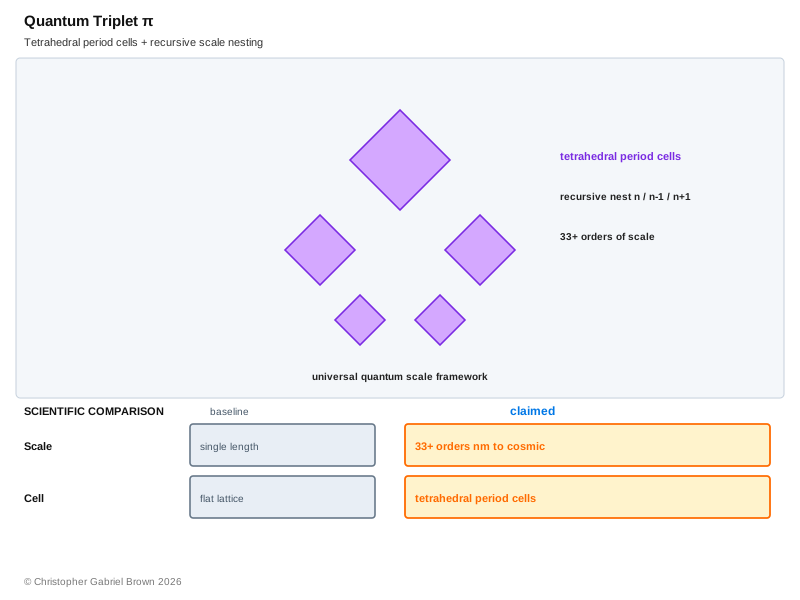
SOURCE RECORD — original published render

First archived 2021-10-20 · buyinvent.com via the Internet Archive · 50,129 bytes
SHA-256 cf8d33139089ab30e7a5625e275d8ba2b6d84f6b0d347ba324d2d33a414eedea
Original URL: https://buyinvent.com/image/cache/catalog/1727-300x300.png