
73-wonderphi-phone
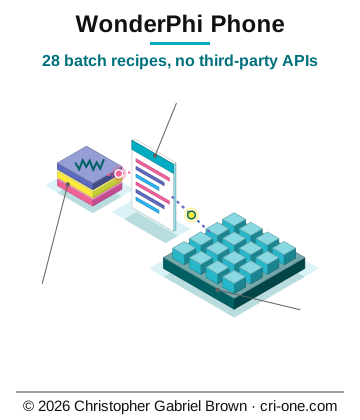
Asset valuation: $2,400,000,000. 28 batch recipes for telephony operations without third-party APIs. Voicemail transcription, call-recording processing, CDR parsing, phone-number normalization, DNC scrubbing, and the "sudo-SMS" queue-to-file pattern for operator-delivered messaging.
Think of a phone number the way you think of a front-door key. Whoever holds it decides who gets through. Hand it to a paid gateway and the monthly bill grows with every text. WonderPhi Phone hands the key back. It is a library of twenty-eight batch recipes for telephony work that calls no third-party API: no Twilio, no Plivo, no Bandwidth.
The library runs nothing itself. It writes a plain-text plan file that WonderPhi Compute runs across every CPU core, and the GPU when present. The recipes cover what a phone operation does: transcribing voicemail with Whisper, timestamped for the courtroom; cleaning recordings with ffmpeg, from loudness-normalising to Opus for long-term storage; turning fax TIFFs into searchable PDFs; parsing call-detail records and flagging premium-rate destinations for toll fraud; normalising numbers to E.164 and scrubbing them against a local Do-Not-Call list; and hashing and encrypting recordings and redacting transcripts before archival.
The "sudo-SMS" pattern deserves a pause. Reminder, passcode and broadcast messages are written one JSON record per number into a local folder, and your operator or your own script delivers them. The number stays yours. It is for telephony and call-center operations teams that keep their own numbers and recordings, and for engineering buyers and licensees pairing it with WonderPhi Compute. Python standard library only, no network connections, no telemetry, and the ten commandments that govern the compute engine stay intact. The buyer takes the recipe library and the queue pattern; the source, plan format and WonderPhi name remain the property of Christopher Gabriel Brown.
Description
Intellectual–property status: All rights, title, and interest in and to WonderPhi Phone — including its source code, plan–file formats, recipe library structure, and documentation — are the exclusive property of Christopher Gabriel Brown, protected by U.S. copyright law (17 U.S.C. § 102(a)(1)) and applicable international treaties. WonderPhi Phone is a companion product to WonderPhi Compute , which carries patent–pending status under the inventor’s USPTO application portfolio (41 applications filed: 28 utility, 6 design, 7 provisional). The WonderPhi name, the constitutional commandments text, the plan.wpc.txt format, and the recipe library structure are the author’s intellectual property.
Overview
WonderPhi Phone v1.0.0 is a library of 28 batch recipes for telephony operations that require zero third–party APIs. It handles voicemail transcription, call–recording processing, CDR (Call Detail Record) parsing, phone–number normalisation, Do–Not–Call scrubbing, and the innovative “sudo–SMS” queue–to–file pattern for operator–delivered messaging — all without ever contacting Twilio, Plivo, Bandwidth, or any other paid gateway.
The library does not run anything itself. It writes a plain–text plan file ( .plan.wpc.txt ) that WonderPhi Compute then executes, dispatching every task across every available CPU core (and GPU, when present). The relationship is simple: WonderPhi Phone writes the plan; WonderPhi Compute runs the plan.
WonderPhi Phone is written in pure Python with zero external dependencies — standard library only. It makes no network connections and includes no telemetry. It never modifies wpc.exe ; the 10 Commandments that govern WonderPhi Compute remain intact at all times.
The “sudo–SMS” Pattern
SMS and voicemail–drop recipes write one JSON queue record per phone number to a local folder. Your operator (or a downstream script you write) delivers them manually from that queue. Phone number is identity — that identity stays with you, not a paid gateway. No Twilio. No monthly bill scaling with volume. A typical queue record looks like this:
{ "phone": "+15555550100", "message": "Your appointment is confirmed for tomorrow at 2pm.", "queued_at": 1721600400.123 }
Recipe Input Model Requires on PATH Description
whisper-vm files whisper + CUDA Transcribe each voicemail with Whisper medium model on GPU (set $WPC_GPU=1 )
whisper-vm-cpu files whisper (CPU only) Transcribe each voicemail on CPU only using the Whisper base model
whisper-vm-tiny files whisper Transcribe each voicemail with Whisper tiny model (fastest; lowest accuracy)
whisper-vm-srt files whisper Transcribe each recording with timestamped SRT output (courtroom–ready)
Audio Processing (7 recipes)
Recipe Input Model Requires on PATH Description Output
loudness-normalize files ffmpeg EBU R128 loudness–normalize each recording (broadcast–safe archival); parameters: I=−16, LRA=11, TP=−1.5 .mp3 (LAME V2)
silence-trim files ffmpeg Trim silence from head and tail of each recording (voicemail cleanup); threshold −40 dB, minimum silence 0.5 s .mp3 (LAME V2)
audio-to-mp3 files ffmpeg Convert each recording to standard MP3 (V2) for archival .mp3
audio-to-opus files ffmpeg Convert each recording to Opus at 32 kbps (long–term storage; approximately 60% smaller than MP3) .opus
audio-mono-8k files ffmpeg Downsample each recording to 8 kHz mono PCM (PSTN–quality; STT–ready); codec: pcm_s16le .wav
audio-spectrogram files ffmpeg Emit a spectrogram PNG per recording (visual audit / anomaly detection); image size 1024×512 .png
audio-waveform files ffmpeg Emit a waveform PNG per recording (silence / clipping audit); image size 1200×200, mono channel layout .png
Fax Processing (2 recipes)
Recipe Input Model Requires on PATH Description Output
fax-tif-to-pdf files ImageMagick + Ghostscript Convert each fax TIFF (including multi–page) to PDF .pdf
fax-ocr-searchable files tesseract OCR each fax TIFF into a searchable text–layer PDF (English language) .pdf
CDR Parsing (2 recipes)
Recipe Input Model Requires on PATH Description Output
cdr-generic-parse files python (stdlib) Parse each CDR CSV file; emit a JSON summary containing total calls, total minutes, and unique–caller count .summary.json
cdr-toll-fraud-scan files python (stdlib) Flag international and premium–rate destinations per CDR for toll–fraud detection (non–domestic = any destination not starting with +1 or 1) .fraud.txt
Phone Number Operations (4 recipes)
Recipe Input Model Requires on PATH Description
e164-normalize lines python (stdlib) Normalize each phone number to E.164 format (+1 followed by the last 10 digits); invalid numbers are flagged
dnc-scrub lines python (stdlib) + DNC list via --tag Flag each number against a local Do–Not–Call list (path provided via --tag ); outputs OK or DNC per number
cnam-lookup-file lines python (stdlib) + cnam.csv via --tag Local caller–ID name lookup from a CSV map (format: phone,name); returns UNKNOWN for unmatched numbers
dial-plan-validate lines python (stdlib) Validate each number against the US dial plan (10–digit NANP); checks that the leading digit is not 0 or 1
SMS Queue — sudo–SMS Pattern (4 recipes)
Recipe Input Model Requires on PATH Description
sms-queue-write lines python (stdlib) Write one SMS–queue JSON record per number (message text via --tag ); operator delivers manually
sms-appointment-reminder-queue lines python (stdlib) Queue an appointment–reminder SMS per number ( --tag = template string, e.g. “Your appt with Dr. X is tomorrow at 2pm.”)
sms-otp-queue lines python (stdlib) Queue a one–time–passcode SMS per number ( --tag = the OTP code)
sms-broadcast-queue lines python (stdlib) Queue the same broadcast message to every number in the list ( --tag = message text)
Voice Queue (2 recipes)
Recipe Input Model Requires on PATH Description
voicemail-drop-queue lines python (stdlib) + audio file via --tag Queue one voicemail–drop record per number; the JSON record includes phone, audio path (from --tag ), action type, and timestamp
reminder-call-queue lines python (stdlib) Queue a reminder–call task per number ( --tag = script text); the JSON record includes phone, action type, script, and timestamp
Compliance & Archival (3 recipes)
Recipe Input Model Requires on PATH Description Output
recording-hash-sidecar files certutil (built–in on Windows) SHA–256 hash sidecar per recording for tamper–evident regulatory archival .sha256
recording-encrypt files 7z (7–Zip) AES–256 password–encrypt each recording with 7z (password via --tag ); header encryption enabled ( -mhe=on ) .7z
transcript-redact-pii files python (stdlib) Regex–redact Social Security Numbers (###–##–####), credit–card numbers (####–####–####–####), and phone–number patterns from each transcript; outputs redacted text with markers [SSN–REDACTED], [CC–REDACTED], [PHONE–REDACTED] .redacted.txt
Supported Input Formats
Category File Extensions Scanned
Audio recordings *.wav , *.mp3 , *.m4a , *.aac , *.flac , *.ogg , *.opus , *.amr
Fax images *.tif , *.tiff
Call Detail Records *.csv , *.cdr , *.log
Transcripts (for PII redaction) *.txt , *.srt
Input Models
Model How It Works
files Recursively scans a folder for files matching the recipe’s extension list; each matched file becomes one task in the plan
lines Reads a text file with one target per line (an E.164 phone number, a file path, etc.); blank lines and lines starting with # are skipped
python wpp-recipe.py --list python wpp-recipe.py [options]
Flag Description
--list List all 28 recipes with their categories, input models, dependencies, and descriptions, then exit
--out FILE Where to write the generated plan file (default: .plan.wpc.txt )
--outdir DIR Where output files go (default: wpp-out )
--tag VALUE Value substituted for {tag} in each recipe template — serves as message text, DNC list path, audio path, encryption password, etc., depending on the recipe
--stdout Print the generated plan to standard output instead of writing a file
--check Dry run: report how many inputs matched without writing anything
External Tool Dependencies
WonderPhi Phone itself has zero external Python dependencies — it uses only the Python standard library. However, the plans it generates invoke the following external tools, which must be present on the operator’s machine:
Tool Used By Purpose
whisper (OpenAI Whisper) whisper–vm, whisper–vm–cpu, whisper–vm–tiny, whisper–vm–srt Speech–to–text transcription (models: medium, base, tiny)
ffmpeg loudness–normalize, silence–trim, audio–to–mp3, audio–to–opus, audio–mono–8k, audio–spectrogram, audio–waveform Audio processing, format conversion, spectrogram and waveform generation
tesseract fax–ocr–searchable Optical character recognition for fax TIFF images
ImageMagick (+ Ghostscript) fax–tif–to–pdf Fax TIFF to PDF conversion
certutil recording–hash–sidecar SHA–256 hashing (built–in on Windows)
7z (7–Zip) recording–encrypt AES–256 archive encryption with header encryption
System Requirements
Requirement Details
Python 3.8 or later (standard library only; no pip install required)
WonderPhi Compute Required to execute the generated .plan.wpc.txt files ( wpc.exe )
Operating System Windows (plan files are cmd.exe –safe; certutil is Windows built–in)
GPU (optional) CUDA–capable GPU recommended for whisper-vm recipe; CPU–only alternatives provided
Usage Examples
Task Command
Transcribe 5,000 voicemails on GPU python wpp-recipe.py whisper-vm .\voicemails
Normalize recordings to broadcast–safe loudness python wpp-recipe.py loudness-normalize .\call_recordings
Downsample recordings for speech–to–text python wpp-recipe.py audio-mono-8k .\recordings
Visual anomaly audit via spectrograms python wpp-recipe.py audio-spectrogram .\suspicious_calls
Parse CDR files into JSON summaries python wpp-recipe.py cdr-generic-parse .\cdrs
Scan CDRs for toll–fraud patterns python wpp-recipe.py cdr-toll-fraud-scan .\cdrs
Normalize a phone list to E.164 python wpp-recipe.py e164-normalize .\raw_phones.txt
DNC–scrub against a local list python wpp-recipe.py dnc-scrub .\prospects.txt --tag dnc_list.txt
Queue SMS appointment reminders python wpp-recipe.py sms-appointment-reminder-queue .\appts.txt --tag "Your appt with Dr. X is tomorrow at 2pm."
SHA–256 every recording for regulatory archival python wpp-recipe.py recording-hash-sidecar .\call_recordings
AES–256 encrypt a recording archive python wpp-recipe.py recording-encrypt .\call_recordings --tag "YourPassphrase"
Redact SSN, CC, and phone patterns from transcripts python wpp-recipe.py transcript-redact-pii .\transcripts
How It Works — The Plan–File Pipeline
- Generate the plan: Run python wpp-recipe.py . WonderPhi Phone scans your input (a folder of files or a text file of phone numbers) and writes a .plan.wpc.txt file containing one command per matched item.
- Execute the plan: Run wpc.exe . WonderPhi Compute reads the plan and dispatches every command across all available cores, respecting its constitutional commandments.
- Collect results: Output files appear in the --outdir directory (default: wpp-out ). For queue recipes (sudo–SMS, voicemail–drop, reminder–call), JSON records appear in the output directory for your operator to deliver.
The plan file follows the # WPC v1 header format and includes metadata comments documenting the recipe name, description, input model, tag value, and task count.
Key Design Principles
- No network: WonderPhi Phone makes zero network connections. Every operation is local.
- No telemetry: Nothing phones home. Ever.
- No third–party APIs: No Twilio, Plivo, Bandwidth, or any paid telephony gateway.
- No external Python dependencies: Standard library only. No pip install .
- Constitutional integrity: Never modifies wpc.exe . The 10 Commandments stay intact.
- Phone number is identity: Your phone numbers stay with you, not with a provider.
- Separation of concerns: WonderPhi Phone writes plans; WonderPhi Compute executes them.
License Scope Key Terms
Retail Single–User Perpetual, non–exclusive, non–transferable license tied to you, the buyer
Install on any and all machines you personally own or administer. No expiration, no annual renewal, no seat count, no activation, no telemetry. May process any lawful workload (personal or commercial) that produces output for yourself or your employer. Source code may be read, studied, and modified for personal understanding and personal–use modifications.
Industrial (Commercial) Perpetual, non–exclusive, non–transferable license tied to a single legal entity
Install on any number of machines, VMs, containers, or cloud instances operated by the licensed organisation. No seat count, no machine limit, no annual renewal, no activation, no telemetry. May process production, customer–facing, and revenue–generating workloads. Employees, contractors, and consultants may operate under the organisation’s direction. Repackaging, rebranding, or exposing the software as a service to third parties requires a separate OEM license.
Both licenses are governed by the laws of the State of Georgia, United States of America, with exclusive jurisdiction in the state or federal courts sitting in Gwinnett County, Georgia.
What Is in the Package
File Description
wpp-recipe.py The recipe generator — a single Python script (standard library only, zero dependencies) containing all 28 recipe definitions, the file–scanner, the line–reader, the plan emitter, and the command–line interface
README.md Full product documentation including overview, recipe list, usage examples, the sudo–SMS pattern explanation, command–line options reference, and package contents
INDEX.md Complete recipe index table listing all 28 recipes with their category, input model, PATH dependencies, and one–line description
LICENSE WonderPhi Software License v1.0.0 — Retail Single–User terms (9 sections covering grant, restrictions, intellectual property, warranty disclaimer, liability limitation, termination, governing law, and entire–agreement clause)
The Industrial (Commercial) license ( LICENSE-INDUSTRIAL.txt ) is provided separately with the Industrial–tier purchase.
Version History
Version Notes
1.0.0 Initial release — 28 recipes across 7 categories (Transcription, Audio Processing, Fax, CDR Parsing, Phone Numbers, SMS Queue, Voice Queue, Compliance & Archival)
How this is delivered
This package ships on a single Blu-ray disc, posted to the delivery address on your order. The archive on the disc is AES-256 encrypted; the passphrase is sent separately, by email, once the disc is despatched — so the disc alone is of no use to anyone who intercepts it.
Discs are despatched by tracked, signed-for post. Allow 5 business days for mastering and verification before despatch.
© 2026 Christopher Gabriel Brown
Photo
Footnotes
- Product number 8523.
- Family: wonderphi.
- Purchase: When you buy, you buy the use of that blueprint only.