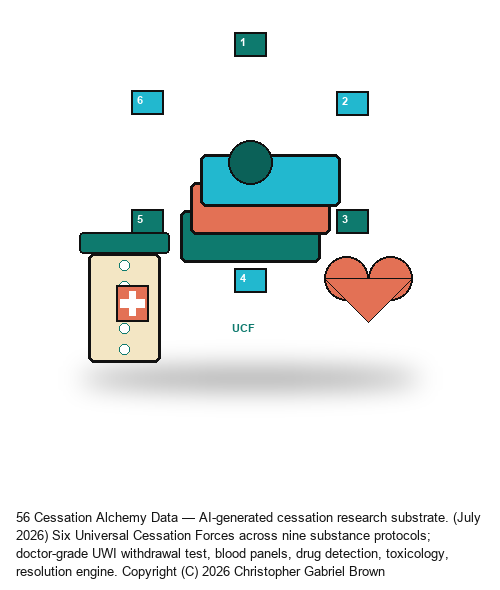
Cessation Alchemy Data -- the Alchemical Architecture for Cessation (UCF family, 6 forces x 9 protocols)
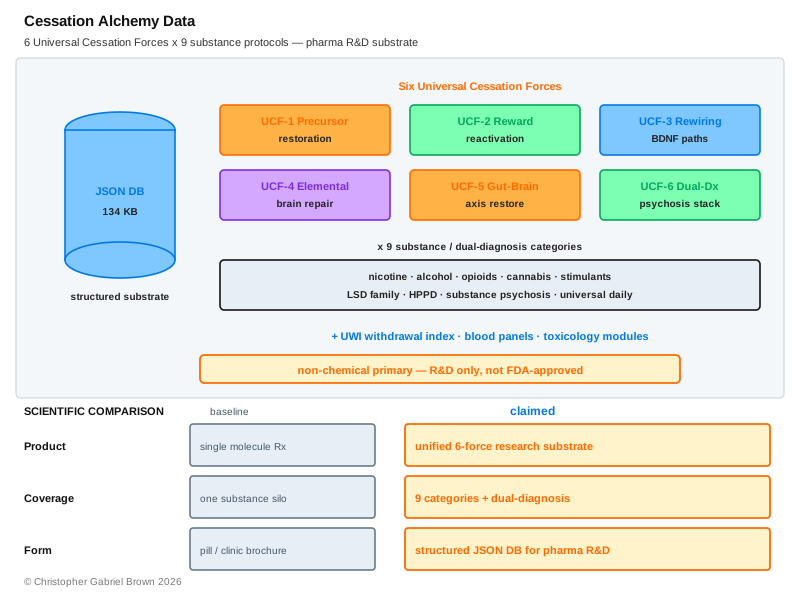
6 Universal Cessation Forces x 9 substance & dual-diagnosis protocols. Doctor-grade Withdrawal Test, 6-panel blood work, 19-substance drug detection, 14-nutrient toxicology, precision dosing, non-chemical pain management, Resolution Computation Engine, 8-compound chemistry comparison, 25-event history + 10 predictions, strategic counsel. Chemical Cooker (Project 16) recipe bridge included. Non-opioid, patent-pending, IP retained, standalone acquisition (not in the All-In-One). Computational research findings -- not medical advice, not clinically tested, not FDA-approved.
© CRI-ONE. All rights reserved. Patents issued and pending. Unauthorized reproduction of the underlying designs is prohibited.
Extended catalog & full narrative — Cessation Alchemy Data -- the Architecture for Non-Chemical Cessation (UCF family, 6 forces x 9 protocols)
The extended dossier appended from the 2026-08-05 catalog snapshot. Prices in the body copy have been stripped; the live-store price on this page is the authoritative figure. Images have been omitted.
Cessation Alchemy Data
— the Architecture for Non-Chemical Cessation
(UCF family, 6 forces × 9 protocols) · Project 56
A first-of-its-kind assembled research substrate for the pharmaceutical, digital-therapeutics, contract-research, and consumer-health industries. Six Universal Cessation Forces (UCFs) applied across nine substance and dual-diagnosis categories, doctor-grade clinical modules (Withdrawal Index test, six-panel blood work, nineteen-substance drug detection, fourteen-nutrient toxicology, precision dosing, non-chemical pain management), an individualized Resolution Computation Engine, an eight-compound chemistry comparison against every FDA-approved cessation drug, a twenty-five-event history timeline, ten AI-generated forward predictions, and strategic counsel for pharma R&D, DTx builders, CROs, and clinicians. Optional interoperability with the Chemical Cooker (Project 16) via a pre-built recipe/G-code bridge.
The substrate is non-opioid and non-chemical primary: it does not require the buyer to synthesize a new molecule. It targets the endogenous neurotransmitter, receptor, elemental, neuroplastic, gut-microbiome, and dual-diagnosis stabilization systems that addiction and substance-induced psychosis disrupt.
“Time is a prayer.”
Cessation is time work. Every receptor system heals on a measurable timeline. Every day of abstinence is a physical prayer to the future self you are becoming. The molecules do not know your name. The receptors do not know your story. But they know time. And they answer.
The Six Universal Cessation Forces (UCF)
The UCF framework is the organizing principle of the substrate. Six mechanistic forces, each with a distinct principle, drive cessation across every substance category. The forces are additive to any existing cessation pharmacotherapy and open novel R&D and product-line pathways.
Neurotransmitter Precursor Restoration
Feed the brain the raw materials to rebuild its own chemistry. Tyrosine, tryptophan, phenylalanine, choline, glutamine mapped per substance.
Endogenous Reward Reactivation
Twenty-eight non-chemical activities across endorphin, dopamine, serotonin, oxytocin, GABA, and endocannabinoid systems. Each with mechanism and evidence citation.
Neural Pathway Rewiring
BDNF-driven neuroplasticity acceleration. Habit-loop replacement. Sleep architecture restoration. Cross-references Project 11 Alzheimer's BDNF science.
Elemental Brain Repair
Precision element restoration per substance: Zn, Fe, Cu, Mg, Se, P, S. Mapped to the twenty brain-critical elements identified in Project 22.
Gut-Brain Axis Restoration
Ninety percent of serotonin is synthesized in the gut. Four-phase remove → repair → reinoculate → rebalance microbiome protocol.
Dual-Diagnosis Psychosis + Substance Withdrawal
LSD, HPPD, cannabis, stimulant, dissociative psychosis stabilization stack. Sleep, grounding, reality anchor, anti-inflammatory nutrition, glutamate modulation. No competing framework covers this gap.
Substance and Dual-Diagnosis Coverage
Full 6-UCF protocols for nine distinct categories. Each protocol identifies the hijacked receptor system, withdrawal timeline, medical warnings where applicable, and precise UCF stack.
- Nicotine / Tobacco — nicotinic acetylcholine receptors
- Alcohol — GABA-A, NMDA, endorphin systems (severe withdrawal warning included)
- Opioids — mu-, kappa-, delta-opioid receptors (non-opioid protocol)
- Cannabis / Marijuana — CB1, CB2 endocannabinoid receptors
- Stimulants — DAT, dopamine release mechanism (cocaine, methamphetamine, amphetamines)
- LSD / Psychedelics — 5-HT2A, 5-HT1A, 5-HT2C receptors
- HPPD (Hallucinogen Persisting Perception Disorder) — dedicated protocol
- Substance-Induced Psychotic Disorder — dual-diagnosis stabilization
- Universal Daily Protocol — substrate-agnostic maintenance
The Test That Was Missing — UCF Withdrawal Index
The single hardest question in recovery is: am I healed yet? Standard cessation medicine has never had an objective answer. The UCF Withdrawal Index (UWI) is the missing test. Ten domains, each scored 0-4, total 0-40. Trackable daily during acute withdrawal, weekly during post-acute, monthly during late recovery.
| UWI Score | Phase | Protocol intensity |
|---|---|---|
| 30-40 | Acute withdrawal | Maximum — medical supervision recommended |
| 20-29 | Post-acute (severe) | High — cravings chemically driven |
| 10-19 | Post-acute (moderate) | Moderate — UCF-3 + sleep emphasis |
| 5-9 | Late recovery | Maintenance — UCF-2 + social reintegration |
| 0-4 | CLEARED | Maintenance; Completion Certificate eligible |
Combined with drug testing at defined windows plus substance-specific abstinence minimums, the UWI supports issuance of a Cessation Completion Certificate — a documented recovery milestone that recovery culture has lacked.
Blood Test + Lab Panel Module (6 panels)
Ordered protocols across baseline, nutrient, neurotransmitter metabolite, substance-specific, inflammation, and clearance certification.
- Panel 1 — Baseline intake: CBC, CMP, LFTs, TSH, lipids, HbA1c, UA, pregnancy screen
- Panel 2 — Nutrient status: Vitamin D 25(OH)D, iron studies, B12/MMA, folate/homocysteine, Mg, Zn, Cu/ceruloplasmin, Se, omega-3 index
- Panel 3 — Neurotransmitter metabolites: 5-HIAA, HVA, VMA, MHPG, salivary cortisol curve, serum BDNF
- Panel 4 — Substance-specific: GGT/CDT/MCV (alcohol), HCV/HIV/testosterone (opioid), ECG/echo (stimulant), cognitive testing (cannabis), EEG/MRI (HPPD)
- Panel 5 — Inflammation + recovery: hsCRP, IL-6, TNF-alpha, homocysteine
- Panel 6 — Clearance certification: composite requirements for signing the Completion Certificate
Drug Testing Reference (19 substances)
Detection windows across urine, blood, saliva, hair, EtG, and breath for 19 substance categories. Includes a false-positive avoidance list (poppy seeds → opiate positive; hemp/CBD → THC positive; pseudoephedrine/bupropion/trazodone → amphetamine positive; kombucha/hand sanitizer → EtG positive) and clearance-test scheduling at 30 / 60 / 90 days of abstinence.
Toxicology Module (14 nutrients)
Doctor-grade safety reference for every UCF-4 nutrient intervention. Each entry includes RDA, UL, therapeutic range, toxic threshold, overdose symptoms, contraindications, form bioavailability, drug interactions, and rescue protocols. Values are public-domain from the Institute of Medicine / National Academy of Medicine Dietary Reference Intakes.
Ten-row Drug-Nutrient Interaction Matrix covering critical combinations: SSRIs/SNRIs/MAOIs vs tryptophan/5-HTP (serotonin syndrome, potentially fatal), MAOIs vs high-dose tyrosine (hypertensive crisis), warfarin vs omega-3, levothyroxine vs iron/calcium/magnesium/zinc, quinolone/tetracycline antibiotics vs mineral chelation, digoxin vs electrolyte shifts, antipsychotics vs tyrosine.
Concentration & Precision Dosing Module
Nine intervention entries with acute-withdrawal dose, maintenance dose, blood-level target, form selection guidance, timing, onset, and duration-of-use. Includes renal (eGFR-based) and hepatic (Child-Pugh) dose adjustments. Baseline lab set for intake plus follow-up intervals: weekly acute, biweekly-monthly stabilization, quarterly maintenance.
Pain During Cessation Module
Cessation is a state of high pain. Standard programs fail because pain drives relapse. This module treats pain as the primary clinical challenge with seven substance-specific pain profiles (mechanism, VAS severity, timeline, clinical scale reference — CIWA-Ar for alcohol, COWS for opioid, CWS for cannabis) and nineteen non-chemical pain interventions across physical, psychic, and sleep domains. Each intervention includes mechanism, dose or duration, cost range, and evidence citation.
Resolution Computation Engine
The product does not merely browse. It computes a resolution — an individualized cessation transformation output. Inputs: primary substance, days abstinent, UWI score, current medications, baseline lab values, demographics, renal/hepatic function, pregnancy status. Outputs:
- Individualized UCF stack for the current week
- Precision doses adjusted for renal/hepatic function and medication interactions
- Ranked non-chemical pain interventions for the current phase
- Drug test schedule (panels + target results)
- Blood test schedule (which labs, when to reorder)
- UWI reassessment schedule (weekly / biweekly / monthly)
- Cessation Completion Certificate criteria specific to substance + patient
- Medical escalation red-flag markers
- Expected receptor recovery timeline personalized to substance + duration of use
- Next review date
The Complete tier includes the algorithmic specification. The buyer implements the engine within their platform (EHR, DTx app, clinical decision support). The substrate provides the deterministic logic; the buyer provides the software surface.
Chemistry Comparison Chart
Eight FDA-approved cessation compounds benchmarked side-by-side against the UCF substrate: Varenicline (Chantix), Bupropion (Zyban / Wellbutrin), Cytisine (Tabex), Naltrexone (ReVia / Vivitrol), Acamprosate (Campral), Disulfiram (Antabuse), Lofexidine (Lucemyra), and N-Acetylcysteine (NAC). Each entry includes molecular formula, mechanism class, target substance, design-target efficacy, black-box warnings, typical side effects, cost range, duration, and UCF overlap analysis.
Positioning is additive, not competitive: the UCF substrate does not displace existing pharmacotherapy. It occupies the adjacent space — what to do besides the drug, or when the drug is contraindicated, or when the drug has failed.
History + Predictions + Strategic Counsel
A 25-event historical timeline from 1935 (AA founding) through 2026 (this substrate), documenting the trajectory of cessation pharmacotherapy: nicotine polacrilex (1984), transdermal patch (1991), naltrexone alcohol indication (1994), bupropion smoking cessation (1997), acamprosate (2004), varenicline (2006), Vivitrol OUD (2010), reSET DTx (2017), lofexidine (2018), reSET-O (2018), psilocybin Phase 2 signals (2020), NAC cannabis-cessation trials (2023), GLP-1 off-label observations (2024).
Ten AI-generated forward predictions across five- and ten-year horizons: GLP-1 agonists as de facto cessation adjuncts, psilocybin-assisted therapy FDA Breakthrough for nicotine and alcohol, digital therapeutics 3-5x market growth, nutritional psychiatry mainstream, HPPD dedicated FDA guidance, substance-induced psychosis DSM sub-category, genetic-and-microbiome-guided precision cessation, AI-generated recovery plans as standard of care, non-chemical parity with chemical programs, and “cessation graduation” displacing “lifelong recovery” framing.
Strategic counsel for pharma R&D teams, digital therapeutics builders, CROs and academic researchers, clinicians and addiction medicine specialists, and inventor-level counsel on pricing, forward compatibility, and category positioning. Five documented failure modes to avoid.
Chemical Cooker Compatibility (Optional)
Bridge to Project 16
The substrate ships with a Chemical Cooker recipe bridge that converts the UCF-4 Elemental Repair formulation for each substance into Cooker-native recipe JSON plus ready-to-run G-code. A Chemical Cooker owner (Project 16, separately available) can natively load and physically prepare the seven UCF-4 blends: CESSATION-NICOTINE, ALCOHOL, OPIOID, CANNABIS, STIMULANT, PSYCHOSIS-DUAL, and UNIVERSAL. The bridge emits schema-conformant files only — no proprietary Cooker code is imported or copied. IP for both projects is retained by the inventor across all tiers.
Companion Research Projects
The substrate cross-references the inventor's health research portfolio. Each companion is a separate acquisition available through cri-one.com/store.
- Project 07 — Alchemy Probability Data (element-combination probability engine)
- Project 10 — Diabetes Cure Discovery (metabolic recovery pathways)
- Project 11 — Alzheimer's Cure Discovery (BDNF & neuroinflammation science)
- Project 12 — Parkinson's Cure Discovery (dopamine neuron regeneration)
- Project 13 — Disease Cure Research (300-disease database)
- Project 16 — Chemical Cooker (24-element formulation platform — Cooker compatibility target)
- Project 22 — Brain Chemistry / NeuroElement (65 neurotransmitters, 20 brain-critical elements)
- Project 33 — Health Recovery (OTC vitamin formulations)
- Project 41 — Alchemy Data Three (compound analysis substrate)
- Project 46 — FDA to Store (FDA compliance pathway framework)
Commercial Tiers
What every tier conveys
- Full cessation_pharma_database.json (v3.1.0, 134 KB structured JSON)
- All documentation (README, BUYER_PITCH, LICENSING, HANDOFF, MANIFEST, WEB_DESCRIPTION)
- Interactive Python query tool (cessation_query.py) with the Resolution Computation Engine
- Chemical Cooker recipe bridge (7 pre-generated recipes + G-code)
- Evidence citation index
- Store-integration snippets and imagery (SVG symbol, banner, icon)
What NO tier conveys
- Any patent license or IP transfer — patents-pending are retained by inventor
- Any right to file continuation patents on the substrate
- Any Chemical Cooker (Project 16) hardware or platform rights
- Any companion project (07, 10, 11, 12, 13, 16, 22, 33, 41, 46) acquisition rights
CEASE-56-RESEARCH
USDRead-only document license. Academic team, internal R&D screening, single-investigator use.
CEASE-56-DESIGN
USDBuildable research package + worldwide commercialization rights within acquirer's cessation program + 60-day email consultation.
CEASE-56-COMPLETE
USDFull substrate + 12-month email + postal consultation + cross-reference index to ten companion research projects + integration package + pharma-industry positioning package.
Candidate Acquirers
- Big-pharma cessation and CNS R&D divisions
- Digital therapeutics companies with cessation programs
- Contract research organizations specializing in addiction and CNS trials
- Consumer-health companies with nutritional-neuroscience programs
- Government and foundation research funders (NIH / NIDA-adjacent programs)
- Academic medical centers with addiction research programs
Target Market
- Global cessation & addiction treatment market — USD + per year (aggregate)
- Smoking cessation — USD + per year
- Alcohol use disorder treatment — USD + per year
- Opioid use disorder treatment — USD + per year and growing
- Digital therapeutics adjacent — USD + per year
- Consumer-health nutritional-neuroscience — USD + per year subset applicable
Design-target aggregate market figures from public category estimates; not investment advice.
Christopher Gabriel Brown · 1341 Wellington Cove, Lawrenceville, GA 30043-5255, USA
Email: crioneaka@outlook.com · crioneaka@outlook.com
Store: cri-one.com/store
Phone (+1 770-776-7023), email, or postal. No brokers or intermediaries. USA-only buyers — up to 4 USA-domiciled entities per transaction, joint & several liability. USD only. Governing law: State of Georgia, Gwinnett County. All sales final and non-refundable. Standalone acquisition — NOT included in the All-In-One bundle.
f9121e3fb4ef1d7804fdce0bafc9bf8357eb0f95f4d2318c57fc1e2d363eb5beCessation Alchemy Data -- the Alchemical Architecture for Cessation (UCF family, 6 forces x 9 protocols)
Publicly online since 2010 · U.S. patent applications since 2012 · inventions offered since 2014. The work of Christopher Gabriel Brown, independently documented.